
114 - Amber Lilyestrom: Little Big Beautiful Things
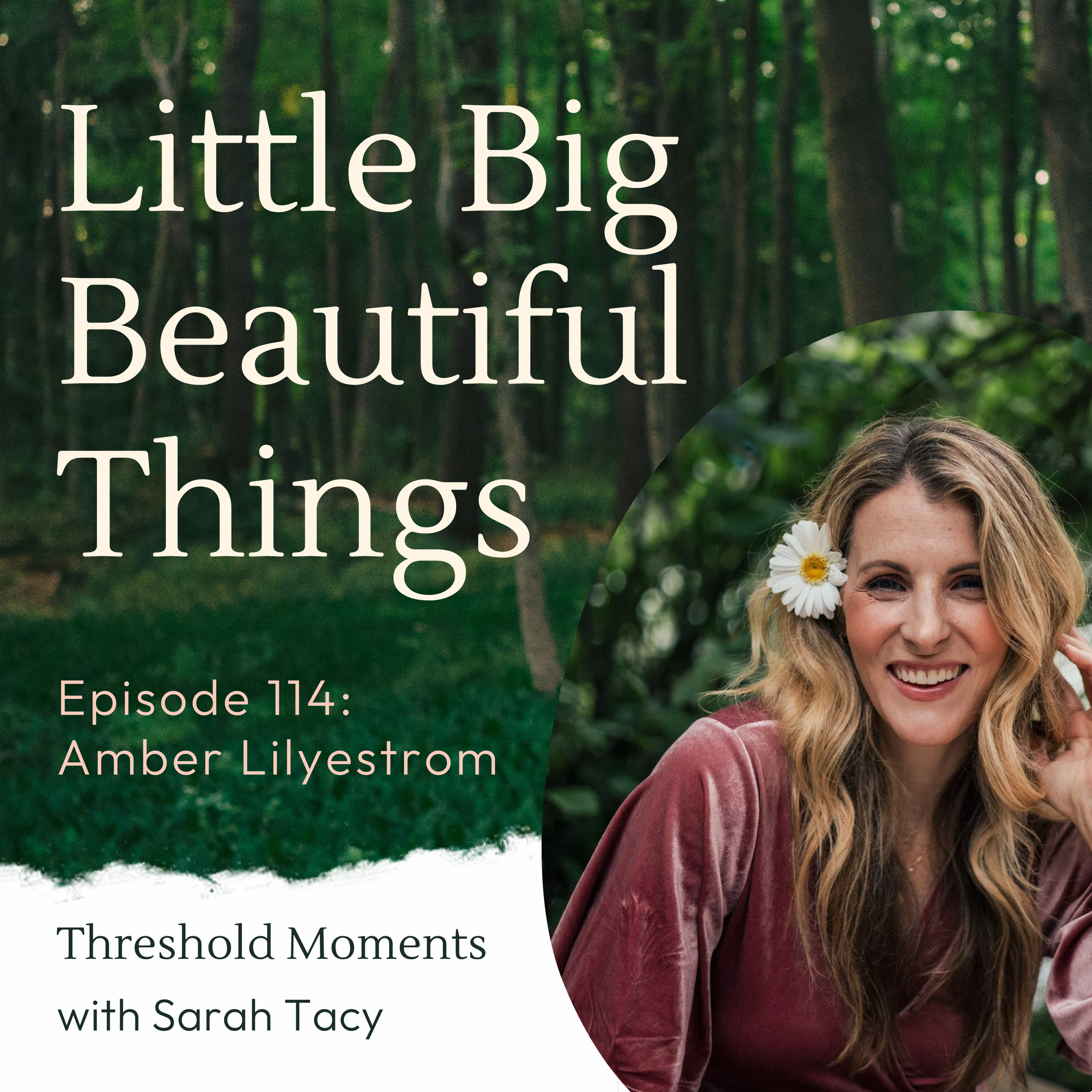
Today Amber Lilyestrom returns to Threshold Moments to share her new poetry collection Little Big Beautiful Things.
Amber is a globally recognized business mentor, a best selling author, a poet and a keynote speaker known for her groundbreaking work in business energetics and strategy. She’s also one of my dear friends.
In this conversation, we explore:
How we’re rewriting the rules in this season of our lives
Personal evolution through poetry
Reconnecting with your heart and living beyond the mind
Feeling rich in the simplicity of life
The timeless wisdom of rocks
How brave it can be to share our stories
Episode Transcript:
Sarah Tacy [00:00:06]:
Hello, welcome, I'm Sarah Tacy and this is Threshold Moments, a podcast where guests and I share stories about the process of updating into truer versions of ourselves. The path is unknown and the pull feels real. Together we share our grief, laughter, love and life saving tools. Join us. Hello my friends, those who have been along for the ride of Threshold Moments, those who are new. Welcome, welcome, welcome. Today we have with us Amber Lili Strum. Amber Lilyestrom is a globally recognized business mentor, a best selling author, a poet and a keynote speaker known for her groundbreaking work in business energetics and strategy.
Sarah Tacy [00:01:05]:
With two decades of experience in marketing and leadership, Amber helps visionary entrepreneurs build deeply aligned, right sized businesses that redefine what's possible and help them scale what matters most. Her work has been featured in Forbes Entrepreneur Success, Mindvalley and Working Mother magazine. She is the host of a top ranked podcast, Homeward, and author of multiple books including Master your Money Mind, Paddle Holm and co author of Quantum Wealth. I have Amber on today. She has a new book of poetry coming out called Little Big Beautiful Things and I love it. I love Amber, but I actually really do love this book of poetry too. I got it last night and I read it before our interview and, and the beauty of the pages and the poetry and the words and the depth and the photos made it so rich and enjoyable to partake in. And so today we get into the conversations of what comes in life when you really, really live into the wholeness of life.
Sarah Tacy [00:02:25]:
The grief, the love, the rebuilding, the. We read a few of her poems and they are epic. And I would love for you to listen all the way to the end because oh my gosh, that one literally brought her to tears, which brought me to tears. And there's one line in particular about picking up the pieces and making a crown from it. And it's just Chef's kiss. It's so good. So without further ado, here is my conversation with my dear friend, Amber Lilyestrom. Welcome, welcome, welcome, welcome, welcome to Threshold Moments.
Sarah Tacy [00:03:08]:
Today we have with us Amber Lilyestrom, whose bio you heard in the intro. Amber was one of my first podcast guests, actually, I think she was episode number three and she's back and I think we're episode 100 and something.
Sarah Tacy [00:03:29]:
And even in that, I just want to say I went two years where it was weekly and then just at some point I was like, wait, I get to choose to take a break. And so I think you and I, something maybe that we have in common is rewriting the rules to really fit, like, what is true, what is real for us, where we're at in life. And today, as I'm kind of in the season three of this podcast and this might be the last episode of this season, and I was like, oh, I would just like, this is the perfect place for when people tap into threshold moments, that this would be the one they come back to, would be an episode with you where I believe we're gonna touch into themes about awe and presence and the richness that comes from really being with the seasons of life. And I think in some of the work that you are putting forward and some of the newsletters and things that have been coming up for me, I'm like, oh, we are same paging in a big way. And so I'll say that we met seven years ago, that we probably met at time where we were both hitting some pretty big thresholds, probably both meeting some levels of grief that were newish and profound and growing in their own ways. That we're both mothers, that we're both entrepreneurs, and that we are friends that continue to kind of touch in with each other here and there in ways that are beautifully supportive and deeply heart touching. And so as you have this new book coming out of Poetry, I was very excited to be able to have you on the podcast so that you can share where you're at and the gifts you have as both a coach and a poet. Welcome.
Amber Lilyestrom [00:05:29]:
Thank you. I'm so excited to be with you. And besides my own podcast, this is the only one that I've done so far with this book. And so it could not be a more fitting, perfect person in my life to share this with because of the way that you steward deep work and intentionality and presence. And that's really what this book is about. So I am really excited to. You know, it's like with a book like this, I know I'm going to read some pieces from it, and in this moment, I don't even know which ones those will be. And that is just so radical and amazing because you and I are both people who came to life feeling like we needed to prepare for everything we were doing all the time, you know, and really as a means of proving and receiving, you know, we're really, really wise, but also wise in the way of I know the buttons I need to push to have the outcome that I want to have.
Amber Lilyestrom [00:06:35]:
And we were pretty masterful at that in our earlier days. And I think for both of us, it's been such a surrender experiment to let that rope out and to try things from a different vantage point. And, you know, motherhood has broken us in beautiful ways and broken us open so that we could actually access more of ourselves, our capacity, our hearts, our ingenuity, and, lo and behold, our wisdom. And so this couldn't be a more beautiful, fun moment to be in with you right now.
Sarah Tacy [00:07:08]:
Yeah. Yeah. I did a podcast a while ago about preparation and how sometimes it can be such a beautiful way to actually be able to go with the flow more in the moment, if. Right. Like, if some of the pieces are already in place. But there are also the ways of preparation in which we spend our whole lives are such a huge part of it. In preparation. So that when we're in the moment, we're still preparing for something else, or we're, like, holding on, hoping that it'll go exactly the way we prepared for as opposed to the preparation, just giving us enough stability to be with the unknown.
Sarah Tacy [00:07:50]:
And this is also what I'm loving about. The conversations I've had recently, especially on this podcast, of just like, yeah, enough. Like, I got to read your poetry. And I. Seven years of friendship gets to count as the preparation. And then what will happen? And the boldness to be in the unknown with another. Yeah. The title of your new book, Little Big Beautiful Things.
Sarah Tacy [00:08:17]:
Can you say anything about that?
Amber Lilyestrom [00:08:19]:
I was writing an email, you know, to my community, and I. And I write in a way that is poetic, you know, it's just my style. And I remember I wrote a line and it was talking about, like, these are the little, big things of our life. And so I was just holding that, you know, and turning it over in my mind for a while of, like, this Little big Things. And I actually had a couple other titles that I had before that that were in my Google Doc that I was saving. One of them was Chasing the Miracle, which I think is interesting. And there was a part of me I was like, yeah, but I don't think you have to chase it. You know, I was just sort of, like, sort of poking at my own evolution around it.
Amber Lilyestrom [00:09:00]:
And there another one was tiny altars. Because a friend said to me, I just think it's so interesting. I come to your home, and, like, everywhere I look, there are, like, these little tiny altars everywhere. And it was like, it's just. You can see how sacred you treat your space and your home and your life. And I was like, oh, wow, okay. Thank you for noticing, you know, my feathers and my pine cones and my, you know, all my little shells and things that I Keep around. And.
Amber Lilyestrom [00:09:27]:
And I was like, oh, my gosh, they are the. They are little big beautiful things. And then, you know, the dedication to the book is to our. To our son Alex, and, oh, I can't even say his name without crying. But I think about him, you know, as like this little, big beautiful boy and how he came into our life and the timing of writing this book. And in the. The edition that you had a reader copy of, it doesn't have, there's a passage that I wrote that was like a personal opening note. I added that to the final version of that will be in the book that you can buy.
Amber Lilyestrom [00:10:01]:
And you know, in Petal, I didn't have that. I actually had had a forward from someone else. And I felt in this book that I didn't want to have a forward from someone else, that I really wanted to hold my own words in the book. And I was almost not going to put something in there. And then I went to, you know, I just thought the poems are enough. I don't need to. I don't need to, like, preface it. I don't need to, like, give an introduction.
Amber Lilyestrom [00:10:25]:
I don't need to, like, say, let me. Let me prepare, you know, for the experience you're about to have. And then I went just last weekend to two concerts, two nights in a row, like, total groupie style of my favorite band, need to Breathe, with my. My dear friend Leah and my daughter. And I was really moved by Bear Reinhart and the stories he was telling before he would perform some of his new work. And I just thought, man, that is special. And there's like this level of ownership that I am really initiating myself into around my work. And I think just in general, in my own story, in my own preferences in my life, what I've discovered through the writing of this book and in the sharing of it, that there's this habit of really sort of de centering myself and not like even doing anything for my books or anything that I'm doing.
Amber Lilyestrom [00:11:24]:
I have this habit of just being like, it's not a big deal. Like, yeah, it's like, it's a big deal, but it's not a big deal. And that is an overcompensation from, you know, wounding and inner child stuff. And I've just really like, pulled that out into the open. And so not only is the book itself a, you know, raw experience to put these words out into the world, but I think what's felt even harder is that bringing it forward in the world and saying, like, this is important to me, and I want to share that, and I want to offer this to you, and I'm also going to back it by telling you why. Why it's important to me. And so I added that passage, and what I share in it is about my journey, you know, of infertility. While I was.
Amber Lilyestrom [00:12:09]:
I had just debuted Paddle Home, my first poetry book, and while I was signing 300 copies of it for my live event that ended up being virtual because of the pandemic in 2021, I was also bleeding and losing my pregnancy after our second IVF round. And it was very clear to me and in my body that that was the end, you know, of my fertility and the end of that part of my story of, like, there wasn't going to be another pregnancy. And it was just deep, deep ache, deep grief, and. Yeah. And so I really was just writing, you know, like, in the background of my life, and these poems came from that. And it took four years, you know, of writing to be able to get to the place of being able to release the collection in this. This way. But I tell a little bit of that story, you know, in the opening notes and kind of what that journey looked like.
Amber Lilyestrom [00:13:04]:
And there's a. There's a line on the back cover, you know, that says that, you know, I'm sharing my reflections as a mother to young children, the daughter of my aging parents, who are been going through health challenges while speaking to the wonder of how life delivers unexpected beauty in the break of becoming. And I think that part, that break of becoming, feels very akin to what we're doing in this one.
Sarah Tacy [00:13:28]:
Yeah, there's a line that you have in there, too, that's like, the heart and the break. And I love that pause in between the two.
Amber Lilyestrom [00:13:40]:
Yeah.
Sarah Tacy [00:13:43]:
There are two things there where I want to go here. There generally are. I have the version that has that opening.
Amber Lilyestrom [00:13:50]:
Oh, you do? Oh, you're the only person that does. I texted it to you. That's right. So you did get to see that.
Sarah Tacy [00:13:55]:
I would love to read it, if it's okay with you.
Amber Lilyestrom [00:13:58]:
I would love it.
Sarah Tacy [00:13:59]:
And I would also like to say this as a friend. When I went through my season of grief, I have, like. There were times of, like, what's wrong with me? How come I'm feeling this bigger than anybody else? Like, other women go through this, and I cried and I did the grieving, and shouldn't I be over this by now? And you've always been such a tender heart and somebody that I can speak to, and you find Silver linings and messages and meaning. And in getting to read this, I think I got to see the parts where you're human lies as well. So for me, I feel like I got to know you even better, maybe in ways that, like, I didn't fully recognize at the time. And so that really feels like a gift to me. And I think with that vulnerability, so much of what I hope to bring through in threshold moments and in my course resource is this idea of accompaniment. So trauma physiology would tell us it's like that feeling of like nobody else knows it quite like we do.
Sarah Tacy [00:15:26]:
Which there's some truth to that, right? Like we're all on our own journey. But it's this. I'm around other people, but I'm isolated in this experience. So it's like that feeling of not having choice, of isolation, of helplessness, of hopelessness. And so when you share these parts of yourself, I think that it is medicinal for anybody who reads and is like, oh, wow. A phrase I learned from Nisha Moodley is just, you know, sister speaks for me. So there are so many parts where you have this gift of taking sensations of the heart and the soul and finding words for them, which isn't a gift that all people possess in the same way, but most people can recognize the resonance. And so my gratitude is in you taking the time to do this, which I know is also medicine for you, but it is a sense of accompaniment and sisterhood, I think to.
Sarah Tacy [00:16:29]:
For those who get to read along. So here is what I would like if. Yeah. For readers just to hear the opening. Also, I want to say my favorite part of concerts is when. When the singer, like, tells a little bit more of the story.
Amber Lilyestrom [00:16:46]:
I'm like, I know.
Sarah Tacy [00:16:47]:
Me too.
Amber Lilyestrom [00:16:48]:
Me too.
Sarah Tacy [00:16:49]:
From my heart to yours. The poems in this book were written in a season where loss landed on the shores of my life in big and unexpected ways. The day I was signing stacks of copies of my first poetry book Paddle Home, I was losing our pregnancy after an arduous infertility journey. In the same year, I was also met with the abrupt end of my fertility, the press of my parents health challenges, the deep knowing that my motherhood felt incomplete in living in a body that I felt I was at war with. The words on these pages emerged in the ache of it all. Each passage a solve for the silent wounds and invisible pain I tended to in those dark months. And what happened when the light returned where I became a witness to the wonder, to the miraculous arrival of our son, the renewal of my spirit, the Surrender found on my knees. And the unimaginable heartbreak.
Sarah Tacy [00:18:01]:
The little big beautiful things that quite literally saved me. Here's to the miracle within the miracle. The dream beneath the dream. The magic in the remaking. With deep appreciation and love, Amber. I'm so glad you included that.
Amber Lilyestrom [00:18:22]:
Thank you for reading it and thank you for the witness work of that.
Sarah Tacy [00:18:26]:
I notice throughout the poetry there are a number of times that the word like that a stone comes into it. Whether it's the heart shaped stone that I think came from a beach when you were getting married to Ben. Or maybe one that was a sign right before Alex came. But then also at the beginning, like the weight of a stone and sinking to the bottom. I'm wondering if you have anything. I was like, oh, there's the stone again. There's the stone and there's the weight and there's the dropping down. I'm wondering if you have anything to say about a stone like this.
Sarah Tacy [00:19:04]:
This is such a weird question, but I was like, oh, there it is, There it is.
Amber Lilyestrom [00:19:07]:
No, it's so funny because I actually think about. You're making me think of this. That in. In Bear's lyrics, need to breathe, he says he talks about bones all the time. All the time. And it's so funny because these are these little things that you don't notice. These themes that are very true for you. I'm a quintessential earth sign.
Amber Lilyestrom [00:19:32]:
I live in the forest. I need water in order to keep me nourished and keep my spirit moving and alive. And yet I can sit like a stone. Right. Like I can. I can hold with a level of strength. And yet I've also felt like I've carried that stone on my back for most of my life or pushed it up the hill.
Sarah Tacy [00:19:59]:
Yeah.
Amber Lilyestrom [00:20:00]:
And so it's beautiful that it's. That that theme is coming up. And I would imagine so many people listening to this could resonate exactly with that theme of this stone being so central.
Sarah Tacy [00:20:14]:
Yeah. And as you say that in it, there were a few times where it was like the stone dropping down through the water to the bottom. And it feels like the heavy moments in life. And when I hear that paired with it either being on your back or getting pushed up a hill.
Amber Lilyestrom [00:20:31]:
Yeah.
Sarah Tacy [00:20:32]:
It really brings to light the beauty of the moments when you stop doing both things right. Just let it drop. Which could be the scariest thing of like, I don't know what's at the bottom. Yeah. And this idea of just like letting it go.
Amber Lilyestrom [00:20:49]:
You know, there's a The first poem of the whole book is. It was. It's inspired by two things. One, me testifying in court as a five year old against my abuser, and secondly, my experience in breathwork, where I quite literally have a gigantic aversion to very active breath work. And my most favorite part of breathwork is the dropping it all the way down, so exhaling all the way out. And every time I do that, I feel like I'm a stone at the bottom of the lake, sitting there watching the fish swim by. And as I say in this particular poem about, you know, where the fish and the rays and the sparkling sand beams where truth turns to diamond, only I can see. And I feel like I'm sitting in my lake with the light coming through.
Amber Lilyestrom [00:21:42]:
And I'm really safe there. I'm really safe at the bottom of my breath.
Sarah Tacy [00:21:49]:
Wow.
Amber Lilyestrom [00:21:51]:
Yeah.
Sarah Tacy [00:21:51]:
I read that poem in the part where it says, bury it deep, don't say a word. Yeah. And on page nine, it says, the lump in my throat reminds me of all the aches I've ever had to swallow. The never getting to say what's real, the raw, the true. And in so many of my private one on one sessions, the number of women that talk about the lump in their throat. Yeah.
Amber Lilyestrom [00:22:20]:
Yep.
Sarah Tacy [00:22:22]:
Has that shifted for you over time or is it just something that's like pretty consistently there?
Amber Lilyestrom [00:22:28]:
Yeah, no, it has shifted. And I honestly, I think even writing the poem is. Is an. Was an important part of it. And I think that the title of that poem is called the Other side. And so the last line, the new versions of us that exist on the other side. Writing that felt like the threshold of really crossing over. But I had to acknowledge, and I think this is the piece that is so incredibly important.
Amber Lilyestrom [00:22:52]:
We have to acknowledge the truth in the lump in our throat, the ache that we've had to swallow, the fact that, you know, no one was asking, even though it was happening, and, you know, the forging on, the burying of batons, the drawing of lines, the dancing in between. It's just the way that the cadence of that. That piece came through felt like just so cathartic, you know. And to answer to your question before we hit record, the sort of the way that the poems come through for me is very much like it just arrives in the moment. And it is not. It's never when I'm trying. It's often in these, like, transition spaces where I'm like going to sleep or I'm waking up or I'm alone in the morning. It happens When I'm driving sometimes.
Amber Lilyestrom [00:23:40]:
In fact, there are a handful of poems in here that I have literally written on my notes app while driving. Like the one soaked. I was writing. That one just makes me cry. This man that I met and I was driving five hours back from St. Augustine, Florida, back to my favorite place, Blue Moon Mountain beach, while I was there for extended family vacation. And Ani and I had taken a trip and we were driving back and it was late at night. I was exhausted and I knew I still had hours to go on this, like, straight road with lots of deer on the side of the road and big trucks.
Amber Lilyestrom [00:24:11]:
And I just. I felt like. I talk about, like, the rag that was just soaked with every emotion I've ever felt, like all the way up. And I just. I just poured it out, you know, I just squeezed it out. And for me, writing was the way to do that. And so I think I have allowed my writing to become medicine. And I've stopped trying to make it fit a form or, you know, I think.
Amber Lilyestrom [00:24:38]:
And I've learned from really beautiful teachers along the way, from Chelsea Diane and from Mark Nepo and David Bedrick and friends who are just prolific writers. And that has become language for me. And it's been this idea and which you might notice and which I noticed after the fact, which I think is hilarious. Pretty much every photo is like my hands. And I'm a. I'm a count by touching kind of girl. Like I am. I can't.
Sarah Tacy [00:25:08]:
I.
Amber Lilyestrom [00:25:08]:
It's just I literally have to, like, write things out. I have to put it in front of me. That's how I can know how. How much of something is there. And my hands are that way of translating, of healing, of sharing. And just the fact that I wrote the poetry with my hands, it just. It's like, oh, that's so moving to me. But I wasn't like that attuned to it when I was arranging the book with beautiful Monica Justinson's photography throughout.
Amber Lilyestrom [00:25:34]:
It was just like, we took so many pictures of my hands in this photo shoot, and they happen to be the ones that are in this book.
Sarah Tacy [00:25:42]:
Yeah, the photography is phenomenal. And the pictures that. That you chose going back just for a second. And we don't need to, like, linger on it too long. But I feel like it's important for the listeners to hear. I was in a session once and a woman was going back. I don't know if it was like an Akashic record thing. And she's like 22 and she's like, pulling up this, like, event.
Sarah Tacy [00:26:05]:
And I think it was one that I was like, oh, I think. I don't know if I thought I had dealt with it. I'm not quite sure. And she was like, it's like it's in a filing system that's been tucked away. And the thing is, when you don't go to meet that one that wasn't met in that moment, it's like you, too, are abandoning her. And is it possible to just go and, like, sit side by side with her? And so I can imagine that in the writing, it's the like, oh, let me hear. Like, how did it feel in your throat? How. And it's just the.
Sarah Tacy [00:26:42]:
Giving it the light that was part of the trauma, as I said, already, is like, that it's in the shadow that nobody sees it. That and so really just bringing to light. I know there's a difference between the catharsis that could amplify something and one that's just, like, as you said, the last line, the new versions of us that exist on the other side. And so I feel like you take in that particular poem an entire arc. Yeah. Which is really what this book is, too, is this arc of really meeting all parts of a threshold. Yes.
Amber Lilyestrom [00:27:18]:
And I don't. You know, for better or for worse. The other working title of this book that actually I believe will be a future book was Confessions. And this one felt. I. I think. I think every book in its own right must be a confessional in some way. I think, like, great books feel that way.
Amber Lilyestrom [00:27:39]:
I think great songs feel like that. And one of the things that's different about Little Big Beautiful Things versus Paddle Home, which was very much my. My first poetry book. And it, in its own right, is a great work, and I'm so proud of it. This is more personal. It's less. I was really worried in paddle about, oh, I don't want so and so to know this poem is about them. And I was still kind of like, thinking that, you know, and some of the poems are very specifically about particular people in my life in that book and.
Amber Lilyestrom [00:28:14]:
And also in this one. But it was more like what my version of the story. It was my vantage point and what was happening inside of me in that dynamic, in that relationship. And it was just very. It was just much more personal and in the writing of this one. And I think that's why it's connecting to people more deeply. It's because it's just much. It's not that the other book wasn't honest it surely was.
Amber Lilyestrom [00:28:41]:
But there's another level and layer of honesty in this book, I think, that is coming forward that has actually felt like even bigger, deeper medicine.
Sarah Tacy [00:29:02]:
Is there a poem? I have a few where I'm like, oh, let's read this one. Yeah, but is there one that you would like to read?
Amber Lilyestrom [00:29:10]:
They're all my friends. They're all my friends. You know what? Yes, I would like to read enough. And I feel like that one's an important one, especially because we. We really talk about bodies here.
Sarah Tacy [00:29:27]:
Maybe I'll listen.
Amber Lilyestrom [00:29:29]:
Okay. My heart. Okay, here we go. I singed my finger fishing my daughter's bagel from the toaster oven. It left a mark in the shape of a heart. I stared at it in awe, never once having to tell it how to do that. A tiny protective bubble holding itself in real time. Never once shrinking in shame for clumsy hands.
Amber Lilyestrom [00:29:52]:
The way skin did what skin does, holding and healing. The way my heart beats 100,000 times a day. The steady rhythm that is my life. The oldest thing I'll ever own. Those eyes staring back at me, witnessing every version there ever was. This honest body, My chance to be here to taste the fruit, to kiss my baby's peach fuzz cheeks, to smell the pillow after he's gone. To be right here, loving what is. The way our children memorize our faces.
Amber Lilyestrom [00:30:23]:
And these soft bellies are their first homes. The way we'll wish we had appreciated her more right now, right this very moment, at this sweet curve, at this tiny wrinkle. And forevermore.
Sarah Tacy [00:30:38]:
Mm. When we first connected about this book, I had just sent an email about awe. How awe feels like the love language of the body to me. And when you responded to it, I was like, I feel like you're the queen of awe. And you're like, that's my word for the month. Because as you write poetry, right? It is these. Like, oh, my gosh, my finger is burned.
Amber Lilyestrom [00:31:08]:
That's amazing. Look at how that's forming. It knows just what to do and.
Sarah Tacy [00:31:15]:
Just the tiny wrinkles, the sweet curves, everything that you name. I feel like what it does for a reader is helps to amplify the things that we miss or take for granted. There was a line in there. I'm like, where is it? I think it's about the heart. The oldest I'll ever own. Yeah.
Amber Lilyestrom [00:31:39]:
I mean, it made me think of when we heard Ani's heartbeat on the monitor the first time when she was, I mean, only six weeks, and we conceived her with IUI And, I mean, I Didn't do it. Like, I didn't do that. It takes my breath away. I'll never forget it just laying there. That was her heart. That was her heart. Six weeks. How is that even real? And so, of course, it makes me then have this awe and wonder at my own heart that I have neglected so much, you know, and really, this book, in so many ways, is a love letter back to my body.
Sarah Tacy [00:32:18]:
How do you feel like you've neglected your heart?
Amber Lilyestrom [00:32:21]:
I think more so the anatomical aspect of it, less the cerebral part of it, because I can really think my way into anything. I'm just a very in the head kind of person. Less in the body. I can. I've lived a lot of my life, like, right up here, and my body is such a patient friend. And, you know, I've had. As we know, we've shared our lots of our stories about our physical invitations and opportunities that helped us to remember that we have bodies that are not just up here. And I think, you know, my heart is this great engine that has literally made every single thing possible.
Amber Lilyestrom [00:33:04]:
And when I lead meditations, often, I will guide women back to their heart, and I will say that, you know, your heart has been steadily beating through every single thing you have ever overcome, every great moment, every heartbreak. It kept going. And I just. It just takes my breath away to think about that truth, that how blessed we are, how lucky we are, how. How supported we are, no matter what, in our hardest moment. It's the steady rhythm of our life.
Sarah Tacy [00:33:37]:
I remember years ago in a Tony Robbins meditation, I feel like that was also an invitation of just, like, you know, like, what is even creating that beat. Yeah, and it's just like you said with growing a baby, where it's like, we aren't. We don't have to think our way through. Okay. Now, today I'm gonna make a liver.
Amber Lilyestrom [00:33:58]:
Or today bite cells or, like, fingernails.
Sarah Tacy [00:34:03]:
And, like, thank goodness we don't have to think about the. The way our heart beats. But. And also, I imagine, like, the wisdom it carries, the emotions it processes, that it just, like, continues to do it. And, yeah, these are such beautiful reminders when life feels overwhelming or when we think we're doing it all on our own to be reminded of all that's happening on our behalf without our effort. Exactly. Exactly.
Amber Lilyestrom [00:34:30]:
Little big beautiful things.
Sarah Tacy [00:34:31]:
Little big, beautiful things. I was sitting with Katie Soule yesterday, and I think this newsletter will come out right before this podcast, and it's just titled I Feel Rich. And I'm wondering if you relate to that at all. And the richness that I feel, there's this really, really incredible painting where it's this tiny little mushroom, and beneath it is just what I perceive as a really rich soil and all of its mycelial webbing. And so Steve and I were walking through Central park, and he was like, what is it about life now that 10 years ago you could not have dreamed of or you wouldn't have guessed? And I perceived that he was, like, talking about, like, our house and the success of his business and our family and this trip that we're on and kind of things like, so. And I'm, like, looking around, and I'm seeing these really big, beautiful trees. I'm like, oh, would be like, that outward expression of the things that you can mark for, you know, success and growth. And I just kept thinking of this picture.
Sarah Tacy [00:35:49]:
I'm like, I feel like a tiny mushroom. But I feel like, you know, I said to him, I was like, these last 10 years have had. Have had me on my knees at times in ways that I had never experienced before. I've experienced love in ways that I've never experienced before. I've experienced death of ego in ways that I've never experienced before, in prolonged periods and, like, physiological challenges that just, like, had no end in sight. And it might have sounded like I was complaining, but this, like, huge, revelatory moment for me that I feel like since then, I'm like, I feel rich. So I feel like soil that's been, like, composted and gone through seasons and had things like die in it and reborn and, like. So on the outside, it might look like a tiny little mushroom, but it's like the soil and the web.
Sarah Tacy [00:36:51]:
But it is this incredible feeling that I'm feeling right now that feels so steady and it feels so wide. I had somebody say to me six months ago, like, oh, I feel bad for you. And I was confused. I was like, wait, what? And I don't know if you feel this way, but I was like, I don't feel bad for myself, for any of those thresholds. I feel made, if that makes sense. Like, I feel made by the. I feel rich. And, of course, like, in those moments, I couldn't see the silver lining.
Sarah Tacy [00:37:28]:
And I don't think you're necessarily supposed to. I think that's where one of the poems where you're like, feel it. Let it wash all the way through you. Let it break you. So those moments are the full. Breaking the full feeling. And it may be years later, but it's like, now all these years later, I feel this sense of myself. And I have my girls right there's.
Amber Lilyestrom [00:37:52]:
Like, oh, And I have these girls.
Sarah Tacy [00:37:55]:
On the other side of it, too, and they're 6 and 10. And I just feel really good right now. And I know I wouldn't feel this way, like, this steady, this deep, this wide, because it's not from what's showing on the outside. And I'm running a course that I freaking love right now. But my richness also doesn't come from that. And, like, wow. I don't feel rich because of my course or my work. It's like the.
Sarah Tacy [00:38:24]:
The soil of me. The essence of me.
Amber Lilyestrom [00:38:27]:
Yes, yes.
Sarah Tacy [00:38:28]:
And I feel like that is also quite a bit what this book is like. And I'm wondering if you feel any. I'm like, what do you feel exactly that.
Amber Lilyestrom [00:38:36]:
I mean, I just think when we were getting into the conversation, I was feeling simultaneously while talking to you, like, looking at you and being like, oh, my gosh, we get to have each other. Like, we get to watch each other get wrinkles and gray hair in dark circles. Oh, my gosh. I know. I just felt this, like, overwhelming sense of, like, being like the stone. So rock steady in myself. Therefore, I can bring that to relationship. And I don't think I've always felt that way.
Amber Lilyestrom [00:39:10]:
And. And so it's fun. Then when you're back with a dear friend that maybe you haven't seen in a little bit, and then you're like, oh, here we are. And it's exactly the. The resonance and the energy and the love is just so there and that. Yeah. So I feel that same level of richness. And.
Amber Lilyestrom [00:39:30]:
And in the places where I feel fluctuation, it is opportunity to really tend to that dimension, because it's like, there's something there for me that is still, you know, ready for deeper roots. Much to your beautiful visual. I love that little mushroom story.
Sarah Tacy [00:39:50]:
It's funny. I'm like, okay, I know what phase of my cycle I'm in right now, too.
Amber Lilyestrom [00:39:53]:
I'm like, I wonder if in two weeks.
Sarah Tacy [00:39:56]:
Do I still feel rich? Do I still feel like. But, yeah, it has just been a very settling feeling. And so while mine, I'm talking about, like, soil, rock also has mineral. And one other thing I'd love to say about rock is I remember before going into a ceremony, I was sitting on this really big piece of ledge, and it was maybe a hundred yards off from the ocean, and there were big trees around me and a field between the trees, this rock and the Ocean. And I'm sitting on the rock and I just like have this amazing feeling come through me about how like a rock, rock has been here. You know, when the indigenous people were here before the colonizers, when the dinosaurs were here before the people, when the animals were here before the people, on this rock, there has probably been war on this rock, there has probably been ceremony and love. And like, this rock is like neutral and steady and it's seen it all and it's just like been there for a lifetime. So the things I think are big.
Sarah Tacy [00:41:16]:
It's just like there is something about rock in particular that is so darn steady, but it also feels wise, like thousands of generations and so.
Amber Lilyestrom [00:41:31]:
And like how it comes into form when you really think about, like how a rock becomes a rock is just radical. You know, it's, it's such. The metaphor is so deep.
Sarah Tacy [00:41:44]:
Tell me, how does a rock become a rock?
Amber Lilyestrom [00:41:46]:
Say like the development of it, how it. The continued mineralization and the, the coming together and, and it's so interesting to think about now. Like, we're not, you're not going to see the result of like a rock becoming a rock in this lifetime. You know, you're just. And you're also. And also, like, we live on the rock, right? And especially like I live in New Hampshire, the Granite State, and there is so much ledge everywhere. There is so much rock everywhere. Anytime there's like construction, they're blasting.
Amber Lilyestrom [00:42:13]:
And like, that's so interesting to think about how you, how do you disrupt rock? You must blast it, you must sledgehammer it, you have to break it. And so, yeah, I mean, it's pretty rich in the metaphors here for us.
Sarah Tacy [00:42:30]:
Yeah. Or shaped by water over time with like thousands of repetition.
Amber Lilyestrom [00:42:34]:
Yes, exactly, exactly.
Sarah Tacy [00:42:39]:
I'm wondering if we could read a few, like a few more poems before we find out. I have how to Survive highlighted. Do you want to read it?
Amber Lilyestrom [00:42:50]:
Yeah, I will surely do that. I am ironically posted that on Instagram today. Oh, isn't that fun?
Sarah Tacy [00:43:01]:
Uh huh.
Amber Lilyestrom [00:43:02]:
All right. How to survive. Feel it all. Feel everything. Let it run through you like a raging river breaking its banks, tearing down everything, every single thing in its path. Let it bring you to your knees. Feel each tiny muscle you never knew you had ignite as you rise up to meet your new self. Crack your own shell.
Amber Lilyestrom [00:43:27]:
Let's let what's inside drip down your entire being. Sit in the pieces that fall away. Pick them up one by one. Wear them like a crown. I mean.
Sarah Tacy [00:43:43]:
As if for me, it's like, every part of this, but especially those last two lines.
Amber Lilyestrom [00:43:49]:
Yeah, yeah, I know that, my friend, is like, we need to get that in print form. I was like, we can work on that. I love the. I feel it. I just. I feel the. Letting it drip down your entire being and picking them up and putting them on your head like a crown. It actually makes me think of this song by this woman.
Amber Lilyestrom [00:44:13]:
I'm going to get her last name wrong. Nicole. Nicole Nordheim, maybe her last name is. It's the song called the Unmaking. And I've sent it to some friends when their life really felt like it was in pieces. And, you know, there's this part where she says, sitting in the rubble, I can see the stars.
Sarah Tacy [00:44:35]:
And in a world where we're often trying to really, like, for. In the nervous system world, for example, when where it's like, oh, how do I make myself feel better? How do I. What I love about this poem, too, is just, like, really letting it, like. Yeah. Having the whole wave and like, the whole part about, like, the tiny muscles you didn't even know you have. Like, how many of us can really relate to that, whether they're emotional muscles or physical muscles. Yeah. Of what it takes to get back up after we, like, really let it wash through.
Sarah Tacy [00:45:07]:
And that whole process is kind of the opposite of the process of swallowing something down. Right.
Amber Lilyestrom [00:45:12]:
Truly.
Sarah Tacy [00:45:13]:
Yeah.
Amber Lilyestrom [00:45:13]:
And I think, you know, my work with people as business coach and watching them birth these next versions of themselves that can actually hold the capacity for what they want to create and the experiences they want to have. The work, whether we like it or not, over and over again, is. Is be becoming more intimate with life, becoming more intimate with self, allowing yourself to feel what is true and real and there in the moment. And it requires a lot of just sitting and being with people to help them move to that, you know, and it's. And I think there are a lot of folks who will live a whole lifetime trying to outrun it, not wanting to feel that feeling. And I. I really get it. I really get it.
Amber Lilyestrom [00:45:57]:
But I also just now I would say in this chapter of my life, and I hope this doesn't sound insensitive, but it's like, I'm just not really interested in that because the stakes are so high. And what I mean by that is, like, our kids deserve us whole. And I think about the biggest hurt of my life. Ache of my life. And maybe this is a little too, you know, making it a little too, like, clean cut in the way I'm saying It. And maybe I'm pathologizing it a little bit too, but it's, you know, the hurts that happened to me as a child, perhaps my theory is, would not have happened had adults dealt with their pain. So here we are, even in adult relationships.
Sarah Tacy [00:46:45]:
Right. It's like, yes, until somebody meets it in themselves, they can't sit with you in yours or vice versa. Correct. And same thing, you know, we've talked about with our kids. It's like, until we meet those wild parts of ourselves, it's hard to meet our children in it, as opposed to just like either sitting there calm or getting enraged by it. Like, to really meet someone in it. I believe in experience. I need to meet that part of myself.
Amber Lilyestrom [00:47:14]:
Correct.
Sarah Tacy [00:47:14]:
And I'd say another amazing thing in the course that I'm running right now is seeing these women meet parts of themselves and start to feel parts of themselves that they haven't had the capacity to meet or feel before. And although it would feel so good just for everyone to feel so good, it's like, oh, these parts they've run from for good reason or have frozen for good reason are starting to receive some attention and care, and it doesn't generally feel comfortable.
Amber Lilyestrom [00:47:54]:
Nope.
Sarah Tacy [00:47:55]:
But the gift on the other side is that richness. The gift on the other side is being able to meet people with more compassion. The gift on the other side is joy and giggling and silliness and love and awe and seeing the big little things. It's that all of that comes alive. Right?
Amber Lilyestrom [00:48:16]:
That's exactly right.
Sarah Tacy [00:48:17]:
And I.
Amber Lilyestrom [00:48:18]:
My hope is that reading this book allows you to have intimate moments in meeting yourself, in witnessing yourself in being witnessed through someone else's story. And it just makes you maybe a little bit more brave on the other side. Maybe it gives you a little more courage to say, oh, my gosh, you know, I'm not the only one who feels like this with my kids and with those quiet moments and in the acknowledgment that, like, this is the. This is what I wanted. This is the moment that I prayed for. And also, it's really hard. It's both. Yeah.
Sarah Tacy [00:49:01]:
Yeah. For sure. Yeah. Will you finish? Will you close us out with Dream Smaller?
Amber Lilyestrom [00:49:07]:
Oh, yeah, sure. Tell me what page 33. You got it.
Sarah Tacy [00:49:14]:
I was gonna have you choose, too, because there's the one that's called truth as well. I'm like, oh, that's so good. And then dream smaller. But let's. Let's.
Amber Lilyestrom [00:49:23]:
Yeah. I mean, I have a lot of.
Sarah Tacy [00:49:25]:
I have actually. I'm turning My page on, like, there's this one. There's. Holy.
Amber Lilyestrom [00:49:28]:
I have one more if you're open to it, that I think would be a cool wrap after this. So I'll just do this one, I'll do the next one, and then we'll have a great dream. Smaller micro to macro. Mini to mega. Tiny to totality. Big dreams rule the day. But what really lives inside of a dream? One million thoughts, actions, synchronistic moments that make up the thing. Countless steps, an entire lifetime.
Amber Lilyestrom [00:49:58]:
We've got this dream thing all wrong. Stem cells proliferate to create life. It starts with one. One egg, one heartbeat. One idea caught in the ether, leading to the next phase of growth. Start small. Start here. Just bloody start.
Amber Lilyestrom [00:50:16]:
Dream small. Live big.
Sarah Tacy [00:50:21]:
I heard a quote, something from a song, and I kept singing. These were not the actual lyrics, but for a while I had this in my head. And this is different than yours, but it's like it was dream big, start small. And I just kept going like, dream big, start small. Dream big, start small. And so although your words are, like, a little different, Kate Northrup reached out about something and it was like. That was kind of the theme. And I was like, oh, this song is in my head.
Sarah Tacy [00:50:46]:
But there is just something to, like, the permission and the freedom and I think the energy that frees up when it's like, oh, we just get to start with the. I mean, there's the smallest step. And this is literally nervous system work. Spiritual. Like, it's all like the tiny things.
Amber Lilyestrom [00:51:04]:
It's the tiny things and you. It's all you really want anyway. You want to be the. Have the feeling of sitting on the balcony, holding your coffee cup in the morning.
Sarah Tacy [00:51:15]:
You.
Amber Lilyestrom [00:51:15]:
That's what you really want. So it's like, okay, well, do it right where you are right now. Don't wait. Yes.
Sarah Tacy [00:51:22]:
Yeah. Yes.
Amber Lilyestrom [00:51:24]:
Okay. So I want to end us with only love. I feel like this is sort of my love letter to all humans. Okay. If this moment was all there is. If the bomb dropped, my heart stopped. God forbid we all turned to dust. I'd leave knowing I loved well every cell of my being.
Amber Lilyestrom [00:51:43]:
In the most unexpected places I brought my best and my worst. I'd been given the greatest gifts of a lifetime. Immeasurable awe, exquisite pain, immaculate joy. But we're still here, my love and this heart beats on so I'll kiss your face infinity times more it always gets me and I'll live in that heavenly light right here on this spinning rock and I'll suck the lemon So I can feel alive and stand with the wind whipping my face. So I can feel what it is to be here. The day I almost died, I touched the truth of all truths. Love is the grand prize. To give it, to get it, to be it.
Amber Lilyestrom [00:52:27]:
And all that remains when we lay in that bed, God willing, is love. Only love. Radiant, spectacular. Orgasmic. Sweet. Exhale, Radical. Release. Oxytocin.
Amber Lilyestrom [00:52:39]:
Overflow. We did it.
Sarah Tacy [00:52:40]:
Vape.
Amber Lilyestrom [00:52:42]:
The most powerful drug in all the cosmos.
Sarah Tacy [00:52:44]:
Love. Feel like I could sit in silence for a long time after that. I think about after a satsang or after chanting where we just sit and we really let it land. I'm so grateful for you, for your medicine, for your willingness to live so fully. It, I believe, helps many of us find our way in the dark, in the light, in the dreams and the small steps and the honesty of it all, in the paradox. Thank you for being you. For being you and allowing me to.
Amber Lilyestrom [00:53:43]:
Spread my wings together with you in this moment. This was such a beautiful conversation.
Sarah Tacy [00:53:49]:
Appreciate you and listeners. As I was reading this, I was remembering the years that I taught yoga and how amazing it is to have great poetry by my side and how the poetry can weave into like the motion and the breath. And I'm also often like a morning journaler or an evening and how amazing it can be to just have a book beside me and I open it up almost like an oracle deck and find like the line, right, like the line to accompany my own journaling. And this book as I was, you know, going through it this morning and just like highlighting like there are so many lines. And I feel like this book would be so great for anyone who is holding spaces, anyone who is teaching yoga, anybody who journals and then like anybody going through life honestly or wants to go through life more honestly. This feels like a really beautiful guidebook. And so where can they find your book of poetry?
Amber Lilyestrom [00:54:57]:
Yeah, well, it's on Amazon, so that's easy. And you can go to my website, amber lillysham.com books and paddle and Little Big are both there. And that is my, I love that you said that because that has been my, my prayer for both of my poetry books that they live on nightstands, they live in purses, they live in accessible places where they're getting dog eared and they're, you know, they've got coffee spilled on them and they are there to walk with you and to invite you in on the journey. And I think the other piece is because we are in a moment of it is the holiday season here And I just keep thinking, I feel like in some ways I've done some work for us and this would be a really great gift to give to that person in your life that maybe you have some tension with, but you deeply, deeply love them and you really want to have a deeper connection. I'm like, this maybe is a little bit of a bridge.
Sarah Tacy [00:56:03]:
I, in this moment have just figured out what I'm going to gift to my coven. I think in the book in the past, I think it's called the Book of Her. It was written, I don't know, maybe 10 years ago. There were two versions of it. There was like the light, the lighter one and the darker one. And it's. I love gifting to my girlfriends, like the ones who want their hearts to be brought alive every day, these books of poetry that. And I don't know why I laughed when you said, like, coffee spilts on it.
Sarah Tacy [00:56:36]:
I'm like, oh, that is a well loved book.
Amber Lilyestrom [00:56:39]:
All my books feel like germs. It's like the greatest thing I could ever even imagine. That this book could literally have coffee rings on it and have like messed up edges and like pages like just that. My greatest books that are like my best friends that I take with me everywhere. One, my one is the book of awakening. And people look like, that looks rough. And I'm like, I know. Isn't that amazing? Yes.
Amber Lilyestrom [00:57:01]:
Yes.
Sarah Tacy [00:57:02]:
Like the greatest act of love for a book where everything must be like, you gotta take care of it, you gotta.
Amber Lilyestrom [00:57:07]:
And I'm like, I don't want anyone. I never want to lose my version, because my version is. It's like, it's my personal. I. I could, I can't.
Sarah Tacy [00:57:18]:
I mean, it's a journal, right? Like, it's essentially like. Like when somebody had asked, there was a different book of mine. We're like, oh, can I borrow that? And I was like, nope. No.
Amber Lilyestrom [00:57:26]:
I have written my deepest.
Sarah Tacy [00:57:30]:
All my confessions are right in this.
Amber Lilyestrom [00:57:32]:
Yes. Yes. Like, absolutely not. No way, no how.
Sarah Tacy [00:57:36]:
By what I've highlighted, you will see exactly how my soul and mind and ego are dancing. Well, love, I appreciate you so much. I'm so glad we did this. This is such a gift for me. So thank you for making my day richer and for sharing yourself with my listeners. And I'm so grateful for you.
Amber Lilyestrom [00:57:58]:
Love you. Thank you, sister.
Sarah Tacy [00:57:59]:
Love you. Thank you for tuning in. It's been such a pleasure. If you're looking for added support, I'm offering a program that's totally free called 2021 Days of Untapped Support. It's pretty awesome. It's very easy. It's very helpful. You can find it@SarahTacey.com and if you love this episode, please subscribe.
Sarah Tacy [00:58:28]:
And like, apparently it's wildly useful, so we could just explore what happens when you scroll down to the bottom, subscribe rate, maybe say, a thing or two. If you're not feeling it, don't do it. It's totally fine. I look forward to gathering with you again. Thank you so.