
130 - Kristin Burgeess: Truth, Grief, and the Courage to Rebuild
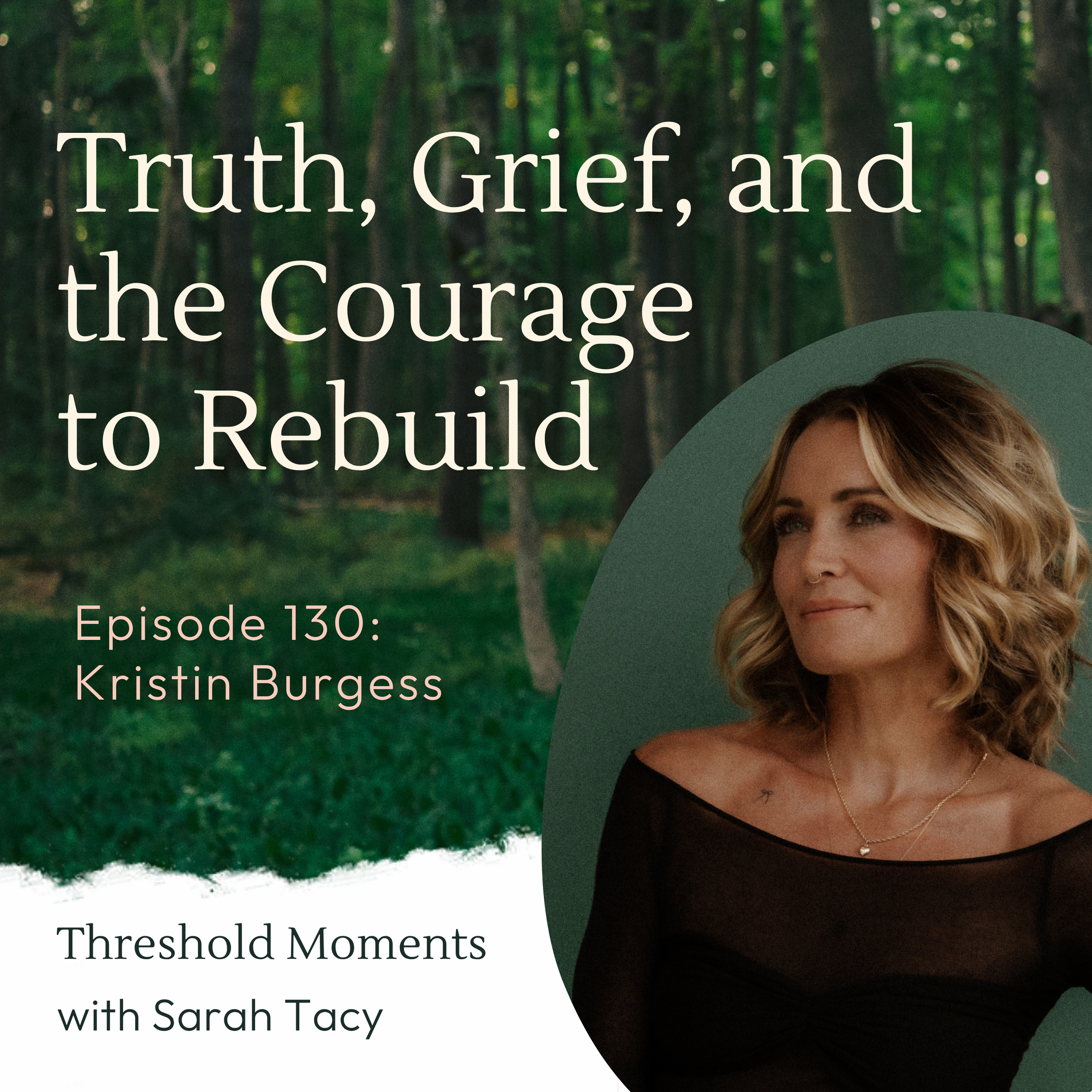
In this deeply expansive conversation, Sarah Tacy sits down with creative director and co-founder of the Prism House, Kristin Burgess, to trace the long arc of a relationship that began at the very start of Kristin’s wedding planning career and unfolds into a story of identity, creativity, partnership, motherhood, and personal truth.
What begins as a nostalgic return to Kristin planning Sarah’s wedding quickly opens into a much larger exploration of thresholds—those quiet, often disorienting moments where life asks us to outgrow who we’ve been.
Kristin reflects on the early days of building her wedding business while working full-time, the instinctive trust that shaped her creative path, and the evolution from wedding design into storytelling for brands through The Prism House. Along the way, she shares how motherhood, partnership, and creative expansion reshaped everything she thought she knew about capacity, identity, and leadership.
The conversation deepens as Kristin speaks candidly about burnout, over-functioning, and the long process of shifting out of survival-driven patterns shaped in childhood. She names the moment she began to move from constant doing into creative clarity—and how that shift quietly changed her marriage, her work, and her sense of self.
A pivotal part of this episode is Kristin’s time in a remote A-frame in Vermont, a self-imposed retreat that became a turning point for reflection, grief, and truth-telling. From there, she shares the unfolding of a major life transition, including divorce, the complexity of love, and what it means to choose alignment even when it disrupts everything familiar.
About the Guest
Kristin Burgess is a Creative Director, stylist, and co-owner of The Prism House, a Boston-based creative agency known for immersive brand storytelling, event production, and visual worlds that feel as transportive as they are strategic. With 17 years of experience in styling and art direction, she leads end-to-end creative for photo and video shoots, helping lifestyle brands, hotels, and restaurants translate their identity into meaningful, high-impact visual narratives.
Her work is grounded in a narrative-first approach shaped by a decade in editorial as a photo editor, overseeing copywriting, sourcing, and visual production across more than 15 magazines annually. Earlier in her career, she was named among Martha Stewart’s Top 50 Wedding Designers, quickly establishing a reputation for creating unforgettable, highly crafted visual experiences. Alongside her creative work, Kristin is known for a life lived in full expression—rooted in movement, nature, motherhood, and a willingness to evolve through both ambition and personal transformation.
Episode Transcript:
Sarah Tacy: [00:00:00] Hello, and welcome to Threshold Moments. Today we have with us Kristin Burgess, I first met Kristin when she showed up to my house. Oh my God, you looked so beautiful. You had your hair, like, up in a bun. I feel like you had this whole, like, jean outfit on, and I came downstairs in my sweats and my hair, like, all messy.
Sarah Tacy: Um, and Kristin was our wedding designer. And- I remember
Kristin Burgess: that
Sarah Tacy: day
Kristin Burgess: so well What do you remember? I do. I remember I was wearing a jean jacket and, um, ridiculous heels, 'cause I think back in those early days of wedding planning it must've been maybe, was it, like, 2011 maybe when we met?
Sarah Tacy: Y- that's
Kristin Burgess: probably
Sarah Tacy: right, yeah.
Sarah Tacy: The wedding was in 2012, so we probably met in 2011. Yeah.
Kristin Burgess: And I think I thought, like, wedding planners just had to wear heels and in order to, like, appear like I knew what I was doing I had to wear heels. So I remember I showed up to your, [00:01:00] to your house in these ridiculous heels that, uh, were so inappropriate.
Kristin Burgess: But I do really... I remember your house really well, and your parents, and just thinking, like, you in your sweats was, that you were so cool. And I was like, "Okay, this is gonna be great."
Sarah Tacy: So I felt the same about you, and I remember your heels. And I don't know if I remember, I'm like, was that the day... I remember doing a site walk, and it was, you know, out on the ocean and you had these, like, leopard print heels on.
Sarah Tacy: And I was like, "This girl's so badass." Like, she's just like, "I'm gonna take my style anywhere," and I loved it. I also remember, I wonder if you remember this, I feel like, um, your neck got, like, a little red during our meeting. And you also showed us Pinterest. At that point we had never seen Pinterest, so we had, like, a folder with actual cut out f- like, pictures.
Sarah Tacy: But- Yes ... when I saw your neck getting, like, a little red I was like, "Oh, this means so much to this woman." Um, [00:02:00] like she- ... devoted, right? Like, when you, like, go to an edge of something where you're, like, nervous, which has nothing to do with your ability to, like, freaking, like, r- rocket sounds like a really old thing.
Sarah Tacy: Appropriate. I was just like, "Oh, she's like..." It felt to me like you were, like, tuned in and turned on, and just, like, really there for it. Um, but it was just such an immediate yes, and we were so lucky to have you. And, and what I said to, uh, my community was, like, you know, I think we were your first or second wedding, and- Yes
Sarah Tacy: um, we really lucked out because there's no way that we should have gotten the services that we got for the price that we got. And two years later- I'm sure you were going, "Yeah, no kidding." Two years. I don't
Kristin Burgess: even remember what I charged back then, but- I do ... I do remember just making numbers up erroneously, so.
Kristin Burgess: I know
Sarah Tacy: that I do, and it's just not actually, like, looking back, I'm like, oh, yeah. But, like, two [00:03:00] years later, you are m- in Martha Stewart's Top 50. Yes. And it's just like, wow. We really lucked- Yeah ... out getting to have you, like, right at the beginning of that part of your journey.
Kristin Burgess: Your wedding probably had a lot to do with that. I made so many valuable connections, and I think you're right. Like, I got Flush, um, just your f- your... Uh, connecting with your parents and ha- Your, um, you know, I'm sure we'll get into this, but I don't come from a big family or a family with a lot of support, and I remember just, like, watching your parents through the process of just even that first meeting, and feeling really connected to them firstly.
Kristin Burgess: Um, you were kind of a no-brainer. And then feeling very connected to them, and then realizing that, like, if this went well, your dad was really quite influential. You know, he was really well-connected through the restaurant and through all of his experiences in that area, and I was like, "This is a big deal."
Kristin Burgess: Like, I need to nail this, [00:04:00] and I did. I had an iPad with Pinterest on it, and it was probably, like... I mean, Pinterest was, like, days old at that point. Um, and I remember your dad being like, "I can't believe you have an iPad. This is so cool," like, at the meeting. And I don't even think it was my iPad. I think it, like, belonged to someone else, and I borrowed it for the meeting.
Kristin Burgess: So it just goes to show, um, that, you know, if you set your mind to it and you wear tall heels and you bring an iPad, you can land your first big client. Anything
Sarah Tacy: is possible. Oh my God, we loved you. And- Yeah ... I'll say, you know, I didn't think we were gonna, like, go back to this, but it was also, you know, it was my first wedding.
Sarah Tacy: So. And also, you know, my aunt was doing the flowers, and Beth, who is the co-own- was, um, now owns Foster's- Mm-hmm ... but back then was, like, my dad's top person, and, um, was really in charge of, like, all the weddings they did, um, was just like- I felt so comfortable just being like, "I am in the best hands." And so I [00:05:00] felt pretty hands-off with a lot of stuff.
Sarah Tacy: But also just how challenging it is for each person to, like, be in their zone of genius when there are multiple people trying to be in their zone of genius. And I was like- Totally ... "This has gotta be so stressful." And I imagine from there you probably made changes as to, like, how you'll work with families or, like, w- who will do what.
Kristin Burgess: Yeah. Yeah, I did learn a lot from that because, again, I was, like, new and fresh, and I think your aunt probably for one was like, "Who is this girl?" Um, but you trusted so wholeheartedly in me. Um, and it's interesting, I actually had, uh, an interview earlier today, and they were like, "What is, like, your number-one business value?"
Kristin Burgess: And I was like, "Trust." Oh. Trusting the client. Trusting, you know, like, coming from wedding planning, like trusting your bride that she knows what's best for her. You're just guiding the story. And I think, um, you and I [00:06:00] trusted each other on, like, such a deep level, and it was, like, one of my first experiences with that.
Kristin Burgess: Really saying, like, "Okay. Trust your intuition. Like, this bride trusts you, so you trust you, and this will go smoothly." And I think we did a really ... Like, even though vendors were looking at me like, "You have zero experience. Like, what are you doing here?" And I was like, "No, I can ... Like, the experience isn't the point.
Kristin Burgess: It's seeing the story. You know, seeing the bride, seeing the couple, understanding their story, and transforming it, and, and telling those vendors how you wanna do it." But then trusting their skill, too. It was ... Yeah, it was really one of those first experiences.
Sarah Tacy: We had everything from, like, is it called chevron?
Sarah Tacy: What's, like, that, that- Yes ... design style that was popular. It was. My God, the ice cream. Chevron. You thought of every detail. We had, like, trees inside the t- I mean, it was, it was epic. And I have- Yeah ... a lot of my clients from New York were there, who [00:07:00] were, like, very wealthy, well-off people who have been to, like, so many events.
Sarah Tacy: And I just got feedback that the wedding was the most beautiful wedding they've ever been to. And I, along with the design, I also think the community you build over a lifetime also really affects just, like, how hard people dance together, how hard people laugh together, how deeply people enjoy, like, the food and company.
Sarah Tacy: Um, but it was just such a special day. Um- Yeah ... going back to mutual trust, I think about the saying where it's like, like see- sees like. Mm-hmm. And part of the reason of inviting you here today, uh, is I think what I've always seen in you, you know, there are qualities that I want to, like, would want to live into myself, which- Is that from a distance watching you shift your business, have an in-person store, close down the store, um, change from doing the [00:08:00] wedding to the Prism House, and then doing it with a team, and just all the shifts that you've made, and then recently, like within your personal life.
Sarah Tacy: From a distance, I keep watching you be a woman who continually checks in with herself to say like, "What is real now? What is my truth now? What do I need to burn down now in order- Yeah ... to build around what is true?" And I'm wondering, you know, we could go to the most recent threshold or if there's like anything before that even that feels like a bridge or a threshold where you are able to say like, "Oh, okay, I exist.
Sarah Tacy: My existence matters, and this is what's calling forward a new truth."
Kristin Burgess: Yeah. I mean, the, the first threshold for that probably was starting the wedding planning business with absolutely zero experience. Um, you know, I came [00:09:00] from, um... I was an art and English major, and I had read a million love stories, and I thought, "You know, I can get to know people and put their stories together in this visual way rather than, you know, a written version of their story."
Kristin Burgess: Um, so that was, you know, I think some people could call it like blind luck. Some people could call it entitlement. There's so many things you could call that first stage. But I just thought to myself, "This is something I can do." Um, and that's really evolved. You know, it evolved from the wedding planning into businesses saying like, "If this is something that you're doing for people, um, we think you could tell our story, too."
Kristin Burgess: And that was like a really interesting evolution, which is what took By Emily B, my first business, um, named for Wuthering Heights, which is like a fun current connection . Um, took By Emily B to Prism is that people were like, "We're seeing [00:10:00] you tell these people's love story. Can you tell the story of my business?
Kristin Burgess: Can you tell the story of my brand?" Um, and again, there is always this level of like just this you have to have this sort of like self-belief that like even, that you can do something you've never done just because you have life experience. Um, so you know, starting, starting that wedding planning business was the first time I really said like, "I can do this even though I don't really know how yet."
Kristin Burgess: Um, and it's so wild that your wedding was such a big part of that. Um, but yeah, that's been a current theme in my life lately is just that it's like I don't know how to do this, but I know I have to. Um- I'm being, I'm being called to it, that, you know, that deep knowing is sending me on my next adventure whether I wanna go or not.
Kristin Burgess: And, um, that theme has really been stronger than ever in these past two years, um, for sure, in the [00:11:00] evolution of both the business and my personal life. Um, so yeah, it's, it's been it's been a wild, a wild journey, um, lately.
Sarah Tacy: When I think about small doable steps, and some things just feel like massive leaps, my recollection is that when you started your wedding business, you were still working full time in Portsmouth, right?
Sarah Tacy: Yeah. And so- Yeah ... like, for listeners, when you, like, have a calling, and you're like, "Oh, well, I can't afford to just, like, totally take a risk and have something fail," I feel like you held on to a job that you had for a very long time that you were very good at, and started this until there was, like, enough evidence that you could thrive here to say, "I'm gonna go in even more into this other realm."
Kristin Burgess: Yeah. I actually did it for the entire time that I had By Emily B until I took on a business partner, um, in 2019 when Prism- Wow ... when we rebranded to [00:12:00] Prism. I stayed. I was at Hawthorne Creative, uh, which when I started in 2008 was Hawthorne Publications. Um, and we were a publishing house, and I really was there with them through the transition from print to digital.
Kristin Burgess: And I was only working part-time at the beginning, and so I was like, "What's another creative way I can make money? I'll plan weddings." And that was kind of how that happened. And then they brought me on full time, and I just... Yeah, I mean, what you said, it's like I just hustled. I, I wanted to do both. I really didn't wanna give up on that.
Kristin Burgess: And what's so interesting is that Prism is the overlapping of those two businesses now. Um, you know, it's the weddings and then it's the marketing. And, uh, you know, I was... So I transitioned into being their photo editor a few years in. So for about eight years, I was the photo editor of, like, 16 different publications every year.
Kristin Burgess: Whoa. And that taught me what I do at Haw- or what I do at Prism. And so I'm so [00:13:00] grateful that I stayed because I learned so much, but it was so many long nights. And I mean, I planned weddings nocturnally. I didn't sleep. And then I worked for Hawthorne during the day, so.
Sarah Tacy: So how did becoming a mother change that for you, if at all?
Kristin Burgess: Everything. Um- Yeah. Yeah, that's really the current story, was that when I got pregnant with Emerald in 2016, I still had, like, a full two years of weddings booked. Um, but I was so exhausted. And so- After, like, the first six months of being a mom, I really just was like, "You have to take a step back. This, this working all night long, um, while having an infant is not working."
Kristin Burgess: And so I, um, I kind of was throwing in the towel, and I hate to say it that way, but I was like, "I'm just gonna work for Hawthorne. It's a job I love. It's steady paycheck. It's health insurance. It's all these things. I'm [00:14:00] gonna let someone else shoulder all that heavy burden of owning a business." And I was going to close down By Emily B.
Kristin Burgess: And simultaneously, um, Carrie Scott, my business partner, uh, she had been working with me at a luxury rental company. She was their, like, lead designer, and we had only worked virtually together. And I was just getting ready to kind of, like, close sales and wrap up my last year of weddings, and she was like, "Let's partner."
Kristin Burgess: And so many people were like, when I took the leap with her, which took, it took her, like, six or eight months to convince me, but when I took the leap, everybody was like, "How can you share this thing you've built with someone you don't know?" And I was like, "I just know. My inner knowing knows that she is the person to share this with," and, um, that otherwise I was dead in the water.
Kristin Burgess: You know, I was, I was exhausted. I was a new mom. I had put my heart and soul into [00:15:00] Hawthorne and my heart and soul into this other thing, and I was just spread too thin. And so to think of shouldering that burden with someone else, um, felt like the most immense relief, and it was. Hm. She came in and just immediately h- helped me handle those weddings, stepped right in.
Kristin Burgess: I mean, she's my... I think I took some notes on this before I came on. Just she's like m- it's a platonic marriage that is so precious and sacred. Um, she... You know, I went from feeling so alone as a business owner all the time, like I was doing everything by myself. I had an amazing team, don't get me wrong, but I didn't have anyone full time and no one helping me shoulder that financial burden of being a business owner.
Kristin Burgess: And she just came in and was like, "Let me hold you." Like, "I've got you." Um, she backs me up like no one else. You know, she believes in me [00:16:00] like no one else. And, um, to have that support really changed everything, and that's where Prism... You know, she was like, "I love By Emily B., but can we rebrand so that it feels like, um, it feels like a part of me as well?"
Kristin Burgess: And so we rebranded to The Prism House,
Sarah Tacy: so yeah. And anybody listening, if... What's, can you tell me, I was gonna say your website. We'll put that in the show notes. But just anyone listening to also go to Kristin's, um, Instagram and to go to Prism House because- The events that they create and the brands that they do are just, like, they're mind-blowing.
Sarah Tacy: Like- Yeah ... they're so fun and they're s- like, I guess it's depending on what it is. Like, some of them are so fun, some of them are so sexy, some of them are, like, so earthy. But every time, I just, like, I wanna watch the whole video if there's a video, and go through every photo. And they transform spaces, like big spaces, into, like, an entire theme where you feel like you've [00:17:00] transported to another time and place.
Sarah Tacy: And the photos you show, and I know sometimes Instagram can be different than, like, real life, but it's like, it's you and it's your team, and, uh, all of you, like, p- creating a whole new world. And I just... I'm always like, "Man, she's so badass." Like, it's so cool. Um- Yeah ... I'm just, like, so obsessed with it. And as you tell this story without, like, maybe saying too much about somebody who's not here, I'm thinking of another friend of mine who has, like, a really big online business and, and, um, she partnered up with somebody a few years ago, and I think she would also describe the relationship as, like, a platonic marriage.
Sarah Tacy: Like, just, like, being with somebody who gets you in a way that nobody has ever quite understood you, and who supports you in a way that no one has quite supported you, and that the two together bring out something even bigger within one another.
Kristin Burgess: Yeah. Definitely. She just, you know, and not just her, the rest of the [00:18:00] team that we've built right now- Yeah
Kristin Burgess: especially, like Prism right now is just in a place that I'm so proud of. Um, and those women, the other women on the team, and, and the way Nick works with us because, you know, it's Nick and the ladies. But, um, i- it's just, it's such a supportive team. Like, we just lift each other up. It's so, um, the energy is just so good, and I'm so grateful, you know, to have Carrie leading this by my side.
Kristin Burgess: And yeah, I mean, I could talk about it all day, but...
Sarah Tacy: Um, so I saw a post, maybe it was this winter, and you're like, "There was a part of me that knew," so just going back to that, like, that inner part of you that knows, that... I, I'm gonna get it wrong, so I'm just gonna need you to update me. But it was like, "There's a part of me that knew that I needed to just, like, be in the woods by myself."
Sarah Tacy: I have an image of, like, an A-frame in my head. Okay. Um, can you [00:19:00] tell a little bit about that story? I know it's, like, part of your most recent transition, but, like, the parts of you that knew, and then your journey of, like, taking each step.
Kristin Burgess: Yeah. It was interesting. Um, yeah, there's a, there's a few things there.
Kristin Burgess: I mean, the A-frame was a threshold moment for sure. Um, but there's been a lot of change, like, so many changes lately and it was interesting when I was, like, brainstorming- Your podcast when I was thinking about it. Um, actually my morning meditation this morning, um, asked me to invite in all the versions of myself, and I was like, "Wow, this is timely."
Kristin Burgess: Um, and it's so, just so interesting 'cause you just... Like, all these transitions, and the A-frame was a huge transition. So I was, you know, feeling in a really difficult place, um, in my marriage. I had spent really five years [00:20:00] fighting, um... Some really great, you know, some really good times in those five years, but we spent five years kind of fighting to figure out how to fix a 22-year relationship.
Kristin Burgess: And, um, I think you bring up the A-frame 'cause I think it was a it really was the symbol. Somebody was like, "You should get a tattoo of that A-frame." Um- Awesome ... it really was a symbol of, like, my freedom, my, um, taking my life into my own hands. You know, even though you're a mom, and you have all... And you're a business owner, and you're a wife, and you have all these responsibilities, um, it was saying, like, I have all these things I need to do and focus on, but if I'm not at 100%, then those things are gonna fall apart.
Kristin Burgess: And I think there's a lot of women experiencing that right now. I think there's a real movement around it and, and I experienced it in, you know, [00:21:00] full, all-out, like, time to embrace your own healing, um, experience this, these past two years. And so basically in, in exploring and looking for, like, my next step, how to either save my marriage or save myself and...
Kristin Burgess: or save both in the process, I, um, was on Facebook just doing something silly. I never go on Facebook. And this ad came up for this A-frame that was for rent for nine months, and I just saw it and was like, "I have to have this experience." And it was in remote Vermont, and I rented it. And what's interesting is, like, none of my friends even came there.
Kristin Burgess: I... When I first rented it, I was like, "I'm gonna have all these experiences here. All these people are gonna come and see how cool this thing I'm doing in Vermont is." Nobody came. It was just me. And me kind of, like, healing and looking at my life and saying, like, "What's next?" Um, you know, I, I think a [00:22:00] lot of people said to me- A lot of older friends said to me, "Just wait until you're 40.
Kristin Burgess: All your childhood trauma comes out." And I was like, "Yeah, yeah, yeah. No, I'm dealing with that." I know myself so well. I've, you know, dug into all that. I've done therapy. I've done, um, all this different kinds of healing, and they were so right. Like, you turn 40, and that stuff rears its head, and if you don't deal with it, you know, you end up in an A-frame in Vermont alone for nine months.
Kristin Burgess: Um, so I think, like, it was just tying it back to, like, my meditation this morning. It was like welcome in all these different versions of you, and I think my biggest lesson in the past two years has been, like, letting other people have whatever version of me they need to have, knowing that, like, I'm taking care of my version of me right now.
Kristin Burgess: Um, and, and that meant, you know, taking care of a lot of other people at the same time as a mother. [00:23:00] But, um, it's, it's just been a big lesson this year to, like, soften into that, let people have their version, just, like, stay in my lane, um, and realize that I can't control... I can only control my own healing. I can't control other people's, um, experience because they're going to...
Kristin Burgess: Their experiences are influenced by things that I know nothing about, just like the version of me that's here right now is, is influenced by my experience and my trauma and, um, my triumphs, um, you know, that they know nothing about. So it's been, it's been, like, quite a road. But anyway, the A-frame gave me that space to really, um, work through a lot of stuff.
Kristin Burgess: And um, yeah, I, I, I was able to sort of get really quiet and listen to that inner knowing that's [00:24:00] always really led me in life and business and, um, and, and really hear it. And you know, it did, it did lead me to burn everything down, pretty much. Um, but you know, it, it, um, it gave me space to hear it, and I think that that is a message that I try to share with women when they come to me and they say, like, "How are you doing this?"
Kristin Burgess: Like, "How did you get here?" Um, and, and by here I mean, you know, working through my divorce, listening to my heart, um, and trusting that my children trust me enough to know that I'm-
Sarah Tacy: Kristin, I think we broke up. Can you hear me?[00:25:00]
Sarah Tacy: Oh, no. Okay. Oh. There you are. Sorry. So we stopped at, like, trusting that my kids know.
Kristin Burgess: Yeah, tru- you know, I... It's funny. Women- when you go through something like this, people come out of the woodwork, um, to, like, kind of beg of you, like, how did you find this, your way? Oh, no. Did
Sarah Tacy: we freeze
Kristin Burgess: again?
Sarah Tacy: The video froze, but I can still hear you.
Sarah Tacy: Shoot. Can you hear me? Hmm. Okay, I can hear you. Can you hear me? We're back. Yeah. Okay. So if you can start back at, like, trusting that my kids know, because we'll have to edit from there.
Kristin Burgess: Yes. Okay.
Sarah Tacy: Yes.
Kristin Burgess: Um, yeah. So trusting that my kids trust me to make the right decisions for us as a family, whether, you know...
Kristin Burgess: And we'll always be a family, whether Dan and I are married or not. And so it really was this journey of trust, and then having so many [00:26:00] people come out of the woodwork and be like, "How did you find your way through this?" Um, you know, this being a massive transition of leaving a 22-year relationship, 12-year marriage, um, to kind of, like, trust this other path that was kind of a mess, to be honest.
Kristin Burgess: Um, a really big mess. Um, and it really was always just about, like, this inner knowing that I was making the right choices, um, even though they sucked, and people around me were judging me really harshly for those choices. Um, so yeah. I-
Sarah Tacy: So I have a few things, a few questions. Yeah. Yeah. I'm gonna come back and just, like, want to know about how one gets through, like, as y- as the judgment is coming.
Sarah Tacy: But what else I hear, like, now that I've heard more of your story, is so many years of going so hard, like, going hard at night, going hard during the day. And [00:27:00] on a, like, on a nervous system app, right, that's, like, the global high intensity activation, it's place six on the seven, on the seven- ... uh, zones. And, and it, and it tends to constantly go there until something in life is, like, no more.
Sarah Tacy: You know- Mm-hmm ... whether that's kids or, like, you're feeling something's off in the marriage. And then, like, all the parts when we start to slow down, which is why it's generally so scary for most people to slow down, is because momentum keeps us from having to feel any of the feelings. And as we slow down- Everything.
Sarah Tacy: Like, think about being in your 40s. Like, we just actually have less energy to go as hard as we went in our 20s. So if we naturally start slowing down, we are gonna start feeling more than what we felt before. And if our estrogen goes down, we're gonna start- ... feeling more. Like, our, our bullshit meter is just, like, so much more tuned.
Sarah Tacy: Oh, so true. So like, we start, like, we start feeling more than we did when we were going so fast. Mm-hmm. And [00:28:00] that can be a lot. Uh, and so as I hear the story, especially hearing just ... I, I guess I didn't know that you were wa- working at Hawthorne that long alongside of your bustling business, and the nights and the days.
Sarah Tacy: And so I can imagine just that, like, push through, that push through. And, um, and I don't know your childhood, but I do know that most people who become highly successful who have trauma in their childhood tend to push harder than almost anybody else would because it got you through a really hard situation.
Sarah Tacy: Yeah. And it, like, serves you so well until it stops serving. Mm-hmm. And so to actually come face to face with those parts is, again, it's so, um, it's so bold, but if you've always been following the path of your heart, then it's- Mm ... also so necessary.
Kristin Burgess: Absolutely. Yeah. I [00:29:00] think something that I really explored during this process, it's, it's actually so interesting that you brought this up this way because
Kristin Burgess: So when I, really around the time I turned 40 was around the time that Prism really found its stride. Um, we had built a team where I finally was able, after all these years of fighting so hard, to step into my most, like, natural position, which is to be just creative, just the creative voice. I had this incredible team running all the operations, all the back end, all the financial, and I was just getting to just be creative.
Kristin Burgess: And it's crazy because there's a simultaneous, like, sense of total relief from that, and then also, like, oh my gosh, I have all this time to feel all these things, which is what you said. And I think what it really led me to explore and w- and where I've really spent a lot of my time in therapy over the last few [00:30:00] years is that I was functioning
Kristin Burgess: Because of my childhood, I grew up in a home with two people who really didn't know how to love each other at all, and I was an only child, so I spent a lot of time alone. I spent a lot of time surrounded by adults, and I spent a lot of time, like, fending for myself, um, which led me to really function from my masculine.
Kristin Burgess: All the time. And I think throughout my 30s, even becoming a mother, I was like this over-functioning woman living in my masculine. And what that did to my marriage, you know, as you can imagine, is it really made, you know, it, it made my husband operate from a less secure place and to feel emotionally unsafe because I was this big energy over-functioning at all times.
Kristin Burgess: Um, and, you know, I'm able to kind of look at that now. And I think what really ended up happening was that [00:31:00] when Prism made this shift and I had all this time to be this creative person and, um, my kids were a little older, so they were a little more self-sufficient, I really started to step into my feminine.
Kristin Burgess: Mm. And that was this whole different empowerment that made me start to make choices around my own, um, like around self-care for the first time in so long. And I think, um, I stepped out of this like over-functioning place and started to look at what all that overworking, all those late nights, all that over-functioning, and all that like operating from my masculine had really done to my relationship.
Kristin Burgess: And while for five years I'd kind of been, you know, trying to get him to look at his trauma and, and go to therapy, and we did all these things, like, there was also [00:32:00] this deep inner knowing that like my next step was right there. And that as much as I wanted it to include him, it, it didn't, um, for me. And that was such a difficult realization.
Kristin Burgess: Um, but like you said, it was really that transit- it's funny to be able to look and see that it's really a, was a transition in my business and my career that kind of like led to those dominoes, that domino effect-
Sarah Tacy: Wow ... the steps.
Kristin Burgess: Um, and, and stepping into my feminine really changed so much because I, I became a really different person.
Kristin Burgess: And so a lot of the people around me, some... You know, I, I have always been like a connector. I've always like kind of been bringing people into the fold and giving opportunities. And, um, you know, I think an interesting thing I think about a lot is like I studied photography in college and, and took a lot of photos, and we [00:33:00] do a lot of photo work at Prism, but I was always giving the camera to someone else.
Kristin Burgess: And being in the creative role, like the control and again, the masculine role of saying like, "I'm gonna control this scenario," rather than be the person actually taking the photo. Um, and so I kind of took a lot of that back and- A lot of the people that I had, like, brought into my circle that really relied on a certain version of me, like, couldn't handle that shift, um, couldn't handle seeing me be, like, putting myself first.
Kristin Burgess: Yeah. Um, which can be interpreted a lot of different ways, and I understand that people are going to interpret that differently, um, that it can be seen as selfish, that it can be seen as narcissistic. Like, people have every version of me, I'm sure that they, um, wanna create. But for me, it was really about, like, for the first time in a really long time making choices that were just for my own wellbeing, um, to get through that [00:34:00] difficult time.
Kristin Burgess: And, um, yeah.
Sarah Tacy: There's a part of me that wants to just, like, jump up and down and be like, "Is everyone hearing this?" Uh, my course that I run in the fall called Resourced, originally it was just this idea that stress is when you have more demands than resources. So to be resourced would be like, oh, now I feel, like, centered enough that I can make these decisions, that I can make these moves.
Sarah Tacy: But as the course gets on, moves on, by the end of it we're really looking at the pattern that so many women have, which is I'm okay when you're okay. Mm-hmm. Mm-hmm. And as we shift to I'm okay when I'm okay, and then I can still attune to other people, right? So it's not like I'm okay when I'm okay and I don't give a shit about anyone.
Sarah Tacy: It's more like I, I tend to myself, and from there I can go out and back in. And we talk about the tension field, which is this place that if our cells, so our cells do do this, our [00:35:00] cells- Mm ... have receptor sites, and the receptor sites vibrate in a certain way, and these little ligands come by. And if they're a match, they'll start, like, dancing together.
Sarah Tacy: And if your system is, like, used to dopamine from, say, like, opening your phone or from having a s- a dessert every night at 7:00, or watching a show, or, or, like, um, being with your lover in the kitc- like, just, like, never being a- whatever it is, we're used to having that connection. Mm-hmm. So the moment that you change even to say, like, "I'm not gonna take the role of controlling everything," in your body but also in the bodies around you, like, your body may have, like, begun already to build new patterns at a cellular level, but the other bodies who feel safe once you take a certain role- Mm
Sarah Tacy: um, they're, like, literally on a cellular level there's this like, oh, wait, there's not a match in here. Mm. And I've said before, it's like being out on a dance floor where [00:36:00] you, like, start dancing and, like, nobody's joining you yet, but, like, you just kind of like I'm just gonna keep with the vibe, and, like, eventually the party will come.
Sarah Tacy: And and so we call this the tension field, this place when you have a new pattern and everybody else's system who is used to your old pattern- Uh, in, in even your o- your own system, like there's this period of time where there's an adjustment in the field, and it tends to be highly uncomfortable. So when I also teach the idea of opting out of urgency, if we stay in urgency, we'll just be like, "Okay, how do I make everyone else feel better so I can feel better?"
Sarah Tacy: Yeah. To be able to stay with the discomfort of people being uncomfortable with you is, is such a big deal, but I feel like it is like the work of middle age, right? It's like the work for women to meet. It really is. And I, I showed you some cards that I pulled at the beginning. The very first card I pulled...
Sarah Tacy: I don't know if you've ever pulled a card and you're like, "Well, I don't get it. I'm gonna pull one
Kristin Burgess: more." Yeah. Always. Always. I'm always a [00:37:00] double card puller. But the second card always explains the first card to me, so...
Sarah Tacy: All right. Well, okay. Well, let's do it like that then. So the first card I pulled, um, actually says security.
Sarah Tacy: And on the back it says, "True security comes from having a reserve of time, space, energy, personal power, and love. Make deposits in all of these accounts and you'll be a wealthy person indeed." Wow. And I was like, "I don't know. Does that... Mm, I'm gonna pull another card." Wow. But as you talk about your time, as you talk about your time in the A frame- Mm-hmm
Sarah Tacy: about like really making those deposits- Yeah ... the time, the space, the energy, the personal power, and the love. Mm-hmm. That that gives you like a different type of security. Yeah. Like a security in, even in like a belief in your knowing. Unique. And the sec- yeah, the second one was self-worth with the word elevate underneath.
Sarah Tacy: So it says, "You get what you believe you deserve. [00:38:00] It's time to raise your standards." And so I only read you the second card, but that's... Yeah, th- that was the order. Yeah.
Kristin Burgess: Yeah. I mean, I think, like you said, you know, w- for women in middle age, it's like a lot of people feel this deep urge to elevate, to burn it down, to, you know, have these like phoenix-like experiences.
Kristin Burgess: Some people do it, some people don't, but, like, if you do, you lose a lot along the way and, and you're shedding the old to make way for the new. And, you know, the... I find myself very deep in the grief of, like, mourning this past life. You know, I had to move out of my home of 17 years. Um, I lost a lot of people and, and I don't, I don't blame that on any of those people.
Kristin Burgess: I think it's just, again, like a natural shedding [00:39:00] and that, you know, not all people handle change in the same way, for, for better or for worse. Um, but, you know, my one of my favorite things, one of my favorite moments with my- Amazing therapist throughout this whole experience was in a very fearful time last winter, spring, like more than a year ago.
Kristin Burgess: He just looked me dead in the eye, and he was like, "If you are not living your truth, you're preventing everyone around you from living theirs." And while I wasn't able to act on that for about another six months, um, which caused a lot of problems, I will never forget that because I am so living in my truth now, and it is difficult.
Kristin Burgess: Some... You know, I had an am- like the most magical morning this morning, and so some days it's easy, and then some days it's so hard. [00:40:00] And but I just think to myself, "You are finally living in your truth. You're not denying things. You're not pretending. You're not doing things to, to serve other people. You're, like, healing.
Kristin Burgess: You're taking care of you, and you're letting the people around you heal and take care of themselves, too." And yeah, it's, ooh, it's so hard.
Sarah Tacy: Um, yeah. I find myself on the other side here being like, "I wonder what she means when she says messy, and I wonder how it feels on the other side." And so you say hard, and I'm like, "I wonder what hard means, and I wonder what it, like, feels like," or if you could, like, even just give some more texture to any of that.
Sarah Tacy: Mm-hmm. I heard you use the word grief, which is one where I'm like, "Okay." Yeah. "I can, I can understand. Yeah, I can understand grief."
Kristin Burgess: Yeah, I mean, again, like, I, [00:41:00] I feel like I'm being a little fragmented here, but I, I really fought for my marriage for about half a decade, for five years. Um, and I'm a... You know, I come from a...
Kristin Burgess: I'm a child of divorce, so I swore that I would never. And I think it's, like, the universe just looking at me and being like, "You can't control it. Like, you don't get to say that you're never gonna have that experience." The universe instead was like, "This is your chance to break the cycle and do it differently."
Kristin Burgess: Um, so while it's been really hard, like, I'm just trying to let myself feel all of it. And, um, you know, the circumstances of the actual ending of the marriage were not pretty. You know, I unfortunately... Well, not unfortunately, but I, um, again, didn't fully live my truth throughout the process and, and that would be my advice to anyone who goes through it, um, is just to, like, really step into your truth, to step into your power around it even when it [00:42:00] seems really hard.
Kristin Burgess: Um, but when I say messy, I mean, I, I kind of- I fell in love with, with, uh, my creative counterpart at work, um, in the final sort of as the marriage started to dissolve. And, um, that is a messy thing to do. Um, but love is also the best thing ever. So there really was, like, a, a real dichotomy there, a real, like, tug of war of, um, you know, how do I deny this, push this away, um, take care of my family, but then also honor what, like, my very soft feminine body was feeling and, um, what my deep knowing was telling me was, like, the right path forward.
Kristin Burgess: Even if it was going to hurt people, even if it was going to push people to find new truths in their life, [00:43:00] um, I, I was called to love this person. So, um, it really wasn't pretty. Um, but... And I, I felt I had very little control over it, which again can be seen in a variety of ways depending on people's perspective.
Kristin Burgess: Um, but, like, the calm and the nervous system regulation I found through choosing that truth and choosing that love and, um,
Kristin Burgess: letting myself experience the grief of the change I had to make, um, that nervous system regulation is worth- Mm ... everything, um, that I experienced in the last two years.
Sarah Tacy: Yeah. Thank you for sharing.
Kristin Burgess: Yeah.
Sarah Tacy: Wild. Well, as you [00:44:00] shared that, um, and I know your kiddos are coming home soon, but I'm thinking about I went to visit my friend in, um, Hawaii when I was a freshman in college, and it was this whole spiritual waking.
Sarah Tacy: It was wh- like, I was in, like, so much pain, chronic pain for a year leading up to that, and we had, like, jumped into this hot water spring after staying at this guy, like, Vasu's house, who was talking about star children and doing all this energy healing on me. And, you know, walk out in the morning and her mom's sitting, like, naked with just, like, a sarong over her head.
Sarah Tacy: And- Uh-huh ... coming from New England, like, I've just, like, never seen anything like this, right? And so then we, like, dive into this hot spring and we're all naked, which again, like, I wouldn't do that. I... Like, it was just different, right? Yeah. And I said to her, and I know I didn't say it in a rude way, and I don't know how else to say it now, but I hadn't at that point seen divorce, um- I must have been in, like, a really weird bubble.
Sarah Tacy: Like, in Exeter, New Hampshire, all my parents' friends were married. All my aunts and uncles were married. Like- Yeah. [00:45:00] And she got divorced after 20 years, and so I said to her, I was like, "What does it feel like to know that you chose the wrong person?" And she was like, "Oh, I didn't." She's like- Mm ... "I chose just the right person."
Sarah Tacy: And she said, "And then at some point, our paths just were no longer the right path, and then we went on to choose the next right thing." Yeah. And I have never been the same since she said that. Yeah. I went from this, like, one idea of what separation or divorce was to, like, an immedi- like, I had so many layers of healing that weekend or that week.
Sarah Tacy: Um, but I was so deeply affected by that, just to go like, "Oh." Yeah. And it just made, it made, for me, um, relationships seem like a continuous check-in and a continuous choice and a continuous, like, um, you know, we say, "Till death do us part," and I think I left this in a message for you, but, like, when those vows were made, all those y- Which, [00:46:00] yeah
Sarah Tacy: like, lived until they were 40. Yeah. But also
Kristin Burgess: which death? So, like, we become so many ver- exactly. Exactly. Like, which death? I mean- Exactly ... there was a death of me, and that is a grief that I carry right now and, and that I confront, you know, daily. It's not, it's not something that goes away. Like, that person...
Kristin Burgess: A- and I think that every time I- I'm deep in the grief is I'm like, "You're mourning something that doesn't exist anymore, because the two of you are different now." And we were together for 22 years. I mean, he is precious to me. I love him so dearly, and I love who he is, and I love watching his new healing experience, and I love co-parenting with him.
Kristin Burgess: Um, so I did. I married just the right person to teach me all the things I learned in those 22 years, um, to get me here. And then the interesting thing about it is that, like, when you go through that grief and when you go through that type of massive life change, you, you [00:47:00] also meet new, not just new parts of yourself, but new parts of the people around you.
Kristin Burgess: And, and one thing that I'm so eternally grateful for, I mean, I have this group of five women, six women, um, and the way they held me through this experience and the way they said, "It's okay. Be just who you are right now, and we've got you," I mean, I cannot begin to have words to explain what that experience has been like.
Kristin Burgess: It is so transformative, and it's something I wouldn't have experienced had I stayed in my bubble, had I stayed the old version of me. There are so many new types of love I experienced through this really deeply difficult time. Um- It, it actually makes me think of, um, Andrea Gibson, who's, like, just got me through this time as well.[00:48:00]
Kristin Burgess: I love there quote, like, "In the end, I want to be... I want my heart to be covered in stretch marks." You can't get those stretch marks if you stay comfortable, if you stay in the same place, if you don't let, like, the roots of all your different experiences, like, nourish you, if you don't make hard choices that might hurt people, if you, you know, if you don't live your truth.
Kristin Burgess: Like, your heart's never gonna get stretch marks. And, um, I think while I grieve that marriage and while I grieve my home all the time, and these, these things that I had, that was this precious time that will always exist, and like, I put it on a shelf and let it, like, glow there and be there and be precious.
Kristin Burgess: And then I look at what I'm getting to experience now, and I'm like, "If you hadn't made those hard choices, like, you wouldn't be also getting this experience." And I, I miss all of those things, but, um, I'm just so grateful to be adding stretch marks Yeah. Right now. Um-
Sarah Tacy: Beautiful. Yeah. [00:49:00] Yeah. Thank you. Um, I'm thinking about...
Sarah Tacy: My God, I'm looking over to my bookshelf for it right now, 'cause I can't think of the name. Untamed, right? When she says, when Glennon Doyle says, "Disappoint everyone before you disappoint yourself." And in that same circle of friends, there's Martha Beck, who wrote the book The Way of Integrity- Mm ... which very much also outlines that when we lie to keep others comfortable, that we're not allowing anyone to really live in their full truth, even if they don't know it yet.
Sarah Tacy: And I think this is why I'm so moved by watching you. Um, because society can put labels on, like, what we should do or what we should this and that. But as you describe, like, falling in love with somebody, it's not convenient. Yeah. Right? It's not like, "Oh, this seems like a convenient thing to do at this time," right?
Sarah Tacy: Like, the convenient thing would be, like- Yeah ... you, that, like, you were in the cabin. You realized, like, this wasn't right. You dissolved the marriage a few [00:50:00] years later. You felt like that's the convenient story that, like, everybody would be like, "Oh, that's good." Yeah. But the heart is never, like, looking- No
Sarah Tacy: for convenience, doesn't care about our timeline. And- Doesn't care ... to me it's, like, an added layer of complexity of, like- Yeah ... and can you still follow your heart even when- Yes ... others will judge it, even when it might hurt others? And, and what I hear you saying is all the forms of love that you've been able to experience- Yeah
Sarah Tacy: as you were able to follow
Kristin Burgess: your truth, your truth. I'll be right back. I'll be right back. Oh, there she goes. Go pop out. I'll be right back. Yeah. I see the time. Threshold moment. Kids walk in. Yeah. Yeah. It, it is not, it's not convenient. You know, I, that's what I heard. You know? And, and that is, oh, God, I think about it all the time.
Kristin Burgess: Like, I t- how hard I tried to press pause, stop, push against it, say no, you know? And it's, it, that wasn't my [00:51:00] truth and, and it's not convenient to expand. You know? Okay. Expansion isn't, um, easy, and it's not convenient, and it's, um, it forces you to live outside of what's comfortable. Um, again, that's where the stretch marks come.
Kristin Burgess: Well- Stretch marks on your heart.
Sarah Tacy: Yeah. Well, thank you so much for sharing your story, for being you, and for l- well, like, allowing me to admire you from afar and, uh, come back in for this conversation. Awesome. Yeah. Thank
Kristin Burgess: you. Yeah. Thank you for reminding, you know, putting women in a place where we can remember, um, you know, our own power and step into it and live our own truths and listen to others who are living theirs.
Kristin Burgess: Um, I'm humbled to have been included. Um, I look at the list of women you've had on the podcast, so.
Sarah Tacy: Yeah. Um, I just, [00:52:00] maybe if I could, like, one little brag over here is, like, I'm like, this is a really cool podcast. Like, I know there are a lot of podcasts- Great ... out there that, um, have, like, top scientists on and top, like, data this and that, and biohacking.
Sarah Tacy: And, like, you know what's so cool about this is it's such a celebration of, of, like, women and of life and of possibility, and part of the theme of this is accompaniment. Like, just to, like, hear another story so that we might go like, "Okay, um, I see it's being done. I, I can do this." Absolutely. And so thank you for, for sharing your story.
Kristin Burgess: Yeah. Thank you so much. It was a pleasure. Yeah. Just such a treat to be here. All right. Go enjoy your kiddos. Thank you. Thank you. We'll talk to you soon.
Sarah Tacy: Thanks, Sarah. Talk to you soon. Bye.