
115 - Kate Northrup: Being a Conductor of Wealth
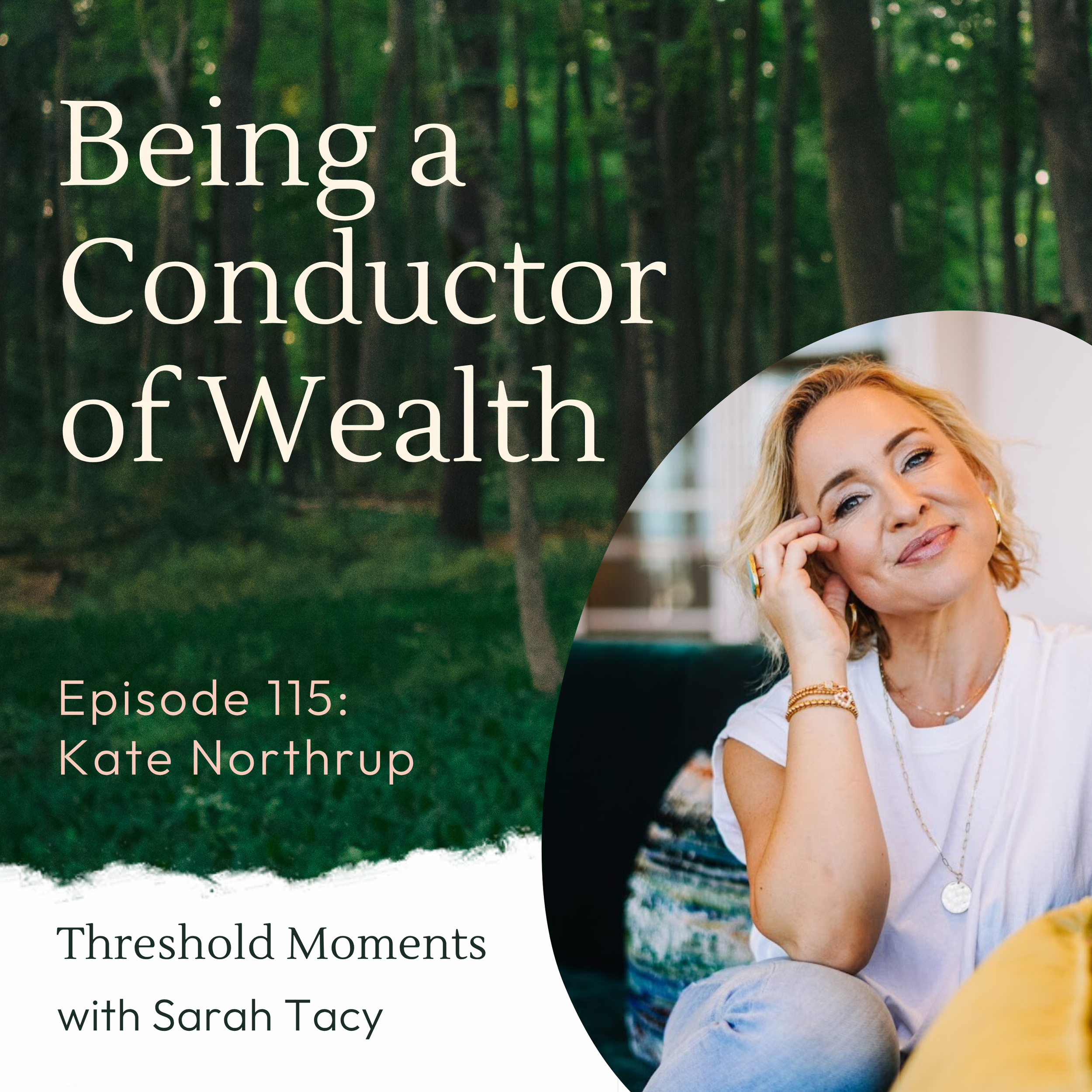
Today, Kate Northrup returns to Threshold Moments for a powerful kickoff to Season 4.
Kate Northrup is a bestselling author, entrepreneur, and body-based financial educator who helps conscious humans build wealth without burning out. Blending practical money strategy with nervous system awareness and cyclical living, she teaches a simple but radical approach: body first, business and money second, so you can feel safe before the external circumstances change and be present through every season of life. Through her program Relaxed Money, her books Do Less and Money: A Love Story, and the Plenty podcast, Kate offers a clear roadmap for expanding prosperity from a well-resourced foundation.
In this expansive and deeply personal conversation, we explore what happens when internal transformation meets real-world structure—and how true power is built from both.
Episode Transcript:
Sarah Tacy: [00:00:00] Welcome everyone to Threshold Moments. This is the first episode of season four, and I'd love to also just say that doing seasons is such. Such a gift to myself to just pause and be like, when am I gonna feel inspired again? And the inspiration hit so hard. And so clearly, and Kate was the first person I wanted to have back on.
Sarah Tacy: And anybody who is listening for the first time, Kate Northrop, has been on this podcast two other times. I think we've done three podcasts in total together. And what I love about having a podcast called Threshold Moments is that when you are a person who is interested in the continuous death birth cycle within yourself and within life, there are going to be many thresholds and there's gonna be a constant evolution of who we are.
Sarah Tacy: And [00:01:00] so every time, Kate, that you've been on this podcast, it's always been you, but a new version of you. And I will do like a more formal who is Kate on the intro? Intro?
Kate Northrup: Great.
Sarah Tacy: The other part of me just really wants to jump right in and say I really love when you're business planning and you're like, this year I'm gonna do good with money again.
Sarah Tacy: Like why recreate something that really works that if someone heard it again and again, they could get something new from it. And there's this little part over me over here that's like he hee he, that's so cute. Because because I feel like you went through a pretty big life change this year.
Kate Northrup: Huge.
Sarah Tacy: And that it's like really affected you to the core and you took some of this even I could say like nervous system work and of. [00:02:00] Added more texture and webbing and dimensionality to it. And I'm wondering for the listeners, if you could tell us a little bit about your journey this fall and how it's affected you.
Sarah Tacy: Just to jump right in.
Kate Northrup: Yeah. No. So good. It's so good. So yeah, I have been on a path of simplification in our business because for a decade I had all these friends of mine who I'd known for such a long time tell me that if you stick with one offer and one core sales system and one core customer.
Kate Northrup: And one core like platform, you'll be able to scale faster and have far less resistance, which we'll get to and just be able to make more money with higher profit margins and serve more people. And I heard them say that, but [00:03:00] I just could not get myself to do it. And I actually knew they were right.
Kate Northrup: It wasn't even oh no, they're wrong. I'm gonna do it my way. I was like, I am aware that my way is worse and yet I cannot stop reinventing the wheel. I like, it was like, I would be like, yeah, we're gonna double down on the same thing. And then I would be three quarters of a way through a new launch for a new program and come to almost like.
Kate Northrup: From a bender and be like, oh, oops, I'm doing it again. And then by that point, I've had people pay me to do the thing, so now I have to follow through. So that happened for years. And so I'm just very proud. I'm feeling so adult now in my early forties in my business, and I would like to report that it really works.
Kate Northrup: And so I know not everyone listening to this has a business, but I know that there are places where this could apply. So when we have. Resistance around [00:04:00] repetition of the same thing. Whether it's an offer in our business, a sales system . It creates so much excess friction and resistance in the system. And I'm even thinking about on a micro level, this particular friend of mine was like, I can't find this person that I need for support with my family and my household and whatever.
Kate Northrup: Because there was something about them thinking that there was some genius way that they were doing the dishwasher loading or unloading that no one else could ever repeat. And that's the same thing, honestly, energetically as me reinventing our marketing campaigns all the time and reinventing our, it was this obsession with the only way this can happen is if it is fully infused with my in the moment presence and my in the moment ability to do whatever, what have you, in like real time. I understand a dishwasher and a marketing campaign may seem different, [00:05:00] but it's like fundamentally the same. So I am coming back to your question, but all that to say, I am very proud that we are doing good with money again.
Kate Northrup: But yes, the sneaky truth is it's going to be completely different. Same bones, new interior, but not new.
Sarah Tacy: This is,
Kate Northrup: different way to get to the same results.
Sarah Tacy: This is to me when I like say like he is more like it. It's like somebody who does an Ashtanga practice every day, which also wasn't me, but I imagine, thank you for those who do, you are returning to the same practice every day, but you're never the same person.
Kate Northrup: Exactly. And
Sarah Tacy: although I am not suggesting that you have to redo all of your slides, the person that you appear as and what has changed within you over the last year shifts the energy and possibly even the stories that come along with it.
Sarah Tacy: So it's like same but different. It's old but new, if that makes sense.
Kate Northrup: A hundred [00:06:00] percent.
Sarah Tacy: Yeah.
Kate Northrup: So second half of the year I got invited to do two things back to back that were very big things that I would've never put on a desire list exactly. But they fell out of the sky and like very big abundant things.
Kate Northrup: So the first one was a fully paid. 10, like 10 day pilgrimage in Egypt to go visit all the sacred sites with a friend of mine, Emily Fletcher, and to do a particular like ceremonial practice wherever possible. They have a lot of rules about these things, but anyway, wherever possible around embodied manifesting.
Kate Northrup: And she was like, do you want to come on this trip as my guest? And this is, it was like a 16, $20,000 gift. And I was like, yes, I do. So I did that. So that was on the calendar. And then like in September, mid-September, maybe even late September, I'm sitting with a new girlfriend of mine in [00:07:00] Nashville.
Kate Northrup: And she was talking about this incredible retreat center, it's like a therapeutic retreat center called Onsite, where they do a practice that I can only describe as improv meets group therapy, meets parts work. And some people would never be excited about that, but I was like, that sounds amazing. And out of the blue, she just literally at the end of the lunch was like, you know what?
Kate Northrup: I'm organizing a group of people to go who are, creatives or entertainers of some way. Do you wanna go? And it was happening basically a month later in the four days before I was leaving for Egypt. And I was like, I can't do that. I'm a mom. Like I have little kids. I have a company to run.
Kate Northrup: I ha I can't, this is too big of a gift to receive. And without getting into too many of the details, I will just simply [00:08:00] say I sat with my husband. We figured out a way to make it work, which included flying my sister to Nashville to come be with my kids, which is not something we had ever done before.
Kate Northrup: 'Cause our usual support was not available. And what happened in, within, I would just say this two week portal was that first I, in about a 25 minute group therapeutic experience, had a complete re-patterning around my relationship with Matt. And I'm happy to talk about the details. If you want, Sarah, you let me know what would be helpful for people.
Kate Northrup: It was so dramatic and so profound and the only word I can use is permanent. It was like I walked in there one person, and then I became another person when I left four days later, which is how things work when we do relational [00:09:00] re-patterning, nervous system work, phenomenal. There were so many layers that made that possible, which of course we can talk about.
Kate Northrup: And then I, came home 36 hours, washed my clothes, whatever, packed, and went to Egypt and had the extension of that experience, which was, I did that internal re-patterning around my relationship with the masculine. And then I was shown over and over again through visions, downloads, meditations, and experiences in my body.
Kate Northrup: And like what they talk about, which is like the codes from the temples, which I totally thought was bullshit. That's real. So what I received was this direct mirror. Of what I had experienced within me. And the fundamental headline is I saw for the first time how my own interior power generator had been offline due to my wounded relationship with the masculine.
Kate Northrup: And [00:10:00] when that shifted, something so profound happened in terms of plugging back into power source that has stuck and it has, it's echoing through the way I teach about money because any conversation about money is actually a conversation about power.
Sarah Tacy: I am, I'm a, so we have a live audience right now, so there's a part of me that like, because I've heard the story and I'm like, okay, now I wanna go tell me about money and power. Yeah. Just I could do a little read from down below. Of do you wanna hear more about what happened in 25 minutes?
Sarah Tacy: Or do I move on to the power source? What I'd love to add, and I don't know if this is true, Kate, is when something changes so significantly in 25 minutes, I often think about the idea of those small doable pieces over time. Like all the work, all the years, all the little shifts [00:11:00] that allow you to be.
Sarah Tacy: Receptive enough.
Kate Northrup: Yeah.
Sarah Tacy: Even to be, get the invite to go right. Like all the work
Kate Northrup: Totally.
Sarah Tacy: That happens to bring it into place. So it's act in my imagination, the way I perceive it is like actually so much preparation to ready it, and then it's like the final ingredient that then binds it all together and is now it's permanent.
Sarah Tacy: And it seems, we actually had this conversation on your podcast last year where it's like the third step of the three direction map, where suddenly there's an extinction of something and you're like, wait. Like you can't even recognize it anymore, but it's often like all the conditions you've changed before.
Kate Northrup: Yeah.
Sarah Tacy: But now that I've built all that up, do you wanna say anything about the experience itself or what it
Kate Northrup: Yeah, sure. Hopefully it'll make sense out of context. Yeah. Some of these things, when you're I think about it when my girls, my daughters, I, we have, I have a 7-year-old and a 10-year-old.
Kate Northrup: And Ruby this morning, my 7-year-old on the way [00:12:00] to school was describing some sort of intricate detail about her classroom setup in a folder and a chair, and like something about the world in that room. And I was just like, not tracking. So I just wanna say, I'm gonna do my best to make this make sense outside this little slice of reality at an onsite therapeutic retreat.
Kate Northrup: Which by the way, if anyone ever, if you're, if you have a family member who's struggling with like deep trauma patterns or, addiction or, relationship stuff. The pa, the programs that they do at this place are. So profound and so deeply rooted in their, they're beyond trauma informed and nervous system safety.
Kate Northrup: And part of the reason that this was able to happen, Sarah, is because we had already done two and a half days of building relational safety in our small group and layer upon layer of resourcing. So not only like the previous, [00:13:00] 42 years of my life, but then also that they did such a good job about that.
Kate Northrup: And I think that one of the mistakes that we can make is we can think oh, we're just gonna go zero to 60. I'm gonna walk into this room and then I'm gonna have some profound explosion, healing moment. And while that can happen, if it does, it often can blow us open in to a degree that then it doesn't integrate and then we can go home all afraid.
Kate Northrup: So I just wanted to say that in terms of your three directions map and the preparation, like they also really warmed us up. So what happened is we each did these, what was called our piece of work. And as you're listening right now, I think it would be interesting for everybody to just ask themselves, if you were in this environment, what would be your piece of work?
Kate Northrup: And it was either a conversation you needed to have or a relationship you needed to address or a pattern. And everybody chose something different. And what originally, what instantly came to me was my relationship with my dad, which I was quite annoyed by. And [00:14:00] so oftentimes the thing that we need to address is the thing that we really don't wanna address.
Kate Northrup: 'Cause I had showed up that I was like, I am here for expansion. I was like, in such a great place in my life, I was like. I forced all my stuff. Like I'm just here to go hire and expand. This was like, oh, how about deal with your dad? And and I will just say, I was talking to a dear friend of Sarah and mine, Dr.
Kate Northrup: Deborah Kern. And she, I was explaining what happened to her and the story I'm about to tell you. And I was like, and she was like, you know what? I had a real, she had the par like as close to quote unquote the perfect relationship one could have with your dad. And she was like, this is so far deeper than your relationship with your individual father because of the way the wounded masculine really does run our patriarchal society.
Kate Northrup: And, we're seeing that dissolve all around us which is painful and beautiful all at the same time. And so I just will say that this is less about my [00:15:00] dad than it is about the masculine. I decided to do this piece of work and I was asked to enroll someone else in the group to be the dad I wish I had.
Kate Northrup: And he sat right in front of me and she, my, our group therapist her name is Leslie. She just asked me to say what I would want to say and so I did, and then she asked me to have him, she asked me what I would want to hear from the dad. I wish I had, and then he just repeated it.
Sarah Tacy: Back to me.
Kate Northrup: The words I had said just came outta my mouth, just repeating them.
Kate Northrup: And we went back and forth like that. And then we had a whole bunch of other people, I had created all this physical support for myself. So I had two people sitting right next to me, both with their hands on the small of my back. I had created this like entire pillow thrown for [00:16:00] myself. And then I also had another person in the group that I'd enrolled to sit back to back with me so I could just feel their spine and lean on them.
Kate Northrup: So what was so profound about it is I had the physical support that was the metaphor for always feeling held and I was able to receive the mirroring of that conversation. And it was it's such a simple thing, but there are things that each of us wishes we would have heard. And it turns out because our bodies don't really do time, they don't know the difference between whether it happened when we were five or 16, or really even who it was, or if it's happening now in real time.
Kate Northrup: And that's what's so beautiful about the transformative field, is that all time is now, and there [00:17:00] is no such thing as something that cannot be re patterned. Like it's literally scientifically impossible, that there's something that you couldn't go back and unwind and redo in a new way. And I just got to have this really incredible conversation that was completely guided by my psyche and just the instinct of what I would've wanted to hear and to say the things I always wanted to say that I never got to say to hear the things I always wanted to hear that I never got to hear to feel the presence that I always desired.
Kate Northrup: And it completely changed my life. And then in, so then it was happened to be, because the universe is funny. It happened to be with a guy who is from Indiana, who's a Virgo. I am married to a guy from Indiana who's a Virgo. Central casting is always like the best. When I found that out, I was like, that's funny.
Kate Northrup: But it doesn't matter. The human doesn't really matter, right? [00:18:00] We can all be anyone for anyone. And that's something that I love offering to people as well. Like that mirroring and reflection. And then, so cut to a week later, I'm in Egypt. At on site, we were not allowed to say our last names or what we do for a living.
Kate Northrup: So we were, we went so deep with this group of new humans that we never met before, most of them, and created bonds. Like it was like that, summer camp feeling when you're growing up that just I'll be best friends with you forever. And I will say our group chat is still like very delicious.
Kate Northrup: But we didn't know anything about each other in terms of like societal markers or status. Or like it, it was zero. What do you do? It was all, who are you actually? So then I went to Egypt, having just come out of that with this group of, I think about 30 new people, most of whom were women. And I continued to relate to people from that vantage [00:19:00] point, even though that wasn't the rule on the Egypt trip, but it just was like the vibe I was in and it felt really good.
Kate Northrup: So I just instantly connected with this guy who was there with his wife. And never in my entire history of my life have I ever gone into a group of primarily women and zeroed in on feeling safe and the most connected with a straight man. That has never happened before. And I was shocked, but it was just like this, like brother, sister, like we had known each other for a million lifetimes and we were locked in.
Kate Northrup: There was no question that we were retreat buddies and, a couple days in, we had not talked about what we do or who we are, whatever. It's just like a lot of other things to talk about. A couple days in we're sitting at dinner and he just happened to mention that he's an orthopedic surgeon and I was like,
Sarah Tacy: whoa,
Kate Northrup: that's wild.
Kate Northrup: 'cause my dad's an orthopedic surgeon and orthopedic surgeons are like our very specific kind of person, which I won't get into, but like I was just [00:20:00] like, okay God, I hear you. I see you. And so there were so many, I mean there's so much more to it and I will go all over the place if you don't stop me and just like guide.
Kate Northrup: But all that to say, I was witnessing the way the internal shift was in training the world around me and. I could see immediately how I just was different without trying, and as a result, everything in my world was different because everyone and everything was responding differently. But I wasn't like trying to be different.
Kate Northrup: And that is awesome.
Sarah Tacy: Yes. This is the best part that when your physiology changes, how you see the world changes, how you interact with it. And it's also when we talk about self-fulfilling prophecies, right? As if you're like, oh, this person's a total jerk, or men are this, then it's like we tend to treat people a [00:21:00] certain way and then they respond back to us.
Sarah Tacy: And when you have a different sureness about yourself
Kate Northrup: Yes.
Sarah Tacy: About the world and relational re relationality and safety, it's just really beautiful to see the way things respond, shift in shape and
Kate Northrup: hundred percent.
Sarah Tacy: So before I asked you to go back and tell that story in there, I like heard a little request of could you guide this?
Sarah Tacy: But I actually really feel like you were giving the medicine that we all need to hear and so it didn't feel like you were off or trailing in places. Okay. That weren't total medicinal places to go. So you come out and you recognize power.
Kate Northrup: Oh, okay. I do have to tell this one other little bit. Okay.
Kate Northrup: Otherwise it won't make it will make sense, but it's better with this other detail. Yeah. So the first place we went in Egypt was the Fle temple. And that is the ISIS temple. And [00:22:00] they actually have moved the whole temple except for the original gates. So the original gates are in the middle of the Nile.
Kate Northrup: There was a flooding situation, and so you have to take a boat. So we took a boat at dark, we got up at four 30. We like, were on the boat at Sunrise. As Dawn is happening. I am inexplicably in tears on this boat. I've no idea why. I'm just like weeping all the way. Is this a past life thing?
Kate Northrup: What's going on? Am I jet lagged? I don't know. So we show up at the temple and Emily invites us into a ceremonial meditation where we really tune into our deepest prayer for the world. And. I am somebody who has always focused on wanting to make the world a better place. But the particular prayer that dropped in was not like one that I was saying it was given to me.
Kate Northrup: And it was that I want to be part of birthing an [00:23:00] economic system where everyone can prosper on the planet and I wanna contribute to that. And prior to that point, I've always worked around the reinvention of our concept of money, our relationship with money, but that vision was, it was like on steroids compared to what I had ever had before.
Kate Northrup: So that instantly elevated what I felt was possible for me and the world and just even the way I was thinking about what I do. And I know that was because I had done that work around re-patterning my safety with the masculine. Like I just felt safer. And when we feel. Safer. And we have a stronger foundation energetically in our relationships, in the infrastructure, in our lives, in our boundaries in the containers that we, and the foundation, the scaffolding of our lives, when we feel safe, we can go so much bigger.
Kate Northrup: And so six days later we [00:24:00] are doing our final ceremony on the Nile and we were in a blue lotus ceremony and it was sunset and both sides of the river had these smaller cities on them where they were echoing out the call to prayer over loudspeakers all over the cities, and they echo over the riverbanks and it's very eerie and haunting and beautiful.
Kate Northrup: And we were. Doing our embodied manifestation, ecstatic prayer and everyone in the cities is doing their Muslim prayers at the end of the day. And it felt really beautiful and synchronistic. And I was, we were asked and guided to connect with our future selves, the version of us who had already manifested the prayer that we have for the world.
Kate Northrup: And I asked my future self, she's 85, like really gorgeous. She was wearing a very well tailored suit, just a stunning woman. And I asked her. To tell me what did I need to [00:25:00] know about my contribution to that prayer for the world, to birthing an economic system where everyone can prosper? What do I need to do?
Kate Northrup: What do I need to know? And she said, you need to flirt more and be in rooms with men more and be, have more men in your spaces. Which was just like, that's so interesting. And by the way, just my concept of flirtation, I learned from Mama Gina, which is to enjoy your oneself in the company of others.
Kate Northrup: It's not at all like sexual or manipulation or to get any kind of result. It's just, it's like personal enjoyment just for the fun of being with other humans, just to be clear. And I was like, that's so interesting, especially given this layering of of experiences. And so when I got home, I was thinking about that and I was like polarity, masculine, feminine, what is this about?
Kate Northrup: And so I started researching and I [00:26:00] asked the question, what does our nervous system. Our ability to connect to power in our bodies and feel powerful. Not power over, but power with the ability to make meaningful change in the world. What does that have to do with polarity in the masculine and feminine and batteries?
Kate Northrup: Because in a battery, naturally in a battery, there's a negative and a positive charge. And if you put the battery in upside down, it doesn't work. 'cause the charge is in the wrong direction. So I know we all know that in order to have something be able to be powered, we need to opposite poles.
Kate Northrup: And yet in our, especially in the like healing spaces, in the empowerment spaces, there's so much conversation that I'm hearing around coming into our feminine and a rise in the feminine and. I [00:27:00] love that so much and I'm part of that movement. And yet I was like, yeah, but that's only one pole. If you have only the one pole, your, your little, your flashlight doesn't turn on.
Kate Northrup: It doesn't work. So this whole piece that I received around we actually need both, increase in our masculine energy, not only just in our own personal selves, but really I see it as an ecosystem. Like how can we increase the clarity and direction and potential that we have in our system? And then how can we also use that to feel safe, to open up our feminine creativity, our flow of energy?
Kate Northrup: And so I started researching and I found out that essentially in our bodies, if we were to see our bodies as a bio battery, which they are, and our nervous system is the electrical [00:28:00] wiring, we have voltage. Which is our clarity, our direction, our intent. And then we have current, and that's more of our feminine our create our creativity the flow.
Kate Northrup: And we need the voltage to be online in order for the current to have direction and somewhere to go. And then when we connect them in our bodies through the heart, which is a conductor, which is a trans miter, essentially a transducer it synchronizes the whole thing into a closed circuit that creates usable power, which is measured in Watts.
Kate Northrup: Which is really fun because my married name is Watts. So when I found that out, I was like, that's so cool. I'm a what? So all of that to say, I've been playing with this whole piece around healing the relationship with the masculine and then [00:29:00] getting these instructions that if we wanna have a new global relationship with power, it's not about only increasing the feminine and it's certainly not about annihilating the masculine, which we've conflated with toxic wounded masculine, right?
Kate Northrup: Like the healed healthy masculine is wonderful. We really all need it. Like without it, I wouldn't even have a floor to stand on literally. So it was really about that. Understanding of integration and bringing them both online because the dance of the two energies between the polarities within all of us, within all of our relationships, within our businesses, within our infrastructure, within society, within our institutions, like that dance of the po, the energies, the polarity, is actually what creates usable power.
Kate Northrup: It's what allows us to make change in the world. And if we're only focused on being on our, in our feminine, or if, we only have the [00:30:00] wounded masculine, we don't actually have usable power in our bodies, in our systems, in our society. So I've been really excited about that.
Sarah Tacy: This is so good. And as I'm listening about the feminine and the rise of the feminine and the masculine, and I know you already. Mentioned how the masculine is often conflated with a wounded masculine.
Kate Northrup: Yeah.
Sarah Tacy: Deb has this list and I think that this is where this is. So I'm just gonna read off the list and when I read it, I was like, I don't really, I had such an interesting experience with this.
Sarah Tacy: I was like, I don't really relate to the wounded masculine within myself much, but when it went to the wounded feminine, I was like, oh, hey there. Hey there, cutie pie. I see you. I know you. And and I think so many women, if it's oh, we need to bring the masculine back, they're often trying to leave behind the wounded masculine that they were living.
Sarah Tacy: Just the, like the win-lose scenarios, the [00:31:00] trying to one up everybody else. The, there's not enough for people like. So we've lived often or competed in that wounded masculine. And so I think that's why sometimes as we go to the fem, there's this pendulum swing.
Kate Northrup: Yes.
Sarah Tacy: But if we're pendulum swinging between the wounds, we're not gonna get the best results.
Sarah Tacy: Yes. And so do you mind if I,
and
Kate Northrup: you actually have a leaky system or a blocked system or both?
Sarah Tacy: Yes.
Kate Northrup: Literally the circuit is blocked or leaking.
Sarah Tacy: Yes. Which I'm really excited to talk about too, because your mastermind day that you offered before James Wedmore, where you talked about codependency within relationships, but also business really spoke to that.
Sarah Tacy: And then the five step process that you've put together for this was just such a clear for me too of oh, systems here and all of the places, and I for years, many people, and I know you have in particular, talked about. Closing up holes [00:32:00] where we're leaking energy, but this feels very specific and very action oriented, which is the masculine.
Sarah Tacy: So I love it and it feels really helpful, like something I can take steps on. But just to name the wounded masculine, which I believe you, you said this comes from Deb Kern, is that correct? Yeah, this list control, aggression, dominance, critical, unstable and abusive power. The wounded feminine, powerless, manipulative, needy, codependent, jealous, and victim energy.
Sarah Tacy: And I just know in the last eight years, maybe the first years of being a mom and being really tired, like the, just that feeling of powerlessness and victim, which is not to also take away from structures and systems that aren't in support, that aren't actually there. But then leaning into the healthy [00:33:00] versions you have here, the voltage direction, boundaries, structure, focus, stability, discipline and clarity, and the healthy, feminine, current flow, creativity, intuition, radiance, surrender, allowing and desire.
Sarah Tacy: And in this moment in my life, in the last couple months, I feel like I have created so much more direction structure. Focus and I feel like I'm just getting these downloads and you've heard me, I've left you some voicemails and so Good. I love it. I'm embarrassed by how excited I am. I'm like so good.
Sarah Tacy: Oh my gosh. The ecosystems that are being created over here and the and just some really cool ideas that are [00:34:00] dropping in and being able to feel the flow of it. And so I feel like I am feeling the benefits already of recreating some of that clarity. And so if we were to take this into money, business or life.
Sarah Tacy: Yeah. If you could speak a little bit to the masculine, like the things that you've noticed have changed within yourself. I do feel like you were a pretty structured person before, but maybe that was what Mike brought too. But what have you noticed in yourself?
Kate Northrup: Yeah. Here's what's so cool. I think that, obviously our culture associates the feminine with women and the masculine with men.
Kate Northrup: But we all have all of these qualities within us. And I have a girlfriend who is mega, mega successful in business. And I remember really well 15 years ago, she was like, oh no, I'm the masculine pole in my marriage. She's a business partners with her husband and she's I'm the [00:35:00] masculine pole, he's the feminine pole.
Kate Northrup: And she was really clear on that. So just to know that each of us does have a default. I think we probably have default settings that are more conditioned, but I do think we have an inherent. Way about us that might be more masculine, more feminine. I certainly know men who are more feminine, et cetera, et cetera.
Kate Northrup: So it's, it, this is really not gendered, even though it's nearly impossible to remove the gendered conversation from it in our society. But just like notice that in, in ourselves. But what's so cool, Sarah, that I've been really thinking about a lot is how is this conversation about ecosystems and how it's not so much about needing to bring both poles all the way into their fullest expression within ourselves.
Kate Northrup: It's about how can we create an ecosystem that has the masculine and the feminine handled. So [00:36:00] as you said, like my husband is incredibly structured and he is voltage. Embodied, he is very clear on like clarity, direction, the most efficient way to do it. And I have a default to be much more vision, desire, big picture.
Kate Northrup: That being said, I, and I don't know how much of this is just like compensation for my own childhood wounding, but yeah, I've always been like fairly structured. But the longer I'm married to Mike and the longer I do business with him, the less I am like that, like the, when I go to an airport alone and when I fly alone, it's, its a little harder for me to figure out what gate I need to go to and like the whole logistics of the whole thing.
Kate Northrup: And I'm like, that's so interesting. That part of me is atrophying. And so anyway, but it's the ecosystem. So what's so cool with our money specifically, and this is part of what I'll be, we'll be actually installing in real time during the Good With Money Workshop, is that when [00:37:00] we. Put in place an architecture of elegant, simple systems that are underneath the surface, right?
Kate Northrup: So there's sure, there's the way the income comes in and that's what most people think about when they think about money. This like one invisible, I'm sorry, this one visible aspect, which is like income, but the, your financial ecosystem, I call it your money ecosystem is so much more vast than that, and the vast majority of your money ecosystem is actually hidden, meaning no one else will ever see it.
Kate Northrup: And the hidden part is by far the most important part. So to use a massively overused analogy, it really is the iceberg, right? Like underneath the surface of the water, that iceberg is 90%, 80% solidly underwater, and then you only [00:38:00] see the tip. So the results in your visible financial life are the result of what's happening in your hidden money ecosystem.
Kate Northrup: And so what are the aspects of that? There's two different sides of it. There's the energetic, which is your nervous system patterns, your emotions, your response to money, and just like the way you feel. About money in different scenarios. And then there's the engineering, which is what accounts do you have?
Kate Northrup: What credit cards do you have? Are you using your points for free travel? What are your auto allocations, if any, what percentage are you putting here, there, and the other place what are you actually doing with money? So one is how are you feeling with money? And the other is what are you doing with money?
Kate Northrup: And those two things create your visible financial life. Now the thing that most people are making the massive mistake of is they're coming in and they're like, I want a different financial life. So they do everything to just work on the visible financial life. It's okay, I'm gonna add, I'm gonna do a side hustle, so I make more money.
Kate Northrup: I'm gonna add another [00:39:00] offer. I'm gonna up my rates. I'm gonna negotiate for a higher salary. I'm gonna x, y, z, da. But if they don't have then the hidden money ecosystem to, for that change in the external, to actually stick and actually feel better, any amount of adding more money to a broken. System only fertilizes or waters the brokenness, right?
Kate Northrup: So if you have a garden full of invasive weeds and you water it and you fertilize it, the weeds get bigger, right? Like the ecosystem is not healthy. But if you have a garden that has a beautiful balance between healthy pollinators and like this species is planted next to that species and they both support each other in their beauty and their beingness, and you've got the right amount of compost and you've got soil health and you've got all these things, and then you water it and you fertilize it, you [00:40:00] get an expansion of the health.
Kate Northrup: And I am really inviting myself and everyone else to see our lives and our experience of our lives financially and otherwise as the result of an ecosystem where it's us, our systems, the other humans in our lives. Not just oh God, I need to have the perfect balance between the masculine and the feminine within myself, because that will definitely keep us stuck and limited.
Kate Northrup: I don't know if I answered your question
Sarah Tacy: immediately I felt a bit of a relief from just noticing that I went back into the part of oh, how do I fix this within myself? How do I adjust this within myself? And when you offered the ecosystem, it reminded me of how I can still lean into my husband and the people on my team and getting to [00:41:00] remember.
Sarah Tacy: My strengths, but also really I really am actually feeling for the first time in my life, the benefit of structure, which as I say that I can go, oh, as an athlete, I had a super structured life.
Kate Northrup: Oh yeah.
Sarah Tacy: It's just somebody else was structuring it for me.
Kate Northrup: But it was part of your ecosystem, which
Sarah Tacy: is, but it was part of my ecosystem.
Sarah Tacy: And even when I was in New York doing my work, my privates were the same time every day, seven years. So I did have structure even though it felt fluid. And
Kate Northrup: yes,
Sarah Tacy: I'm just getting to see the ways that it's disappeared and as I call them back, how much like health and vibrancy. And I would say even the last two weeks, there's been this feeling of can I run this much energy?
Sarah Tacy: Like I have felt such high levels of enthusiasm that at some points it feels. Like a lot to contain. And so I'm just noticing it in my system. I'm also being mindful because I know that things are title and as I'm saying, I'm like, and [00:42:00] it's so exciting. It feels really good. And so I, yeah, no, what I wanna do right now is really just thank you for making the invitation again to loosen the grip on the, which might even fall into like the wounded masculine of it's all on me.
Sarah Tacy: Oh. And now I need to,
Kate Northrup: that's totally wounded masculine, which is our culture.
Sarah Tacy: And I need to fix the wound. It have to do it all, and find the healthy masculine, which is like through the lens of the wounded masculine. '
Kate Northrup: cause why
Sarah Tacy: the most? Are you so grateful when you went further on in explaining that?
Sarah Tacy: And the other thing I've noticed is the truth of like, when people say, when you make more, you spend more. And it is it's just like percentages of what you're. Playing with, and it might be millions of dollars or it could be hundreds of dollars.
Kate Northrup: Yeah.
Sarah Tacy: But what I have noticed, because when I was in New York working almost all of my clients had many millions of dollars.
Sarah Tacy: And naturally because life has a lot of demands [00:43:00] there's still a lot of stress and anxiety and a lot of people depending on them, and a lot of, people who have families who are working in their companies that are depending on them. And so what I for sure saw was that an increase of money didn't change the nervous system to feeling safer.
Sarah Tacy: And this is what I really appreciate about your work and maybe we could bring up here, I think it's okay, of course, we can edit anything else, anything out. But at about the same time, you and I have also said yes to some edgy. Upgrades, which could also come into this resistance thing, which I'm like, oh, this is so interesting.
Sarah Tacy: When Steve and I signed this loan I think we both had a moment of con, it was like expansion and it was like contraction of oh shoot, what did we do? We were in a really good place. We were starting to invest. We were like, do we have to throw ourselves into this edgy place? And so I am curious even about like [00:44:00] your take on, maybe is it a human desire to play at an edge, to go a little further, to be in the unknown? And I've even been thinking of oh, I do a program called Opting out of Urgency. Does urgency help to also create focus? As long as this is not like a chronic urgency, right? But
Kate Northrup: Right.
Sarah Tacy: Do moments of it help to create.
Sarah Tacy: Focus and some discipline. So I'm just playing with that edge because I was like, okay, this is where relaxed money comes in. This is where it's like important. Can we find safety before the 30 year loan is up? Can we find safety before we figure it out? If we work more, if we do this or that, so that we can feel safe because we're making more this, I had this moment after signing it, I was like, oh, this is where the relaxed money work can really come in for me in a new way.
Sarah Tacy: That's a different way than it has in the past. So relaxed money has affected me in many ways over the years, [00:45:00] but I haven't necessarily felt a lack of safety with my finances re recently. And so with this was like edgy.
Kate Northrup: Yeah.
Sarah Tacy: And I was like, oh, this is where the practices come in.
Kate Northrup: This is where the practices come in, whether it's that you've just gone for an expansion like you all, or whether it's, life has unexpectedly handed you a contraction because someone lost a job or, there was a house fire or there's, or or a launch didn't go as planned.
Kate Northrup: There are so many moments that bring us to our edge. Sometimes we do them on purpose and sometimes life does them for us. And I've been thinking about this idea of resistance, which is that, I was talking to a woman I met in Egypt who is a physicist, and she explained to me that in order to have a circuit to create usable power with the poles of the voltage and the [00:46:00] current, and then the conductor of the heart, it, this is in our body.
Kate Northrup: Of course, there's all sorts of circuits. There's a circuit that's powering lights. There's a circuit that's powering, a heater. There's, you need a, the, you need the right amount of resistance. So in personal development, we talk a lot about eliminating resistance, and we've said that any kind of resistance is bad, but what we know is that, in order to make a pearl, you need.
Kate Northrup: Resistance, right? You need agitation. In order for a pearl to be made out of a piece of a grain of sand in an oyster, in order for a diamond to be made, you need pressure. That's a certain amount of resistance. So it's not about no resistance, it's just not, oh, yeah. Good example. One of our participants is saying healthy heat equals a fever, right?
Kate Northrup: So creating the right amount of resistance when your body is fighting something off is creating the heat to then get rid of, this is a total side note. PSA, the fever is the solution, not the problem. So [00:47:00] that's a whole other thing, but. In our lives with our money resistance really is the structure and the boundaries and the slowing down enough to make a wise, grounded decision that's not only grounded in your desires and your vision, but also grounded in your numbers and your plans.
Kate Northrup: And so it's not about no resistance because for example, in a river, you are gonna get how fast the river is flowing will be a result of one, the potential for that river to flow, which is the angle that the land is on, and how much the river is flowing downhill. That creates the the voltage, essentially, like how much potential is there?
Kate Northrup: Then the current of the river is the amount of water that's flowing. So that's, you get the amount of [00:48:00] water is the current and the current and the voltage create the speed that the water is flowing. But if you don't have river banks to keep the water in the river, you get a flood. And so the river banks are the resistance.
Kate Northrup: And so the right amount of resistance would be river banks. Too much resistance would be a dam. So it's not about, no, resistance is about the right resistance in the right places. And that's why I love to teach about hidden money ecosystems because resistance can show up in a huge. Emotional block, like maybe your family went through a bankruptcy when you were growing up, and so you have an underlying unconscious pattern in your nervous system of terror, which is that it's all gonna go away.
Kate Northrup: So no amount of money you [00:49:00] make ever makes you feel any more secure because what's running the system is a fundamental pattern of terror that it's gonna disappear. Or maybe you have a logistical block in your engineering of your hidden money ecosystem and maybe that block is you just. Bring in the income and it goes into your business checking and then willy-nilly with no plan as needed.
Kate Northrup: You just transfer money from your business account to your personal account and there's no rhyme or reason or percentages. And then you end up with not enough money in your business checking to pay your team or pay for the upgrades, and then it's just so it's like a mess. That would be the same as a river with no banks.
Kate Northrup: It's just blah. So these are all the things that we can work with in terms of bringing in the right amount of resistance in the [00:50:00] right places, because the right amount of resistance in the right places actually creates that friction for usable power. So when you're, we're out there on these financial edges, I don't even think it's about is it right or is it wrong?
Kate Northrup: Am I doing the right thing or am I not doing the right thing? The work is in, how am I relating to this? So the win isn't always in the decision itself. The win is in the way we're relating to the decision and how we're moving through the decision and how we're moving through the edge itself.
Sarah Tacy: I just want we're right at the end of the hour and I'm just over here like having a little mic drop moment because I know you said so many more important things there, but what I'm like really on right now is I had a number of meetings yesterday and there were a number of conversations around making the right decision.[00:51:00]
Sarah Tacy: And so many brilliant thought leaders in our arena will just say just make a decision. And it's not about the decision you make, it's about what you learn in the process. And I believe her name is Ellen Langer, who was the, I love her professor at Harvard. And that's exactly what she says. It's like you can't make the wrong decision because if you decide that no matter what decision I'm going to make, I am going to grow, evolve, and be able to make a next right step, then.
Sarah Tacy: You were on the right path, and you gave me a deck of cards many years ago at one of your masterminds by Cheryl Richardson, and there's a card on there about choices. One side just says choice. And on the other side it essentially says, believe that you can handle whatever choice you've made. And as I've been working with people about taking small doable steps about this on-Ramp [00:52:00] method there, it's a good reminder for me because I was just like, oh, did we this was a really big decision.
Sarah Tacy: Did we do it out of like old patterns? Did we? But if I can remind myself that when we make these, that it's just, it is always an opportunity for growth. It's always an opportunity to, just see that the next right step in this new environment and the new arena and see what shows up in me or Steve or my environment.
Sarah Tacy: But I was really loving the end part there where you really spoke to. How did you say it? How did you say it? Will you fill it out for me one
Kate Northrup: more time? It was something like I don't believe it's about making the right or the wrong decision. I think that the win is in the way we are relating to the decision and relating to ourselves through the decision.
Kate Northrup: That's what that's the result we're looking for. I think we're in such a [00:53:00] culture that is obsessed with visible results, but we all know that visible results, like the big paycheck, the achievement, the degree, the whatever, like those moments are fleeting in terms of satisfaction.
Kate Northrup: And what we know is hedonic adaptation has us to renormalize back to our baseline very quickly as soon as we expand in any external way. But when we expand internally, which is what I was describing between onsite and Egypt and this deep shift with my relationship with the masculine and a real like profound reintegration of the dance of polarity within myself, within my relationships, within my ecosystem, no one else can see that.
Kate Northrup: So when we make those internal infrastructure and energetic [00:54:00] shifts and patterning shifts within our nervous system, they do lead to visible results. But the internal shift never goes away. It's not fleeting. It creates long-term satisfaction to the point where the other day I was like. Outside in the morning, lights, squatting on the grass, working on my hip mobility, just like deep in fascination with the clover and like in this whole portal with the clover, I'm not on drugs or anything, and it's just wow, that was such a profound moment that filled me up so deeply.
Kate Northrup: And we can have those all day every day, and most of them are free and require no increase in income or net worth or whatever. Because at the end of the day, like what we are all desiring, that you and I talk about all the time, Sarah, is to feel more alive. And we cannot feel more alive unless we [00:55:00] tend to the hidden parts within ourselves and within our ecosystem of our lives that no one else is ever gonna see.
Kate Northrup: But that change the way we feel and that changes everything about our lives.
Sarah Tacy: Thank you. And I would just add people can't see it. They can feel it and it changes even their system as they're around us. It just shows a new way by the way. You be.
Kate Northrup: Yeah.
Sarah Tacy: Yeah. So thanks for being you. Thanks for doing the work.
Sarah Tacy: Thanks for coming here today on Threshold Moments.