
118 - Kaitlyn Carlson Q&A: Planning for Support
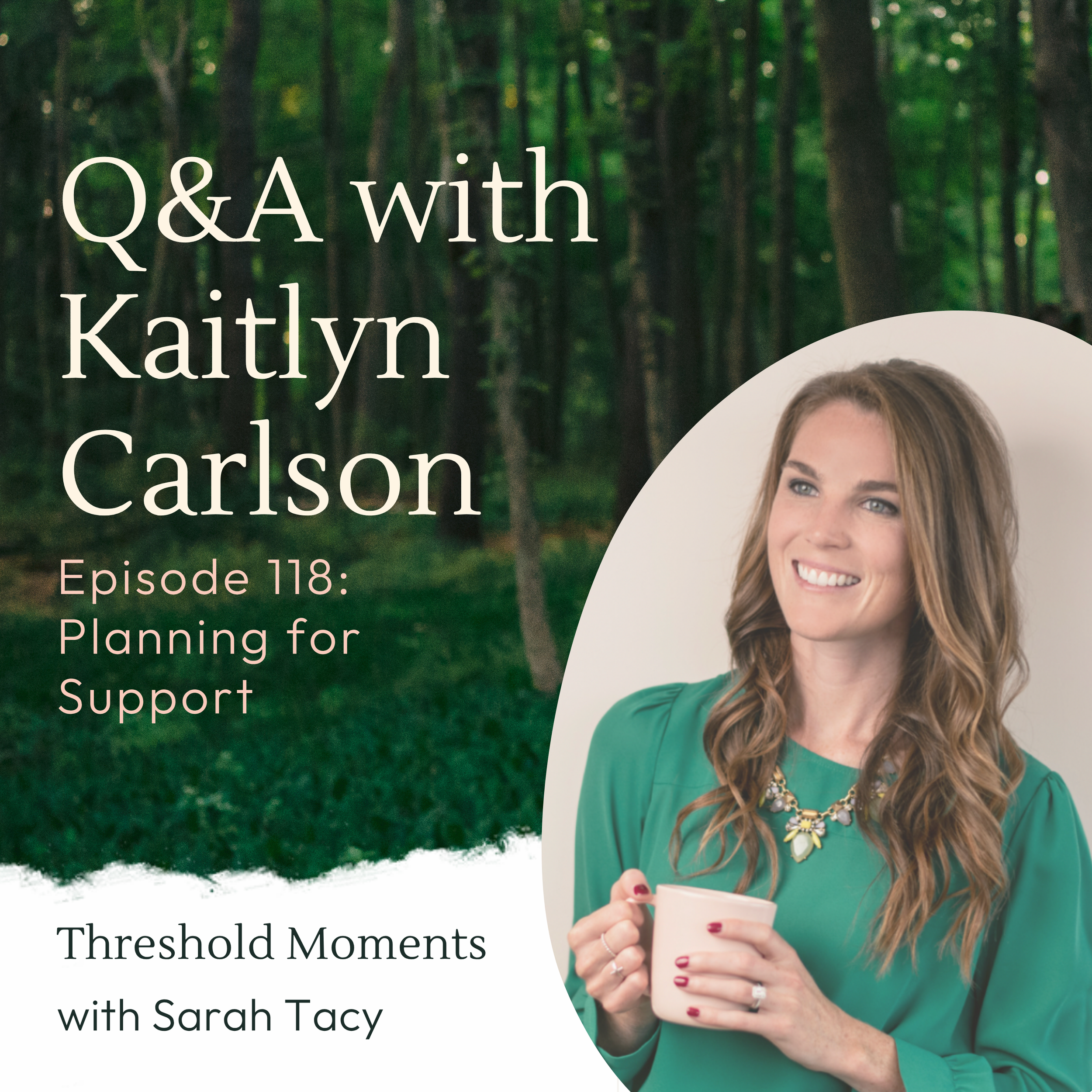
In this special Q&A episode of Threshold Moments, Sarah Tacy is joined by financial strategist Kaitlyn Carlson for an honest, grounded conversation with members of the JUICE community.
Kaitlyn Carlson is the founder of Theory Planning Partners a wealth building firm. She brings experience from advising some of the wealthiest entrepreneurs in America. Kaitlyn’s work blends financial mastery with intuition, action with intention, and strategy with sustainability — offering a grounded, empowering perspective on wealth that benefits both visionary founders and everyday high achievers who want to grow their money wisely and well.
Together, they explore what it really looks like to stand at a personal threshold, the moment where authenticity calls you forward but certainty hasn’t arrived yet.
Through live audience questions, Kaitlyn shares the behind-the-scenes reality of leaving a stable but soul sucking job to build something new. What she would do differently if she were to go back, and what small internal shifts create lasting transformation, and why financial systems, and our relationship to money, may be more expansive than we’ve been taught to believe.
Also can capitalism really be regenerative?
This conversation moves beyond mindset into practical, emotional, and philosophical territory: from trusting inner whispers to redefining capitalism, building sustainable business foundations, and taking the first doable steps toward financial stability (doing something is better than doing nothing!).
If you’ve ever felt the pull toward a new version of yourself but wondered how people actually make the leap, this episode offers both reassurance and real-world guidance.
Episode Transcript:
Sarah Tacy: Welcome to the q and a. We have two members from Juice here, and I just wanna open it up to see if they have any questions for you. And go ahead, Vicky.
Vicky: Hello, Kathleen. I have a question. First of all, thank you for your story, your share. It was so inspirational for me, and my question is about. I really feel that I'm in a threshold of my own [00:03:00] authenticity just to take the leap.
Vicky: And my question is for you is that I really sensed in your story that you took that leap. Like you, you own your authenticity and you were able to step in your next best self. And I would like to ask an advice like, and what would be like this micro inner movement, which could make the difference? Like how did you do that, that you were like, in real time, how could you?
Vicky: I love that.
Kaitlyn Carlson: It's such a great question. It's a great question because looking back, it can be almost like glorified. Like it was this like profound moment and I knew it was all gonna work out and I so didn't,
Sarah Tacy: but
Kaitlyn Carlson: it was scary and I had to [00:04:00] get scrappy, so I walked away. I didn't have a salary. I had to crunch the numbers to see if my husband's salary could support the both of us.
Kaitlyn Carlson: And we were about to bring a child into the world. So it was like Sarah was saying, with the whisper, I had to trust the whispers. If I could go back, I would spend a little bit more time meditating. If I could go back and meditate every morning for 15 minutes, I think I would've gotten even more clarity faster, and I think I would have probably been even more magnetic.
Kaitlyn Carlson: Versus trying to control. My tendency is when I don't meditate, then I'm like, okay, work harder. And that's not always the answer. So it was this balance of, there's a very real component. There's like a, okay, can I do this? Can we live off of one salary? And I have to give my husband credit. He, from day one was like, just build it the right way.
Kaitlyn Carlson: If you build it the right way. [00:05:00] It will take care of itself. And so it was almost like he had more faith in me in the beginning than I had in me. I remember a sales call, like my first year, it was a woman in town and I met with her and her husband and I was like, it was a Friday afternoon. I had been on with them for 90 minutes and I was like, so I can do a financial plan for you.
Kaitlyn Carlson: It's gonna be $2,500, but you don't have to pay it if you don't want to. And my husband was like. That was so brutal. I don't even know what to do with that. So I don't wanna make it seem like I like came out like guns a blazing. It was just this like little bit of growth, little bit of growth, little bit of growth.
Kaitlyn Carlson: But I would say like it always ended up working out. And so now if I could go back to my younger self, I would act from a place of what if it all works out. And that I think would help. Calm my nervous system. So if I were in your shoes, I would meditate 10 to [00:06:00] 15 minutes a day and I would act from the place of it's guaranteed to work out.
Kaitlyn Carlson: So how are you moving through the world? How are you showing up in the world? And if I could just add, thank you. Two other parts to your story to highlight. There's, surround yourself with people who will hold the vision for you when you're unsure if you can hold it yourself. Yeah. The second one was build the foundation. I'll say build the foundation with integrity and then it will work.
Kaitlyn Carlson: Build it to last because. I've seen so many business owners come and go in the six years since I started the business. I actually felt tremendous ease once I built a framework because then it wasn't reliant on me. It was like the framework was what was going to create the transformation. Before that I had a lot of anxiety 'cause I was like, oh my God, I have to show up. It's me. It's, and it wasn't replicable.
Kaitlyn Carlson: The framework really tethered my feet to the ground.
Sarah Tacy: Thank [00:07:00] you, Vicki.
Amna: I loved everything that was shared and I noticed when you said. Capitalism can be regenerative. I felt my body tightened because I don't like capitalism.
Amna: And that made me curious. I'd love to hear more about what that means because I know the answer is usually in the thing, not in a separate place. So I've never thought of it that way, so I'd love to hear more.
Kaitlyn Carlson: Most people think of capitalism like a pie. If I get some, that means you get less.
Kaitlyn Carlson: It's not like that. If you are creating value, the money will show up. So it's actually more like a garden. Jeff Bezos has an amazing shareholder letter where he just talked about if you are creating value, the money will show up. And we live in a fiat currency system. For better or worse, we do. We are not on the gold standard anymore.
Kaitlyn Carlson: Gold standard. There was more, this is my whole existence. I have three kids under five, so I'm totally, with a [00:08:00] fiat currency system, like they can print more money, there is, it's like the universe is constantly expanding, right? Capitalism is the same way. If you wake up and you have an idea and you're creating value, you are creating something that didn't exist.
Kaitlyn Carlson: And that's what capitalism rewards. So if you are enhancing my life by creating a service. Then like you're creating value, and if you're creating enough value, there's going to be a dollar assignment to that value, but it's not a pie. I'm not taking it from Vicki to give to you because I'm also creating a service that's creating value.
Kaitlyn Carlson: And so we have this fiat currency system where like part of the Fed's job is to balance IMF balances like money and circulation. Yeah. And so they're the ones that kind of keep tabs on like, where is inflation, where is unemployment, and like how much money is dispersed in the system?
Kaitlyn Carlson: So it's not finite, it is actually infinite. But people, most people [00:09:00] think of it as finite. If I'm winning, you're losing. That's not how it is though.
Amna: Oh, I love that. I'm gonna sit with that because I thought something was missing with the definition of capitalism. But you're saying it. That framework can work as long as we do it differently and we see it differently.
Kaitlyn Carlson: Yeah. Like I just read this morning, the CEO of Google, his compensation package is he has a base salary of 2 million and he could potentially get shares of like up to 260 million contingent upon him creating value. That's fine because he's creating value. But I guess another question for me would be like, do you need $260 million or can that be allocated in a different fashion?
Amna: Yes.
Kaitlyn Carlson: That's what needs to be rethought.
Amna: Thank you. Thank you for sharing that.
Kaitlyn Carlson: You're welcome.
[00:10:00] [00:11:00] [00:12:00] I wanted to add my own question and the question I have is for listeners who may not have access to a financial strategist or wealth management yet. What are some places they could start if they want to move forward towards more financial stability and freedom?
So do you have any small doable steps that people could take if, we talked in the interview about $50 a week, or maybe it's $10 a week and having that routine, but where does that money go?
Okay, if somebody is just starting out, and I also wanna disclaim this is not investment advice, but general broad brush guidance. I think it's very important to do something rather than do nothing, because when you do something, you start to build credibility with yourself. And investing is more accessible now than [00:13:00] it ever has been.
So somebody can go to Vanguard or Betterment and open up an investment account, and both of those companies offer like very easy ways to get started. If someone's. Just starting out their investing journey, I would probably go with a more aggressive portfolio.
And you could even just start out in the beginning with just US exposure. So to give you an example, like SPY or VTI. I think VTI could be a good one, but again, disclaiming that this is not investment advice, but just general market exposure so people can start to get the hang of their money, making money, and I think that would be a great place to start.
I.
Sarah Tacy: Thank you Caitlin, so much for coming on. Thank you guys so much for coming today.
[00:14:00]