
119 - Elisabeth Kristof: Somatics & Nervous System for Wealth
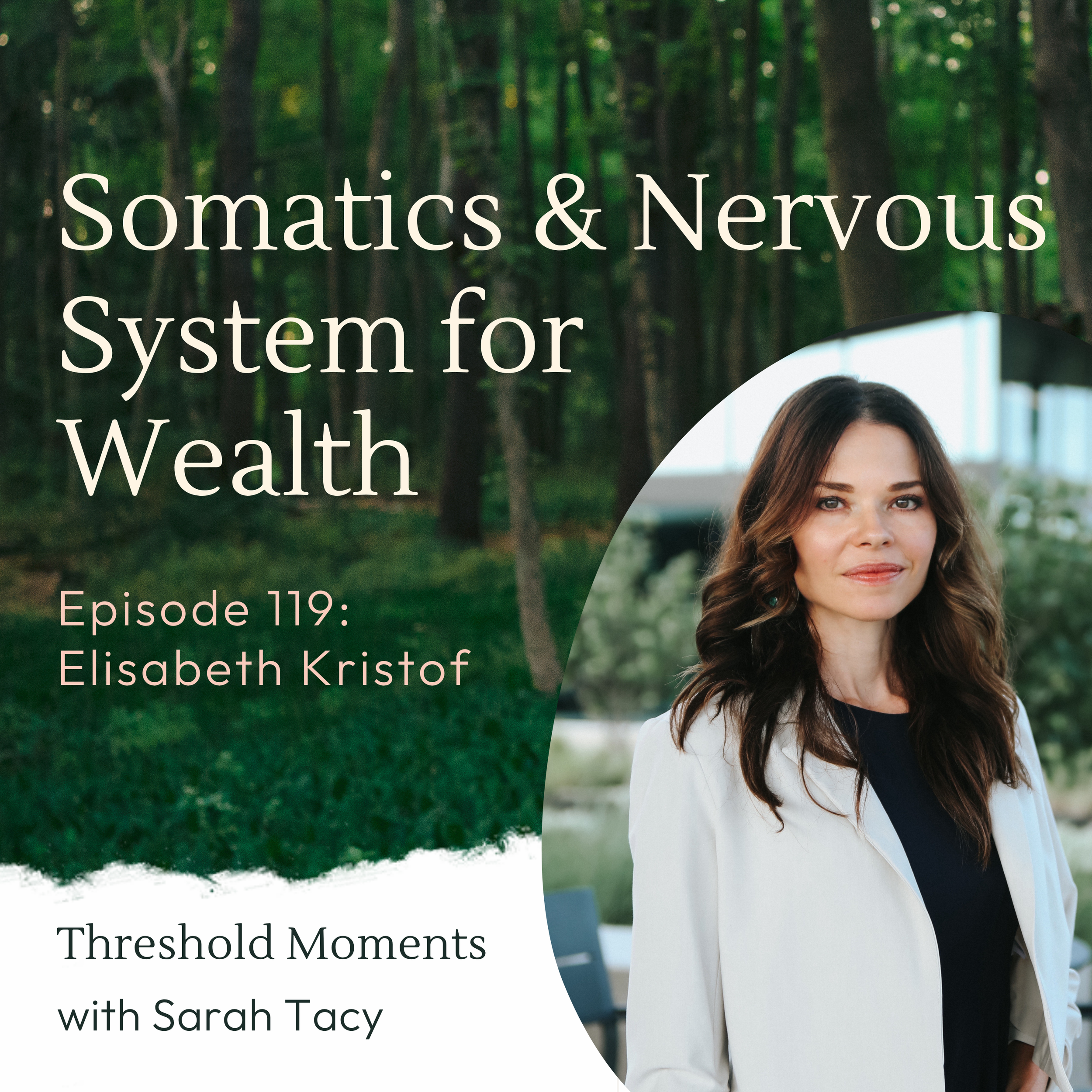
In this episode of Threshold Moments, Sarah Tacy sits down with Elisabeth Kristof, founder of Brain-Based Wellness and Neuro Somatic Intelligence (NSI), and co-host of the podcast Trauma Rewired. Together, they explore the intersection of applied neurology, somatic practices, and nervous system rehabilitation for personal growth and healing.
In this episode, Sarah’s focus on subtle somatic presence and co-regulation meets Elisabeth’s applied neurology tools for practical, everyday nervous system support. They discuss:
How early experiences and adverse childhood events (ACE scores) shape nervous system patterns and lifelong coping mechanisms.
Elisabeth's personal story with early hardship and addiction and how these nervous system practices have brought so much stability and agency into her life.
The journey from high-achievement and perfectionism to deeper nervous system regulation and self-awareness.
Practical tools to “re-pattern” the nervous system, from modulation and resourcing to body mapping and balance training.
The importance of slowing down, allowing for presence, and integrating small, doable practices into daily life.
Stories of transformation, including managing dysregulation, chronic stress, and high activation in everyday life.
How NSI bridges the gap between athletic performance, trauma recovery, and personal growth, creating tools that are actionable, personalized, and sustainable.
Whether you’re interested in somatics, applied neurology, or nervous system wellness, this conversation offers insights for anyone looking to understand their body’s responses, create lasting change, and live more fully in their own nervous system.
EPISODE TRANSCRIPT:
Sarah Tacy: [00:00:00] Welcome to threshold Moments. Today we have with us Elisabeth Kristof and Elisabeth and I don't formally know each other super well yet. But our world beginning, yes, it's just the beginning, but our worlds have overlapped. I first saw you last year at Relax Money, and I saw you from a distance and I understood that your work has had a huge impact on Relax money and really how they do so much of their work in there.
Sarah Tacy: And then this year we were sitting like right next to each other, most of the time at Relax Money. And it wasn't until the end where we're like, hello. And we exchanged numbers and here we are. And I think something that could be really cool today is that you and I both work with bodies and nervous systems and brains and humans, and we have [00:01:00] like same but different, right?
Sarah Tacy: Like they, they feel in some ways so different. And there are these beautiful crossovers that just feel so supportive of one another and. I thought it could be really cool to bring on somebody that's not speaking like my exact same language and having tools that are actually so complimentary. So anybody who was in resource last year I did actually have Carrie Montgomery come on, who is a graduate of your neuro somatic intelligence program.
Sarah Tacy: Come on. And do a 45 minute intro of the nervous system from that perspective and some of those tools. And people loved it. And so I just think it's like, again, it's so complimentary. Elisabeth Kristof is the founder of Brain-Based Wellness and Neuro Somatic Intelligence. Is the co-host of the podcast Trauma Rewired.
Sarah Tacy: I have here that your work lives at the intersection of applied neurology and the way I understand that, so [00:02:00] again, I'm just so excited for you to update me on all of this, how our brain predicts patterns and how we can update those predictions with new input to create new output and trauma and informs somatic practices.
Elisabeth Kristof: . We have so much to talk about and I just wanna say, I'm so happy to be here and I actually got to see you speak at Relaxed Money the year before and recognize how much overlap there is in our work and how complimentary the two ways of looking at things can be.
Elisabeth Kristof: There's a really beautiful I feel the perspective that you have so much of aligning with nature and these ways to come into rhythms and working with somatics in that way. And then there's like the applied neurology part, which is these practical, tangible tools. And a lot of what I've been focusing on is how to integrate applied neurology with these other beautiful somatic practices.
Elisabeth Kristof: So it's really about merging together rather than two different [00:03:00] ways,
Sarah Tacy: yes. And I will say that when I started, so in some ways I feel like I've been studying the nervous system for 20 years, but from a bunch of different lenses. So first it was with professional high school and then college, and then professional athletes and really about like reflexes and overwhelm and underwhelm and, and then more in the yogic form, again, looking at a lot of these same things of what is affecting mind, body, spirit. And then in 2019, looking more from trauma resolution.
Sarah Tacy: Which was a very it was very subtle and very nuanced, and the lens through which I learned could be considered very yin, like a lot less structured form and so much about presence and co-regulation and attuning to very subtle waves.
Sarah Tacy: And then when I would, people would ask me to come on with a group, they'd be like, what are your favorite nervous system [00:04:00] tools? I'm like, oh, that's so interesting. It's such a different lens from where I come. And as I started getting familiar with your work, I was like, oh my gosh, this is what the people wanted.
Sarah Tacy: Not either or again. But it was like, again, that integration of can you give me something now that could help me in this moment? And something that's specific to my body.
Sarah Tacy: Which again, sometimes in bigger groups, that can be hard to find in that moment, but I do think this is a place where your work really shines.
Sarah Tacy: And I think it's what so many people in the world are really looking for right now.
Elisabeth Kristof: It's a nice bridge, to be able to have things that you can use in the moment. That are very practical that you can integrate on a daily basis so that we are then continuing to re-pattern and rehabilitate the nervous system by doing these things continuously so that we have more capacity for some of the deeper somatic work and even the capacity to slow down, right?
Elisabeth Kristof: And to [00:05:00] have these different practices that so many of us, when we're constantly used to living in a state of hypervigilance and hustle and big sympathetic charge all of the time. Taking a practice where you're slowing down and feeling and being present can be pretty overwhelming in the beginning. So can I have these practical tools to rehabilitate all of my different sensory input systems so I have more capacity, I have better skill of modulation, and then I can begin to move into these other ways at a deeper level.
Elisabeth Kristof: Without it being so threatening
Elisabeth Kristof: To my state, there's just more capacity for it.
Sarah Tacy: I remember the first, like the first 10 years of motherhood, maybe it was eight, but how everything slowed down so much. And it did feel like such a threat to my system because I had, I was an athlete, but I also think in society it's can you get things done?
Sarah Tacy: [00:06:00] Who's the most efficient? Can you get it done faster? Can you get it done first? Can you get more done and in less time? And so to really slow down was such a re-patterning of can I even survive here? And as I started working in the containers I was working where everything was so slow, which enabled me to really feel and sense more.
Sarah Tacy: I do know that when I work with bigger groups. People will say a year later, like a year into the program, that was the most important thing, was learning how to slow down how I speak. And it was the hardest thing at the beginning. So some people will write in the comments, I love your voice. I feel so relaxed.
Sarah Tacy: This feels so good. And other people. And this year I brought it like to the forefront. I'm like, some of you may be having a very hard time. And it's actually really not my desire either to [00:07:00] overwhelm anybody with my level of slow. And so tell Darna, a mentor of mine would say, I go slow on purpose, but you can go whatever speed you want.
Sarah Tacy: And so as you listen to me, you could wash dishes, you could go for a walk, you can. Not take this class and you can listen to it double time later. Totally. Just to give options of your system's not wrong, this is how I'm going on purpose. And then is there any way in between where our bodies can meet?
Sarah Tacy: And if not, it doesn't have to. And I did speak to a few people at Relax Money. I was like, whoa, do you think? I was like, I could always start with a more neutral pace. And they're like, no, don't change it. But it is, I am like very aware. I can feel it in my own system and I try to find stability in my own system knowing that when I go slow it can create a variety of experiences and that everybody's body [00:08:00] is responding differently to that piece.
Elisabeth Kristof: Yeah, absolutely. Absolutely. I will agree. For me. Slowing down and having a little bit more of an intentional life, like not just in my speaking cadence, but like slowing my life down is a journey. It's still a journey, and like you, I was an athlete. I've been an athlete and an entrepreneur my whole life and started my first business when I was 24 years old in movement and athletics and pain rehabilitation.
Elisabeth Kristof: That's what really led me to applied neurology. And and I'm a body that carries a high A score, right? And that has, that patterning has been running my whole life as well. And so it really wasn't until 2019 when that whole business fell apart, I went through a huge. Time in my life where the four really fell out underneath me.
Elisabeth Kristof: I was with a partner that was diagnosed with cancer. I went into being a full-time caretaker for him. [00:09:00] I lost my business, I lost my community, I lost all of my money. It was just a one of those times, right? And then all of the unprocessed childhood trauma came back up to the surface that I had no idea was there.
Elisabeth Kristof: And that's when I started really getting into somatics. I had all this background of applied neurology and I'd been using it to help people run faster and jump higher and maybe get out of pain. And I loved neuro. I had gone through a deep education in that, and I was hitting this place where I was seeing all of these protective outputs in my own nervous system that I couldn't neuro tool my way out of.
Elisabeth Kristof: There's a deeper level of stress, relational stress, deep patterning. And so that's when I really got into somatics and had to start slowing the pace down and working on my interception and embodiment. And that was also when I saw there was a beautiful way to bring these worlds together because somatics [00:10:00] was so challenging for me and I really wanted it.
Elisabeth Kristof: I knew that I needed that to be able to create change in the outputs that I was experiencing. And then I had this beautiful framework of applied neurology really rehabilitating the nervous system that could be applied to so much more beyond athletics. And so that was when I started weaving the two together and trying to find a way to support nervous system rehabilitation for healing and personal growth and personal development rather than just athletics.
Sarah Tacy: So I have some questions from there. Yeah. I'm wondering if, for the listeners, if you could describe what an ACE score is and you don't need to name each, is it 10 elements to it,
Elisabeth Kristof: 10 ACE scores,
Sarah Tacy: but maybe just a general feel of what it is.
Elisabeth Kristof: Yeah. A stands for adverse childhood [00:11:00] experience. So it's the things, the way that we look at it in neuro somatics is it's the waters that you're swimming in development that create patterns in your nervous system, adaptive intelligent patterns that are keeping you alive at that time.
Elisabeth Kristof: So it's usually when we're talking about complex trauma, we're looking at these adverse childhood experiences as. Relational wounds. So they have to do with like parents getting a divorce or perhaps sexual abuse or physical abuse or having a parent that is addicted to drugs or in jail. So it's our relationship with our family and the attachment systems that develop and then the patterns that are developed in the nervous system.
Elisabeth Kristof: And there is a lot of research starting in, I think the nineties was when this started getting really big. With Dr. Vincent fti, looking at the more ACE scores you have, the worse health outcomes you have later in life. There's a big correlation between adverse [00:12:00] experiences in childhood and health outcomes later in life.
Elisabeth Kristof: And we can know, looking back at that, it is because of chronic stress and the dis the patterns of dysregulation that live in the nervous system. And then the World Health Organization has a much more comprehensive list. There's a lot that's left out of the ACE questionnaire, like racial trauma or like violence at a societal level.
Elisabeth Kristof: A lot of the big structural systemic traumas are left out of the ACE score. So the World Health Organization one, I think is a little bit more comprehensive, but you can look at those not to put a sentence on yourself it has to be this way because I have this, but to understand that there are.
Elisabeth Kristof: Reasons that we experienced the protective outputs that we do, given the waters that we were swimming in during development.
Sarah Tacy: And in 2019, when you said the floor fell out from underneath you, [00:13:00] is that when you started looking at your childhood and how it was affecting you at that point? And I guess my curiosity right next to that is that along with ACE score and along with, predicted health outcomes, there can also be like likelihood of incarceration and other and I find also that some people who had a lot of challenge early on, there's like a smaller percentage who become super.
Sarah Tacy: Independent and successful. And they, all of those adaptations continue to work for them to become highly successful humans, often in a way that others might not even have the same, what feels like an inherent motivation. And I'm wondering if, as an athlete, and if in your early [00:14:00] life you were feeling more of that,
Elisabeth Kristof: This is, I'm going to, I'm gonna go deep guys here.
Elisabeth Kristof: Yes. And just be really open. I also, I think that underneath most high performers is a pretty high A score. Those, there's inherent gifts that come from our trauma. There's also hyper vigilance and perfectionism and a drive, right? And so I think for a lot of us that would identify as maybe being a high performer, those things service well.
Elisabeth Kristof: And there is also a cost of the stress load underneath and like that inability to rest. And there's gifts from our trauma and there's also opportunities for re-patterning so that we can have a balance between the gifts that it gave us and not at the expense of ourselves. Yeah, I was trucking along, like thinking I was doing pretty well.
Elisabeth Kristof: I was from an early age, I was an addict alcoholic. [00:15:00] And I. I had a pretty turbulent adolescence. There was some, jail time and some institution time. And, but I got sober at an early age. I got sober at the age of 24. And from that point on, it really looked like my life was turning around.
Elisabeth Kristof: I owned a successful business. We had two studios in Austin, a national teacher training program. I was running marathons. I had bought my own house. At the same time, I had a pretty bad eating disorder. My, I would binge eating was also something that I used for regulation and survival all of my life. I can remember binge eating at a very early age.
Elisabeth Kristof: And so that was still happening and I was a real deal workaholic, like I was working myself into the ground. Physically exhausted, would just come home and crash and binge be out for the weekend and then rinse and repeat the next week. And then I fell in love with a man who also had a very high level of complex trauma.
Elisabeth Kristof: [00:16:00] And as we moved in together, a lot of stuff started to come up for both of us because this is a relational wound. Yeah. And then he was diagnosed with a really rare cancer around his heart. He didn't have family there. So I went into being a full-time caretaker for him. And I started trying to really understand why, like, why does this healthy 40-year-old man who doesn't drink and we exercise, why did he get cancer?
Elisabeth Kristof: Why is all of this happening? What about these other outputs that we're both experiencing? And that's when I started reading like the classic books of, waking the Tiger, our Body Keeps the Score. And I was researching for him. But in the books I saw myself.
Elisabeth Kristof: And especially Complex Trauma, complex PTSD, surviving to Thriving by Pete Walker.
Elisabeth Kristof: And I was like oh, and at the same time everything was happening with the business. I was losing the business, some real bad business partnership. There was some financial [00:17:00] stuff going on. So there was all of that stress. The business I'd had the business for 12 years, so it was my community. So I was losing all of that, and I was going through everything with him.
Elisabeth Kristof: And the outputs of my own nervous system started to get really intense. I would black out at times. I would just faint. I was throwing up, I was in chronic pain. I had eczema all over my body. And I just realized. There's more going on underneath here. And then it was like, as soon as I had that thought, it was like the portal in my brain opened and it was like, oh, I remember, yeah, I remember all of this.
Elisabeth Kristof: And I just didn't know my voice is,
Elisabeth Kristof: Giving out a little, talking on this one. And then as I started to look back, so much of my life started to make sense, why I was an addict alcoholic, why I had been binge eating my whole life, why I had self-harmed, the level of dysregulation that I'd [00:18:00] been just pushing my way through the world with, and then that led into a whole long time of working with a lot of different somatic practitioners in many different modalities. Diving deeper into applied neurology, contacting that, being like, is there a way that we can bridge these things together? And it was a lot of deep healing first, and then rolling it out with brain-based for individuals to be like, this is what we're trying here, this is what's really helping me.
Elisabeth Kristof: And then that started to just really grow and expand. And then in 2022 is when I was like, let's see if we can get these tools out to more practitioners. And that was when we started n si. Wow.
Sarah Tacy: Thank you for sharing your story.
Elisabeth Kristof: Yeah, I
Sarah Tacy: think
Elisabeth Kristof: it's happy for asking.
Sarah Tacy: Yeah. I think it's really helpful for people who are listening to really get a [00:19:00] feel for the road, because I think sometimes when somatics or nervous system work is presented, it can feel like there's this perfect other side or perhaps that this is how you've always been, or, and to really get to hear that you have had such a full life and that you've experienced so much and that these tools have helped you come home to yourself and also released the parts of yourself that possibly you didn't see.
Sarah Tacy: Were under the wiring. And so I just really think that when you share what is true, I think it can be really inspirational.
Elisabeth Kristof: Yeah.
Sarah Tacy: For others who are really like processing and when we, even the phrase like coming out sideways, right? It's like this idea that they like the way that we act and the way that we perceive the world.
Sarah Tacy: We may have one idea about why we're doing it, but it's often coming out sideways. Like it's not actually the root. [00:20:00] Yeah. And to have then put together a program, as I was, I told you at the beginning of the recording that I was listening to a training that you put on. And when I listened to Neuro Somatic Intelligence and the program you put together, it feels like it's been around for 15 years.
Sarah Tacy: It doesn't feel like, oh, this is something she's just put together. Which obviously, as you're saying, you've been doing the applied neuroscience for a long time and you went really deep with the body work, and you do have so much experience and your program really feels that way. And the way that you talk about it is I'm just like, oh, it feels so steady.
Sarah Tacy: And so it's really amazing that you are, that you're able to create something so steady and something so useful.
Elisabeth Kristof: Oh, thank you for that. And I will say like it rests on the framework of Applied Neurology, which is not me. I did not create Applied Neurology. That was Dr. Cobb. [00:21:00] Both Matt and I are Z Health certified, and that's where I did a big bulk of my education.
Elisabeth Kristof: And Matt was my teacher in Z Health for many years. Matt's wife was the co-founder of Z Health and he worked as their lead instructor for over a decade. So he has a lot of experience teaching Applied neurology. Just Z Health is very geared toward athletic performance. It's a very like masculine, linear, totally performance in athletics based framework and model.
Elisabeth Kristof: And there had to be some kind of way for me, it just didn't, it wasn't important to me anymore. What was important to me was people, like you said, being able to come home to their bodies. And I had been teaching mindful movement and Pilates and training for, again, over a decade, and had been doing that the entire [00:22:00] time, living in a really big state of dissociation.
Elisabeth Kristof: And it was really scary to start to come back and inhabit my body again, to feel sensations. There were big outputs. Like I said, I would get a rash all over my body. I would immediately get nauseous and throw up. I would I just, every time I went into a somatic therapy session, I would leave in an emotional flashback for a week or two.
Sarah Tacy: Wow.
Elisabeth Kristof: Feeling the feelings that I had felt in adolescence and being like, I don't understand. Like I'm here, I'm like a 39-year-old woman. Why am I experiencing all of this so intensely? And. I wanted to be able to use the tools to support people in being able to come into their body in being able to do the somatic work and having ways to calibrate it for their unique nervous system so that it would be possible without the big protective outputs, without the intense [00:23:00] emotional flashbacks.
Elisabeth Kristof: So it's really meant to marry with these things to, to make it more possible.
Sarah Tacy: Yeah, and I really get that. Even with speaking to Carrie Montgomery and I'd say what she shared publicly too, just those, what my teacher, Bridget Vixens would say, small doable pieces over time. I think your program really highlights that in a way that people can find out like, what is my small doable piece?
Sarah Tacy: Like it's a phrase, but then being able to find specifically what is my small, doable piece? There's a phrase that you keep using output and I'm wondering if you could clarify that for listeners too.
Elisabeth Kristof: Yeah. In N si and in applied neurology, we look at everything. We break the nervous system down into a very overly simplified but useful model, which is that we use our nervous system to take in information about the world.
Elisabeth Kristof: Those are our inputs and that comes in through our sensory systems, like my eyes, the balance system in my inner ear, my body mapping system, my interceptive system, the system inside that [00:24:00] tells my brain what's going on inside of my body. Internal perception. And then my brain takes all of that information through my sensory inputs and it integrates it and interprets it, and it makes a decision.
Elisabeth Kristof: And the biggest, most important piece of that decision is safe or unsafe, right? Safe, socially, emotionally, or physically. And then we generate an output. So the model is input, interpretation, output, and the outputs are everything that we experience, right? It's my range of motion, it's how I breathe. It's my speech, my vocal tone, but it's also my behavior.
Elisabeth Kristof: It's any of the patterns that I go into. And so when I can start to look at that from that model. I can start to see everything in my life as an output. I'm going into a binge that's an output. I am having a moment of panic and anxiety. Those are physiological changes that are the output. I'm getting a migraine.
Elisabeth Kristof: That's the protective output. And so [00:25:00] instead of trying to just change the output, what we're doing is going back over here. What are the inputs? How is my nervous system taking in information about the world that is creating that interpretation that's leading to this output? So can I start to change the inputs to create more prediction, more safety, more state change in the nervous system for that interpretation part, and then let that organically lead to a new output instead of cognitively trying to push my way into a different way of being.
Sarah Tacy: Are there any either in yourself or case studies that where you can share the process that someone's been through where. If they were having, say it's migraines or an inability to sleep and then they do this program and just how, yeah. Would you be able to give us a
Elisabeth Kristof: Yeah. Yeah. So we have many of between brain-based and NSI.
Elisabeth Kristof: There's many people. Those are some of the biggest things, like chronic pain, migraine, [00:26:00] insomnia, and so when someone comes in to work with this work, it's really important to follow a sequence. Yes, we give a lot of tools and that's. Great. And it's nice to have tools in the moment. That's the best place to start.
Elisabeth Kristof: But it is important to have a daily training practice and to do that in a sequenced order. So there's some intentionality behind it. So first we're like rehabilitating the nervous systems skill of modulation, right? Being able to be activated or maybe be shut down and come back up to baseline from that.
Elisabeth Kristof: And that's a skill that many of our nervous systems didn't learn. Initially. So we work on rehabilitating that through finding high payoff tools for someone. They practice that for a while. And then we work on resourcing the nervous system through fueling and respiration and, minimum effective dose interceptive training so that you can hear your own needs so that we're making sure that someone has capacity to train their [00:27:00] higher order systems like vision and balance.
Elisabeth Kristof: And so there's a lot of time spent in that part of really resourcing the nervous system and creating capacity. And then we go into training the visual system, the balance system, the body mapping system. And so many people will just get through the first two parts of the framework before they even begin training their visual and balance system.
Elisabeth Kristof: But once they have a more resource to nervous system, and once they've learned the skill of modulation. I've developed a wind down practice. At the end of the day, I'm working with my system and now I can sleep. Or I have tools to use in those moments of dysregulation where I would normally reach for substance or food or my phone and social media scroll.
Elisabeth Kristof: And now I have other tools. And so that's enough to interrupt the behavior and just re-pattern that over time.
Sarah Tacy: When I first spoke to you [00:28:00] this past year, so just a few months ago, I was telling you that through Peter Levine and Bridget Vixens, there's a map that I love called the Three Directions Map.
Sarah Tacy: And if the vertical line represents how activated our system is and the horizontal line being. Time, and I say that very loosely because something could happen in a lifetime, two lifetimes or one second would be that as the line starts rising. So if you think like a rainbow and the line starts going up and the activation starts happening, that generally the way we come back down is through soothing or distracting.
Sarah Tacy: And what I love about the work in alchemical alignment is that it really desham so much of it, which I think you do in your work as well, which is to say, I'm thinking about a time I was working with a woman who had shared her story on here and she was in the [00:29:00] absolute, darkest days of her life and researching Can I die of of a broken heart, right?
Sarah Tacy: To say, eat food, drink water, and go for a walk. Like that would be too much. And so she reached for maybe two cigarettes a day and it was lifesaving, right? And so it's wow, that was lifesaving. And then over time, as she became more resourced, those changes, like those decisions also changed.
Sarah Tacy: And what I love about the first direction of this three direction map is that it could de shame the things that we might be like those aren't good ways to soothe the distract and just say oh, they're all lifesaving. And over time as we become more resourced, maybe more skilled, although I imagine even the most skilled practitioner can get thrown into depths of life that feel so disorienting that it's hard to reach for the quote unquote healthy tools.
Sarah Tacy: But I also think that so many of the [00:30:00] tools that you offer can be a way that as activation is starting, we can come back to ourselves in a way that we might not have to pay for a side effect later, right? Like a negative side effect. And so it's oh, I get to come back to myself and I don't have to pay for it later in any way.
Sarah Tacy: And Glennon Doyle in one of her first books, talks about this God-sized hole that we all have in our hearts and the different ways we try to fill it. And that there are some things that we do that will make that hole feel better for a moment. But if later that day or the next day the hole feels bigger, that would be a good indicator that might not be a good long-term strategy.
Sarah Tacy: Yeah. And. This place feels so important. The next place is the one that Bridgette added, which is the looping and the double [00:31:00] binds, where it's like the activation has happened. And we might be beyond being able to reach for tools like maybe it happened so fast, like we meant to go in slowly. We meant to go in resourced or something happened and we didn't predict it was gonna happen.
Sarah Tacy: And in that place we can hear all or nothing thinking like, clearly I'm no good at this, or I'm gonna have to do this forever, and this or that, right? And I find again, it's not all that different. Like those tools from the first place, small doable steps over time may be the way out co-regulation.
Sarah Tacy: And sometimes it's just like letting the system runs and then it comes down.
Elisabeth Kristof: Yes, I 100% agree with that. There's never gonna be a time in my life where I don't sometimes hit a peak dysregulation, right? We live in a dysregulating world and I am in a body that carries an A score of eight.
Elisabeth Kristof: So like I can do all of this stuff with my nervous system and there will be [00:32:00] times where dysregulation happens. And if I'm setting myself up to think that's not, that's wild. And I need to understand that like my system is intelligent and it knows what to do, and it's running these predictive patterns.
Elisabeth Kristof: And I truly believe, like you were saying too, about the woman smoking two cigarettes a day. I believe binge eating saved my life. I could not regulate my own system. I was a little kid under a tremendous amount of stress, and I found food as a way to help me come out of an activated state so that I wasn't under the chronic stress all of the time.
Elisabeth Kristof: It gave me a break. It helped me rest and recover. And like you're saying, after the aftermath can be tough, but it served its purpose and it kept me alive, and then I can begin to gradually work with it so that I have new. Tools or offerings for my nervous system to give it what it needs in those moments.
Elisabeth Kristof: So I don't always have [00:33:00] to reach for the same thing, but if I do sometimes reach for the same old coping mechanism, that's okay. That's a well-worn path. And it's, there will be times where I tank myself and it happens, and just that grace of this is an output of my system doing what it's learned to do to keep me alive.
Elisabeth Kristof: To a certain extent, it worked, and it's really not the end of the world if someone has a cigarette or eats too much chocolate or, takes a drink. Like I, there's some grace in that,
Sarah Tacy: yeah. There are a few times where I reach for something food wise and I'm like, do I, does my body really want this or am I bored?
Sarah Tacy: Does my, and every now and then I'll go oh, it's bored, or, oh, it's anxious, and I'm like. I'm gonna have it, oh, I could do a nervous system tool, or I could have this piece of chocolate. Yeah. And and I know that's not even the full point that you're getting to for me, falling more in the realm of like high performance and perfectionism, the wanting to [00:34:00] get it right.
Sarah Tacy: And if I teach it, wanting to always be able to live into it and oh my gosh, I'm feeling the dysregulation and I shouldn't this or that. And it's helpful for me to remind myself that dysregulation is such a beautiful, I know it doesn't generally feel good, but it is such a beautiful redirect.
Sarah Tacy: Like I sometimes say that the body is a no B-S-G-P-S, which I know in so many circumstances we could say that's not always true because of the wiring that like, but it, at some point I feel like it is gonna redirect us. And if we're not getting redirected. If we're not having things that really challenge our perception of what is real, which means that something has to die.
Sarah Tacy: If we are getting challenged with that perception, it only makes sense that we would have those waves. Yes. And so again, with this map, it's not don't do one, two, or three. It's just these are all a part of it. Yeah. And the third direction is, [00:35:00] I call it creating conditions. I'm like, is that what they call it?
Sarah Tacy: The idea is that at the end, if as you build the tools and as you build the conditions to stay with the activation and it doesn't either put you into collapse or hyper, that oftentimes we can ride a pattern to completion. And again, it could be a lifetime and it could be a single event. And as you.
Sarah Tacy: I think you would agree. Kate Northrop was on the other day telling a story about how something shifted in her in 25 minutes. And and it's and I said yes, and the thousands of reps before that, that allow you to be in that scenario and be present and be embodied and have the pattern become extinct.
Elisabeth Kristof: Yes.
Sarah Tacy: And often when it's extinct, it's wait, who? I don't even remember that. You don't have to use a tool. The same thing happens and you don't even have to like, [00:36:00] use a tool, which is so cool.
Elisabeth Kristof: That's right.
Sarah Tacy: And the part I love about the creating conditions, and I think it is probably, I think it is a part that I want the most, whatever that says about me it's co-regulation, boundary repair, right distance, right relationship I'm hearing the word right a lot here. But it is like really the internal and external environment that we create so that when we are doing whatever we do in phase one, if over time we use that. So in Kate's program, it's like she uses it to help.
Sarah Tacy: She asks people like, use this before you do your money work, and then again at the end so that the conditions change, the relationship to the thing that triggered you changes because the environment that you're creating through the relationships you have, having the conversations like being able to stay with a hard conversation or, for me, I'm just noticing [00:37:00] when my husband and I are having to make a lot of decisions about a project we're both working on and there are moments where I notice I'm not processing at all.
Sarah Tacy: So just, like being able to come back and self-soothe a little bit and then feel myself re-engage. I'm like, wow, these practices are so helpful at living into the life that I wanna live about. Being able to stay with the things that otherwise I might either not even notice exist or just decide that's not for me.
Sarah Tacy: Or just give up early or put it off. And it's been really fun to just and I don't, it's not even, I don't wanna say it's even enjoyable, but to, it feels like really adulting. Yeah. To really be able to like, to actually have a boundary to what I noticed in my nervous system work originally, which was different than my 15 years of yoga, where I could name every bone, every muscle, every was like, [00:38:00] oh, I have the tiniest sense of a desire and.
Sarah Tacy: I can feel in my body that I exist and then building the skills to be able to name the sensation.
Sarah Tacy: Name the desire and speak from naming my sensations and desires was so profound, even though I couldn't predict how others would respond.
Sarah Tacy: That coming into existence and mattering and noticing is life altering.
Elisabeth Kristof: I completely agree. It's it's beautifully said and I think. The point for me is presence, right? Is I want to live a present life. I want to be in the moments where, yeah, maybe I am activated, but can I be activated and stay in my body and be present for [00:39:00] that? Can I have a difficult conversation?
Elisabeth Kristof: Can I set a boundary? Can I do the things without self abandoning? With staying attuned to myself through these, like you were talking about all the reps that came before. These moments of self attunement and expression that I practice regularly so that when I'm in the moment, I can stay attuned to myself and be attuned to someone else and be attuned to my external environment, and I'm like, here.
Elisabeth Kristof: In the world doing the thing. And that is really what nervous system work has given me. It's not a flat line life where I'm calm and regulated all of the time. And I also wanna make sure people never think the tools are to regulate ourself out of an emotional experience. It's not that I'm feeling an emotion and I want it to go away, so I use my tool.
Elisabeth Kristof: It's to create capacity to feel and to mobilize the emotion, right? [00:40:00] To keep that skill restored in the body that we all inherently have. And so it's just a practice of working with my nervous system over time and my brain and my body to, to be able to stay a present being. As I move through all of it and be with what is, and then, yeah, sometimes I can go into something and I like, wow, I reacted really differently in this situation.
Elisabeth Kristof: Or this is something that would've led to that output before. And it didn't. And that's really neat to see is my capacity builds. But what is most exciting is, like the other day I was having a fight with my partner. I'm in a new partnership now. We've been together for a while, but, we fight sometimes still.
Elisabeth Kristof: And most of the time in my past if that happened with conflict, I would just check out, leave the room. And this time I was activated and using my voice, but I was like, so there and still [00:41:00] present with him and in the argument, but fully present. And that was like a huge win.
Sarah Tacy: That's incredible.
Sarah Tacy: I. This is a practice for me. My husband has a higher level intensity than I do, and I have always been known to be so calm. And what I realized, a couple years ago I was like, oh, I might be frozen. Like high intensity comes and it might actually not be calm. It might actually just be like, I can freeze through this and breathe and stay calm.
Sarah Tacy: But actually the process of like really being present and finding internal safety and being able to use my voice is still something that continues to come online. But I just think that is such a high skill because there's like being in the argument and you lose yourself and you say things that you don't really mean, and there could be screaming and that's why the that might be like, oh, those people might wanna be calm and other people might go into [00:42:00] freeze.
Sarah Tacy: And so again, it's all intelligent. And to get, to have an experience where you might be like it's not like I'm aiming to be in fights, but if I'm in a conflict, I actually think conflict resolution, especially as I'm like being a mother to two young girls right now wow, what a high life skill.
Sarah Tacy: Because the more projects that you engage in, in work in life, the more you wanna be a part of a community. I think the reason why community is so separated right now is because as we've, as a society had enough finances to, it's the way society is set up, but sometimes it's easier to pay somebody to help with something if you have that ability than it is to work on a relationship with your parents.
Sarah Tacy: I'm thinking about like childcare. And so yeah, I just, conflict resolution is. I think a skill that is like most needed in on [00:43:00] this planet right now.
Elisabeth Kristof: I agree 100%. I think there is so much division right now. Maybe there always has been. Historically. I know the roots of this country, especially if we're talking about here in the United States, are built on a lot of divide and not great things, but I feel like right now it's very acute and you see so much divide.
Elisabeth Kristof: And it is, I think really important that we do the individual work to be able to regulate and stay present through conflict, to stay open, to stay connected, because that is. We are meant to be connected beings. We are connected. We are one big nervous system. We're always in communication with each other, through each other's nervous systems.
Elisabeth Kristof: And I really think if we want to have this opportunity that I also think exists right now, that people are talking about in the [00:44:00] world to create something new, that there has to be a way to, to be present and open with one another in difficult conversations. Yeah. Yeah. I just think it's very important for this time.
Sarah Tacy: Yeah. I love when I hear a thread weave through three different conversations. And so in the last, this Friday, Monday and Tuesday, I've been recording podcasts and each person is bringing forth the work of creating collective change and birthing. Hopefully dreaming into a more beautiful world, a different system.
Sarah Tacy: And I often would say this is where we're looking for the sacred third, not the either or. And as we are looking for a sacred third, it often means, oh, if I were to use your system, like possibly regulate to the next right step regulate it's like it's a new reality that we have [00:45:00] to live into, that the maps may be there from some ancestral patterns from indigenous wisdoms.
Sarah Tacy: And it is something to me that it seems like we need to live into step by step.
Elisabeth Kristof: Yeah. So many of us have been so disconnected from that ancestral wisdom, and we live in a world that is very not conducive to nervous system health. Yeah. The screens, how close things are to our field of vision all of the time.
Elisabeth Kristof: The amount of natural light we get, the amount of movement, the amount of in-person connection. And so there really is a need to rehabilitate some of this to be able to reconnect to those inherent practices that that our body probably knows. And it is like that. It's, I want to show up to have big, important conversations.
Elisabeth Kristof: I want to. Run this business in a different way. I want to be present with my partner. So it is [00:46:00] before the difficult conversations or weaving in throughout the day. These moments of working with my nervous system, discharging the stress, creating capacity so that I'm just continuously able resourced and able to show up, present and then move through whatever is coming up without getting held in that state.
Elisabeth Kristof: And then you just keep doing it.
Elisabeth Kristof: And then next action. Next action. Next action.
Sarah Tacy: There's a part of me that's wondering if you'd be willing to walk us through one or two of these practices, and before before that, I am thinking about. A poem called Desa Ada that my great aunt used to have on her wall.
Sarah Tacy: And I just found it tucked behind my filing cabinet today, and it's all tattered. And this was the poem that she read. She was hit by a car when she was 19 and it was around World War ii and she was writing to a lot of the soldiers. And when they came back she was not supposed to live more [00:47:00] than three weeks and then three months they introduced her to the new technology that was there for paraplegics and she ended up living another 50 years after that.
Sarah Tacy: And she was such an, an inspiration to all of us. And my understanding is that she read this every day. There is one part in it, like I could go out to the kitchen and pull, pull it up. I'm trying to flatten it out right now where it essentially says to. Practice your practices while you're well, so that when hard times hit, because they will, your system is more buffered and resilient.
Sarah Tacy: Of course, because it's in poem form, it's so much more beautiful than that. But I just always remember as part of and I notice even the other day I was really not feeling well and suddenly I was juicing vegetables. And sometimes when things are hard, the practices increase more. But also, as you were saying, to have any, I would imagine like any type of daily practice where you say, oh, these are the tools that [00:48:00] work for me and I'm not gonna wait until I'm dysregulated necessarily, but also have the practice before that.
Elisabeth Kristof: The daily practice is so important because again, like you're saying like in those peak moments, we may not reach for a tool, sometimes you're like, oh, I'm, it's we're in it. And the way that applied neurology and neuro somatics works is it really is about training the systems. So it's like a rehabilitation program for these systems.
Elisabeth Kristof: And so you need novel input. You need to build in time at your right dose. It's about learning to become the expert of your own nervous system, but continuously expanding that toolkit. And so it is. It's really important for me that people understand it's not gonna be a one and done. Like I can give you a tool and that is helpful in these moments to use.
Elisabeth Kristof: But if we wanna really increase capacity, it does take working with the system daily. We call it like a nervous system hygiene practice. Like the way you brush your teeth or [00:49:00] take a shower. You have to keep doing it in order to, maintain the health of your nervous system. It doesn't have to be long, it can be five minutes, 10 minutes.
Elisabeth Kristof: And that really is to why we created the membership site on brain-based is because I was like, people need to have a space to have these practices and to not have to worry about the sequencing or how to progress it for themselves. And they can just come and have this rehabilitation system. So it is.
Elisabeth Kristof: I don't wanna over promise people what you can do with just a few tools, because it is about cultivating a practice of rehabilitating the nervous system that really creates lasting change so that we aren't as likely to go into those big peak moments where we can't regulate out of, because we're taking in information differently about the world and we have more room in our bucket to handle stress without getting pushed into those peak states of shutdown or overactivation.
Sarah Tacy: Beautiful. I love that. Do you, I know [00:50:00] because it's unique to each system that this might not, but be ideal. Would you be open to teaching a tool or two or does that feel Yeah. Yeah. Out work?
Elisabeth Kristof: Yeah, we can do, let's do it. Okay. We'll just make sure to assess and reassess first. Great. So that people can understand.
Elisabeth Kristof: So when we're working with the nervous system, the most important thing to remember is the n equals one. So every nervous system is unique and different, and how you respond to a tool could be totally different than how I do. And so we always wanna assess and reassess so that we know that we're choosing something to do that is moving us in the direction that we want and not just continuing to do something because we like saw it on Instagram while I do this for my nervous system, but it's not really working.
Elisabeth Kristof: So we'll use range of motion for an assessment. So I'm just gonna have you bring your elbow up to about shoulder height, one hand on your collarbone so that you know your shoulder blade isn't moving. And then we're just gonna internally rotate the arm a little bit and notice what our [00:51:00] range of motion is.
Elisabeth Kristof: So we're just getting a snapshot of how our nervous system is doing. Range of motion is letting us know. We'll look for a change in range of motion to see how the tool affected us, but know that's indicative of a whole state change, so it's, it looks like more movement, but it's also a change in our state.
Elisabeth Kristof: And then we'll do a tool.
Sarah Tacy: Can I add one thing? Yeah. So just for our listeners, because you don't have a visual we're putting our arm up. It's 90 degrees at the armpit and 90 degrees at the elbow with the fingers facing up. So I imagine as a half of a cactus arm and that internal rotation would then have it be that the elbow still stays in line with the shoulder, and then at the end, the fingers are gonna be pointing more out or down towards the ground.
Sarah Tacy: Does that. Makes sense,
Elisabeth Kristof: like a goalpost or a cactus arm. Perfect. And then you rotate down toward the floor and try not to move your collarbone or shoulder blade and just notice what the range is. Perfect. [00:52:00] And if that is too much for somebody, if that hurts your shoulder, you have any kind of limitation there.
Elisabeth Kristof: We don't ever wanna move into pain. You could also just test your cervical range of motion. So just turn your head side to side and notice what your eyes are looking at so that we make it as measurable as possible. And then I'm gonna do a tongue tool, tongue stimulus tool. So we're gonna do some tongue circles.
Elisabeth Kristof: This is gonna activate some of our cranial nerves. It boosts interceptive stimulus a little bit, and it's usually pretty positive for most people. So I'm starting out with a pretty gentle tool. So we're gonna take your tongue, over your teeth and under your lips and make some big slow circle. I'm keeping my mouth closed, but my jaw is relaxed.
Elisabeth Kristof: And I want you to think about touching a further back molar each time. And can you feel the sensations of your tongue on your teeth? [00:53:00] See if you can feel a stretch. And then let's go the other direction. Five circles in the other direction. Over the teeth, under the lips. Lips are closed, but draw is soft.
Elisabeth Kristof: Reaching a little further back with each rotation
Elisabeth Kristof: and then relax. Take a breath in, take a nice long, so exhale, give the nervous system a beat to adapt, and then you can reassess with your shoulder, internal rotation or with your cervical rotation. Turning your head side to side and noticing. If anything shifted. So it's just a little piece of stimulus working with some of our cranial nerves.
Elisabeth Kristof: But if you notice any shift, even if it's really small, if you got more range of motion that's indicative of that, this is some stimulus that my nervous system responds well to. And [00:54:00] even a little change in range of motion is a positive adaptation in your nervous system. So you can know that this is a tool that would be good to do maybe before you wanna have a hard conversation, or maybe before you wanna go into a somatic practice to help boost some interceptive signaling so that you can feel more of what's going on in your body.
Elisabeth Kristof: If you got a negative response, no big deal. Don't stress out about it. We're just gathering information. We're just being curious and learning about your system. And maybe just shake that out a little, make some noise, shake the arms out, process a little bit of the stress, and know that there are so many different tools for working with so many different input systems.
Elisabeth Kristof: And it's really about the process of learning, which is right for you. Where does your nervous system have some deficits? Where does it need rehabilitation? Where does it get stimulus that it likes? And so it's a process. We're just gathering information and being curious.
Sarah Tacy: I love that. Thank you so much.
Sarah Tacy: Yeah. I just, I'm, I [00:55:00] have the same oh, I could talk to you forever, but I am also aware of the time. And yeah. I wanna thank you for your time with us. We're gonna go into q and a next, but just to close out this portion, I wanna thank you for your time with us for the stories that you've shared for your generosity.
Sarah Tacy: Thank you for your presence. And I also wanna hear that in your in your training that I took this morning, I really heard that element of presence coming up again and again. And so I really love the way that you are weaving various worlds together for the health of self, but also how we can be present with others and how much that.
Sarah Tacy: Affects us as community. So I'm so thankful for the work that you're doing and I love that you're doing it through a certificate so that people can really bring it into their work, whether they're coaches or they're leading other trainings. And again, as I've mentioned that, I know that Kate's used it in relaxed money, and so she reaches thousands of people, which [00:56:00] then your work reaches thousands of people.
Sarah Tacy: And I know you have many other people who are using this work. And it's just really cool to create something so profound and healing in the world. So thank
Elisabeth Kristof: you. Thank you so much for that. And thank you for the opportunity to be here and talk to you. And I'm equally grateful to you for your work and of the way that it is.
Elisabeth Kristof: I feel like we're all holding up the same mission of, presence and connection and helping people understand themselves in a different way that allows for. Compassion and growth and connection, so thank you for that.
Sarah Tacy: Thank you.