
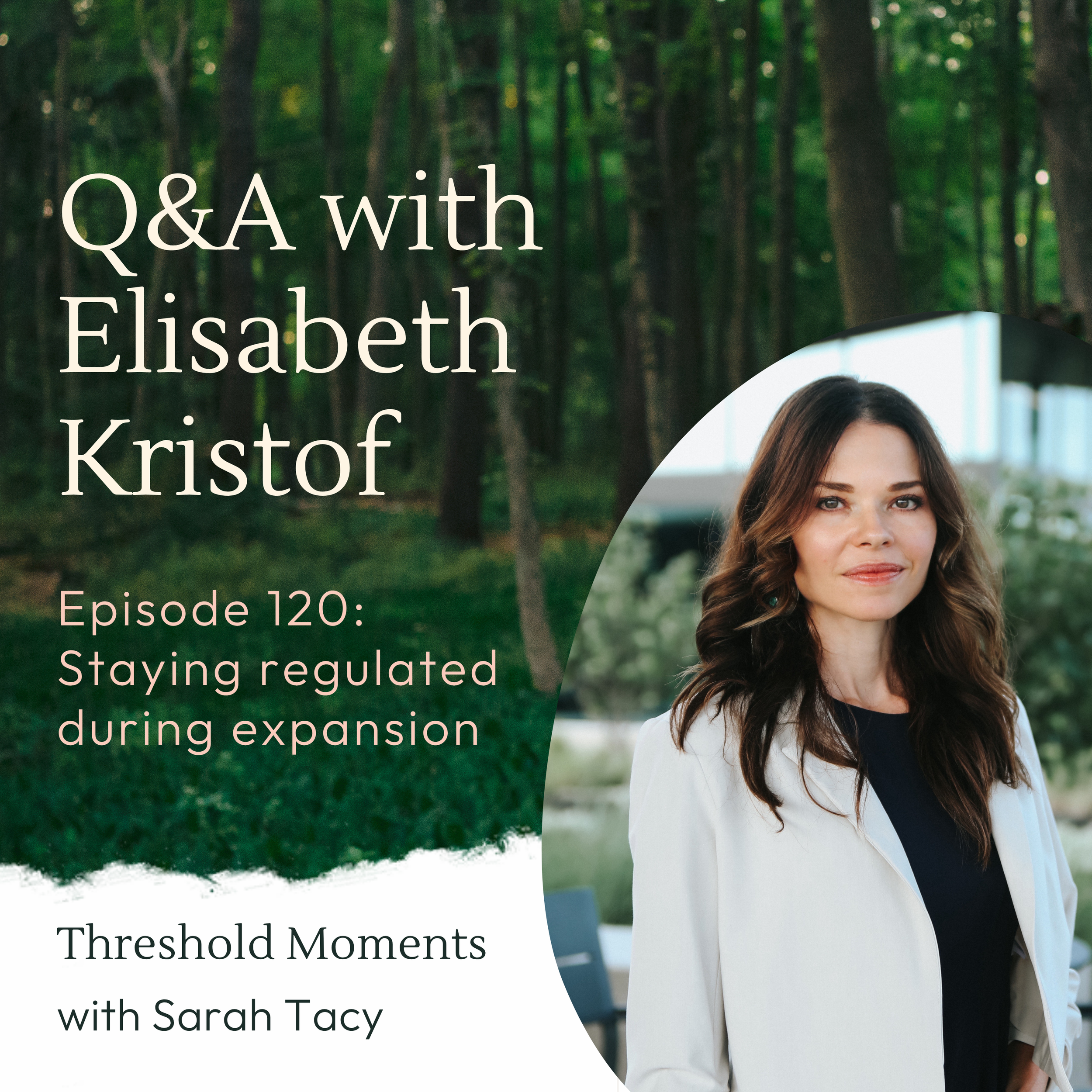
What happens when you are no longer in crisis, but you are not yet fully yourself?
Most nervous system conversations start at the bottom — trauma, shutdown, survival mode. This one starts in the middle. That in-between place where you have done real work, you can see the progress, and somehow it still feels harder than you thought it would by now.
In this episode I sat down live with my Juice members (a nervous system reset- movement membership) for a Q&A conversation with Elisabeth Kristof. She is the founder of Neurosomatic Intelligence, co-host of the Apple Top 100 podcast Trauma Rewired, and one of the leading voices applying neurology to complex trauma resolution. Elisabeth has been working in neuro and movement based therapies since 2007, and what she brings to this conversation is both the science and the lived humanity of it.
We go into what it actually looks like to heal in real time. The burnout. The rebuilding. The cycles of expansion and contraction that nobody warns you about. The difference between regulating your emotions and suppressing them. And why resourcing sometimes opens the door to more feeling, not less.
If you have ever wondered why this work takes as long as it does, this conversation will make you feel less alone in that question, and more oriented inside the process.
Together, we explore what it actually looks like to live this work in real time, moving beyond theory into the lived, messy, human experience of nervous system healing.
This conversation weaves science and story, physiology and poetry, as we explore:
What it means to feel “stuck in the middle” — not in crisis, but not fully thriving and how nervous system can really help for performance not just trauma resolution
The reality of burnout, depletion, and rebuilding capacity over time
Why healing isn’t linear (and often includes cycles of expansion and contraction)
The difference between emotional regulation and emotional suppression
What it looks like to begin this work with curiosity and self-compassion
Why resourcing can sometimes open the door to more feeling—not less
How to stay with yourself through intensity, discomfort, and the unknown
You’ll hear powerful reflections on liminal space, rehabilitation, and the slow return to aliveness—along with an honest look at how long this work can take, and why that’s not a failure, but part of the process.
Episode Transcript:
Sarah Tacy: [00:00:00] Welcome to Threshold Moments. We have the follow up q and a with members who are in juice, which is a monthly membership that we do, so that we can have these nervous system practices woven in weekly. And we have with us today, Elisabeth Kristof, who was our previous podcast guest. Please go back and listen.
Sarah Tacy: She is the founder of Neuro Somatic Intelligence, and we have. A few lovely women here who have been listening in and we're gonna open up the floor for any questions. Oh, welcome, Elisabeth and everybody else here.
Elisabeth Kristof: Thank you. Thanks for having me. And thanks to all of you for listening and engaging. So I'm excited for the questions.
Guest: Hi Elisabeth. Thank you. Sarah I loved listening to the conversation and I love your work. I'm familiar with it and have practiced elements of it, so I've been [00:01:00] geeking out this whole time. And as someone who has been healing from C-P-T-S-D for many years due to my own version of childhood trauma and someone who's a practitioner and works with clients as well.
Guest: And continues on my own path. I have a question about nervous systems that you see, or that might be stuck in a bit of a middle zone, like no major crash into chronic illness per se, or like very explicit outputs. Still functional, but like chronically capped at a certain place. Like there's a low grade holding pattern and just that.
Guest: That tricky place of being that in between. 'cause there's no real dip really, one way or the other. But it does prevent like full expansion into, to thriving, which just seems admirably amazingly. You've been able to do, just given how much, how many levels, how much chronic stress you,
Elisabeth Kristof: you experienced in your
Guest: life as well.
Guest: Sure. I [00:02:00] relate. So I'm curious what your thoughts are about that and what that looks like physiologically and what could tend to move it.
Elisabeth Kristof: I think, nervous system work really has no bounds, right? Because we can use it in a deeply rehabilitative way, but we can also use it for performance and increased presence and elevating up.
Elisabeth Kristof: And so I think. We can always still find areas where there are deficits in someone's nervous system, whether it's the way that they are breathing, breathing mechanics or visual issues or balance issues or body mapping issues. As we start to rehabilitate those and help people have clear more accurate information coming into their nervous system, capacity will expand.
Elisabeth Kristof: And there is no doubt that they do have that. Some issues that are pouring stress into their bucket all of the time. That's limiting that growth cap. And so you can really train the nervous system and rehabilitate it for [00:03:00] performance as well. Just knowing where to focus for that individual.
Elisabeth Kristof: Maybe it's vocal practices, maybe it's visual exercises. And a lot of people that do come in come for these reasons. And then also too, we can still find their edges in something, right? So there's still a pattern that's coming up that they're limited in some way, whether it's in their relationships or their work or their, creativity and something is coming up that's keeping them in that holding spot. And so you can still find those places. And can we work with the nervous system in those particular moments to start to re-pattern and create change? And if we are processing some of that stress, if we're attuning to ourselves, if we're expressing emotions, if we're using our tools to modulate through the experience, can we start to get a new outcome that is a little bit expanded wherever that.
Elisabeth Kristof: Cap is for them. So like really thinking about [00:04:00] where we're applying it for that person.
Guest: So just working uniquely with the range, wherever it is. Is this, yeah. I guess the work applies in the same way.
Elisabeth Kristof: Yeah. Is it, do feel comfortable giving an example of what kind of, is it just that they're just medium all of the time?
Elisabeth Kristof: Or are there
Guest: like specific? I think there was like a, like almost a colla so much sympathetic, so so much sympathetic dominance and then moved more into just like deplete so much depletion and exhaustion. And there were so much vigilance and it's oh my gosh, okay. The system just can't do that anymore.
Guest: And then having a hard time like. Knowing that okay, you can't create from vigilance and from hyper productivity anymore and the urgency might have shifted externally. Like one might be living a more, much more slower life. But yet also having a hard time recreating like that drive and momentum.
Elisabeth Kristof: Okay. Yeah, for sure. That makes sense. Yes. So I think there is some [00:05:00] component of that. It takes time when we've pushed into this place of depletion and when we're talking about like real deal physiological burnout. There is gonna have to be time where the, where we spend time really resourcing that nervous system, respiration, fueling gentle body mapping, gentle sensory stimulus, gentle tools.
Elisabeth Kristof: Allowing every time after a practice for there to be long windows for rest and recovery. And truly, I can't overemphasize fueling, like literally getting enough glucose for neuroplastic change to happen and then doing some tools, maybe like bad breathing or air hunger that change the CO2 regulation so that their brain is getting the oxygen and the glucose that it needs.
Elisabeth Kristof: And then. Downregulating tools, even though they feel relaxed, being able to get high quality [00:06:00] sleep and knowing that's gonna be a process that takes some time and there is a little bit of trust that has to start to come. That as I put the time in when my capacity builds, I will be able to create again and go out again.
Elisabeth Kristof: It might look different, the pace might look different, but. It maybe is an illusion that it has to look the way that it had to look before for me to be successful. And so just a different timeline for that because I do find that it just, there's no way around giving the nervous system time for rest and recovery before we can start to push out into a different space.
Guest: Makes perfect sense. Thank you. Do you mind if I add a little something? Yeah, I was gonna say, Sarah, do you have something on that?
Sarah Tacy: Mine is gonna wax a little more poetic, a [00:07:00] little and a little less scientific. But it's what speaks to my personal experience. Right now is maple season in New England, which means that during the day it has to be about 40 degrees or more for the water to start flowing.
Sarah Tacy: And at night it has to go below freezing. And when I was coming out of my deep freeze, like my personal deep freeze, I would get these 40 degree days symbolically, right? Where it's oh my gosh, I think I'm coming back to life. I have this idea, I wanna do this thing. And then I would get hit by the freeze again, and it could feel so devastating.
Sarah Tacy: Oh, I'm never gonna get out of this. I can't believe this is taking so long. I've given it. This winter has been so long and when I got to look at nature and I got to just see oh, this is how we get the sweet water. It's earthy and it's sweet. And it's like the purest, most filtrated, right?
Sarah Tacy: It's filtrated by the [00:08:00] trees and you tap it and it comes pouring out, but it actually needs and that it will stop and it needs to go into a freeze and come back out. And the more that I participate in this work, and the more I see that it isn't like winter to spring if we think that it's a direct line, but that there is this pendulation.
Sarah Tacy: That it can feel devastating if we get too hooked on to I'll never be the same. And then the hope that it could be better, but also the fear that can come with over coupling the idea that success, ambition, and drive comes at a cost of burnout. And so it's like a very slow uncoupling to again live into the sacred third.
Sarah Tacy: Even just asking the question. Can I have ambition? What does it even look like to feel alive? I went through a process of learning how to regulate my nervous system, and then it felt very scary that I felt [00:09:00] flat, and then just getting to ask the question, so activating the reticular activating system of what brings me alive.
Sarah Tacy: And slowly just paying attention to any nudges of what that looked like and then how to like resource around those things that did that. And I am in the process that now feels like about Spring, but it's, I don't know that it's like a good news that it's like it take, it's that it took the time it took, but if I'm hearing you I just wonder, I think about the in bulk to Maping season and what that can feel like in our psyche, but how beautifully nature shows us that every year. Yeah.
Guest: I love that. All the liminal spaces.
Sarah Tacy: Liminal spaces, which takes it takes so much. When I think about regulation, so much of that is like, being able to live in the [00:10:00] unknown takes so much capacity.
Sarah Tacy: Because otherwise we just wanna go back to the same pattern that was before, which then triggers like, that's really scary. And so it, it is like we just keep resourcing ourselves to even be in the unknown. Yeah.
Elisabeth Kristof: And I think it's important. It was not like my life fell apart and then I started a new business and everything just was, there was like time, there was years in there, right?
Elisabeth Kristof: So like everything crashed in 2020, in 2019. Then 2020 came and there was the pandemic and COVID ID and my life was quiet. I was taking long walks. I was gradually putting myself back together, and then gradually things started unfolding. I never had the intention of starting another business. I was like, you could not pay me enough to start another business.
Elisabeth Kristof: It just happened organically. People reached out. You teach on Facebook. I did a private Facebook group so that we could be together in these practices. A year [00:11:00] later that turned into membership. And so there is just, yeah, there's that time and seasons and there's still times where I overdo it, where there'll be moments of freeze, there'll be moments of flight, and so it's an ongoing journey.
Sarah Tacy: Thank
Elisabeth Kristof: you.
Guest: Thank you. Thank you so much. I could ask you a million iterations of all the things. So I'll just say thank you.
Sarah Tacy: Yeah.
Guest: I appreciate it.
Sarah Tacy: Thanks Whitney. Thank you for your question. Thank you. And then Jenny, I believe I saw your hand raise. Yeah.
Yeah. It's more of a comment. And just a deep gratitude that Elisabeth, I met you and Sarah both at Relax Money, not this year, but last year.
And Elisabeth we're in Austin together. So I wanna. Make that connection. Okay. Amazing. But I just wanted to say, and I saw the faces of the other women. Just so say it out loud is what a lovely gift to have, Elisabeth, you giving like the science and the [00:12:00] context of it. And then Sarah half of these books over here are poetry. So like that, like the fact that you said you're gonna, go poetic. I was like, ugh. Bring it. Like this balance of the science and how it works and like what our nervous system is doing and then bringing in and this is what it feels like. It feels like un thawing, it feels like maple syrup.
I just wanna tell you that you guys are singing my song and I'm. Really like you, you helped this land deeply. So thank you. Not a question, just a thank you.
Elisabeth Kristof: Thank you, Jenny. Thank you so
Guest: much, Jenny.
Elisabeth Kristof: We should take this show on the road.
Elisabeth Kristof: Amazing. Thank you. And we should definitely connect in Austin.
Sarah Tacy: Yeah, that would be great, Noelle.
Guest: Okay. Yeah, I also wanna thank you both and it's interesting because I started [00:13:00] Brain Base in January and then Sarah you had your, the membership start, and so I started both at the same time. And just the combination of the two have been really helpful to me. Awesome. And it's like I have, the brain-based practice, which gives me that.
Guest: And then your practice on Wednesdays. And it has been extremely helpful to my life. And a question keeps coming up when I was listening to both of you, 'cause you both speak in such a beautiful way, how would you speak to somebody who's just beginning on their journey and in the healing journey, and what advice would you give them to help them along and to encourage them?
Elisabeth Kristof: I would say, first of all, I'm so happy that you're here and thanks for being on Brain based and thank you for being the living example of weaving these things together. That's a really exciting and beautiful for someone just starting on their journey, I [00:14:00] always wanna just say as much as you can, lean into curiosity as possible, right?
Elisabeth Kristof: So that we can start to just open up. A little bit of looking at our experience and our behavior differently. What is my system trying to tell me? How could this unfold? Having as much curiosity as possible and to know that the I'll bring it into some science here too, that we are neuroplastic beings.
Elisabeth Kristof: That is the truth of how we are made. We are constantly adapting. Constantly we don't stop. There's not an age where our brain and our nervous system stop adapting to stimulus. We are always changing, given the inputs that we're receiving, and so neuroscience is a very hopeful science because it teaches us that we're never stuck.
Elisabeth Kristof: We can always create change. Our system is always adapting. I think we just have to have [00:15:00] some understanding of how we work and how to be able to work with that. System to drive change in the positive direction so that we have some agency in working at this level, at this root level. And that, we can know that we're never stuck.
Elisabeth Kristof: We can stay curious. And that curiosity lends itself to a little more self-compassion when I can start to understand that these experiences, my pain, my binge eating, my. Reactivity. Our intelligent adaptations that our system developed to keep us alive we're not broken because of it. It's doing exactly what it was supposed to do.
Elisabeth Kristof: It was adapting to survive the environment. And so when we can start to look at things a little bit that way. We bring in a little more self-compassion, a little more curiosity, and that is a foundation [00:16:00] where we have more possibility for grading something different.
Sarah Tacy: Beautiful. Do you want me to add to that or just 'cause that feels pretty complete to me. I was just wanting to highlight curiosity. Self-compassion. And possibility when I think about the nervous system and the way we perceive life, and especially if we are in a place of rehabil, oh, something else just came to me actually.
Sarah Tacy: Woo. This one's getting me. I remember being in the arms of Therese Jolan, who will be a guest coming up soon, and she whispered to me, you're in rehabilitation. Meaning because I was so confused, because I would always think of myself, who would want to include all the people who would want to make the invites, who would [00:17:00] want to make the soup for the person who was sick, who would act in ways that were different than I was.
Sarah Tacy: And I was wanting to say no to things but didn't know how yet. And so she just giving me that permission, and I don't know if this is true for you. But giving me the permission to say, but this is just another phase. So if stress is when we have more demands than resources, if I'm in the phase, if we think of a cycle of awareness where there are seven different phases and I'm in the place of rehabilitation.
Sarah Tacy: Then I'm going to have different, no, like different answers. And it might be no instead of yes, which might even be hard to access. But even just knowing that's the case. And the other thing I think about going back that definition that Jerry Mulder gave to me or spoke stress is when we have more demands and resources.
Sarah Tacy: So I also think about that practice of starting with health. So we get to notice all the things that are hard, the [00:18:00] noticing of that beautiful piece of wood behind you and what it feels like to lean back on it. And for me, I like to like my ancestors, my teachers looking in the periphery at nature.
Sarah Tacy: Just that process too of the simplest things where I can notice the health of a tree over there and its stability and the season. I may have just gone too wide with this, but there is that process for me sometimes of just noticing what phase in the cycle I am, which I think goes along with a curiosity like, oh, orienting.
Sarah Tacy: It's oh, I'm orienting to here and now in this stage. What is right for me today and in this place? That makes sense too, because then it also gets to change with time. It's not stagnant. I guess it goes back to that neuroplasticity as well. Yeah.
Guest: Yeah.
Sarah Tacy: Beautiful. Thank you. [00:19:00] Noelle,
Guest: can I add something as a student of yours, like I feel like it gets really hard before it gets better.
Guest: I think redefining to not be like all great and positive and like we gotta feel like the stuff we've not been feeling that's been really different than the way I've lived for most of my,
Guest: yeah.
Elisabeth Kristof: Yeah. Thank you for sharing that and honor that, like I said, too. Embodiment can be a lot in the beginning. Oh my gosh, there's so many feelings and sometimes it's terror and sometimes it's rage, and sometimes it's grief. And I never felt it before. And the first few [00:20:00] times of like being in my body, I didn't know if I was gonna make it.
Elisabeth Kristof: I thought. I'm not going to survive this. And then paired it down a little, minimum effective dose. It resourced myself like Sarah was talking about, being, letting myself be in that rehabilitation stage. And then there's something that happened. The more I went through it, the more I trusted.
Elisabeth Kristof: There's another side and I get through it and I started to trust my own skill in modulating through an experience, and I started to have different interpretations of those sensations. Like it was re predictive patterning, like reproductive patterning in real time. So that now I'm feeling these sensations and they don't equate death to my brain, but there's more space for curiosity.
Elisabeth Kristof: And what is this sensation like? Does it have a color? Does it have a texture? Oh, I'm feeling all these things. And then it started [00:21:00] there started to be some. Pleasure. Even in some of the grief practices or in some of the anger and just the feeling of aliveness. But it had to build up over time and it was shocking and disorienting at first.
Elisabeth Kristof: Yeah, I really honor that.
Sarah Tacy: I really appreciate you bringing that question in Omni, especially if we, talk about the beginning stages of something and sometimes I always laugh at how I'll talk. Again, poetically about the fertile void and, but then when I'm in it, I'm like, oh God, when is this gonna end?
Sarah Tacy: And it's so easy to talk about it from the other side, but like when I am in it, I'm like, oh, like I look back at the times that I've lectured on something, I'm like, this is so real. And so I appreciate you bringing the realness into it. And it reminds me of. My course called [00:22:00] Resource and how I think sometimes people are surprised because as they become a bit more resourced, instead of immediately being like, I'm calm all the time, I feel great.
Sarah Tacy: I have so much capacity. It's oh, I have capacity to be with feelings I haven't been with yet. And I think that was something that, arose. And arises quite a bit in this work is the, I don't wanna call it surprise, but then also a number of people were able to stay with it and call in resources as they were processing through it, and to really name the discomfort of that, but then also to survive it and to think I love the idea of smallest, doable peace. And then sometimes life comes in a way where it's I can't turn the volume down. I know Sarah says, just turn the volume down, it won't turn down. And so I know that also [00:23:00] happens. And so I really appreciate you bringing that forward so that if anyone who's listening is having a similar experience, that it is named more as this makes sense.
Elisabeth Kristof: It is so true what you said about as we resource and we get more capacity, oh wow. Now I'm feeling some things. That's what the capacity allowed me to do. And so it is, and then the I can't emphasize enough the resourcing yourself more and more in those times, knowing that you don't have to do it alone work with practitioners or be in community or as, as much as we can to resource with community as well.
Sarah Tacy: If I could speak a little bit to the. This idea that you can't selectively feel emotions. So if we just want more joy, it's often and we need to be with all the parts to have a really fun side effect that I've noticed over the last two [00:24:00] years in particular as like I'm having these moments that are so much more silly and laughing and giggling with friends in ways that I haven't in the past.
Sarah Tacy: And you can't really make that up. Like you can't, like silliness just it comes and like playfulness and and I was like, oh, is this a side effect of. Being with feelings when they arise. And one of my favorites is just like hands on the heart and it really works for me. And I just breathe and I just notice until my breath slows down.
Sarah Tacy: And I notice so many times that then the tears will come. And so just like Elisabeth was saying, that it's not resourcing. It's not resourcing or bypassing away emotions that I'm like, oh, I'm not gonna speed through it. I'm not even like colla. It's just like I feel so held and then the tears come. I know this is a smaller thing of, than the intolerable.
Sarah Tacy: I can't live [00:25:00] through this. It's just like a, this is a small, doable piece that I now get to experience sometimes. And then I find when I step back into the conversation or the thing, I just feel like I'm coming from a place that feels less reactive, less young. And I'm so grateful for these practices.
Sarah Tacy: Again, just naming like with this cycle of awareness, which we haven't named here and I won't do now, I think is episode one or two of this podcast. The cycle of awareness says that no matter how much practice you've done, no matter who you are, no matter what tools you have, we are all meant to go through cycles where eventually it's chaos and confusion.
Sarah Tacy: 'cause what once worked doesn't work anymore and we go into the fertile void and it takes the time it takes before insight and inspiration integration evolve state new norm, which then gets the cycle again. So I, I don't what I just said, I don't mean in a hierarchical way of oh, it's so great over here.
Sarah Tacy: But I did wanna share that was a fun side effect that I am noticing at this point in the cycle. [00:26:00] Yeah.
Sarah Tacy: Do you have time for one more question, Elisabeth? Sure. Okay. So we'll do one more question and then we'll close it up. Thank you.
Guest: I love this so much, this conversation, and it gets me thinking to the difference between, I'm curious your thoughts, the difference between feeling feelings that haven't been accessed and emotional dysregulation, because sometimes it's yes, maybe I'll just leave it there.
Guest: Sometimes we're actually just dysregulated and feeding into feelings that are. Lying to us or based on, old brain patterns or what, whatever it may be in the nervous system. And sometimes it's, so there's a curious differentiation between the two. I'm curious your thoughts.
Elisabeth Kristof: Yeah. This is a deep and important question that comes up a lot and there's it's been a really long time talking about this answer, but I think one is.[00:27:00]
Elisabeth Kristof: Emotional self attunement and emotional expression is when I can be with what is and express it and mobilize it and stay connected to self or maybe return to self, right? If I need to tap out for a little bit and then come back in, I have this way of moving through, feeling the sensations that are here right now, being able to express them, being able to attune to my own needs.
Elisabeth Kristof: So there are times right when I can be maybe in an emotional flashback, something happens to shift the neuro tag, the filters of my brain, and I'm experiencing big disproportionate emotions that are out of context with a given moment. My partner says something a certain way and suddenly there is massive feelings of abandonment or betrayal or grief and.
Elisabeth Kristof: I still think there's benefit to processing those [00:28:00] emotions, that those are the emotions that are there right now, right? And and that if I am just like, this isn't appropriate for this moment, I need to regulate myself out of this so that I can show up and have this conversation as my 43-year-old self, then I'm still repressing those emotions that maybe never got to be expressed.
Elisabeth Kristof: And so if I can make time, and this is after I've built some capacity, I've practiced being with emotions and sensations, but if I can let myself, wale and cry and hold myself and soothe myself in those moments, even if it's a flashback, even if it's not linked to the reality. I'm still learning that skill of mobilizing through, and that is true emotional regulation.
Elisabeth Kristof: When I'm actually able to be with and move through and attuned to whatever part of myself needs what it needs, and then I feel like I'm also less likely to go into those emotional flashbacks in the future because that isn't [00:29:00] there underneath the surface as much. And I will say on top of that, I do think this is sometimes why.
Elisabeth Kristof: It's not always beneficial in talk therapy to go back and revisit the past over and over again because maybe we're tapping into that neuro tag and we don't necessarily wanna bring up those emotions all of the time, especially if we don't have the ability to modulate 'em. So I'm not saying you have to go back and relive your trauma all of the time in order to get better, but if it comes up in life, maybe if we can be with it and move it through.
Elisabeth Kristof: That is a part of emotional regulation, even though it's seemingly very disproportionate for the moment at hand.
Guest: I love that. It's like there's a natural completion to allowing it to rise and move through.
Elisabeth Kristof: Yeah.
Guest: Thank you. I think I have an example of exactly that and I can share that with you.[00:30:00]
Guest: Example too. Mine was crazy. But like that merge of dysregulation, but like awareness like, oh, this is happening. This is the container I need. And just like letting it out with nothing I'd done before.
Elisabeth Kristof: Yeah. It's really amazing when we can be present with ourselves in an emotional flashback.
Elisabeth Kristof: Emotional flashbacks are real deal, and it's this experience that our system then has of it, we can be the attuned presence for ourselves that we never got, and that is really a big re-patterning and maybe even have the people in our lives that can also be an attuned presence in those times, maybe, or dog or tree.
Sarah Tacy: Yeah. Thank you so much. Thank you. Thank you. Thank you. I just as you're saying that, I'm thinking about, [00:31:00] the way I think about trauma physiology is the felt experience of not that you actually are alone. Feeling alone, feeling unheard, feeling isolated, and not having an outlet being completed or not having a sensation that got to completion and then being without choice.
Sarah Tacy: And so even if it feels like you're choosing to stay with it or feels like you're staying with yourself, then there's that younger part that didn't get that, that you're. Giving that to yourself. And so there's this re-patterning that is happening and yeah. Added bonus if it's that you now have a partner or an animal or a tree or an ancestor or a pillow that you're adding into the equation as layers of support.
Sarah Tacy: Yeah.
Guest: Beautiful.
Sarah Tacy: Thank you all so much. I generally, I, I say generally, I guess we've just done this a few times, might close out with a little reticular activating system, [00:32:00] prayer, see what comes up. Yeah. So this is my first time that I'm standing during an interview. So I'm just gonna find my feet.
Sarah Tacy: In this moment, I would love to bring forth the sensation of gratitude that I'm feeling, or all of those who are willing and wanting to be in the conversation to be in curiosity around reweaving patterns. To come home to ourselves to build a system of support and ecosystem where we can all thrive with our differences.[00:33:00]
Sarah Tacy: And knowing that self care is a form of community care. May we stay curious, may we stay open? And may we notice any examples around us of those who have been through similar things and have come out the other side. May we stay open to any layers of support that may just be awaiting us taking a nice, easy inhale and your own exhale.
Sarah Tacy: Thank you all so much.