
123 - Wendy Snyder Q&A: Parenting Without Shame
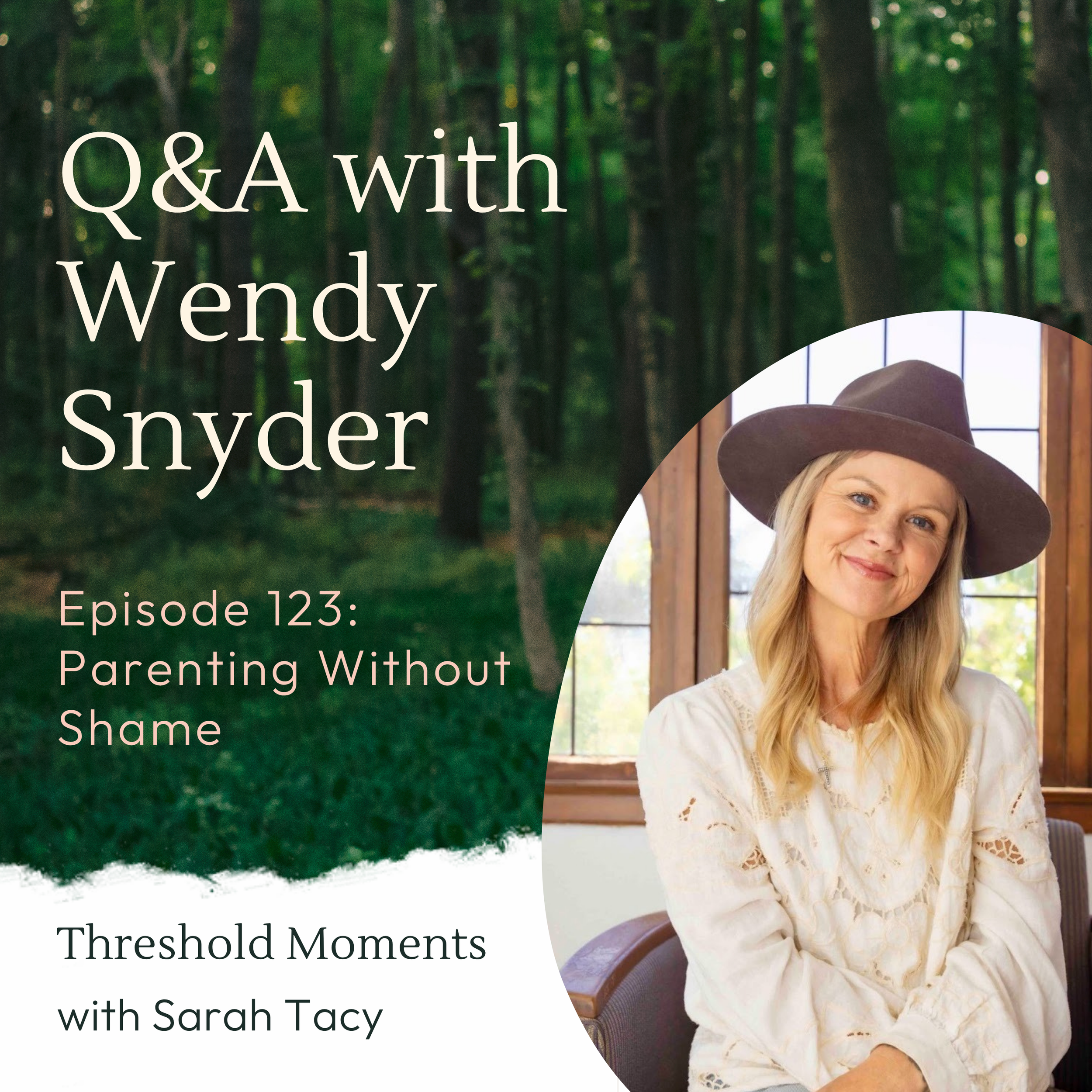
In this heartfelt Q&A episode of Threshold Moments, Sarah Tacy and parenting educator Wendy Snyder dive deeper into the realities of parenting sensitive, strong-willed, and emotionally expressive children.
Through live coaching conversations with members of the Juice community, Wendy shares practical tools and compassionate reframes for navigating co-sleeping, separation anxiety, power struggles, “bossy” behavior, emotional regulation, and parenting as a team.
Together, they explore how children’s behaviors are often forms of communication, not proof that something is wrong, and how parents can shift from fear, rescue, shame, and control toward connection, encouragement, and empowerment.
This conversation is filled with wisdom for parents learning how to regulate themselves while raising children who challenge, mirror, and deeply transform them.
In This Episode, We Explore:
Understanding “inadequacy behavior” and separation anxiety
Why sensitive children often need encouragement instead of rescue
The difference between praise and encouragement
Parenting strong-willed and outspoken daughters without shame
How labels like “bossy” and “mean” create suffering
What to do when you truly don’t know how to respond
Nervous system regulation during parenting conflict
Co-parenting when one partner is more invested in the work
How connection changes difficult conversations
Why children’s behavior often mirrors our own healing journey
About the Guest:
Wendy Snyder is a Certified Positive Parenting Educator, Family Life Coach, and founder of Fresh Start Family, where she helps families ditch fear-based discipline and raise strong, emotionally healthy kids with compassion and confidence. Through her podcast, courses, and coaching programs, she’s guided thousands of parents to break painful generational cycles and create homes rooted in connection, peace, and purpose. She is the author of the upcoming book Fresh Start Your Family: Powerful Parenting to Restore Peace in Your Home. Wendy lives in Southern California with her husband Terry—her high school sweetheart—and their two kids, where they’re rewriting their own family legacy, one grace-filled day at a time.
Episode Transcript:
Sarah Tacy: [00:00:00] Hello. Welcome to Threshold Moments. We are back for the Q&A with Wendy Snyder. We have members of our Juice community here who are welcome to ask any questions they have, and I still have questions from our episode, so I, too, will be asking another question. And first up, we have Vicky from Hungary. And Vicky, if you wanna ask your question, please go right ahead.
Juice Member: Thank you. Um, my question is, or my request, that I would love to hear more about sensitivity. Uh, like my child is very sensitive, and I am having like, um, a lion, a lioness to be raised. So, um, and, uh, choice [00:01:00] is really good for me, um, which, um, which I have in my toolkit. But, um, what I'm struggling re- uh, with right now is that separation, that, uh, my child is seven, and right now we are co-sleeping, but I, I really loved, would love her to, to sleep by herself.
Juice Member: So this is one thing which, uh, which I struggle with to, with her. Like, um, she, sh- I guess she has some issues, um, like a deep, uh, embedded memory in her body somehow that, uh, she doesn't want to be apart of me. Um, and also she just won't go play dates without me, so-
Yeah ...
Juice Member: which is again, a, a biggie for us.
Juice Member: [00:02:00] Like she's happy. She's, she's very, uh, social, but she won't stay without me in, in, in anywhere, so.
Wendy Snyder: Yeah. Oh, Victoria, or Vicky, I can relate so much to this question because this was, as I, as I mentioned in our, in our episode, this was m- the story with my little guy, who's, again, I call him my little guy, but he's 15.
Wendy Snyder: He's 6'2" now. Um, but he, this was his big thing. We swore that we, I went, I think it began when I went to watch the movie ET with him at my parents' house in Maryland. I'll never forget, and he got scared. When the, when the parents fly away, you know, the parents leave in the spaceship. And I swear, from that day forward, it was like a three-year period where it was so heartbreaking 'cause he just- Would not leave my side.
Wendy Snyder: Um, it started, like, when he was, um, probably about, like, almost five years [00:03:00] old. He started to have p- panic attacks when I would leave him at preschool. Um, in kindergarten, we have memories of him, like, climbing the fence, um, to, to have us not leave. And then we, we used to joke, I try to make things at least funny to some degree, not to make fun of them, but we called it the shrink office, that he would have to go to at elementary school, and we always remember they had a little punching bag.
Wendy Snyder: And we actually have an elementary school that is so highly invested in social emotional literacy here in California, and so I feel so lucky that he had two teachers, um, Mrs. Wood and, um, Mrs. Grazely, that just didn't leave his side, and we were all basically teaching the same thing. And that's what I'm getting to here, Vicki, of this is in the category of misbehaviors that we teach.
Wendy Snyder: This type of behavior is what we would label as inadequacy behavior. I do it more as behavior, less as misbehavior. Power struggle's to me, revenge misbehavior, those are misbehaviors. [00:04:00] Inadequacy is more a behavior, um, because I don't really see it as a misbehavior. So what is the root of inadequacy behaviors is this core belief that I can't, I am incapable.
Wendy Snyder: And you know that your kid is in it when you have a feeling of pity and, like, you wanna rescue them. The other categories of misbehavior are very different. If you're in a power struggle, you're gonna feel provoked and challenged. Like, you're like, "No, I will make you brush your teeth because I am the boss, and you will listen to me, and I'm not gonna pay for that cavity bill."
Wendy Snyder: If it's revenge misbehavior and a child does it, hitting, kicking, biting, saying, "I hate you," you're gonna feel hurt. Like, "Oh, did you just say that to me? Did you just throw that Lego at me?" Like, hurt and angry is usually what happens in revenge. Attention misbehavior is when a kid is, like, making super annoying sounds in the back of the car, and every sibling is screaming at him to stop, and he won't.
Wendy Snyder: You're gonna feel irritated and annoyed. But [00:05:00] inadequacy, you're often gonna feel pity and rescue, and that causes us to not follow through. That causes us to not go for what we want, right? So you're having this intuitive hit right now that's like, "I think it'd be really great if she did find the confidence to go on a playdate and feel the empowerment of making new friends without having to have me by her side," right?
Wendy Snyder: Like, I- you're getting this amazing motherly knowledge of, like, "This is the next life skill that I wanna teach this kid." But when you fall into pity and rescue and continuing to believe- kind of the lie that she's not capable, then she will feel that. So kids are like, we often say, like little sponges to what we're thinking and feeling.
Wendy Snyder: So we think if we don't say it, then they're not gonna think it. But when we think it, they feel it. And so we just wanna start with see- being able to see our kids in the light when they can't see themselves. And [00:06:00] so really grounding down into how she is capable, right? Like she, if she's seven, she's, she is doing some things on her own that she's learned.
Wendy Snyder: You know, you could make a little list of all the things that she's learned how to do. Maybe she's learned to ride a bike. Maybe she's learned how to brush her own teeth. Obviously, go pee pee on the potty, um, sleep all night, whatever it may be. But just reminding yourself that she's capable, and right now she's probably just feeling scared that she's not capable.
Wendy Snyder: And one of the biggest tools that we teach for this category of misbehavior is breaking things down into small steps. That is like the number one thing. The, like, the other things are watching your inner voice. So if you have a tendency to beat yourself up or, like, kind of feel incapable in your own ways, you gotta, you gotta look at that 'cause it'll energetically, like, get translate to our kid.
Wendy Snyder: But really, one of the easiest things that we [00:07:00] can just touch on today is breaking this into small steps. So when the, in the play date scenario, what it looks like is, "Hey, so I'm gonna stay at the play date today, but I do need to take a phone call with the doctor's office to set your whatever. So what I'm gonna do is I'm gonna sit on the, the porch where you can see me through the window, and let's just see if I can make it through this 10-minute call."
Wendy Snyder: And then what you can do with these kids, too, is you can make love signals ahead of time. So you can agree that even though you're not next to each other, you could communicate with, like, maybe, like, a peace sign over your heart or blowing kisses at each other, and that communicates we are together even though we're physically apart.
Wendy Snyder: And let's just see if we could do 10 minutes at this play date, but I, I will be where you can see me. Does that work for you? And so we can start building up your courage to see, like, what you can find the ability to do as you're learning this life skill. And then after that, you might come in, you might sit down and [00:08:00] play, catch up with the mom at the house, and then you could be like, "Hey, so would you be okay if I go back out to the porch?
Wendy Snyder: I have one more, um, phone call to make this time. I'm gonna see. This one might take a little bit longer. It might take me 15 minutes. Are you okay if we do that? Let's, can we see if we can make it 15 minutes this time? Again, I'll be in the same place where you can see me, but I'm just gonna take the phone call."
Wendy Snyder: That's just an example, Vicki, of, like, what it would look like to start scaffolding the Um, the wins for a kid, so they start to feel. And then afterwards, you just celebrate whatever they were able to get to. So if, even if she, like, comes running to you at minute seven, then you're, you're not gonna come at it of like, "Dude, remember?
Wendy Snyder: Come on, you said 10 minutes." You would be like, "Okay, you can sit next to me. I, I still gotta finish up, but, like, you made it seven minutes. You made it seven minutes." Like, do you understand what a big deal that is? Take a minute [00:09:00] to congratulate yourself and love on yourself while I finish the phone call.
Wendy Snyder: It's very different than... So we here, Vicki, we teach encouragement versus praise. So praise is like, "Good job, you made it seven minutes." Encouragement is like, "Wow, you did it. And then on the way home, how did you do that? How did you work through it when you felt scared and you wanted me by your side?
Wendy Snyder: Because you did wait seven minutes." Like, I want you to celebrate that about yourself. I'm inspired by you, right? Like, I u- Then you bring it to yourself, Vicki. I used to think I couldn't do t- taxes alone, and I used to, used to think I had to have Daddy by my side to open up the tax document, and last week I opened up this email all by myself.
Wendy Snyder: And so I'm just... You've inspired me to keep doing this type of thing, because you and I are awesome, and we're highly capable of doing things even though sometimes we feel scared. So does that help a little bit to give you some ideas on how you would work with a inadequacy [00:10:00] behavior?
Juice Member: Yes. Thank you. Yeah.
Juice Member: You hit some points on my, uh, soul as well. Like, I really believe that, uh, a mother and children, uh, it's not a two different issue to solve, but one. Like, uh, um- Well said ... I really believe that, uh, I have to work on myself. And as I do, it, uh, things shifting. And, um, yes, g- you give me, um, a really good path to follow, some really good advices.
Juice Member: Thank you, Wendy. Thank
Wendy Snyder: you. You're welcome, Vicki. There's a whole chapter in the book, Frustrate Your Family, that's called Healing Through the Mirror. Mm-hmm. And it has become one of the most joyful adventures for me to find all the mirror spots. And then the kid with, the kids with anxiety, it's often, like, it...
Wendy Snyder: With all behaviors, but yeah, when my little guy was going through all those years of the [00:11:00] anxiety and the... It's like I now realize that I also was holding some- Yes ... that I've continued to work through. Um- Yes ... and it's been- become such a blessing to find the blind spots instead of-
Mm ...
Wendy Snyder: a, "Uh-oh, that means I'm messing them up."
Wendy Snyder: It's like, no, we just... The way you said it was so beautiful, Vicki, the... I forget exactly what you said, but something around, like, shared mother-child is one. Like, it, it really is. Yes.
Juice Member: Like,
Wendy Snyder: that is, that is the truth. So thank you for sharing.
Juice Member: Hmm. Thank you. Thank you for your work. It's, it's really well done.
Juice Member: Mm-hmm. It's really well done. Thank you.
Wendy Snyder: Yeah.
Sarah Tacy: Thank you, Vicky. We- th- thank you, Wendy. And in the comments we just have someone saying, "That was so helpful." Good. And I really agree. Um, my kiddos love to like, to co-sleep, and we're like, "Oh, that's just become the easiest way and a place to connect." And it's really, uh, what I love [00:12:00] what you offer there, Wendy, was I never would've thought of it as inadequacy.
Sarah Tacy: And when you offered the part of pity and rescue, I also think, like, my daughter, who is in the s- the same preschool teacher who I think is, like, the gift from God and all the angels for children, like the best of the best, when she- Yeah ... moved for the first time in her life to a new place, and suddenly I saw her not wanting to go to school and holding onto my leg.
Sarah Tacy: And, and I totally felt that, like, wanting to rescue her part, even though I know she could do it. But man, it was such a hard feeling to not rescue her. She was going to another great place, but I'd never seen her struggle before. She was a kid who just, like, she was the second one. She's just, like, literally backpack on her back before she was allowed to even go to school, and go, "I ready."
Sarah Tacy: Ready. And so to see her not feel ready, I hadn't before. And so Vicky, I really appreciate your [00:13:00] question. And Wendy, I really love that when you talked about in- inadequacy, revenge, attention, misbehavior, to then match that with how the parents might feel during those times.
Wendy Snyder: Yeah.
Sarah Tacy: That's really brilliant, and I've never heard that done like that before.
Sarah Tacy: Thank you.
Wendy Snyder: Yes. It is so helpful, right?
Sarah Tacy: Mm-hmm.
Wendy Snyder: Yeah. It's based on how we feel, not on what they are doing. So you would... It's so countercultural, right? It's
Sarah Tacy: amazing.
Wendy Snyder: But, but parenting is relational, right? So it's like, it's all gonna, it's all gonna be different based on what's happening between, as Vicky says, you and the child, because you are one.
Wendy Snyder: I love it.
Sarah Tacy: So going back to parenting is relational, this is the question that I still have from our conversation, which is funny, you and I met each other through Relax Money, and the question, 'cause sometimes you're like, "What if I'm doing the money work but my partner doesn't wanna do the money work?" Or, "I wanna do the nervous system part with the money and my partner thinks it's silly."
Sarah Tacy: And with the parenting, [00:14:00] if one parent is more invested in reading the books and doing the work, what does that look like since all of this is so relational?
Wendy Snyder: Yes. Well, there is a whole subsection in the book about this, and the first thing I would say is- You know, finding the courage to go first and finding power in that is, I think, a big deal because it is a way of leading.
Wendy Snyder: It is a... I think, you know, in partnership, we all take turns leading, right? And so to be able to find the humility of like, "Okay, so I'm clearly leading here," and where are they leading, right? Like, m- my husband has a, has a great ability to be like, "Hey, remember? Here's, here's five things" And I teach a deep healing weekend course that we just had.
Wendy Snyder: He was there all weekend, and I was like, "While you're here, let's do the work together. Give me a complaint about me." And he was [00:15:00] like, "You always forget the places I lead." He's like, 'cause I'm, you know... I think it's clear, as my, uh, mother-in-law said the other day, there's a lot of alpha women in this house.
Wendy Snyder: My husky, my husk- female husky dog is alpha. I'm a bit of a, you know, type A alpha. But Terry will often say, "Well, honey, just say, just remember, I lead A, B, C, and D." Like-
Sarah Tacy: Mm ...
Wendy Snyder: I, he is a m- m- so awesome with, like, schoolwork and paperwork and, like, getting them registered for the next year, and there's more that I could come up with, but it's not off the top of my head 'cause I am like most people, right, where my little ego goes to like, "Well, I'm leading here," you know?
Wendy Snyder: So point being, it helps us drop into humility if we can make a little list or ask them, "Could you help me just... I wanna make sure I have clarity on, like... Because I want it to be at the top of my mind. Where do you see you leading our family?" Um, and then you can be like, "Oh, yeah, you're right. You're right," right?
Wendy Snyder: Like, a lot of [00:16:00] men, for example, might lead with the, like, financial accounting systems. Now, we learn that we-- It's really great if you can step up and learn that too, but a lot of relationships might say, "Okay, you do lead in that way, and I wanna just stop having a blind spot around it." So that can just help drop you back into, like, it's a yin and a yang in a lot of relationships.
Wendy Snyder: Um, and then you can look at it less from, like, a resentment angle and more of, like, a, a balance angle, and also, like, stepping into the empowered lens of, like, ask... We can ask for what we want and keep asking for what we want, and that doesn't make us annoying or bad. That just makes us really caring about it, right?
Wendy Snyder: So podcast episodes, programs where there's, like, base programs. Like in our program, we have a base program called the Foundations Course that's in our membership. But really asking for Your birthday, for Mother's Day, like instead of the candle or the flowers, like would you just be willing to go through this [00:17:00] program with me?
Wendy Snyder: Would you be willing to read this book and then have us talk about it? But having, building up that skill set to be able to ask for what you want. And then I do write in the book that there is a, there is a line if, if someone is hurting and harming- Mm ... that is where it's like, okay, it's not really an option anymore to just be like, "Well, I'm, you know, I'm doing my best to lead."
Wendy Snyder: Like, that's where we really say, "Go ahead and, and, and invest in the outside resources." So if you need to get, um, the marriage therapist or in our world, we have a lot of parents who are like being in a group program for a year did way more than just an individual therapy situation for years. So just look at the support that's available to you, and sometimes you really do need to invest in someone to help you set the firm boundaries.
Wendy Snyder: So if a, if a co-partner is consistently like intimidating and screaming in a kid's face- Mm ... and [00:18:00] moving to physical aggression- Mm ... um, that's an example of like where it- we would advise that you, you don't just think you have to do it all alone, that it is time to, to call in some help there 'cause, um, a lot of the emotional stuff, you know, just, just, just get the help now.
Wendy Snyder: Don't, don't wait another day. But trying to think what else I could say, Sarah, there, um, as far as, um... I think it would just be that any-- Just whatever you do, don't come at, don't come at it from a pressured, um, judgy angle of like, "Look at me. I'm doing all this work and you're over there." Um, do it more as like a, "Can I share with something with you that I've learned that I think may help you?
Wendy Snyder: Are you open to that?" And, and I'll leave by telling a story, um, of one of my teacher's students actually years ago, but she had a husband [00:19:00] who, same thing, wasn't doing as much work, but he had, they had As a couple decided that they had some common goals, and this is, we have a, um, parenting as a team lesson within our membership, and this is what we teach essentially is you get together, you decide on your shared values and your shared goals for your children, and you get on the same page there.
Wendy Snyder: And then you might have some general, general goals there. But they had a- he had agreed that he didn't wanna scream at his daughter anymore, and then one day he had a disagreement with his teenage daughter, and he, he screamed at her, and then sha- I'm sure shamed her, and, like, sent her to her room, and she ran off to her room, slammed the door.
Wendy Snyder: And the wife heard this downstairs going on, and she was like, "Damn it." Like, she started to march up the stairs. Mm. She was like, "Oh, I'm gonna ch- what is he..." Like, he literally, he just said that he didn't wanna do that, and now look at him. Like, he's, all the thoughts, right? Like, he's not as invested. He doesn't care.
Wendy Snyder: Like, I'm doing [00:20:00] all the work. And she said she just stopped herself, sat down on the stairs. And now, and knowing you, I realize she did nervous system regulation work in that moment, whatever it was available to her at that time, and then she reminded herself who her husband actually is, their agreement about the shared tools.
Wendy Snyder: And she said she went upstairs, and instead of lecturing him and telling him, like, "You need to do better," she just laid down to him, lay- on, like, next to him and cuddled him and hugged him.
Sarah Tacy: Wow.
Wendy Snyder: Wow. And sh- he took a deep breath, and then from that point he said to her, "How did you know that's exactly what I needed?"
Sarah Tacy: Mm. "
Wendy Snyder: I, I don't wanna do this anymore, and I just get, I get so worked up that I don't know how to stop myself." And from that place they were able to really have a meaningful, connected conversation. And she, I forget what happened next, but, uh, I'm sure she was [00:21:00] probably then in a position to be able to be like, "Well, can I share something that might help next time?"
Wendy Snyder: Or, "Now you could, you know, here's an idea of how you could make amends. This is why it makes you strong, not weak, to admit that you lost your cool." Like, whatever. But she then was in a position from a point of connection, not from a place of judgment and pressure.
Sarah Tacy: And so what I hear, too, is, like, it's so, this, the work is so similar whether we're doing it with adults or with kids.
Wendy Snyder: Yep.
Sarah Tacy: To regulate first, to connect first, to understand that we're good people who have similar goals and desires, and that we're here together working together wanting to build a happy home and kids who feel safe being themselves. And so, yeah, there were so many points within there that I marked as like, oh yeah, that's really important.
Sarah Tacy: And, um- Mm ... but I'm really hearing in that moment how much she used the same tools- Yeah ... with [00:22:00] her husband that she would want to use with her kids.
Wendy Snyder: Yep, and we all have our own little backpack of rocks. Yeah. We all have stuff we brought in, you know, so it's like-
Sarah Tacy: Yeah, for sure. For sure ... you
Wendy Snyder: know, you just get to listen.
Sarah Tacy: And I just wanna, like, as I'm saying this, I wanna just be clear that I'm not, like, always the one who gets it right. Like, it's so helpful to be in partnerships- Yeah ... where if I start to get, feel the heat in me, that he could tap and be like, "Sarah," and I can be like, "Okay, I'm gonna step over here." Um, but that's so helpful.
Sarah Tacy: Thank you.
Wendy Snyder: Beautiful how that works a lot, right? Yeah, yeah. Like, there is often a yin- yin- and a yang thing that happens where it's like, it's so funny, a lot of the stuff that triggers me the most, he's chill, and then he'll be triggered AF, and I'm like, I'm, "Hey, go take a walk," you know? Yeah. "I got this. I'm not as triggered."
Wendy Snyder: Um, but yeah. And it's, and it's okay to admit, like, I hold some feelings about going first and being the leader, and, and, uh, that's a... I love being honest, too, and have that- having that not be a dig. Yeah. But instead, like, "Hey, help me work [00:23:00] through this so I can have more compassion and more humility as I work with this person that I love so much."
Sarah Tacy: It reminds me of the other highlighted thing that went off in my brain, was not being afraid to ask. Mm, yeah. And think that if you ask and you ask, yeah, that there would be... So there's the not coming with judgment, but also not being a- afraid to ask for what you want, and I think those are really beautiful things.
Sarah Tacy: Uh, Amna does have a question. She's here. Yeah. And I would love to give her a moment to ask as well.
Wendy, thank you for that story. I got teared up when, uh, you shared- Oh, good ... how she gave her husband the love instead of the judgment. Um, something that's been coming through me is, you know that phrase of when you give to somebody else, you're actually giving it to yourself?
And I'm noticing the opposite is true as well. Like, what you withhold from someone else, you're actually also withholding from yourself, right? So, like, those moments of compassion. And with my, my eldest daughter, something that's [00:24:00] very, it's always been prominent in her literally from, like, the day she came out of my womb, is, like, how, like, sturdy she is in her power.
Mm-hmm.
Wendy Snyder: And- Great
way to
Wendy Snyder: say it.
And, um, a lot of times it manifests in, like, a bossy and mean and manipulative way, and I've done a lot of work to know I don't wanna suppress it, but since it's been so suppressed within me, I get so triggered. It- it's almost like- Yeah ... how dare you speak like that when I was never allowed to speak like that?
Like, I hear that in my own inner voice, right? And I don't know what to do with it because it's like I, I was never shown it and, and so many people around me are c- the, the girls are conformed, you know? They're not bossy. They're not me. And, um, something that's been coming up recently, she just- she's about to turn 11, but when she [00:25:00] turned 10, is, like, this meanness to boys, the opposite sex.
"I don't like them. I don't like him." And, and just, like, almost bullying-ish. So I don't know if y- you've seen this or if you have anything for that.
Wendy Snyder: Heck yeah. I have the kid who I remember when sh- how, how old again, Amna, is your little girl?
She is about to be 11 in, like, a couple months.
Wendy Snyder: Okay. Um, yeah, I, same year.
Wendy Snyder: Same year that we were just, like, had that teacher who we were learning to, like, really c- be confident in our footing. Stella was accused of being the bully. Um, kind, kind of wild because on- one of the, one of the moms that accused her ended up going on to have two kids that fell so deep into the victim mindset to the point it was heartbreaking to watch how deeply it affected them.
Wendy Snyder: Like, she pulled them out of the school system. They continued to be, air [00:26:00] quotes, bullied, kind of their whole child- like, their whole elementary school experience. So there is a whole bully-victim paradigm. Um, we have a whole lesson on that in our membership, um, because there, the, it's a very interesting dance that happens when people view people as bullies, um, and often fall into the victim role and, and vice versa.
Wendy Snyder: But anyways, um, what I did at that time was I would go into the classroom and volunteer so I could see it in real life what was actually happening. And what I realized was a true, like, bullying type of situation is very different than a very outspoken kid who, like, for example, Stella at the time, she would, like, butt in line.
Wendy Snyder: She'd be like, "Excuse me," and she'd, like, kind of bump someone out of the way. Super obnoxious. I wouldn't necessarily classify it as bullying, but other kids, they saw it as bullying, right? Um, and so I think it, it really helps to [00:27:00] just be very clear and s- making sure you're seeing the behavior with your own eyes versus hearing what somebody else is saying.
Wendy Snyder: So it sounds like you probably have some of your own eyes on it, Amna, Amna, but just to make sure, I mention that. And then for me, being able to go into the classroom and teach peaceful conflict resolution or how to get what you want, um, without hurting others or to be able to listen intently was some of the things that I taught when I volunteered in her classroom back then.
Wendy Snyder: Now, okay, so the other thing I wanna m- talk to here is this idea of the words bossy and mean. And- Sheryl Sandberg, she was the president of, um, or the CEO of Facebook for quite some time. Obviously, a very big role, but it's, it's been a long time. But she wrote a book called Lean In, and she said, "If every little girl that's ever been told she's bossy was instead taught how to lead, the world would be a different place."
Wendy Snyder: That's a paraphrase of her, her words, but it's a, it's a great quote. And [00:28:00] I think what you're speaking to is spot on as far as, like, what you've not learned to love about yourself, you will be very critical of others. So that is the work that we do in our, our deep healing weekend that we teach once a year.
Wendy Snyder: It's called Freedom to Be, where we really do a deep dive on escaping blame, and we basically do it by realizing that what we blame others for, what we criticize others for, what triggers us the most, often is what we believe about ourselves and what we judge about ourselves. And so my little girl has been a great mirror for me, because for years, I would tell her, "Gosh, Stella, you're just aggressive.
Wendy Snyder: You are aggressive with Taryn," her little brother. And I remember it got to the point where she was just about this age, and by... s- just about 11 years old, so she had been doing the work since she was three. So by that time, she was a mini teacher. She actually started teaching in our community at the age of eight.
Wendy Snyder: She has, like, a whole kids program in our membership. But she looked right at me and she said, "Mom, [00:29:00] you know, actually, you're aggressive." And I was f- I was at the point in my journey at that time to be able to be like, "Damn, you're right. You're right. Thank you. Thank you for pointing that out." And I was also at the point, she's 18 now, so that was eight years ago, where I was still a little stingy about it.
Wendy Snyder: Like, "Oof, that's bad that I'm aggressive. That makes me bossy and mean." Like, all the words that you would use. I was still feeling it a little bit, but I was also at the point in my journey where I was able to be like, "Y- you're right." I, especially if I have to call AT&T and they have messed up my bill for the seventh time and I've already called twice, years ago at that season of my life, I was probably gonna be a total B on the phone when I called them.
Wendy Snyder: But it was... you know, no one was really seeing it. But it was in me, right? Like, I had these aggressive behaviors. I was still... I mean, I think I wrote [00:30:00] the article, I threw a... the night I threw a book at my kid when Stella was, like, nine. I wrote an article. I've written an article. I tell all these stories in the book.
Wendy Snyder: Um, I left bruises. My son was five. Like, I have aggressive patterns. So through the years, I have stayed and double timed my work and my commitment to learning to love myself more, which we would call self-compassion work, and realized that with a personality like mine that really goes for what I want in life, um- I, I don't hold back, right?
Wendy Snyder: Like, I am, as I joked about, a bit more of the alpha. I speak my mind. I stand up for what I believe is right. I... If someone is getting harmed, I'm gonna be the one that steps up and, and gets in the way of someone harming them, right? And so it's taken me years to learn that I might have behavior sometimes that I wanna change, that isn't, is not, air quotes, "perfect," but I'm not bossy.
Wendy Snyder: I'm not [00:31:00] mean. I'm actually not aggressive. I am an amazing person who, when I'm in a triggered, non-regulated state, I will move into behaviors like that to try to get my needs met, and to, like, work through it. But it's, it's not what I want. It's not who I am. It's just somehow, sometimes that will show up.
Wendy Snyder: And so as, and I'm going somewhere with this, I promise, and I can't wait to get your thoughts here. But th- the last workshop I taught, that, that yearly healing program, I... What my biggest takeaway was at the end was like, wow, 15 years later, I've done that, taught that program 10 times now, been in the program 30.
Wendy Snyder: I finally am at the place where I love myself so deeply that I don't... The inner critic, that inner beat-up, is really pretty, pretty much 98% gone. And guess what? When I see Stella acting in these, air quotes, "ways," like sometimes after volleyball, [00:32:00] you know, she'll play someone and she'll be like, "You know, sorry, but they were just, like, really bad."
Wendy Snyder: And the hit comes into me of like, "Ooh, that's mean." And then I'm like, "Actually, she's just a super competitive kid, and she's also not perfect." Right? So she's not, she's not the Dalai Lama. She's not like, "You know that kid I played today? I beat 'em by 18 points, but they, you know, they're trying." Like, she's just, she's not perfect, and she's...
Wendy Snyder: I'm also not gonna label her as, like, bossy or mean anymore because I'm not labeling myself as bossy or mean. Does that make sense? And so for me, it really has always been about learning to love myself more. If, when there is a mirror with my children, and then all of a sudden that, that, like, quickness and that, that part of them that gets under my nerves and grates me, it just starts to melt away.
Wendy Snyder: It still is there, but I now have the ability to look at it and not judge it, [00:33:00] and not go into my amygdala about how it's, like, the worst thing in the planet. And remember that old school belief is a misbehaving child equals a bad child equals a bad parent. So, if you've got a bad kid that's bossy and mean, that means you're failing.
Wendy Snyder: So you just, over time, start to recondition your belief system to be like, oh, this is a communicating child, and I guarantee you at 11 she's in a, um, power surge stage of life, and she d- Like, she wants more than anything to belong. And she wants anything, m- more than anything to feel powerful. So she might be having some behaviors right now that are, she thinks are helping her get what she wants, but it's actually probably creating suffering.
Wendy Snyder: And so you just start to teach her. Like, "Hey, I notice sometimes that what you're trying to get what you want, and you do it in this way. Can I give you another idea?" And one of the things I taught Stella back in the day was instead of telling your friends what to do, [00:34:00] try asking them or giving them a choice.
Wendy Snyder: Like, "Hey, guys, would you be willing to try it this way? This is a really great idea." And then I taught her to, like, understand kind of what selling is, right? Like, selling is having excitement about your idea and presenting it and asking your friends if they'd be willing to try it your way. And that was just one way of teaching her how to lead versus making her bossiness and meanness be a flaw about her.
Wendy Snyder: Does that help at all? That was a lot.
Oh, no. That was so good. What I saw pretty clearly as you were speaking was, like, how the labels essentially pr- uh, create suffering, but also don't allow me to see the process of, or, like, what's actually alive in front of me. So, like, the more I can release myself of that, I can just be present to it.
I saw that-
Wendy Snyder: Yeah ...
pretty, a- and of course, the self-work. [00:35:00] And- I love
Wendy Snyder: that. Yeah ...
I want to save, um, y- you said a reframe of a bad kid is a bad parent, is blah blah blah. But then there was a reframe. I wanna write that down. Yeah. What was that?
Wendy Snyder: Yes, and that is in chapter one of the book. It's a misbehaving child equals a communicating child equals an empowered parent who can redirect with grace and dignity.
That is gold.
Wendy Snyder: And that really is just what's happening for your little girl. At 11, I mean, do you guys remember being 11? It was like your whole identity is like, "Who am I? Does anyone even like me? Am I ugly? Am, are my jeans stupid?" Like, I remember back when I was 11, all I wanted was to have the Guess jeans with the triangle on the butt, and, like, just to fit in, you know?
Wendy Snyder: And so I, ugh, we would do the, the s- just the weirdest stuff to fit in, [00:36:00] you know? Like, we would do sleepovers, and then we would call- poor peop- like poor older people at midnight, and then we'd ask them, "Is your refrigerator running?" And they'd be like, "Oh, yeah." And we'd be like, "Good. Go chase it." And then we'd hang up the phone, right?
Wendy Snyder: And it's like a way to feel like you're, you belong, and like, and also to feel powerful, right? So kids are just experimenting with it at that age. What's gonna make me feel powerful? What's gonna make me belong? And so it's just, it is a wild season of teaching your kids, okay, that was an experiment, and that, that's not within our family values to call that kid stupid, ugly, and fat.
Wendy Snyder: And I know, I can see why. Like, yeah. Like, empathy, compassion. And let me give you a different way to stand tall for what you wanna say that will respect yourself and others.
Thank you so much.
Wendy Snyder: You're welcome.
Sarah Tacy: Wyndi, what [00:37:00] happens if you get into the situation and you just straight out, you're like, "I don't know what to do. I know how I would have acted in the past. I feel that uprising of wanting to, like, say, 'If you do this, then you can't have this,' or, 'Hey, you're acting mean. Stop it.'" Right? And you're like, "Okay, no, that's not the way, but I don't know the right way."
Wendy Snyder: Yeah.
Sarah Tacy: Like, for those places in between before you've... I'm thinking about, like, playing lacrosse, right? I played lacrosse in college, so there's like the whole part where it becomes muscle memory and you're not thinking about how to run the play. You're not thinking about how to catch the ball. But that middle place between knowing you want to, I think you keep using the word dissent from- Yeah
Sarah Tacy: one way of parenting and move towards another, but you don't have the methodology in your system yet. Do you have any tips for what to do in that [00:38:00] moment?
Wendy Snyder: Yeah. Well, first off, I would say do all your work, right? So your work, Sarah. Mm-hmm. Like, first is the nervous system regulation stuff, for sure. And then I would say two things.
Wendy Snyder: H- I would s- especially if you're, like, a more vocal outwardly person, um, is say how you feel, and then also say aloud what you actually- Don't know. So a lot of parents, for example, see not knowing what to do as a failure. And so they will try to hide that. They'll try to suppress it, and really to me, that's just a feeling of scared.
Wendy Snyder: So scared I don't know what to do, scared I'm failing, scared you're gonna grow up to be an entitled brat. Like, it's just scared, but it might be, you know, in that moment if you have siblings fighting, you might say something like, "I feel so scared that you're gonna hurt yourself, and I feel anger rising in my body, and I don't know what [00:39:00] to do right now.
Wendy Snyder: And so I am gonna go regulate my nervous system like Sarah always teaches me to." "And Wendy writes about in the book. Like, and then I will be back, and I love you, and I am so angry right now, and I feel so scared. And I know I can't control you guys, and so I will be back." Like, something like that. I feel like even just the words of saying, "I don't know what to do right now," you tell the truth and you find strength in that.
Wendy Snyder: Like, that does not make you weak. That makes you honest, and it also is very beautiful to ch- for children to see their parent having, like, a high, like, a rise of an emotion and it not be a problem. Mm-hmm. It's like, you know, and so we teach the basic five emotions here, happy, mad, sad, hurt, scared, and once you get really good at realizing when you're scared, when you're hurt, and when you're angry.
Wendy Snyder: Sadness, sadness is different. Like, a lot of people will say, "I just [00:40:00] feel sad when you hit your brother." Mm. No, you don't. Like, you're more, like, scared that she's gonna grow up to be a bully or she's gonna grow up to be a mean person. Um, sadness, we, we don't... And not that I'm, I make it a habit of telling people they're wrong in their emotions, but a lot of parents use the word sad for everything, when really there's the big triggered moments are often hurt, angry, and scared.
Wendy Snyder: And so just normalizing that. When kids watch you do that, and you don't move exactly, like, you don't move quickly to fixing it, but instead you move quickly to regulation, and from that place, then you get into that creative thinking part of your brain where you can pull the tools, right? Where that's where you can pick up the book.
Wendy Snyder: You can look at the printout that you put on your fridge and remind yourself, "Oh yeah, I do have, I do..." Like, I'll pop quiz my people in a private or sometimes on our calls, and they know the four steps to the setting firm limits process. But in the moment when that, [00:41:00] when they're dysregulated, they can't access it.
Wendy Snyder: So it just takes, "I don't know what to do," going and doing your thing, whether it's water, backyard, bathroom. Like, going pee for three minutes can- ... do wonders, right? I love this. Um, yeah, so.
Sarah Tacy: Yeah. Okay. So what I w- the reason why I wanna say a special thank you for that is because I often think of the analogy that Dr.
Sarah Tacy: Becky talks about, like, you're the pilot. Right? And so, like, if you're gonna go over turbulence, you, like, you, like, you still wanna be like, "I'm driving the plane." And so I have done this before, as you've said, I'm like, "Wait, is, does that make them feel unsafe because I don't know what to do?" So it's really helpful to have it reframed in a way of having a moment of honesty, of seeing what it looks like when somebody doesn't know what to do, but takes time just to get back to their body before they rush a decision.
Sarah Tacy: Yeah. And it does remind me that with one of my own friends, when they, uh, [00:42:00] they were going to publish y- a book and a very, like, well-known, not the person that we're probably thinking of, just, like, somebody else, and it was going to use a name that, um, was a big part of my business. And I got into, like, what would the higher self do?
Sarah Tacy: What would... And then, like, but wait, am I just not sup- And so I felt all the thoughts of, like, I don't know what to do, and I'm letting my brain. And so what I was able to do was just leave a voice memo and say, "Hey, I'm noticing that I'm feeling really activated by this, and so I'm just gonna wait until I can feel myself back in my body.
Sarah Tacy: And so if you don't hear from me for, like, a couple days, I'm just waiting until the intelligence of my body has a clear signal." Mm. Beautiful. "And then I'll reach back out." And it was so great because I didn't need to figure out an answer right away, and I didn't need to... But I was able to respond, um, without [00:43:00] anger, without just like, "Oh, I'm just noticing this feeling."
Sarah Tacy: Um, and from there it allowed her to, like, she had such clarity from there, and everything worked out really beautifully because we, we did that. And so it's helpful to hear that this is a good method because this is something I can do. I- I love
Wendy Snyder: that, yeah ...
Sarah Tacy: can name my feelings and take res- without being like, "You did it," but I can just, like- Yes
Sarah Tacy: name the feelings in my body and give myself some time and say something honestly. And I hear what you're saying, that then the creative juices might flow of like, oh, now what do we do next to work this out? So that feels really liberating to me. And also being able to say- It's like a really good
Wendy Snyder: middle
Sarah Tacy: ground.
Wendy Snyder: Yeah, and also being able to say, "I don't wanna do something that I regret. I don't wanna say or do something that I regret, so I just need to step away for a minute and I'll be back." Like, that's a thing too- Mm-hmm ... that you, your kids start to learn of, like, mom... And it, I make it very clear in my house, like, I am learning a [00:44:00] new way.
Wendy Snyder: This is what I inherited. Like, just this morning my mom called me, ugh, bless her heart, but she, you know, she just never did any type of this work, and so she still runs, like, highly anxious. And, um, the, the technology, like, they're, they're on, like, a 10-year-old, 15-year-old Mac, and it always... And she calls me, she's cursing on the printer, and she's like, "I-" "Wendy, what am I supposed to do with this?"
Wendy Snyder: And instantly my body is just like I'm back to being a child, and I'm like, "Oh, yeah, that's right." And I always get off the phone and I say, "Man, I love Grandma, but..." Taryn, if you... I said it this morning. I go, "If you ever wonder why I am so reactive, I'm not trying to blame anybody, but man, did I grow up in a highly dysregulated home."
Wendy Snyder: And I'm just, I'm learning a new way here, and so, like, I just sometimes need to step away, and so I can do my work and then come back. I, I like, like to make that known to kids, that us leaving is not about torturing [00:45:00] them or silent treatment. It's actually to get us back into a place where we can treat them the way that they deserve to be treated.
Sarah Tacy: Mm. I love that. I love that. And I can even imagine just saying, "I'm going to take a moment until I can feel calm in my body, and then I'll come back so that you can be treated the way you deserve to be treated." Yeah. And even just letting them know, "And I'll be back."
Wendy Snyder: I will be back.
Sarah Tacy: Yeah.
Wendy Snyder: Trust me. We're gonna solve this.
Wendy Snyder: You're gonna pick up that room.
Sarah Tacy: Well, thank you so much. You were very, very generous with your time. Thank you for answering all of our questions, and I just really appreciate you. When you talk about selling of, you said, um, being excited about your idea and then offering it. Yeah. It's so easy for me to want to sell this book because I...
Sarah Tacy: Not that I'm selling it, but I'm like, "Ah." Yeah. Uh, I'm just seeing how useful this could be in all areas [00:46:00] of life. And so thank you for doing the work you do. Everything that you spoke about, the way you distill things, it makes so much sense to me. Aw. Uh, so thank you. Thank you for being you and being so dedicated to the- Thank you, Sarah
Sarah Tacy: possibility of a new way.
Wendy Snyder: Yay. Mm-hmm. And thank you to your community. It's so fun to have questions in real time, and, and I love how they were very different questions. And yeah, just so fun to be together with your community and do a little Q&A here, Sarah, so thanks again for having me.
Sarah Tacy: Thank you, Wendy.
Sarah Tacy: Thank you, Amna and Vicky.