
124 - Amina AlTai: Existential Crisis and Staying with the Dream
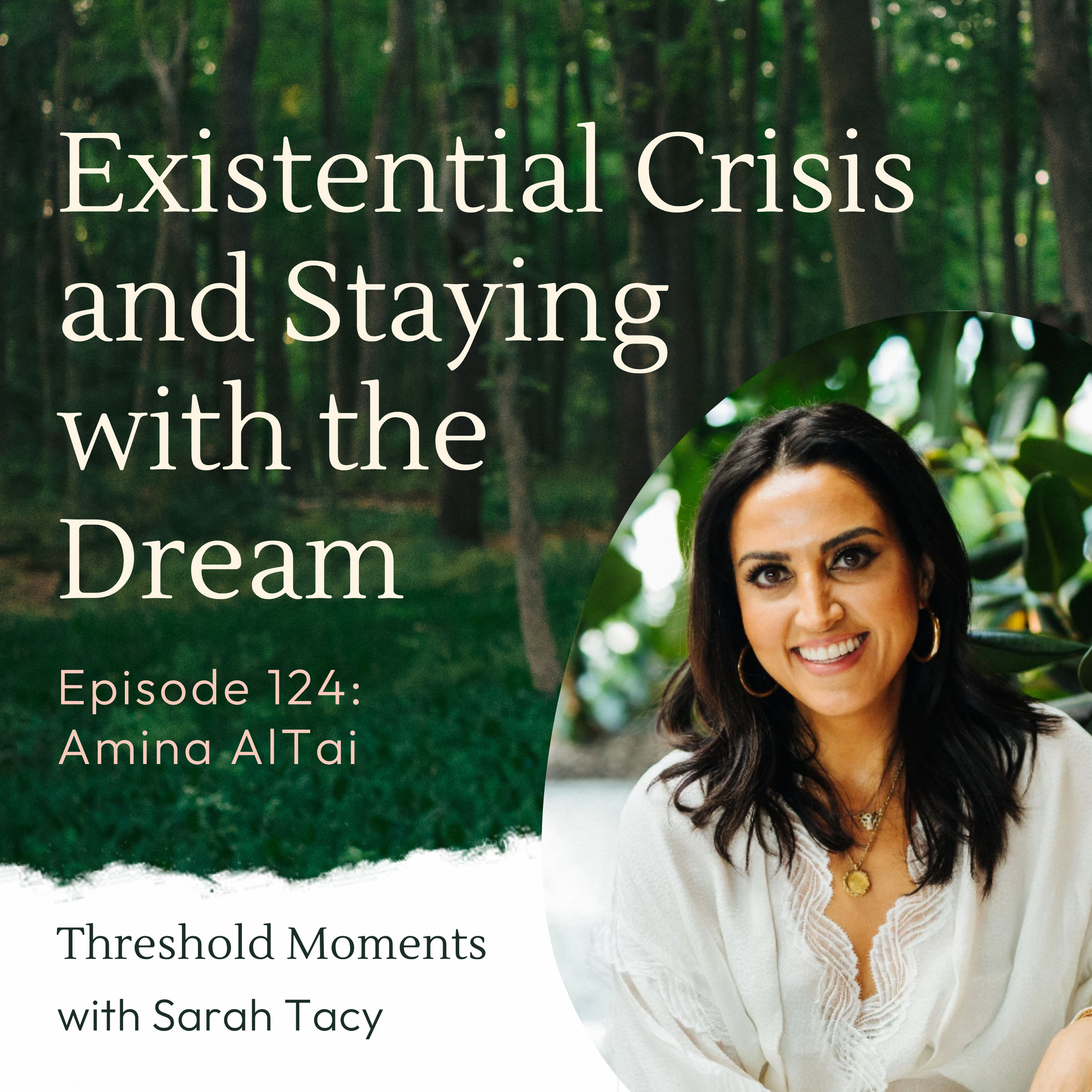
What happens after the dream comes true? OR when your dream didn’t quite come true, but other beautiful realities appeared that you could not have imagined? And what happens when success still asks more of your nervous system, your body, and your spirit than you expected?
In this deeply reflective third conversation with returning guest Amina AlTai, Sarah and Amina explore the tender realities of life after a major threshold, from launching a bestselling book to navigating burnout, ambition, existential questioning, and the ongoing practice of staying resourced in an overwhelming world.
Amina shares honestly about the hidden emotional terrain of book launches, the pressure of metrics and expectations, and how she had to embody the exact teachings from her book The Ambition Trap throughout the process. Together, Sarah and Amina unpack nervous system care, rest, recovery, identity, over-responsibility, and the ways many of us are quietly asking: “What is the point of all of this?”
This conversation is both grounding and expansive, a reminder that we do not have to hold the entire world alone, and that there are ways to remain deeply engaged without abandoning ourselves in the process.
Amina first joined Sarah in season one for a heartfelt conversation on burnout, codependency, and the hidden ways ambition can disconnect us from ourselves. She returned in season three to explore regenerative ambition, nervous system healing, and redefining success in a culture driven by urgency and overwork. If today’s episode resonates, go back and listen to witness the evolution of Amina’s work—and the deeper layers of these conversations unfolding over time.
027 - Amina AlTai: Unraveling Codependency »
098 - Amina AlTai: Cultivating Regenerative Ambition »
In this episode, we discuss:
The reality of life after a major success or threshold moment
How ambition can quietly pull us back into burnout patterns
Micro moments of nervous system regulation and recovery
Body mapping, rest practices, and tools for staying grounded
The relationship between exhaustion, identity, and self-worth
Existential fatigue in the age of AI, social media, and constant exposure
Internal Family Systems (IFS) and understanding protective parts
Why “all or nothing” thinking often signals nervous system overwhelm
The importance of finding your role in collective change
How to stay human, connected, and resourced during uncertain times
About the Guest
Amina AlTai (pronounced AH-MIN-UH) is a business and career coach, proud immigrant and chronic illness advocate. A leading coach to notable female leaders and impact-driven celebrities-Amina’s mastery is in connecting us to our brilliance and teaching us to live and lead from it each day. As a woman of color of Iraqi descent, she often works with underrepresented communities to help them realize possibilities in a way that honors their particular lived experiences. She’s a Success Magazine 125 Leaders Finalist, a Forbes Contributor, an Entrepreneur Magazine expert-in-residence and has been featured in The New York Times, goop, NBC, Entrepreneur and more. She is working on her first book The Ambition Trap in collaboration with Penguin and The Open Field and is the host of the Amina Change Your Life Podcast.
Episode Transcript:
Sarah Tacy: [00:00:00] Welcome to Threshold Moments. Often before I say those words right there, I will take a moment to really feel my seat, on my seat, and my feet on the ground, and I'll take a breath to center myself. And this time, I actually found I had so much upward energy, so much excitement to be here with Amina AlTai.
Sarah Tacy: , It's such a great feeling to feel this excited to speak to a friend, to, uh, put an hour aside to be with you. Mm. I'm gonna read a formal bio. Uh, and I'll also say to the listeners, this is Amina's third time on my podcast. So grateful. And this season in particular is a season of checking in with people after a threshold.
Sarah Tacy: The podcast is [00:01:00] called Threshold Moments, and I often get to talk to people in the middle of a threshold, or maybe they're on the other side of a threshold and beginning something new. And to check in a year later or two years later, what is so amazing to me is, in some ways, like how many lives we can live in one life.
Sarah Tacy: But also through lines of like, "Oh, and I'm still me. I'm still here." So I asked Amina to come on today because last time we spoke to her, she was just about to bring her book baby into the world. It's right behind me, The Ambition Trap. It became a bestseller. She met so many of... I don't know if it's okay to call them, like, idols or just people you really respect and look up to, who were in love with your work and your book.
Sarah Tacy: And so I wanted to talk about what it was like to go through that and to somewhat be on the other side of that. [00:02:00] Before I ask the question, let me do a little intro for my listeners. Yeah. So Amina AlTai is a business and career coach. She's a proud immigrant and a chronic illness advocate, a leading coach to notable female leaders and impact-driven celebrities.
Sarah Tacy: Amina's mastery is in connecting us to our brilliance and teaching us to live and lead from it each day. As a woman of color of Iraqi descent, she often works with underrepresented communities to help them realize possibilities in a way that honors their particular lived experiences She is a Forbes contributor, an Entrepreneur magazine expert in residence, and has been featured in The New York Times, Goop, NBC, Entrepreneur, and more.
Sarah Tacy: She is a best-selling author of The Ambition Trap, and is the host of the I'm Gonna Change Your Life [00:03:00] podcast. Welcome. Thank you so much for having me. I can't believe this is our third time, but I learn so much every time I sit with you, so I'm so grateful. Yeah. I feel the exact same way, and I think what's not unusual is that the podcast ends, and then there will be this kind of trail time where we're texting or voice memo-ing, like, "Oh, and what about this?"
Sarah Tacy: Yeah. "And do you think about it this way? And remember when you said this thing?" Where it's like we still, like, need to kind of, like, digest a little bit more. Yes. Uh, so welcome. Thank you. And before I ask about the book launch, when I was going to your website to get this more professional bio, I saw that you said intrapreneurs and entrepreneurs.
Amina AlTai: Mm-hmm. And I'm just so curious. I don't know what that means. Yeah. Can you tell me what an intrapreneur is? Yeah. So somebody that works inside of an organization, but has [00:04:00] an entrepreneurial mindset. I think I work with people that want freedom in a framework when they're those intrapreneurs. So they're like, "Okay, I'm gonna push the envelope.
I wanna do something different. Maybe I wanna work on the system, but while I'm in the system." Um, so they have that entrepreneurial mindset, but they're inside of an org. I love that. Work on the system while I'm inside of a system. Mm-hmm. That's really powerful. Thank you for, for helping me with that. And then you said something around the fact of we spend the majority of our heartbeats inside our career.
Amina AlTai: Mm-hmm. And so making it something that we love, or I might say are proud of, would be a huge part of the work that you bring forward into the world. Yeah. It kind of breaks my heart, and that's how I got to this work, but we do sp- it eclipses time that we spend with our loved ones, traveling the world, on our hobbies and passion projects.
And so I think it has to be aligned, otherwise we're always swimming upstream and then it causes [00:05:00] bodily harm. Yeah. You used the phrase, "It kind of breaks my heart," when we were talking about the number of heartbeats. Yeah. And I was like, "Ugh." I actually, when I read that on your website, I didn't like it. I was like, "No."
Sarah Tacy: Yeah. "No." I don't... Like, I didn't want it to be true. Yeah. But then I realized if it was going to be true, maybe this is, like, a different version of an intrapreneur. If it was going to be true, then how do we make the most of it? Exactly Yeah Exactly. Most of us have to have jobs, right? Most of us don't have trust funds.
We're not billionaires. And so, you know, if we can't spend all of our days, you know, staring at leaves and flowers- ... can we at least choose something that's aligned with the truth of who we are? Yeah. So your work on ambition and burnout and trying to find what I would call the sacred third of being in work that's meaningful in a way that's [00:06:00] sustainable is something that you've brought forth into your book Am- The Ambition Trap.
Sarah Tacy: And even as I prepare today, I'm about to present for, I'm guessing there will be, like, 400-ish people, uh- Oh ... for Relax Money's first nervous system call. So cool And I went back to your book because I wanted to go to the why. A lot of people are like, "Why are we doing a nervous system call?" Even though Kate, like, really lays it out, like, why, why is this meditation helpful for me and money?
Sarah Tacy: And in your book, there's a section where it, it, it's about... It says the expansive mindset and the narrow mindset, and I was thinking that I would read that to them today to, after describing the physiology, what it looks like and how it presents. And so this is such a really cool part of where our work overlaps, is just you see within the systems and within the people with [00:07:00] that burnout or, um...
Sarah Tacy: How would you call it? You did not call it toxic ambition. You called it- Painful ambition ... painful ambition, um, affects the body. Uh, so as you went through the process of launching a book, which I imagine to be a big effort, how did you find your own book useful to you as you went through your launch period?
Yeah. And I'm not sure if I said this on the, the last podcast, but I think that writing a book and working with a traditional publisher is a form of the ambition trap because- I found it so challenging the whole time not to fall in, right? Like, not to overwork, not to live into the narrow mindset, not to instrumentalize my body, not to try to win no matter the cost, right?
It was just an exercise in using all the tools, and the launch was exactly the same [00:08:00] way. You know, you sent me a voice note a couple of days ago to prepare for today's conversation, and one of the things you said was, "You know, I'm sure that you've, like, set your goals and shattered your goals, and, like, let's talk about that."
Well, I didn't meet my goals, and that's been such an interesting experience because how do you be in relationship to that but then not hurt yourself and continue and keep getting back up but in a way that is sustainable? And that's a daily conversation for me of, like, how do I keep going? Because it's important for me to continue to get this work out but in a way that really honors myself and doesn't hurt myself.
But I found the whole process really required me to be the work every single day, and I would get so close to the line some days. I would get so close to it, I- that it would almost feel too familiar and a little scary like the old days, and then I would be aware, and then I would choose something different.
But my gosh, it really asked me to be the work. Mm. So what's so interesting is from the [00:09:00] outside watching your book launch, I believe you hit a bestseller list, and you're sitting side by side with Maria Shriver and, uh, your coach... Can you remind me her name? Rachel? Rachel Rodgers. Rachel Rodgers. Um, can you name some other people that you're like, "Whoa, this is really awesome"?
Yes. Uh, honestly, one of my favorites was Gay Hendricks. So Gay Hendricks- Oh, yeah ... wrote the book The Big Leap and coined the term zone of genius. And, you know, I've studied his work for a long time and just had such love and admiration for his contribution to the world, and I had him on my podcast when my podcast was active.
And it was one of my favorite conversations because you know those moments, um, I think they're referred to as, like, kairotic moments, like kairos is sort of you literally feel God coming through. And that's how I felt when I sat with him. I was like, "God is here." Like, whatever you believe about, you know, however you wanna call it, God, a higher power, [00:10:00] you know, God of your own understanding, but I literally felt God in the conversation with us.
And so that was one of my very favorite moments of getting an endorsement from Gay Hendricks. Um, that was really special to me. And then, you know, to be a little flippant and silly because that is part of me too, I was interviewed by Chrissy Teigen for her pod- podcast, which was such a gift. Um, and I got to meet John Legend because it was recorded at her house.
Whoa. And it was honestly so sweet, and I got to meet their daughter. Like, it was just- Precious and amazing and like a pinch me moment. And I was like, "I can't believe I'm sitting in John and Chrissy's house here in LA." Wow. It was wild. Like, there were so many beautiful pinch me moments. And you know what's so interesting, is, you know, I'm definitely into the spiritual and the woo and all the things really, but, um, before the book came out, I did a Vedic astrology reading, just a little check-in, right?
To be like, "What's this saying about the book?" And one of the things that the astrologer said to me was, "You are [00:11:00] gonna be everywhere you wanted to be and nowhere you expected to be." And I, I feel like that was such a perfect way of summing it up, because I never could have imagined that I would be in Chrissy and John's house.
I, I never could have imagined that Gay Hendricks would be so kind as to endorse my work. I never could have imagined any of these things. And so I think it's such a beautiful thing too, because it was also a reminder for me that the how is never any of our business, and it can be so much bigger than we can imagine.
Sarah Tacy: Yeah. That reminds me of the phrase, "This or something better." Yes. Yes. This is so random. I was just in York, Maine this weekend, and we ran into this man who, on Steve and I's fifth anniversary, we did this thing with Laird Hamilton and Gabby Reece. And it was, you know, it was the cold plunging and the saunas and the breathwork and the [00:12:00] nutrition.
Sarah Tacy: And, um, Gabby sat with us. Like, I guess they both sat with us on our anniversary and just, like, talked to us about life and marriage. And then we were out paddleboarding with them on the ocean. So anybody who doesn't know, Laird Hamilton is a big wave surfer, and Gabby was a professional volleyball player and an incredible podcast host.
Sarah Tacy: And a woman was on the board next to me, she's like, "This is a dream I never knew I had." And I think about that sometimes, where we're in scenarios- So cool ... like, we didn't try to imagine up and we didn't try to make happen. But you're like, "Wait, this is such a dream." Right. It didn't even try to man- Like, it didn't...
Sarah Tacy: I couldn't- Right ... have manifested it if I wanted to. How could you have known to even manifest it, right? It's such a special moment. That's the coolest thing. And so what I'm loving right now is a little bit of the paradox, or maybe the both/and- Mm-hmm ... of being able to stay with, like, I didn't hit my [00:13:00] goals, and I had all of these pinch me moments- Yeah
Sarah Tacy: that I couldn't have dreamed of. So the goals are like the ones you dream of. Mm-hmm. Are the ones we measure ourselves against. And then the pinch me moments are, like, the ones you couldn't have anticipated. Totally. Yeah. You know, it's, it, it's so interesting, and it has really been a both and, and I couldn't be more proud of myself because of it.
I couldn't be more proud of myself for not hitting my goals, and I know that sounds, like, a little bit wonky, especially for somebody that wrote a book about ambition. But a lot of the goals that I had were around certain numbers, right? Your publishers have expectations for you, and one of the things that's been important for me is that I wanna keep the, the door open for a second book.
I don't know if I'll write one, but in order to with a traditional publisher, you need good numbers, right? And so my numbers didn't land where I'd hoped that they had landed, but it required me then to show up differently. So instead of there being, like, this moment of lift where, [00:14:00] like, oh, the, all the pod- podcasts and the stages are kind of crescendoing together, and they're lifting you, and you don't have to do much, I had to keep going.
And it then ended up being this kind of, like, master class and practice of recovery and resilience, and not hurting myself to get to the goal. And so it kind of perpetuated, like, you need to keep being the work, which I think is really poetic and beautiful. Mm. Um, so you know, when I look back a- across the year, I've done over 80 talks.
Whoa. And that's not, that's not including podcasts. You know? Oh, my God. Right. And I just think that it's incredible that I was able to sustain that and to take care of myself, and yeah, it, it is, again, I think just allowed me to flower into the work in a way that I, I didn't know that I could or expect to.
Wow. It's amazing to me, so often I see that when people write a book on a certain topic- Yeah ... that very topic will [00:15:00] come and challenge you tenfold. Instead of just being like, "Oh, she's got it, and now we're just gonna, like, make it an easy path." Uh, you know, when Kate Northrup wrote Do Less, then so many things in her life got exponentially harder.
Sarah Tacy: Yes. And it was like, are, are you really gonna do less now? Yeah. Right? With all this, right? And, um, you know, Jen Racioppi has her own story of cosmic health, and then what took place in her life. And so we were joking, and it was like, "Oh, if I ever write a book, we're gonna write it on, like, hula hooping" or like- Yeah.
Sacred ease and lots of money. That's the book. Yeah, but then the challenge would be, like, the opposite of that, right? Yeah. And it's like, well, how do I... Anyway, um- It, it is wild though, but I think that when you write a book from your soul, it makes sense that that happens, right? Because there's still little bits of lessons that we're getting.
And kinda going back to that Vedic astrologer, not to make it everything, but, um, ambition is actually exalted in my chart, and so it makes a ton of sense that I wrote a book [00:16:00] on the topic, and it makes a ton of sense that I keep getting lessons and learnings on the topic. So I think when you really mine something from your soul, and you can tell when a book is birthed of somebody's soul.
It's like the energy of it, right? It's not even the words, but when you open it and you're kind of thumbing through the pages, something just happens for you because of the energy of it. Yeah. I think you get invited into, into that experience. Yeah. That's incredible. I, um... I'm thinking now when I reached out to you a few months ago to talk about expansion and contraction, I didn't necessarily get...
Sarah Tacy: This is actually so, uh, apropos of our relationship, I think. I didn't get the response that I thought I was going to get, um, 'cause I was like, "What did it feel like?" Like, the- there must have been so much expansion, and then you come back and, like, what happens on the other side when there's, like, not the book [00:17:00] launch and, like...
Sarah Tacy: 'Cause I imagine one to be super activating and dopamine and, and then the other is to, like, come back and like, "Oh, I still have my life here, and my private sessions, and my..." So I was wondering if you experienced that, and I'll, and I'll let you just answer it of, like, how, what your experience was so that I can really wrap my mind around it.
Sarah Tacy: 'Cause to me, from what you just shared, it sounds like you were, uh, almost like a professional athlete. Like, like do a rep and then recover enough. So almost like there was, like, expansion, contraction, expansion, contraction through the whole process. That is exactly the perfect way to sum it up. So I always think that life is kind of like this, like up and down.
I'm just gonna, like I drew it on my notepad, right? Like, you're sort of like there's always peaks and valleys, and I think sometimes there's [00:18:00] a lot of space between the peaks and valleys, and sometimes there's very little space between the peaks and valleys. And what this journey has felt like for me is very little space between the peaks and valleys.
So it was really a practice of, like, where are these micro moments of rest, or how can I take these m- these minutes or a weekend of respite and rest, right? But never kind of like this long stretch, but, but constantly in the conversation. Like, this is a peak week, actually. Um, it's actually Arab American Heritage Month, and I've been Arab my whole life, but this is the first time I've ever been asked to speak during Arab American Heritage Month, and I have four keynotes this week.
And I- but I'm laughing about it because, like, this is kind of the nature of how it's been. It's been like these, like, do everything this week, and then next week is a little slower. Do everything this week. And then next week's a little slower. Um- And, like, learning to take care of yourself in that. What did you do?
Sarah Tacy: When you say learning to take care of yourself, what does that look like for you? [00:19:00] Um, it's been big stuff and small stuff. Like, uh, I'm a student of nervous system work, too, and so using those tools consistently has been really huge. Like, before getting on this call, before getting on any call, doing, you know, my drills in the morning.
Um, I'm also a Vedic medit- so meditation's been a big part of my life. Um, journaling has been a huge release valve as well during this process. And then I do feel a little bit like a high-performance athlete, but, like, in real life I'm more of a mathlete than an athlete. But I have been getting ... It's true.
Um, I've been getting, like, vitamin IVs. If, okay, so when I fly, my routine gets even more rigorous, just because chronic illness girlie and I do feel like flying has a- an impact on my body. So with flying, if I have a keynote, then I'll do a vitamin IB- IV. Sometimes I'll do hyperbaric oxygen therapy too. But just being really judicious about my tools.
And then when there's moments of rest, I really take them, where I'm, like, not answering my phone. If anybody [00:20:00] needs me, come to my house, right? Or going to the beach for two days. Um, also trying to tack things onto my trips. So last week I had a speaking event in Miami, and I was, like, going to the beach for two days afterwards.
And then, uh, after that I had a speaking event in Atlanta, and I was like, "I'm gonna go stay with my friend for two days who I haven't seen in, like, six months." Um, so really kind of finding the time in between, but then bringing all the tools on the journey as well. When you say your nervous system tools, what tools do you use?
Sarah Tacy: Like, what are your go-tos? Um, I use body mapping, which is really, really very helpful for me. I know everybody's body and everybody's nervous system is different, and that's a tool for me that is just, it just works so well for me, and so I use it very consistently. Can you describe body mapping for us?
Yes. So, and I think it might mean different things in different modalities. So I'm currently in NSI, um, which I'm really loving. I feel like it's, like, filling in the gaps of information. It's been so helpful. I love [00:21:00] it. Um, for those that don't know, but they probably know because they listen to your podcast, it's neurosomatic intelligence.
Um, but anyway, uh, before I was in NSI, I worked with a practitioner that taught the Fajardo Method of biomechanics. And so for them, mapping is basically updating your brain's map of the body by bringing awareness and attention to specific body parts. So for example, this week I'm actually mapping my feet.
So I'm mapping from the heel to the fleshy mid part of my foot, right? Kind of updating the map, because I never actually check in on my feet. And when we bring our awareness to those different parts of our bodies, we actually come into the moment. Because most of us are spending time in the future or the past, we lose the map of the moment, and our bodies then are like, "Well, better safe than sorry.
Let me become sympathetic, because I don't know what's happening in the room." And so mapping really helps with that. Mm. And so you do that every day? I do that every day. Actually, I do it, because it's such an invisible practice, I often do it while I'm sitting with clients or on a podcast. [00:22:00] Mm. Um, 'cause it helps me stay in my body.
Sarah Tacy: I love that. Thank you so much. And thank you for taking time to describe that, because I think it's helpful for listeners. And often I think people are looking for tools that they can use while they're with people. I'm finding my hand going like this. Um, so one of the tools in neurosomatic intelligence, right?
Sarah Tacy: And Carrie Montgomery brought this into my course resource last year, is just this, like, figure eight movement. And she's like, "I love just when I'm at the checkout, I will just do this with my hand, and I can feel myself regulating." So anyone who can't see me, I'm just doing a figure eight with my wrist and my hand, and it's a pretty small movement.
Sarah Tacy: And every week during my juice course that we do, where it's breathing and, uh, nervous system tools and movement and expression, we generally start with a really just easy movement like that. [00:23:00] And, uh, Elizabeth Kristof was on my podcast just a few episodes before you. Her episode, her Q&A came out this morning, and last week came out.
Sarah Tacy: Great. And I've actually, like, just re-listened to it, and I was like, "Oh, that's so great. That's so useful." How fortuitous. Yeah. And I have a very similar relationship with her in that our brains work differently, and I love how they weave together. Hmm. Yeah. So anyway, thank you for bringing that in. Um, when you are going back and forth between the peaks and valleys and the resourcing yourself, do you ever get fatigued or feel...
Sarah Tacy: Numb is the wrong word. Numb is not the right word.
Sarah Tacy: Yeah, of, like, the effort in self-care [00:24:00] and effort in self-care. Like, does that ever get tiring for you, or is it helping you stay in a life that feels aligned and fulfilled? Yeah. Or somewhere between . It's, it's a beautiful question. I think it might be a both/and, where, you know, this is the life, for all intents and purposes, that I dreamed of and prayed for.
And I'm so grateful to be here, because I've had a wild journey, and it hasn't always been simple or easy. And so I feel so grateful to be here. And so for me, I'm like, if this is what it takes to be here- Mm ... I'm gonna use the tools, right? Mm-hmm. I'm gonna do what I need to do. But I have a very tricky relationship with the word tired, and it's something that I've actually worked on with nervous system work.
Because- I have two autoimmune diseases, and I also at one point had, uh, really bad toxic mold exposure. So every major illness I've ever had was precipitated by being really tired. [00:25:00] And so sometimes I can misinterpret the feeling of being tired as a problem, and then perpetuate it as a problem, and then to stay dysregulated because I've made it a problem.
So I've been working in the last couple of years to really tease apart what is, is tired, and what are the different types of tired, and then what are the different tools that I need for the different types of tired. But really working and checking in to make sure that I'm not unnecessarily making it a problem, because that's what I would do, and I would spin out.
Um, so that's been part of my work, too. Makes sense. It's all connected to the ambition trap. Well, it is. And I think right next to that is how activating it can be to move slow. Mm. You and I have talked about this before. Yes. Right. I, so again, I'm about to lead this call, and when I lead the call, during the meditation I speak slowly on purpose, and I give [00:26:00] people permission to, you know, maybe do the dishes or go for a walk while you listen to this.
Sarah Tacy: Like, this might feel too slow, and that might feel activating. Um, you could not listen to it now and listen to it on 1.5 later, right? Like, the options. But slow, and for me, um, fatigue, um, was ... Yeah, it's still, it's still something that my system works with, uh, because I took so much pride in, you know, being a sprinter, being an athlete, being
Sarah Tacy: You know, getting it done fast, putting in the hours that were extra if I had to. And so there is something of the uncoupling. In your book, you said something, gosh, I might have even written it down, "Rest is as important as action." Mm-hmm. And so if we can uncouple [00:27:00] the feeling of tired and rest, and, like, how important rest is- Yeah.
Sarah Tacy: Yes. And- Or slow, and how important slow is. And then right below that you said, "In our restful moments we connect to our bigger why." Yeah. Yeah. I, I used to joke, like I love rest and sleep so much that... And again, like people are often like, "How does that sit next to ambition?" But I think that it's so important, and I've known a different life where I didn't live that way and it did not serve me.
But, um, I used to sleep so well that I would joke that I could sleep for the Olympics. That I was, I was that good at it. I'm like, "I'm such a good sleeper. I would gold medal any day." Um, now it's a little harder in midlife, but, you know, thinking about the different ways that we can get rest, and this has been really interesting with NSI too, like, you know, they encourage us to use the mindfold.
And so even, like, allowing my eyes to rest throughout the day has been a really interesting practice and experience that I'm loving [00:28:00] and offering to clients as well. Like, what are the different types of rest we can offer- Yeah ... ourselves? Because, you know, you mentioned high-performance athletes. I have clients like that, and then there are also clients that are, like, corporate high performers, right?
Where they're leading a Fortune 100 or they're, you know, a big showrunner, and they, they don't have a day off. And so what do you do in those moments where you don't have a day off for weeks or months at a time? How can you find the, the pockets and moments of rest to take care of yourself? As you say that, I think about motherhood too, where it's just, it's possible that you're up all night every night, and then your day starts at 5:00 a.m.
Sarah Tacy: and it keeps going and it's just like day after day after day. And so there's not like, "Oh, and you get the weekend off," or- Yeah ... "You're done at 5:00." And so that would be really important too, or just really useful I could say, is to find the little ways that we can reset. The other day I was, um, my [00:29:00] husband asked me if I could go pick up Sophia, and I was like, "I just nee-" I could feel in my body, I was starting to feel a little disoriented, and it's like a slight tightening.
Sarah Tacy: Mm-hmm.
Sarah Tacy: Um, everything feels up. Mm-hmm. And when I sense that, I was like, "Oh, I just need to go starfish," which means just lay on the ground in a starfish position. And I, so I, you know, I know every body is different, but for me, I can start to feel energy pulsing through my body, and it's like as I lay there, I can feel it start to fill out, going like hand to hand to heart to foot to...
Sarah Tacy: And I like, until everything eventually feels grounded and like it's in a circuit together. And it just took five minutes, and then I popped up and I was like, "Oh, now I'll go pick up Sophia." But [00:30:00] it was just a great reminder of, like, I don't need a full nap right now. I don't need... But if I could just lay on the earth or lay on the floor for five minutes, it's such an awesome reset.
Sarah Tacy: Yeah. So finding the little things. Yeah. The floor is my favorite too, right? Because especially if you're ly- laying on your back body, you're getting all of the sensory input from the floor, and then that's so much information for your brain, for your nervous system. For me, that's, like, the biggest rest.
Since I was a kid, like, my parents would always be like, "Get off the floor." Yeah. But there was something adaptive, you know, that I was doing, and I was like, "No, there's something great down here." Totally. It's so much stability right underneath us. It's just like, I got you, and you get to turn off, like, all of the parts that are, um...
Sarah Tacy: If you're, when you're standing up, there are so many parts that are constantly sensing. Mm. And, like, proprioception and all these little, uh, fibers up your spine. And when you can let that all go, the intelligence can go to other [00:31:00] places, if that makes sense too. I love that. So it's like you just, like, let that sleep so that other parts can turn on- Yeah
Sarah Tacy: and regulate. Yeah. I imagine for people that are, like, holding the world up for other people, that is such a game changer, right? Like, that, that the ground is supporting you and holding you up, and you can let go. Yeah, like how can I be held? Where am I already held? One of my favorite practices is looking for the 75% that's already being done that we don't have to do.
Sarah Tacy: Ooh. Um, this was an art exhibit at Connecticut College when I was when I was there, and I remember going in. I was like, "This is brilliant." So the students were asked to create art where 75% of it was done without their effort. And so one wall was filled with tire tracks, so it was like they just put paper on the ground and let people run over it and kind of, like, then created art from that.
Sarah Tacy: And somebody else [00:32:00] put lint from the dryer. I- this will, I will bring this around in a second. But now every time I take the lint out of the dryer, it's like, wow, I didn't have to do any of that to create this lint. I didn't have to, like, clean it and dry it or suck it up and, and every time I look at lint now from the dryer, I'm reminded to consider, like, a better example is when I look out at nature, I don't have to remem- remind the trees now it's time to bud or bloom.
Amina AlTai: Aw. Right? So beautiful. Um, I don't have to keep the seasons in check. I don't have to be in charge of the weather. I, um, I don't have to ask the ground to be stable for me, right? There are all of these things, like I don't have to ask a tree to have stability. Like, it just already has it. And then I can lean into it.
Sarah Tacy: And so- I'm obsessed with this. Sorry to cut you off. [00:33:00] Yeah. I'm obsessed with this. And i- it's actually really great when I'm leading meditations and I bring this up, 'cause it, again, it's like I, I need these reminders, 'cause it's very easy for me to fall into the pattern of it's all on me. Yeah. For all of us.
Sarah Tacy: For often, it's all on me. In the book, when I talk about painful admission, I talk about how it's driven by the core wounds, and one wound is betrayal and the mask we wear is control, right? So tho- for those of us with a control wound, this reframe, right, like our confirmation bias says that we have to control everything, and if we don't, the world falls.
But I love this reframe of 75% of it's already done for you. Yeah. I don't have to invite the trees to change or the ground to hold me. Like, it's so beautiful. I'm taking that with me today. No, I just think of all the things I have to keep on to- for scheduling for my two kids and my husband, like, and it can really overwhelm me.
Sarah Tacy: So when I look outside and I go, "Oh, I didn't schedule any of that" Makes me wanna cry ... and, like, the birds know when to go south. They know when to come back. Like, the sun [00:34:00] knows when to rise, when to set. This, like, just all of that really helps me go like, "Oh, it's actually not all on me." Mm-hmm. And thank God, because I wouldn't...
Sarah Tacy: Yeah. Thank, thank God. Um. Yeah. Thank God. It, but it literally makes me, like, im- immediately melt.
Sarah Tacy: Mm.
Sarah Tacy: I was just imagining myself on the floor melting. Yeah. And I was thinking like, that's gonna be fun. Um- We should've recorded this from the floor. Oh, that's a good idea. Maybe our next one. If we, if we do a fourth, we have to. Okay. I would love that. Me against the tree, or a flo- like, looking up towards the sky.
Sarah Tacy: There is a really great... Oh my gosh, I'm just gonna go here. There's a really great co-listening exercise. I've been leading it for 20 years. And I originally learned it from Dawn Stapleton. And a few years ago, I was at a [00:35:00] secret hunting retreat with my husband, and they do a lot of authentic relating. And the majority of the people in it are men, and they invited me to lead this experience, and a lot of them have done a lot of work.
Sarah Tacy: So there was a part of me that's like, "Oh, this is gonna be really basic," and but I just ki- kinda introduced it, like the importance of going back to the basics. And the exercise is to sit shoulder to shoulder so that you're not looking at each other, because as you are probably aware of with our nervous system, our bodies are constantly reading the other person's perception of us through their body.
Sarah Tacy: So it takes a lot of energy, and it can take us away from just staying with our truth. So you go side by side, or you can go back to back, which gives you the opportunity to have a somatic lean. Or- You lay on the ground, and you're head-to-head with your feet going in the opposite [00:36:00] direction. So then you have the resource of the sky and the earth beneath you.
Amina AlTai: Mm. And the practice is for eight minutes to just say whatever is present. There may be a... There may be something, uh, that the facilitator says, "This is what we're gonna check in on." And it's such a beautiful practice, because when somebody is then deeply listening while being supported, and somebody is speaking while being listened to and supported, so many layers of truth come out that often the speaker didn't know was there.
Sarah Tacy: When it's all over, when the listener reflects back, the person speaking often hears things about themselves that they wouldn't have understood otherwise. Or they could say, "Oh, that's not what I meant. Here's an update." But there is something about the laying on the ground or being [00:37:00] back-to-back or being supported by something that I do think takes us to a different level of communication.
Mm. And so yeah, let's do that next time. I feel like I... When I'm on the floor b- by myself, but there... Because there's that level of support, there's often usually, like, an opening or an insight. So sometimes when I'll do a guided meditation, I'll do it on the floor because I don't know wh- well, I guess I know why now.
Mm-hmm. Um, just the level of awareness and insight on the floor is so different than if I'm seated in a chair. I was talking to Emily Fletcher briefly about her meditation and the guidance of it, and she always has people lean against the wall and keep their head off the wall. Mm. But I said to her, "This to me is so brilliant," because our psoas is...
Sarah Tacy: Our psoas is a muscle, just for the listeners, it's a muscle that goes from the front, like deep front of your hip. [00:38:00] A, kind of traverses your body to the lower spine, and there's not a lot of fascia that would give it, like, a one directional movement. But it is thought to be actually a breathing muscle, not just like a hip flexion muscle, and really connected to the nervous system.
Sarah Tacy: Like, the f- like, it's the closest to the spine that would then create action. Mm. So when we sit in a seated meditation and we're using that muscle to keep us upright, it can create a lot of tension through the back and hips, but it's also activating to the nervous system. So just to be supported, as you're saying, laying on the ground or leaning against the back, it allows the psoas...
Sarah Tacy: Such a geek right now. It allows the psoas to relax more as well, which can allow the breath to soften and the nervous system to downregulate. Wow. That's beautiful. I love the geek part of you. Thank you. I can still see. [00:39:00] You're genius. Um, all right, the other big thing, I am just, like, jumping from that. The other day, you posted, I don't remember if it was on Instagram or if it was a newsletter, about being in a conversation with four other author friends of yours- Yeah
Sarah Tacy: and the existential crisis that came up. Would you mind sharing that a bit? Because when you wrote that, I was like, "Oh my God, me too." And I feel like it's in the water, and I think if we name it here, maybe other people go, "Oh yeah, I get that." But will you just kind of lay the foundation for us of the conversation and what was coming up?
Yeah. You know, I'm so glad that I wrote a newsletter about it, because it is... I'm getting s- there's so much resonance around it. I think all of us are feeling it, so I'm so glad I just said the thing. Yeah. Um, I'm usually glad I just said the thing, but this time especially. So I'm part of this author group, and all of us launched [00:40:00] books roughly w- within the same year, and so it was created to support each other, just to kind of...
Because the journey is so opaque. Nobody tells you what it's gonna be like. Nobody seems to know. So like , let's just all support each other and, like, create this space. And so we're all just kind of, like, updating each other on the journey, and then it's, like, three minutes before the end of the call and I'm like, "Uh, is anybody else basically, like, losing their mind?
Is anybody else feeling super existential as, like, what is the point of any of this?" And, like, literally all of us burst out laughing, because I think I was saying the thing that all of us were feeling but none of us were naming quite yet. And each and every one of us was just like, "Yeah." Like, you know, all of us, for the majority, we're mostly women of color that work in DEI or DEI adjacent.
Like, I think my work is DEI adjacent. But as a woman of color, I often get put in the DEI space. Um, and so just kind of like how that area's been compressed and gone through an overhaul. Even with AI, all of us are also, [00:41:00] um, prescriptive nonfiction authors, and that market has been really soft this year.
And so all of us were just kind of, like, going through a lot of turmoil and upheaval, and it's just a really interesting time to be a human, I think more so than any other times I have experienced being a human. So, um, but what's interesting is, yeah, naming it, so many people are feeling the same thing, and what I...
I then was like, "Okay, I need to unpack this a little bit more for myself." And I, over the last six months, have gotten really into internal family systems work, and I'm so glad that I did. I actually had a, a big conflict with a dear, dear friend, and we, we just kept making it worse. Like, every time we'd go to repair, we were just making it worse.
Mm-hmm. And but I'm like- We're both very intense, and I, like, refused to let it go because I was like, "This is a friendship that I want. Like, I really want this friendship, and I really care about this person." So we just kept trying and trying, and then I finally turned to internal family systems. So for those that, um, don't know internal family systems, it is a non-pathologizing type of [00:42:00] psychotherapy where we talk about the mind as having many parts, not a singular mind, right?
So I have a joyous part, but I also have a judgmental part. I have a righteous part. I have a perfectionistic part. And we also have a wise self, and the wise self is the true nature, right? It's like the God self. It's the one that's curious and creative, and they have seven Cs that are connecting the wise self.
But anyway, um, when I looked at it, what I realized is my existential part comes up as a protector, right? Mm-hmm. When the part of me that is like, "What is the point?" What is... You know, that doesn't wanna touch the, the true tenderness and pain of what it is to be a human in this moment. It's easy to just kind of crumble and be like, "So what?"
You know, "What's the point of any of it," right? That's kind of where I go. And it was really helpful to see that because I can go there a lot, and I can almost reconcile it as a philosophical self. Um, but it's, but it's a bit more [00:43:00] defeatist than that. Um, and it was really helpful to tease it apart and be like, well, wise self actually, you know, honors that but has something different to say.
Sarah Tacy: Mm. As you were saying this, I'm reminded, remembering that I sent out a newsletter, I'm, I'm thinking it must've been before the Relax Money launch, and it was around, like, waking up in the middle of the night. And I decided I was just going to write whatever came to my mind, just unfiltered. And it was like, "Maybe I should just stop doing the podcast.
Sarah Tacy: Maybe I should just stop doing privates. Maybe I should just stop doing my membership. Maybe I should just like..." And, and there was some truth where it was like, "And, and just garden and just be with my kids, and then I'll do every pickup and every..." And then at some point, uh, I, I think the all or nothing can have some wisdom in it, and can have some, like, oh, you wanna spend more time with your [00:44:00] kids.
Sarah Tacy: Oh, you want to garden, um, a little bit. And like... But it was really interesting to watch my body when I said, like, "Stop the membership. Don't teach resource." It actually, like, I, I went from feeling some relief to feeling some flatline. Hmm. It, which is where I could tell this isn't all truth. This is a protector.
Sarah Tacy: So it was like a similar thing. And I was in a mastermind, it was just a day-long mastermind back in February, and there were so many people at the table who were like- And these are, like, really high-achieving women, like big businesses, and were like, "I think I just want to, like, move into the woods and make friends with wild animals from my distance."
Sarah Tacy: Mm-hmm. And I [00:45:00] have never felt more in my system that the nervous system practices and all of the things that you've named, they feel essential to me right now to figure out the sacred third, to figure out the next right step, to honor where there might be truth in it. And I think that with AI, which is so fast, and robots, and war, um, it can really make a population of people kind of wonder what it's all about and what is here for us, you know, on Earth, and that, like, the ex- existential parts that I'm ne- I'm not sure I've ever felt in the same way that I've been feeling it this year.
Sarah Tacy: So I wanna pay attention to the intelligence, and [00:46:00] I'm really like, "Wow, I need to take care of myself in a way that I haven't necessarily had to in the past," if that makes sense. Like, I- yeah. I think... Yeah, sorry. No, go for it. I think that's such a beautiful invitation for us all, of... You know, one thing I think about all the time is just, you know, even before AI, is just, like, all of the screens and social media.
And basically, like, you know, decades ago, generations ago, we didn't see what was happening across the world, right? And I'm not saying look away, not at all, but taking that in has an impact on us, and so it would make sense that this moment is requiring more tools than ever. You know, I've been thinking about that, and I'm like, "Is it me?"
Like, I'm, like, "Something happening with me. Am I wonky? Like, what is going on?" But it makes complete sense that this moment is requiring more resourcing. Yeah. Thank God we have teachers like you. Well, well, thank you. Um, and, you know, maybe that's the humbling part where I'm like, [00:47:00] holy smokes, I am- You can't, you can't just garden now.
We need you more than ever. No. And like you said with the launch of your book where it's not like, oh, I've nailed this ambition thing, it's more that it's really asking you to stay in the work with it, and I, and I'm, I'm feeling that more. Yeah. N- now more than ever, is to- Yeah ... like, to stay with it, uh, and sometimes feeling like it'd be easier to, you know, go- Just lay outside on the earth all day.
Sarah Tacy: And that is, and I know, I know, know, know, know, know from all of this work, all or nothing is a place of, like, fight or collapse. Mm-hmm. So I'm aware of it, and it still shows up, and I guess that's the really humbling part of, like, "Oh, that's happening to me." Yeah. Yeah. And I think, again, like, so grateful that you're a [00:48:00] teacher because I think that it is gonna show up for people more and more because the burden just keeps getting heavier, so more of us are gonna fight or collapse, right?
I, I've seen this with my own work, right? I help people around pivots in their careers, and so many people are like, "Okay, I'm ready to just quit this and start the flower shop, or open the bookstore." And I'm like, "That's beautiful. Let's look at that dream, but there is a part of you that feels like you can't sustain this, and that's why we're kind of running from it.
It's not the truth with a capital T." Mm-hmm. And so we're... Teach us to lay in the grass and do the thing as you're doing, right? I'm so grateful that you're here and that you're continuing, because we couldn't do this without you. Thank you. Well, I feel the same way about you, which is why I love having these conversations.
Sarah Tacy: It's why I really appreciated you naming the thing. And one more thing I wanna say about the exposure we have, um, and I'm not sure if this will be too [00:49:00] triggering. Here's how I'll start it. I imagine that hundreds of years ago when we lived in villages that were 150 to 250 people, if there was a war, we were all in it together.
Amina AlTai: Mm. And so we would all then know our roles of how to support or what to do. Mm. If there was health in the village, we would all know our roles and what to do, and I'm sure there's still, like, there's always change in being h- you know, humans and relational, so I don't want to oversimplify it. And then what can get con- really confusing is to see something from a distance and then be set up in a society where we're kept so busy just to survive that there can be a real sense of helplessness of, how do I [00:50:00] help this?
Sarah Tacy: Which could lead us into, um, fight outlets, which might be online, like fighting for something online which might not actually impact what's going on overseas. Maybe it does, but I do think it's a little bit more confusing than when something is local. So what I was going to say is that when, um, ICE was in our community,
Sarah Tacy: there were some more, like, real clear action steps of how we could be useful. And it felt different than seeing something online that was really far away. It didn't make it feel great. Do you know what I mean? But it was different when he goes, "Oh, this is in my community, and now we can start to talk to each other and see, like, how can we be of support."
Yeah. Yeah, I think when it's, like, geographically close to us, and then also close to us in [00:51:00] terms of, like, culturally speaking and how we identify, right? When it happens to people that look like you or your neighbors, there's more connective tissue. Yes. One thing that I love is, um, Deepa Iyer. Do you know who she is?
Sarah Tacy: I don't. So she created something called the social change map, and it's so beautiful. I'm gonna pull it up right now. Um,
it's essentially the idea that we all have different roles, and choosing what our role is, right? So equity and liberation requires all of us, and so you can be a guide. You can be a storyteller. You can be a healer. You can be a disruptor. You can be a caregiver. You can be a visionary. You can be a frontline responder.
And what I love about that is that it breaks it down, 'cause I think sometimes the challenges can feel so far and so hard that we don't even... We don't know how to get involved, and then the default is then, I just won't, right? But if [00:52:00] we name our role and we know that it's connected to our good contribution, it invites us in perpetually.
Um, and I love that. I love that, too. I felt tingles going through my body as you said that, and it felt like such a relief because it has been something that I've been circling around maybe the last, like, five or six years. And so just in one moment, you gave me a resource that I think is gonna be wildly helpful, and so we'll put that in the show notes.
Sarah Tacy: And thank you for that. It's one of my favorites. I keep going back to it, and I think that our roles can evolve, too. Like, I identify as a guide and a disruptor, kind of both of, like, I'll say the edgy thing, but also here to kind of like hold space. And, um, but I think as we evolve, the roles evolve, too, but I think it's just a beautiful entry point into the conversation, so thank you for sharing with your listeners.
Sarah Tacy: I love it. I love it because, again, for me, I'm like, do you f- yeah, I, I don't know. I feel lost in it, and so that breakdown is so useful. [00:53:00] Well, I'm gonna thank you so much for your time. I, uh, I love what you bring to the world. I could... Oh, your book is down now.
Sarah Tacy: As I was going back through your book today and even in preparation for my call later, I was like, wait, I wanna read this book again- Oh ... because it's so good. And even just as we were just speaking and you said to me there's- geographic distance, but then there's also distance in how we see our, ourselves, like how close we are in different ways.
Sarah Tacy: Um, I feel like you weave that into your book in so many different ways. You say things that help me, uh, recognize what make, might make me distance myself from something more, or things that I don't understand about other people's experiences. And you do it in a way that [00:54:00] is an entry that feels digestible and important.
Sarah Tacy: And so again, as I got to talk, speak to you today, but even as I was paging through your book this morning, um, I was like, "Oh, this, this is worth a reread." And it's just highlighted inside and out. So thank you for what you do. And for anybody looking for an incredible book call- it's called The Ambition Trap, and it will weave in nervous system, it will weave in, um, practical tools, it will weave in really great reflective questions.
Sarah Tacy: And for me, it just helped me to see the experiences of, you know, I hold a lot of privileges, and it helped me see a bigger array of what people are experiencing and understanding my role. Um, and almost just [00:55:00] like what you did when you said, "Here are some ways," like, "Here are some ways you can break down roles for that, where you can be, like, useful and it can feel empowering."
Sarah Tacy: I think your book does that too. Thank you so much. Yeah. That means the world to me that you would... Like, honestly, like, that was, like, one of my goals that, like, somebody would read this book a second time. So to hear that, honestly, it is, like, goes right to my heart center and feels like a salve. But I think I have to thank you so much for your openness.
I feel like you're always so open to learning something new, to seeing something different, to welcoming somebody else's perspective even if it's different to yours, and you're just such a, a beacon in that way, and I'm just very grateful for your friendship and how you help me see differently literally every time we connect.
Sarah Tacy: Hmm. Thank you so much, and good luck with your like, four other talks you have this week. It's gonna be great. And everything in between. Gonna use my mind fold in between, get on the floor. It's gonna be fabulous. I love it. All right. Until [00:56:00] next time.