
126 - Therese Jornlin: What Happens When You Stop Protecting Yourself From Life
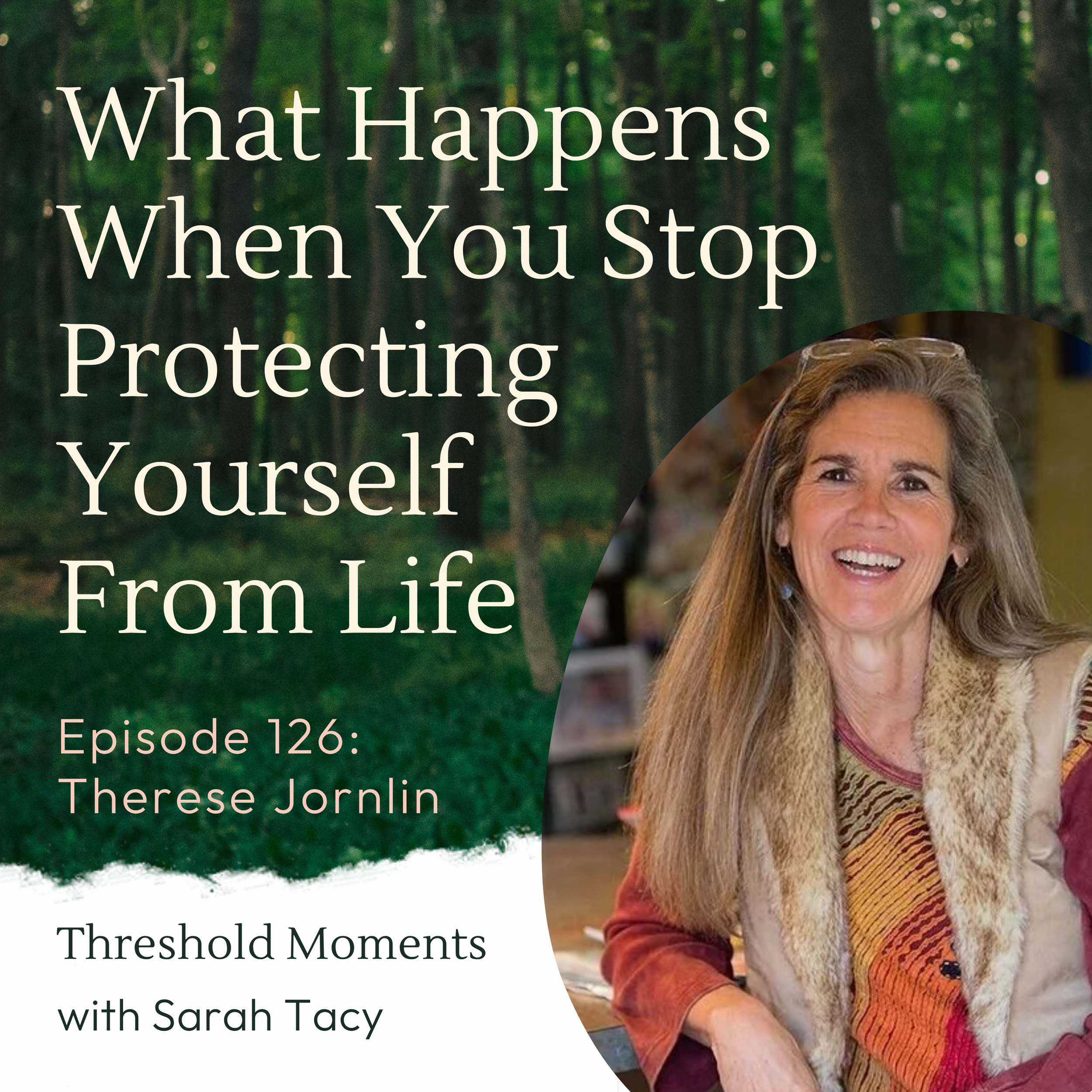
In this deeply reflective conversation, Sarah Tacy sits down with Therese Jornlin to explore a life shaped by threshold moments—those irreversible openings that change how reality is perceived and lived.
Therese shares her early experiences of profound awakening following the sudden death of her father at age 15, describing a piercing sense of love, continuity, and the dissolution of fear around death. From there, her life unfolds as a series of inner calls that eventually lead her to Calcutta at age 21, where she lives and serves alongside the Missionaries of Charity.
In Calcutta, Therese encounters the raw edges of human suffering and devotion—an experience that strips away narrative, identity, and mental certainty. What remains is presence, service, and an embodied confrontation with what it means to be alive in a world of profound disparity.
About the Guest
Therese Jornlin is a holistic health educator, transformational coach, and therapeutic bodywork practitioner with more than 35 years of experience exploring the connection between body, energy, spirit, and matter. Guided by extensive study, global travel, and deep personal practice, she integrates teachings from both Eastern and Western traditions to support embodied empowerment, self-healing, and meaningful connection with others and the earth. She holds a BA from Duke University and an MA from Loyola University, along with numerous certifications in therapeutic modalities including massage therapy, craniosacral work, Reiki, Zero Balancing, Svastha Yoga, QiGong, and integrative wellness programs. Influenced early by service with Mother Teresa’s Missionaries of Charity and later by advanced studies in yoga and women’s embodiment, Therese developed the transformational program Women Awake, focused on healing and empowering individuals and communities. A devoted mother of three, her experience as a single parent deeply informs her compassionate, practical, and heart-centered approach to teaching and healing.
Episode Transcript:
[00:00:00] Hey everybody, I do not want to make you wait much longer. I simply wanna say that you're in for a treat today. There were multiple times where I took a long pause because the words and the story that Therese shares today, Therese Jordan, our guest, needed time to land because I understand what it feels like for a transmission to happen, meaning that behind the story there is an energy that if we can be with the pace of her voice, with the story she's sharing, that there's wisdom that seeps into us.
So a little bit more about Therese. She is a wise woman who has lived so many experiences that most of us will only ever read about, and has done the work [00:01:00] to Allow those experiences to integrate into everyday life. In this episode, she talks about chopping wood and carrying water. And so in this episode, we are going to briefly touch upon the death of her father, which we talked about in episode eighty-six when she was fifteen.
And she also had an experience that feels like a near-death experience as I describe it, but is where, like, the other world opened up to her. And then when that brightness closed down, it's like, "Oh, now back into this real world, and where are the grief ceremonies, and how do I process what just happened?"
And we talk a little bit about death and life, and then move into where she surrounded herself with even more death when she ended up being in service with Mother Teresa at the House of the Dying. And so this episode really touches into how [00:02:00] do we move from the platform of the mind when we are making stories around what should we do, how should we feel, is that good or is that bad, or to stepping off the platform and getting in, getting into the dirt, getting in with the people, and being in aligned action of the heart.
And maybe I would even take out the word aligned and just say being in action through the heart. We get to talk about, structure versus tuning in more to faith and where those things can weave in. So she tells us some miraculous stories that happened at the House of the Dying with Mother Teresa in Calcutta, and she at the end shares a little bit about her experiences with the Great Mother.
So you'll hear her throughout the episode referring to Mother Teresa as Mother, and at the end we hear about the energy and the wisdom and the somatic [00:03:00] experience of the Great Mother. what is so powerful in this episode is that we can take the lessons that Therese has learned throughout her life and use them today, here and now, as reminders of practices to come back to our joy, to come back to our inner wisdom, to, hone our inner light, and to recognize the influence that we all are by tending, as Therese said in the last episode, tending to our birth.
And so I think that this episode is so powerful because it connects to some of the, so much of the pain that's in the world now, but also gives us action steps of how to be with it. Without further ado, I give you Therese Jørgensen.
Sarah Tacy: Welcome to Threshold Moments. I'm here with my friend Therese Jornlin. Therese, I just looked up the last [00:04:00] episode we did together. It was number 86, and it was called Taking Care Of Your Birth. So Therese Jornlin, I... When I think of you, I think of you as a wise woman who has walked this life constantly being open.
Sarah Tacy: Oh, maybe even being open is not the right word, but
Sarah Tacy: receiving and being available to... each time that life has cracked open the perception of reality,the phrase that was coming to me this morning is this phrase about learning by living, and I just feel like you've really lived a life where you are learning along the way and constantly open to, like, what now, what next?
Sarah Tacy: And so due to that, [00:05:00] I perceive your life to be filled with thresholds. Like, it's not like, oh, she had this one threshold and so- Yeah ... that's why we were on. For
Therese Jornlin: sure.
Sarah Tacy: I was like, oh, we could cover these five thresholds. the episode happened in October, and so the theme that month had more to do with death, which is why I was smiling when I saw that the title was Taking Care Of Your Birth.
Sarah Tacy: Because I just- Mm-hmm ... that is very on point with you.
Therese Jornlin: Yes. They are one and the same.
Sarah Tacy: Um, so you and I got together a few weeks ago when I had asked you to come back on the podcast, and originally I thought this was going to be a spring podcast. And I got to come over to your house and sit and sip tea with you.
Therese Jornlin: So great. And I
Sarah Tacy: found this one, uh, impulse or urge in front of me of just like, wait, I really want to hear [00:06:00] about Mother Teresa. I had no idea where on the timeline this life experience fit into your life.
Sarah Tacy: Mm. So what was interesting to me, if I can give a t- like a really quick recap of 86, the last episode, which I highly, highly recommend going back and listening to if you're interested in, the life birth cycle and how connected they are, was that episode really centered around the opening you had when your father-
Therese Jornlin: Mm-hmm
Sarah Tacy: suddenly passed away.
Therese Jornlin: Mm-hmm. Mm-hmm. And
Sarah Tacy: you both seeing the light, literally seeing the light- Mm-hmm. Mm-hmm ...
Therese Jornlin: and
Sarah Tacy: also being in the confusion of there are no grief rituals, this doesn't make sense.
Therese Jornlin: Mm-hmm.
Sarah Tacy: I understand you, you attempt to go back into daily life, [00:07:00] but only a few years later you end up going to India.
Therese Jornlin: Was that- ... I was 15 and then I was there when I was 21. Yeah.
Sarah Tacy: can you tell us a little bit about after having gone through this period, 'cause you went, you went to Duke, correct? Mm-hmm. You played field hockey.
Therese Jornlin: Mm-hmm. And did
Sarah Tacy: incredible um- Mm-hmm ... with school. And so going from this really big experience to being, an achiever ... and then perhaps how that led you into the next step.
Therese Jornlin: Okay. And redirect me as we go if you need.
Therese Jornlin: Yeah. Yeah. Well, first of all, thank you. I so love being with you anytime, to keep the conversation going. You know, it's, it's very, um... It was so, so wonderful to have so much time, you know, that I felt like we entered [00:08:00] into a timeless bubble. So thank you for that. I just want to affirm l- learning by living, despite, looking for someone outside that could tell me, show me, whatever, whether it's a teacher, a monastery, a, a, being a, a man, a chi- it, um...
Therese Jornlin: So that's for sure, uh, true. and then I had to laugh when you said, "Theresa's so cracked." I was like, some people would probably say so and not mean it, you know- ... quite so respectfully. So it's been... what I would say. It's like, the shedding process, you know?
Therese Jornlin: So that's, that's, uh, what I'm so grateful I've, just innately been able to trust even though, it's like labor. It's painful. It's, uh... But it's natural. It's in nature. It's, it's in all of us. so my [00:09:00] father's death, as we talked about, really I had to, I just used this phrase this past weekend talking with an old college friend actually, and I was trying to explain it, and it was almost like his death was so sudden and so traumatic, but I also, um, got to ride on the coattails of his death and have my own version of a near-death experience.
Therese Jornlin: but I didn't go over, so it was like the veil was completely cracked, completely opened, and the awareness was we don't die, and I was 15, you know? So it was an experience of profound... It was the experience of right now, that we are loved, we are creator creating itself. it was, uh, cellular, and then that set me on this, like, whoa.
Therese Jornlin: I would say I started to kind of bifocal. Like, I wasn't gonna talk about that. this is a very long time ago, [00:10:00] 1975, and I just knew to hold it, quietly. So, like, from 15 to- Um, '19 I had another pretty profound experience. I just had all of these organic, I don't know what to, true, natural, supernatural, but not otherworldly.
Therese Jornlin: You know? I, I don't wanna call it otherworldly because, um, it happened in and through my body and in and through my life experience. Uh, the call to Calcutta came, and I didn't know India, I didn't know any- anything. I was at Duke. I was ... I wasn't one that read The New York Times, and, you know, I wasn't up on, on any of that.
Therese Jornlin: But the inner call was to, get in the dirt. That was the guidance, and what that meant was to be in the counterpose of Duke University and, just all that that meant. And f- for me it, it was a guidance to [00:11:00] be with the poor. I was raised very service- my f- we were always doing service projects.
Therese Jornlin: My family was very civic-minded, you know? So, um, it wasn't out of the ordinary, but it, it felt like I needed to go do that for a while. And I, again, I hadn't traveled much or anything like that, I could go into Wilmington, Delaware, where I was from, and I had a whole list on my wall.
Therese Jornlin: it was sort of like a national Peace Corps thing, was VISTA it was called. and I kept looking, and I didn't know how good of a honing device my body was at the time, but that's the way I would, call it now. so I just had this whole list, but nothing was really landing. And then, uh, then I learned of a friend who was going to...
Therese Jornlin: He said, "Guess where I'm going this summer?" "Where?" "I'm going to Calcutta." "Where's that?" And he said, "I'm gonna be, um, working with the Missionaries of Charity who serve the poorest of the poor." And,I was like, "Tell me more." it inaugurated a whole, [00:12:00] process. Uh, yeah, I had another wild thing happen with how I got there, so that's sort of another story.
Therese Jornlin: I got confirmation. It landed in my body, "You're going to India." I had no idea where India was or anything, and thank God I didn't know anything I wouldn't have gone, you know what I mean? If I had known what, what that would be. So I left at the last minute.
Therese Jornlin: A dear friend of mine said, "Can I come for a couple months?" Um, and so she came for, a couple months, which was really, really helpful. But they say, Calcutta assaults the senses, and it was just every, layer of existence was, um, talk about shedding, was affronted, you know, both in something as simple as the smells, um, or, or as dramatic as the poverty, everywhere.
Therese Jornlin: So, um, yeah. That's how I got there.
Sarah Tacy: I found myself, as I was listening to you, when you s- [00:13:00] said kind of offhand, "Another thing happened when I was 19" Mm-hmm.
Therese Jornlin: And
Sarah Tacy: I know that any one of these fit stops, that I, if I were to get off at the stop and go into it, we should like really go into it.
Therese Jornlin: Mm-hmm.
Therese Jornlin: But
Sarah Tacy: it feels important to me i- if you're willing to share a little bit about what happened at 19, and also if you can find any words to describe what it's like to have big experiences... And just to be clear, like the cracking open, for me, the way I see it is, I see it almost like a piece of paper ripping open a little bit, and the piece of paper is the screen your mind looks at, and it rips open, and maybe there's like in your first experience like gold beyond it, and you see all the...
Sarah Tacy: You see th- the other side. But then it closes, and you're back in this realm.
Therese Jornlin: Mm-hmm. Mm-hmm. Mm-hmm. Mm-hmm.
Sarah Tacy: I think that some people have these experiences, whether they're near-death [00:14:00] experiences, uh, psychedelic experiences, and that the integration can be confusing.
Therese Jornlin: Mm-hmm.
Sarah Tacy: So I told you I wanted to talk about, your time in Kolkata, and it feels like a space right here where-
Therese Jornlin: Mm-hmm
Therese Jornlin: it could
Sarah Tacy: be useful even here if you're able to share at all like what it's like
Therese Jornlin: to- Yeah ...
Sarah Tacy: a big experience, and then- Yeah ... but there's like this bifurcation of two parts of you. Yeah.
Therese Jornlin: Yeah, yeah, yeah. That's how it felt initially. I mean, and, and the integration from Kolkata w- was I think probably the biggest integration I've ever had to go through when I came back to the West, you know?
Therese Jornlin: So no, it's definitely, pertinent. Yeah, I feel like w- with that, awakening I'm gonna call it, with my father's death, was, kinda dramatic. It was like a big, you used the word ripping, i- out of, of the veil, and I almost feel like it also matched [00:15:00] the voltage of his death. W- there was a s- a, a, a, a, a, a synchronistic, um, counterpost to the voltage.
Therese Jornlin: It was very big. I didn't doubt it for a second. In fact, it was more real than anything. and yet I had to process, going back to the house and having lost my father and- how we were doing grief, and, you know, it was just like, very confusing. But I, I didn't question what happened to me, and I knew it was, love beyond measure, and I knew we don't die.
Therese Jornlin: so that was just, like, done. But now I'm a person, I'm here , I have to understand, you know? Like, um, and I did have several things happen in between 15 and 19, but again, they weren't as dramatic and, it was almost like I was collecting data, you know? I was, I was like, "Okay, did I make that up?"
Therese Jornlin: You know? Uh, I had, I had some of these things, and pretty [00:16:00] much kept it quiet. I did do writing. Um, and then at 19, it was completely uneventful. I was just leaning against a tree. I was out at a, um, uh, off-campus, I- we were at, at a workshop, and I came out to just lean against a tree and eat lunch.
Therese Jornlin: and it was a deep dive workshop, so it wasn't like, I was in the soup of reflection, and then I'm looking out at my forest right now. I just, there's a forest there, and I was just looking at the forest, and, uh, all of a sudden, the way I, I described it to somebody recently was like the, the forest, all the trees, took their clothes off, you know?
Therese Jornlin: It's like, like, the solid image of the forest, of the trees, and it was like seeing, energy. Mm. And it did not... It was not... It was so kind. It was not... Uh, I know this sounds strange, but it was not dramatic. It wasn't a ripping, it was just like, oof, we're gonna, we're gonna [00:17:00] show you ourselves kind of thing.
Therese Jornlin: It was significant because it felt very affirming. Yeah. Not that I n- I belie- I, I believed. I did not doubt what I saw when I was 15, but it was just like, okay, like, I'm a, I'm a, I'm a hound dog and I'm on the trail, you know? It was like, I'm, I'm, I'm staying with this.
Sarah Tacy: Sounds like to me is, if the first experience was this and that, like- Mm-hmm
Sarah Tacy: the other side and this world, when you look out to the trees and you see them as their vibrational frequency, it to me feels like the marriage of the two here and now.
Therese Jornlin: Yeah. Good. well said. Yeah.
Sarah Tacy: it's being able- Yeah ... to see them not necessarily as it counterposes, but perhaps the effect of a counterpose maybe.
Sarah Tacy: Yeah.
Therese Jornlin: Interesting. Like- Yeah. Yeah. 'Cause I would say it wasn't until I was maybe in my mid-30s that I realized there was nothing outside of me. Mm. I, I have to say, [00:18:00] these experiences did feel outside of me. Yeah. 'Cause they were so- They were so different. and thinking something, some being, some otherworldly something or other is outside me, I, I
Therese Jornlin: Th- that got clear to me in my, in my 30s, when it's like, oh, there's nothing ... It's ins- it's inside me. It's in my DNA. It's in my ... It's in the design of, like the way a computer is coded. It's in, it's in the coding of m- me. How else would I have experienced it? It's me. You know? So I didn't, I didn't get to that articulation that you described really well, until probably my, my mid-30s.
Therese Jornlin: Yeah.
Sarah Tacy: I'm sitting here processing your mid-30s experience, and my mind is like, well, what does that feel like to just know, like, to just know that you're one with everything and everything is you and you're ... Because the day to day,
Sarah Tacy: Do you [00:19:00] experience it as coming in and out of that awareness? Or is it something that you really hold steady in most of the time?
Therese Jornlin: Um, yeah. I think that's the practice. Yeah. You know? If you've been, shown that, the language I'm gonna use is I was shown, what was more true. and then you can't unsee something.
Therese Jornlin: You can't unknow something. And then it, then I just call it l- sort of digestion. Like, it takes a couple hours to digest your food, so it, it, it took quite ... I, I did in my 20s consciously look for a, a teacher or a guide. I had so many things happen to me between 15 and 24. I was like, I, I gotta put some bones to all of this, you know?
Therese Jornlin: I need ... I tried a couple different people, and, yeah. And my journey has been constantly being put back into the teacher, the guide, the guru, the, [00:20:00] the being of, um, of my own biology and my own spirit and, and all of that. I think that, that experience, though, led me, set my path.
Therese Jornlin: Like, it opened up the path that I'm to be on, and then that attracted, different ... You know, I got involved in body work, 'cause I knew there was a relationship between the spirit and the body. how is energy in form? I had that thing happen with the trees. Like, I saw the energy. Well, how does it form?
Therese Jornlin: so- My, my left brain kicked in with I wanna understand, and I think that's important. That's a lot of what this dimension's about, you know, and it's part of integration. And that, um, brought me, studying, m- tons of different kinds of body work therapies, and it brought me into somatic energy work, and it brought me into...
Therese Jornlin: I lived in India a second time, and I was studying with, a incredible premier yoga teacher who I wanna... AG Mohan. [00:21:00] A lot got awakened, that was in my mid-30s, and that, that was when, okay, this is ancient technology. Th- we in the West are pretty young, I am tapping into that.
Therese Jornlin: And then there's what I call the cultivation. Then you have to do the cultivations, the practices. and if we don't align and follow those, those inner lighthouses, those inner awakenings, the culture that aligns with that light on the inside is there. It's already here. We're already awake, you know?
Therese Jornlin: And I need to take time to build that inner culture. otherwise, the outer culture, will tell me who I am. It must, you know? if there's a vacuum, it's gonna be filled. So that's what I would say. I would say it's... From then on, it was the work of chop wood, carry water, and I was blessed to be connected in with some of these ancient traditions.
Therese Jornlin: So Svasta Yoga and [00:22:00] medical qigong have been just key, practices, home bases, that help steady, these things, 'cause the concern with psychedelics is it's efficient, and it's so helpful. Um, but without the stabilization of the new bandwidths, it can be problematic.
Therese Jornlin: We need to go through the whole cycle, as we talked about before. Yeah.
Sarah Tacy: So many places I wanna go here. There's a nagging part, like, on my left shoulder that's like, "Hey, you, you geared everybody up for the calcotic conversation." Yeah,
Therese Jornlin: yeah. So many places
Sarah Tacy: what I'm taking is building the inner scaffolding, and when I think of mirror neurons How easily we can mirror the things around us, like what are we choosing to mirror?
Sarah Tacy: But also I'm thinking about the inner work of the, the chop wood, carry water, the inner scaffolding.
Therese Jornlin: Exactly.
Sarah Tacy: are our mirror neurons able to take that- [00:23:00]
Therese Jornlin: Right ...
Sarah Tacy: and build architecture off that instead of everything we're seeing around us? Right. Because the input is so great from the outside.
Sarah Tacy: Right. Right. And so it's a really good reminder for me, and it helps me get out of the... Wishful thinking is not the right word, but the like, oh, is there just some day where you have an awakening and then you just live with that? And chop wood, carry water, do the practices- Mm-hmm ... build the scaffolding.
Sarah Tacy: Mm-hmm. And what I love about that is that you can fall away from it and come back, and fall away and come back,
Therese Jornlin: Mm-hmm. Mm-hmm ... um,
Sarah Tacy: And so I'm loving all of that, and I'm also hearing that every time that one of these experiences happened with you, through you, that it guided you to the next thing.
Sarah Tacy: And so where you are going, before I ask you to take a left turn - Mm-hmm. Mm-hmm ... uh, was that you were on your way to Calcutta. Mm-hmm. And what I didn't know from our first story [00:24:00] is you went with two friends?
Therese Jornlin: Uh, no. Okay One friend came literally at that, at the last minute, 'cause I was going, but I, you know, it wasn't until about three months before I left that I didn't know she had just...
Therese Jornlin: I didn't know who she was. I wasn't going for her. Um, that she had won the Nobel Peace Prize, and then this friend, you know, said, "Can I come for a couple weeks or a couple months?" And, I was gonna stay. I had an intuition before I left, like I'm gonna need more time. Thank God I, I did. Even though it's was hard,
Therese Jornlin: It would've been really incomplete. So I was able to stay about seven months. yeah. So we, yeah, we left, and our experiences were so, so, so different. She laughs 'cause she said, "Because I compartmentalize." And I'm like, "I don't know how to do that," you know? So, and because of that, it was, devastating.
Therese Jornlin: Mm. Devastating. Um, yeah, to, uh, [00:25:00] just be... and such a sh- at 21 years old, in a very insular, family and lifestyle. And, now I think how are we doing college, you know? We should be having these different experiences, whether it's in our own state or whatever. There's so many different cultures and countries and experiences just to hone us,
Therese Jornlin: So when I look back at the whole seven months, what I say is, It was like speed therapy. it's sort of like what I would have gone through in the 20s, what you, you know, develop, and then in the 30s you realize, okay, that's not quite it, and then that goes away and, oh, I thought it was this, and I thought it was money, and I thought it was da, da, da.
Therese Jornlin: I- it's almost like it all, like, happened, quickly. So it was a, it was a massive... I've had a couple big dismemberments. It was a, a m- major, um, being, being disoriented, [00:26:00] being shed. Everything was made clear about what's, lasts, and it's very simple. It's not so all of my training and ambition just got s- spit out like a bug,
Therese Jornlin: so it ma- it made returning probably harder than going, actually. Uh, but it also ga- it took my... it took the encasements around my heart and gave me my heart. Um, and it was from just being with, especially the first day, I think we might have talked about the Home for the Dying. so many of the things that people are, sick from or dying of are related to the first world, you know?
Therese Jornlin: So that we're consuming two-thirds of the world's resources and I'm seeing the impact of that. So there was a- Wow ... we had just gotten there. Mother said, "Go to the Home for the Dying," which is what I had planned on doing, and, we're in these little buses with the nuns going there, and you're just seeing, like, so much.
Therese Jornlin: Like, the streets are overwhelming [00:27:00] enough, and we get tothe i- interesting, it's the Kali Temple, you know, the goddess of destruction that destroys what's g- har- going to harm you. they had an annex next to the temple that she, they let her use for the Home for the Dying. So we walk in, and green, just this green, green little young Westerner girl, you know?
Therese Jornlin: You probably don't know, but I used to say it was like these old movies called Gidget Goes to the Beach. it was like Gidget goes to India. I mean, I was so s- how green I was and innocent was actually helpful because it made it very dramatic because I, I was like, "Oh my God."
Therese Jornlin: And we're standing on this platform overlooking this long room, with all these floor beds- On the floor, and then there was a tier, and then all these other floor beds. And Sister Luke, who was so hilarious, she's [00:28:00] yelling. It's so much commotion in the place, and she goes, "This is the men's, this is the men's ward, and over there is the women's ward.
Therese Jornlin: if we have medicines, give. If not, give TLC. Bottom tier is death row. Top tier, they have a better chance of m- making it. So we bathe. The morgue is over there." And I could hardly process even what she was saying. I was like, my stomach was ... I thought I was gonna throw up. these people all look like skeletons.
Therese Jornlin: There was not, so malnourished. And, so I'm starting to get tears in my eyes, and I also had this five-second thing of, like, "Where's the plane? I can't do this," you know? And I felt like the whole world's suffering was in this room, and I, as a Westerner, and I didn't have any of this language, but I definitely could see the relationship between the body of the Earth and the different cultures unconsciously influencing each other by our choices, by how we're living in [00:29:00] sync with nature or not.
Therese Jornlin: And I was about to cry. She saw that I was crying, about to cry, and 'cause she was tough and hilarious and a huge heart, and to get me awake, she smacked me and she said, "Hey, hey, hey. Get to work." Which was perfect because what happened is I was looking at a National Geographic picture, you know?
Therese Jornlin: it flooded me with all kinds of insights. Uh, but as soon as I got off of the platform and started walking, among the people, it became real. And over time, I had real trouble in the beginning, staying there. I just couldn't, I couldn't compartmentalize, you know?
Therese Jornlin: Uh, and so Mother actually recommended I go to, the orphanage and this, clinic, outdoor clinic. So I actually did do that for a few months, and then eventually went back to the, home for the dying. so once you got among the people, just how some were easier than others, [00:30:00] you know?
Therese Jornlin: Some ... it became a human, experience. yeah, just pro- profound things that happened, at all the places I got to work, but in the home for the dying big time. And of course, I'm carrying this death thing. Like, I smothered myself in death is what I did,
Sarah Tacy: There seems to be real symbolism of getting off the platform.
Therese Jornlin: Mm-hmm.
Sarah Tacy: And then- Yeah ... the action. I'm so curious about that because in the work I do, we do slow down. Mm-hmm. We slow down to, to feel the moment, to bring in, you know, layers of support, which may be, uh, sensing ancestors. It may be widening the perception of the moment. And considering all that's happening in the world right now, which I assume a lot of hard things are happening in the world all the time, and we didn't always know about it.
Therese Jornlin: Mm.
Sarah Tacy: There's something about actually being there- [00:31:00] Mm-hmm ... I imagine, and being able to take proactive action that is in communion and in service that weaves us into the fabric of the moment, that I think living here, I live in the United States, you and I do right now, and seeing things abroad can feel very- Right
Sarah Tacy: disorienting of like, well, what can I do from here? And I just wonder if it's a much different feeling... And not saying I heard you use the word devastating, so I'm not trying to then, like, you know, whitewash it and say, like, oh, that's better to be there. But something about being able to, as you said earlier, like, get dirty, get in there, get off the platform- Yes
Sarah Tacy: and be with the people.
Therese Jornlin: Yes. So if I had to use another analogy for the platform, it was get out of the story. [00:32:00]
Sarah Tacy: Mm. Whoa. Yep.
Therese Jornlin: Get underneath the narratives. You can have them. I was having all sorts of things coming in, but what that did is it immobilized me.
Sarah Tacy: Whoa.
Therese Jornlin: Which is why she smacked me, you know?
Therese Jornlin: Yeah. It immobilized me, and I lost sight that any of my narratives or any of my perceptions, what I now call is talk for sport. Mm. We're just talking for sport. I don't know. I can't know. One person can't know, but we are so storied, and allowing our energies to be controlled, by my story, her story, his story, the stories of geopolitics, uh, et cetera.
Therese Jornlin: it's important to learn and to study, but what I think can happen is it [00:33:00] usurps, um, the truth of the heart and our connection as human beings. It, it takes over. So you get off the platform. Hold your narratives, keep learning, 'cause the narratives, but be willing to have your narrative exploded. I've had mine exploded many times, thanks be to creator.
Therese Jornlin: it's, and that's not, where it's at. So you get down off the platform, start working with the people, start having days where I was tired. I didn't w- wanna be there. It was hard to bathe them, and then feel, then I have to decide, am I gonna feel bad about that?
Therese Jornlin: Am I gonna, feel guilty about that? it just beat the you know what out of me. I mean, it just... Because none of that was useful. None of it. Mm-hmm. So I, a- and then thank goodness I was there for a long time, so I, I couldn't continue it.
Therese Jornlin: And those things wear themselves out. These thoughts, beliefs, they have an expiration date. I was very blessed to be [00:34:00] in a circumstance where I hit the expiration date on a lot of them. You know, where what's right, what's wrong, I should be... Yes, the narratives need to happen, and the reflections, but stay in the heart, stay in the flesh, stay in contact.
Therese Jornlin: We are, we are one human. There's one human here. Why are there... We are one, one being, you know? so stabilizing, which again, I was so glad I could be there for a while, because I was so destabilized, and that destabilization allowed a tremendous amount of, inbreakings to come, and then stabilize. So for what's happening today, I thank God for so many decades of this, the most important thing, whether I'm writing letters or attending rallies or, down in DC or, on podcasts, whatever I'm doing, is this, this vessel [00:35:00] here, is my greatest offering to the field.
Therese Jornlin: And so what vibration am I generating? And I need to be, first is paying attention to the war within myself. Where, where are there dissonant, um, where's there othering happening in, in myself? And it's happening in all of us. And so do my practice, I get outside, lay belly on the ground, It's simple.
Therese Jornlin: We, we make it very, we make it very complicated, Life, is complex in a beautiful divine design kind of way, but it's actually not complicated, you know?
Sarah Tacy: We- I, uh, I think you and I spoke about this. I know you and I both love to just dance hard- Mm-hmm ... just to move our bodies. Um- The best
Therese Jornlin: prayer.
Sarah Tacy: Yeah. a few years ago I was writing a newsletter and
Sarah Tacy: This is not what the person said, but this is what I took from it, is, like, what ways am I making it, or does the society make [00:36:00] it more complicated, more in the head verse the things that our ancestors have always known to do?
Therese Jornlin: Mm.
Sarah Tacy: Gather, breathe together- Right. Mm ... drum together- Mm-hmm ... build a fire- Mm-hmm ... to tell stories, get your feet on the earth, dance, dance for hours- Mm-hmm
Therese Jornlin: eat
Sarah Tacy: together.
Therese Jornlin: Mm-hmm.
Sarah Tacy: Move your body, right? Like, these things that there are some really cool resets that you can do for your vagus nerve, but, so many of the things we actually naturally do. We naturally put our hands on our heart, and now we can be like, "Oh, the vagus nerve goes through the heart."
Sarah Tacy: Yeah. Or we naturally press different places on our face, but it's like our bodies know, and it isn't that complicated.
Therese Jornlin: Right, and it's creating a field. So the next step, when you're engaging in making a fire, have dinner with friends, your body will give you... your physiology will show you when you're in coherence by- Yeah
Therese Jornlin: the [00:37:00] redness that shows up in your face, by the length of the breath, by that relaxation that we all have felt, you know, on a vacation or something like that. So it will show you that. But the next, the next level of consciousness is to know that that is happening, versus when I'm just with friends or when I'm holding a retreat space or something, um, it's a whole other thing to be conscious that I'm conscious, to be conscious that I am in a state of joy.
Therese Jornlin: Because I was hearing someone the other day like, "I feel guilty feeling joy." It's like, no, more joy, because it's a frequency change, and whatever we're in right now is the old frequency, if I wanna use that language, um, has served us life, and boy, is it ever... You know, whatever toxins are there are coming out, just like they do in my body.
Therese Jornlin: Mm. You know, if I've got an infection or something. So we need to be doing the both/and, and, and really generating that higher [00:38:00] frequency so that when I'm dancing I'm not... And, and I've been told this in meditation, you are not... Laughing is not just laughing. Dancing is not just dancing. So there's a point where, if I'm lucky, I get to lose my mind in the dance.
Therese Jornlin: Mm. Mm. And then I'm praying, and then it's just like take, take this, take this energy. And I'm it is over the Middle East. I'm not paying any attention to... That intelligence knows what to do. we have a coherent circle here that we're doing it on purpose. So there's the next level of consciousness to know, uh, that it has a huge impact.
Therese Jornlin: Um, and it's not just something sweet and nice. It's everything, actually, you know?
Sarah Tacy: I take these long pauses because it's really landing with me.
Therese Jornlin: Mm-hmm.
Sarah Tacy: Yeah. Yeah.
Therese Jornlin: Like, if I imagine the work you're [00:39:00] doing, something I wanna do with groups who are already creating coherent fields. Mm. I'm thinking of a, a yoga class or a sound bowl healing or something like that. These, these people, facilitators, got into this work, how to help us reconnect with that original passion, that original call.
Therese Jornlin: you're creating coherent fields. How do we take 5, 10 minutes at the end of that, coherent, coherence experience to drop in as one body to vibrate, just pulse. it knows where to go, but we do it consciously. Versus just creating a coherent field and everybody leaves the class feeling really good, and their families are definitely enhanced by it, but we're way powerful.
Therese Jornlin: Mm. We can stop war and natural disaster, but not... You know, we need to gather and have that added little, pop [00:40:00] into helping people be conscious collectively of their impact.
Sarah Tacy: This is gonna be same, same, but different. Again, when I do somatic work, We start with stability, so whether it's outside the body, inside the body, sometimes looking for both.
Sarah Tacy: Generally, Before we go into looking for, wherever their story lands in their body, it'll be can we find stability anywhere in the body?
Therese Jornlin: Mm.
Sarah Tacy: Then, you know, someone might be like, "My sits bone," or, "My elbow." And instead of moving on, I get curious about amplifying the field, just like-
Therese Jornlin: Right
Sarah Tacy: what does that feel like? Is there a color? Is there a, a texture? Is there- a vibration because you get to take that with you wherever it is. But to amplify, whether it's amplifying the joy or amplifying the stability, it's already there, and to turn that up a little bit more-
Therese Jornlin: Right ...
Sarah Tacy: to buoy [00:41:00] us as we navigate everything else that's also showing up, that's also there.
Sarah Tacy: So it's not, only focusing on that because the rest doesn't e- doesn't exist, but to actually, amplify-
Therese Jornlin: Right ...
Sarah Tacy: and to bring awareness to it. And what I'm hearing what you're saying is, like, as we gather, as we make coherent fields, to take the time to really amplify that so we notice it, feel it, and can expand
Therese Jornlin: it.
Therese Jornlin: Right. Right. And as a group, it's a different, it's a different thing. I was just in California, and the redwoods, you know, have such a shallow root system, but they're 2,000 years old because they grow another child. They're in clusters. You know? So there's, there's this ability to become, uh...
Therese Jornlin: I think of it as like the GE power plant. when I'm... I, I do my practice on my own, but when we gather together with that intention, and are a [00:42:00] batch of redwoods, you know, uh, we're creating a much larger, coherent field that is nourishing me while it in its brilliant intelligence is impacting the waters in a way I don't need to unders- even understand.
Therese Jornlin: Mm-hmm. Uh, i- i- impacting the land, human beings, you know? Yeah.
Sarah Tacy: Were you able to access any of this while you were in Calcutta?
Therese Jornlin: Yeah. As we're talking here I'm once again thanking Calcutta, because, it was like being taken to just, being forced to go to an incredibly deep well. Hmm. A super, super deep well that took a very long time to, stabilize.
Therese Jornlin: I have had that experience with some, some... n- not a lot, but with a couple plant medicine experiences. It was like, oh, this is gonna take a couple years, to stabilize this. Yeah. so Calcutta for sure, began that. But Returning to the West, and [00:43:00] I felt guided to come back to the West, 'cause I was contemplating staying.
Therese Jornlin: It was very scary because I, I died in Calcutta. You know what I mean? Like, that person's gone, and I just don't... How am I gonna do this back here? And the thing that kept me, able to do it is I knew I was to be there, and sometimes that was all I knew. I... things weren't opening up, weren't working out. I didn't know where to go.
Therese Jornlin: I didn't know why I'm here. I didn't know... I knew why I'm here, but I didn't know what the form to take. Well, I know it was very clear that I'm supposed to be in the West here, and then trust, follow the path. Mm. Mm-hmm. But the stabilization is what I was looking for in a teacher.
Therese Jornlin: I kept saying, "I need some structure to put all of these experiences on," you know?
Sarah Tacy: So this is funny, not funny, and maybe you can clarify, but you told me a story about how disorganized things were, [00:44:00] and how- Oh, God. You went up to Mother Teresa and said something like- It's classic ... I could create a handbook- Yeah
Sarah Tacy: so that when people come- I... Yeah, yeah ... they know where to eat. They know- Yeah ... where to go. They know where... I know. So as you say, like, you're going somewhere to find stability.
Therese Jornlin: Yeah.
Sarah Tacy: The irony-
Therese Jornlin: I know ... that the person who found- Well, it's sort of the both and. Yeah. It's like they could use to be more organized.
Therese Jornlin: So that's the invitation, is where am I not holding both and how do I hold both and, you know? So I get there. All these volunteers are coming from all over the world, doctors, nurses, and all of us were just sort of in shock, you know? And we're staying at, the Y, the Salvation Army, you know, really...
Therese Jornlin: and that was amazing, but we're all in a good bit of shock. And then your personal body, like, where do you eat? Where do you get toilet paper? Where do you get the bus to, to Kalighat? So in my distress, because in those beginning weeks, I was just blown apart. So I remember after [00:45:00] mass one day, I asked her with several of the volunteers, if we could write up a, a booklet
Therese Jornlin: 'Cause they're coming and going, you know? So that it's in the Y, it's at the Salvation Army, and they can see and save time, and then you can really utilize them. And, and she's like, not... You know, she's, she's sort of shrugging her shoulders, kind of just buying, giving me time. And, uh, she goes, "Well, okay."
Therese Jornlin: Um, and then she takes her hand, like writing a pencil, She goes, "As long as you write it with a pen." And I'm like, "Fine. Who cares? Yes, okay. I'll do it with a pen." And, versus type it or something. Okay. So we worked six weeks on this, and when I think back to it, it w- it did help create an organizing principle, but I was on the platform.
Therese Jornlin: I was in the mind. I was in, like, okay, this will... Like, what Americans are so good at, structure, order, you know, um, creating systems. so yes, and, I also was [00:46:00] just madly trying not to feel all of this. It helped me, but- how often we lose our way in creating that, right? So we finished the booklet. so s- after mass in the morning, I come up to her and I said, "Here's the booklet.
Therese Jornlin: We, we have it finished," and she kind of holds it like, whatever, you know, just, just courteous. And she says, "You know, they call us the most disorganized organization in all the world." And I'm like inside going like, "Yeah." And it's kind of driving me nuts. And, uh, and she said, "But we have to stay," and her hands were sort of like waving in the air.
Therese Jornlin: She goes, "We have to stay a little, uh, disorganized." and I'm thinking, "What are you saying? you have so much potential here, you know?" "We have to stay a little disorganized, otherwise we'll become lost in the rules and the procedures of things and in trying to stay organized, and we won't be [00:47:00] open to, God's work."
Therese Jornlin: And for her that meant... And I saw so much magic happen, so, so much. Just when we needed clothes, clothes would arrive. Just when we ran out of food, more food would come. it's not my style. and yet it really was a profound, teaching, for me, not to give up the structure, 'cause I think the booklet helped, but I could see where, "Oh, okay.
Therese Jornlin: I get, I get what you're saying,"
Sarah Tacy: I'm thinking about when, I did a lot of yoga. We'll start with I, I was an athlete, so I did a lot of lifting first, and when I did a lot of lifting without any stretching- Mm ... or mobilization, I could feel in my physiology and in my perception that things begin to tighten and become more rigid.
Sarah Tacy: Mm-hmm. And so there's power and strength and stability, but everything gets more rigid. And then when I moved to more of a full yoga practice, everything got so [00:48:00] flowy.
Therese Jornlin: Yeah. Right. And then I
Sarah Tacy: was like, "Oh, I could really-" Yep.
Therese Jornlin: I get that.
Sarah Tacy: Right? And so, uh, I had Kate Northrup on the podcast the other week, and sh- it's funny 'cause she was also talking about the, the idea of voltage and, having this yin and yang and how to have usable power.
Sarah Tacy: And she was saying, 'cause I know you and I are both, like, reaching out to, to teammates now, that we can have those parts in our ecosystem, that we don't have to hold-
Therese Jornlin: Yes, please ... each part.
Sarah Tacy: So, like- Yes ... yes, systems and structure aren't natural to me. Mm-hmm.
Therese Jornlin: Uh,
Sarah Tacy: and I can learn and turn the volume up on that a bit, and having somebody on my team- or in my life or in my household or a friend- Mm-hmm
Sarah Tacy: who is really good at, thinking about, Ginny is really good at planning things, and she knows when things happen. So be like, "Hey- Mm-hmm ... can you just give me a tap when, like, it's [00:49:00] time- Yeah ... to sign up for things or whatever. Right. And so the ecosystem within, but also the ecosystem we create around us.
Sarah Tacy: And then the part I'd love for you to also share is about the praying to the Great Mother. Did I hear- Mm ... that right in your original story, that when she was, like, that part of the not relying on systems-
Therese Jornlin: Yeah. Yeah ... relying on faith
Sarah Tacy: and, the- Yeah ... what might happen after? I had so much
Therese Jornlin: happen.
Sarah Tacy: Yeah. I had
Therese Jornlin: so much happen with the Great Mother.
Therese Jornlin: That was, that was a- another, vision comfort. it happened to me personally, but her, um, m- m- multiple times, we, we would, uh... You know, she... they would pray. Uh, you know, that, uh, uh, Hail Mary. So this was, um... I'll try to make it short, but it was w- dramatic. we're in the home for the dying.
Therese Jornlin: It's Christmas. all the [00:50:00] people, in the area know that, Christians give out more stuff at Christmas, right? So they're all re- get ready. We had created, um, almost, 1,000 bundles of clothing- Wow ... for weeks, prior, and it was up on the roof of, the home for the dying.
Therese Jornlin: So they're all given these tickets over this period of time. short story is we realized that we gave out more tickets than bundles of clothes, and we're kind of in a mob scene. Now mind you, the men's ward is still there. You know, the, the women's ward's there. We've got bundles on the roof. We've got th- 1,000 people outside waiting to get food, so it was really cha- chaotic, potential tinder- tinder box.
Therese Jornlin: so we find out we need 500 more bundles, and we're thinking, "Okay, we'll take apart..." Us Westerners, we're like- Yeah ... "We'll take apart these bundles here. People don't mind waiting, and we'll resort and make less clothes," da da da da. And Sister Luke goes, uh, um... Now again, I can't... I can still [00:51:00] hear the cacophony of noise.
Therese Jornlin: It was so loud inside, outside. And she's like, "No, no, no. We, we pray," and she points to the plastic statue of Mary. So we all go over there and- This, I was used to this now, but this one was pretty dramatic. And so, you know, Hail Mary full of grace, we're doing the thing amidst all this noise, and then a guy comes in from the front and he taps her and he says, "Sister Luke," and she says, "Shut up, man.
Therese Jornlin: I'm praying. Shut up," you know? And, and so we're, "Blah, blah, blah, Hail Mary, blah, blah, blah, blah," and he keeps tapping her and she keeps sort of smacking him away. And, "Hail Mary, blah, blah, blah," and he goes, "Sister, there's, there's a bus outside with clothes from the mother house. What should I do?" So this whole bus had come in with, It was like fish and loaves, you know what I mean?more clothes than what we could do. And, and that was quite dramatic, but I saw instances of that o- over and over and over again. And, and my life has been very [00:52:00] much, very much that, how do we create those cultivations for people so that they clear up the path to their inner GPS system, to really learn to trust, their, their own inner guidance and then, call to themselves, teachers, beings, friends who are in resonance to serve as the ecosystem of, of guidance, to be the guide.
Therese Jornlin: So even though the world is saying you should be doing this, yes, you listen to that. There's so many times I'm like, "I'm crazy. What am I doing," you know? And I have to check the ground with my, with my feet, you know? It's like, okay, there's a... There's air here. And it's like, no, damn, there's ground there.
Therese Jornlin: Mm-hmm. But it's going against the grain or something. So, um, and that, in many ways, is also how I got to Calcutta, 'cause there was a lot of disturbance, you know, from family and my own psyche and fears before I went. But there was... there's a beacon, there's a light inside that it's our [00:53:00] responsibility to, keep it, um, polish it, you know?
Therese Jornlin: and stay in touch with it amidst, amidst storms and dismemberment and heavy labor, All of that.
Sarah Tacy: Can you tell me a little bit or a lot bit, wherever you wanna go, about... There are two things I wanna know. Your experience with the Great Mother. You said that- Mm-hmm ... you had some experiences.
Sarah Tacy: And for me, I don't feel like I have a clear relationship with her or that energy.
Therese Jornlin: In
Sarah Tacy: a way where I'd be like, "I know what you're talking about. Oh my God, me too," all the time. Mm. But sometimes when someone can name something and explain it, I've experienced in the past where it's like, oh wait, I remember that, or I've felt that, or it can start to, just like you talked about, like GPS points or little points of data.
Sarah Tacy: I'm wondering if you could share a little bit [00:54:00] about your experience.
Therese Jornlin: Mm.
Therese Jornlin: You've knocked on my closet door. This is the closet inside the closet. Um, yeah, out of, out of regard, out of respect for, probably the primary relationship in my life, um, I'm, I'm gonna save it for another three-hour talk with you, or another podcast or something. But what I can say is, what I realized in Calcutta when I...
Therese Jornlin: so it was those first three weeks that I was there, those first four weeks that were just so intense and, and I knew I couldn't get back on the plane, thank goodness. You know, I saw all these businessmen coming in, staying the weekend, and I was like, "I don't, I don't blame you for staying in your hotel.
Therese Jornlin: You know, just stay in your hotel and then leave." But I couldn't leave. I also knew that I would never be able to leave, [00:55:00] even though I would come home, you know? And I, I just couldn't, couldn't get it together. And so there was a church at the end of the, street where I lived, and I, I literally would just, crawl, crawl there at the end of the day and just...
Therese Jornlin: It was the closest thing I could get to an airport, you know? I could... Um, I didn't have anything in me to... I just would sit there, like, "Help," you know? I, I, I'm here for a long time and I had an experience that was very somatic, it was not, visual, A friend gave me a rosary before I left, so I wasn't raised in a Catholic school, so I didn't know how to say the ros- my relationship with the rosary was Italian ladies in the front pew of church do- you know, doing whatever.
Therese Jornlin: Um, I did know the Hail Mary, But this friend, this dear, you know, very devout Catholic, um, woman gave me this rosary. It was like a talisman. I kept it- In my pocket, and, [00:56:00] uh, and I remember taking it out. Now I know what mala beads are, but they were kind of just, like, rubbing. I would just rub, rub these things.
Therese Jornlin: And I have to m- really reflect on the words for this, but it was a, experience of being completely, encloaked. Mm-hmm. I was just completely encloaked and not even, uh, aware that I was aware I was being encloaked. it was just this most, um,
Therese Jornlin: gentle, but that's the wrong word. Um, safe, secure, eternal, encloaking. I was rubbing these b- beads. I did know the Hail Mary, and I'm humming something. And when I opened my eyes, I went in there around 3:30. When I opened my eyes, it was 6:30, and I, it was that [00:57:00] feeling of, a plane landing, returning
Therese Jornlin: Like, I did go to the airport, you know? I was in another elevation or something. But I was so... It was s- I was having such a hard time. and so that, that experience was very akin to that first experience I had when I was 15 that was more dramatic, but that was the mother. It was the mother that was just like all there is this luminous, love, eternal this is who you are.
Therese Jornlin: It was, it was absolutely the mother. And the m- now that I've studied yoga and Shakti and Shiva and... It is the creator. The creator is the mother. The pater, the father, the paternal is the pattern. The mater, the matter, the material is the mother, is Shakti. Mm. I had multiple, experiences.
Therese Jornlin: That, that cloak, that [00:58:00] encloaking had just, always been with me, and then I had several other, experiences with her that were very, very tangible. If I write a book, that's the book I have to write. Mm-hmm. Because the, what's happening in the world today is, the mother, the creator, the right order of creation.
Therese Jornlin: We are here to pr- To put things in right order, I mean that in the Buddhist sense, in myself, where Shakti and Shiva, structure and form- formlessness, cohabitate and vibrate, in a dynamic. And we are so, so out of balance, and out of balance or incoherence is the greatest, fastest guide back into coherence.
Therese Jornlin: So our task, my task, o- one of the main reasons I'm on the planet, is to bring the mother back into the center of the creative wheel of life. And if we take that a step further [00:59:00] is put the womb, the womb back in, in the center. Our first home from which all things come. All, all women are connected to the cosmic womb from which all things are created.
Therese Jornlin: So imagine women knowing that. Mm. And that was definitely seeded. So much was seeded, or brought home when I was in Kolkata, you know?
Sarah Tacy: As I hear you say womb, I had an experience of feeling like something was cleared from my body, and I was with a woman who was guiding me through this process, and I couldn't find myself within myself, and she started speaking another language and going over my body.
Sarah Tacy: And as she did, I could feel myself return into myself. [01:00:00] And the first line was Avinu Malkeinu. Mm-hmm.
Therese Jornlin: And like...
Sarah Tacy: And it's the Ab, the Abba. Mm-hmm. Father. Mm-hmm. Womb. Mm-hmm. So instead of father, so it's the first line of the Lord's Prayer in Aramaic.
Therese Jornlin: Mm-hmm.
Sarah Tacy: And instead of, um, it being something about father, right?
Sarah Tacy: It's- Mm-hmm ... father, mother, father, womb.
Therese Jornlin: Yes. Creator
Sarah Tacy: of the cosmos.
Therese Jornlin: Yes.
Sarah Tacy: The vibration, and like the, the, that name, like hallowed be thy name is, name is really like vibration in that language.
Therese Jornlin: Yeah.
Sarah Tacy: And how much that prayer really- That's who we are ... like how much of the feminine is included in it, in the first word.
Sarah Tacy: Womb is right in there.
Therese Jornlin: Yeah. Yeah, yeah, yeah. And that's what's rebalancing with us or without us. Mm-hmm. Yeah. It's the nature. It's our nature, and it sounds, like, cosmic and out there. Well, we are cosmic. [01:01:00] We are galactic. We are terrestrial. Yeah. It's, it's, um, our nature. Yeah. And the Earth is having her experience, you know?
Therese Jornlin: she is the... The mater, the matter, the Gaia that we, besides our womb, that gives us a connection- Mm ... to, the mother. so her body is evolving, and is still actualizing, um, herself, of which every human being is a key player in helping, that evolution. You know, this is where, they... I, I always look at words, and I, like, wanna, I wanna do a thing on recl- reclaiming words that have been co-opted, and one word that has been co-opted is influencer.
Therese Jornlin: Mm. When I first heard that, I was like, "What is [01:02:00] that?" You know? Influencer. It's like every human being is an influencer. Every single one right now is emitting one thing or another.
Sarah Tacy: Yes. And it is
Therese Jornlin: impacting her body. Yes. it is impacting my body. somebody in Canada, in Quebec right So that's what I learned about I'll never be able to leave Calcutta, because I couldn't, uh...
Therese Jornlin: or I'm c- connected, you know? Mm-hmm. Yeah. We're all connected. We're all influencing each other. Connected. And how are we using that influence? Mm-hmm. Mm-hmm.
Sarah Tacy: And so that goes right into the idea of magnetism. increase your magnetism. We're all magnetic.
Therese Jornlin: Exactly.
Sarah Tacy: What are we magnetizing? What are we putting out?
Sarah Tacy: What are we influencing?
Therese Jornlin: Mm-hmm.
Sarah Tacy: It's a powerful thing to remember.
Therese Jornlin: Yeah. Yeah. And so- It's the primary thing to remember. Yeah. Yeah,
Sarah Tacy: that's my point.
Therese Jornlin: It's o- it's my only offering, [01:03:00] truly. That's where we go back to taking care of your birth. It's actually my o- my only true offering is to take care of this, inner culture, of this terrain, because of how influential it is- Mm
Therese Jornlin: uh, um, on the planet, to the planet, with other human beings, to all my organs, you know? Yeah.
Sarah Tacy: Thank you, Therese.
Therese Jornlin: Yeah. Thank you.
Sarah Tacy: Thank you. So I just, as I was listening to you today, I was like this is so generous of you to take this time to come on to, come onto the podcast, and I- Mm ... every time I sit with you, whether it's, at your house with a cup of tea or, here on the podcast,
Sarah Tacy: I feel the wisdom. I feel a transmission, and I know that it's bigger than words. And going back to the idea of [01:04:00] amplifying it, there's that part of me that- hopes that my cells will remember, and I also know I can let go of needing to, hold on to the remembering. but I know that something...
Sarah Tacy: Although you've shared so much wisdom, I I feel, a transmission of remembering, if
Therese Jornlin: that makes sense. Mm. Oh, awesome. Yeah, yeah, yeah. And for me too, you know? That's what I mean. It's this incredible... when we're in this, flow state, there's an incredible reciprocity that happens that expands my state.
Therese Jornlin: So we need each other. I need, I need you. I'm- I've been so blessed by your questions and, like, all of a sudden we're down this hole. we're on this cloud, we're at that table. Oh, it's wonderful. I feel so grateful. Yeah. Thank you.
Sarah Tacy: Thank you.
Therese Jornlin: Mm-hmm.
Sarah Tacy: Thank you to everyone here [01:05:00] listening. Uh, Therese, is there anywhere that people could find you if they want to learn more about- Mm ... your offerings or your teachings, where they could work with you?
Therese Jornlin: Yeah. Thanks. Um, I am... We talked about the ecosystem, you know. I, I finally have, uh, some help and renovating the, the website and the platform.
Therese Jornlin: Um, so go to the website theresejormon.org. You'll see some stuff still in construction, some stuff, um, uh, set up. So I'm in that, creating new forms, same vibration, same intention to help all of us remember. Uh, in July there is a retreat called Return to the Womb of the Mother, that is gonna be happening in Freeport, Maine.
Therese Jornlin: and then in the fall, we'll be initiating some other offerings. So yeah, I think that's all I can
Sarah Tacy: think of now. Will you be doing your online offering?
Therese Jornlin: The Women Awake?
Sarah Tacy: Women Awake.
Sarah Tacy:
Therese Jornlin: I was running it online. This is what I'm in, [01:06:00] deep discernment about, how the mother wants the form, because it was such a deep dive, and, just took all of my heart and soul and womb It's so seminal in terms of bringing the mother back- Helping women reconnect with their superpower, in their biology that, I'm think I'm gonna be doing retreat formats.
Therese Jornlin: So the format's gonna be changing a little bit, and that's little bit's what's gonna be happening this summer. it feeds everything that I'm offering.
Sarah Tacy: Beautiful. Thank you. Yeah. Thank you for your time. Thank you. Thank you, everybody. Thanks,
Therese Jornlin: everybody