
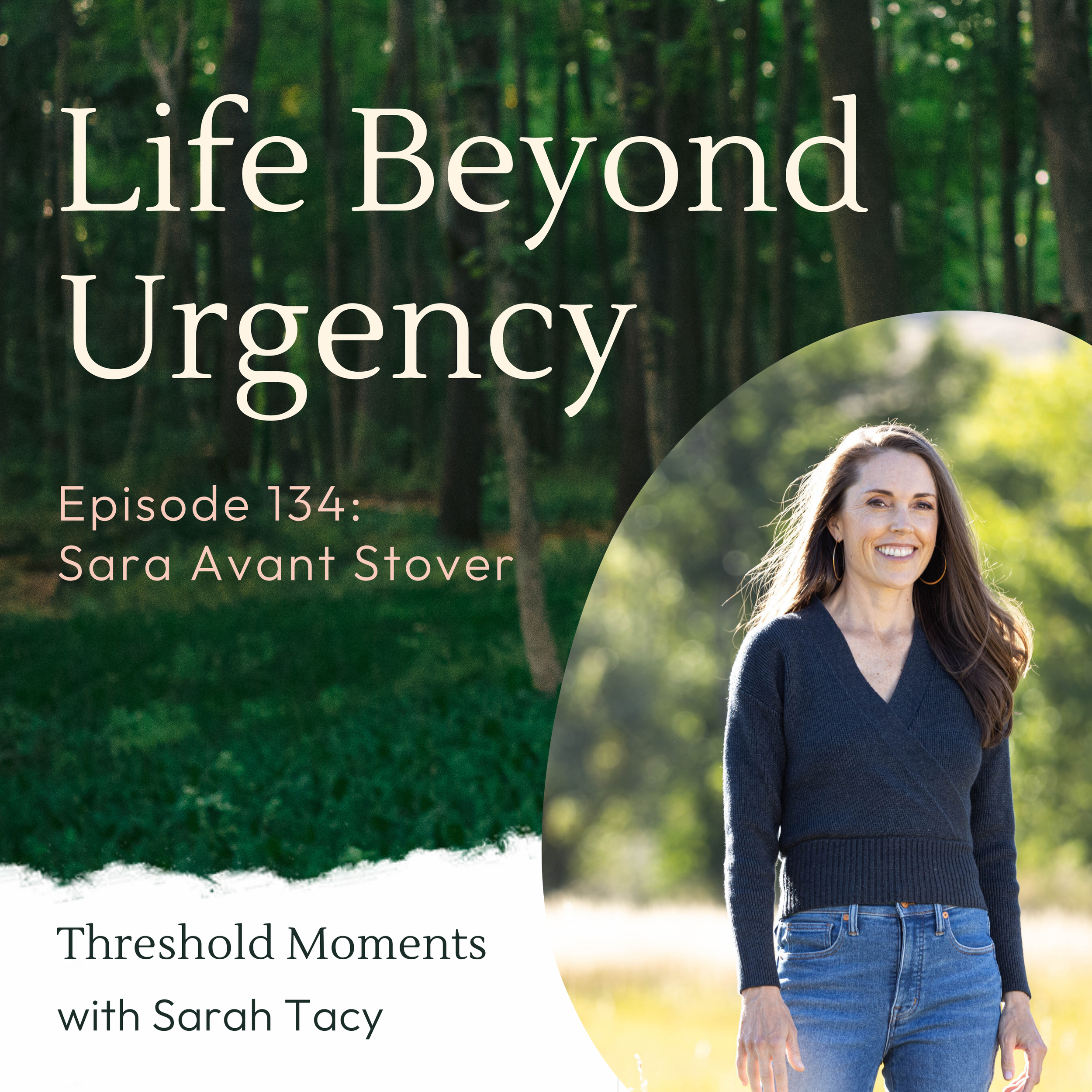
134 - Sara Avant Stover: Life Beyond Urgency
How do you know when it's time to let go of a version of yourself that once worked?
In this rich and deeply reflective conversation, Sarah sits down with returning guest Sara Avant Stover to discuss the seasons of life that require us to slow down, dismantle old identities, and listen more closely to what wants to emerge.
Since their last conversation, Sara has experienced a profound period of transformation. She stepped away from a thriving business, deleted social media, got married, moved to France, navigated grief, and entered perimenopause—all while learning to trust a slower, more sustainable pace.
Together, Sarah and Sara explore Internal Family Systems (IFS), intuition, nervous system regulation, entrepreneurship, self-trust, and why healing often looks far less dramatic than we imagine.
They also discuss the cultural differences between American productivity and the French art de vivre—the art of living—and how learning to value rest, pleasure, and spaciousness can become its own form of healing.
If today’s episode resonates, go back and listen to witness the earlier threshold where this journey began.
Episode Transcript:
Sarah Tacy: [00:00:00] Welcome to Threshold Moments. My name is Sarah Tacy, and today we have with us Sara Avant Stover, who has been here on the podcast previously, sharing her book and speaking about the variety of thresholds she had been through or has been through in her life. What I just shared with her, and I'll share with you, is that I've been so inspired to continue to watch the arc of her life and where she has gone from where she was.
Sarah Tacy: And I thought that my listeners, that all of you might also enjoy and feel inspired by what is possible as we continue to grow and learn and be turned over and over and over again by life. And so, yeah, I invited, uh, I think a three or four podcast, mm, previous interviews that I've done with people in the past to redo for season four [00:01:00] or to update for season four, and Sara is one of those people.
Sarah Tacy: Welcome.
Sara Avant Stover: Thank you, Sarah. I'm honored to be, to be back with you.
Sarah Tacy: And you are tapping in or coming in here from France, which is new.
Sara Avant Stover: Yeah? It is new. I am in southwest France in Bordeaux, and my husband and I moved here on September 1st. Tomorrow is July 1st, so it'll be our 10-month anniversary since- Wow
Sara Avant Stover: arriving here, and it's been, it's been a full experience these past 10 months.
Sarah Tacy: Do you speak French?
Sara Avant Stover: I, I, um, I wouldn't say I'm fluent by, by any stretch. I studied French a lot in school starting in the sixth grade until my freshman year in college, and I lived in Paris for a summer after I graduated college.
Sara Avant Stover: And I also traveled to some [00:02:00] Francophone countries in Africa and in Asia where I always spoke French whenever I got the chance. And one of my reasons for moving here is I, I really want to become fluent in French. So- Hmm ... I am actively studying it with a weekly tutor and just daily, daily drills, and it's, it's challenging, and it's also really enjoyable.
Sarah Tacy: Wow. Were there any other things that called you to France in particular, or was it the language where you're like, "I just really wanna dive in"?
Sara Avant Stover: It was a number of things. So it was the language, and also, I love the culture. I love the beauty. I love the elegance. I love the attention to precision. Mm.
Sara Avant Stover: Whether it's how one makes a croissant or the architecture, um, just so many, so much precision [00:03:00] in how things are presented. And I also just love living abroad. I lived in Thailand in my 20s, and I just always knew that I wanted to get back overseas, particularly to Europe.
Sarah Tacy: Mm. When we last spoke, your book had just come out, and we spoke quite a bit about how no matter how many practices you have, because before the timeline in your book, you were a meditation teacher.
Sarah Tacy: And I'm curious, like, do you still teach meditation? What are you into now? Um, you had all of the practices and still hit some pretty hard moments in life, which when I teach my nervous system class, I always love to say, like, "We're not teaching a fix-all for life where suddenly you're not gonna have hard times and you're not gonna, like, still have rock bottoms."
Sarah Tacy: Would you be able to take us through that arc [00:04:00] briefly, and then- Begin to share like what shifted for you as you began to choose new relationships and make new choices in life?
Sara Avant Stover: Sure. So in my early 20s, I started in my work of women's spirituality-
Sarah Tacy: Hmm ...
Sara Avant Stover: which was teaching women's yoga and meditation in person, then eventually online.
Sara Avant Stover: And then early, in the early 2000s, I was one of the first women doing this type of work online back when you could just count us with basically two hands, and some of those other women are still doing, you know, their work and, and we know some of those women. It's, um... And I achieved a, a lot of success with that, and really, like, the height of my success with that I'd say was around 2011, 2012, '13, '14, '15, even '16.
Sara Avant Stover: And then in 2016, [00:05:00] I experienced a massive betrayal with the man that I was engaged to at the time, and my life started to just unravel from there. It was just a series of devastations and betrayals- Hmm ... uh, personally and professionally between the years of 2016 and 2020 that led me to just dismantle everything in my work, let everything go in my personal life, and start over And I started rebuilding everything in 2021.
Sara Avant Stover: I met my now husband ac- actually at the end of 2020. And in those years when things were f- falling apart, I was also putting them back toget- putting myself back together inside. I call those the years of my deepest healing.
Sarah Tacy: Mm.
Sara Avant Stover: And what helped me the most at that time was a modality that... Well, actually a couple things.
Sara Avant Stover: Um, one was a [00:06:00] modality that I was introduced to prior to everything falling apart, and that is the psychotherapeutic model of internal family systems, or IFS. And I started taking that on very intensively during those years, weekly sessions, sometimes, you know, twice a week. And that really started to shift things for me in a big way.
Sara Avant Stover: And in IFS, and I know in many traditions, it's said the inner creates the outer.
Sarah Tacy: Mm.
Sara Avant Stover: So I was doing that internally, and then for many years or f- you know, it just didn't seem like anything was changing 'cause the, like more challenging things kept happening. But I persisted 'cause I know that life is a series of peaks and valleys, and that was a lot of what I taught to women.
Sara Avant Stover: I, I used to teach a lot about cycles and seasons and rhythms. [00:07:00] And so I knew it was a cycle that was gonna shift eventually, or at least I really held onto that belief like in times when parts of me didn't fully believe it. And I feel that that deep work, and also a deepening in my spiritual practice, deepening- Mm
Sara Avant Stover: my connection to my higher power, which I know as God, and my highest self, healing my relationship with my intuition- My instinctual self. Life started rearranging in a significant way, and I met my now husband, who is the exact opposite of the kind of man that I used to be attracted to, in a good way. We got married last summer in August, so I was married for the first time at age 47.
Sarah Tacy: Mm. [00:08:00]
Sara Avant Stover: And like we shared in the beginning of this conversation, we moved to France three weeks after our wedding, which was a longtime dream of mine.
Sarah Tacy: Mm. Very-
Sara Avant Stover: And my work also kind of rearranged in the process, too, and I feel it's been a continuation of what I was doing in those earlier years. Um, and it also feels like a deeper stabilization- Yeah
Sara Avant Stover: of it, and simplification.
Sarah Tacy: I would love to hear more about that. I underlined, like wrote down and underlined, "Dismantled everything in my work." I'm like, "Oh, I wanna hear more about that." Can you tell me a little bit more what that means to you, or exactly how you did that?
Sara Avant Stover: Yeah, so it was early 2019, and I was already, prior to that, I was already kind of getting the messages that this isn't, this isn't the right path anymore, but I was fighting [00:09:00] it.
Sara Avant Stover: Yeah. It felt, that, that just felt too scary for me to even face. And in- Because you'd had
Sarah Tacy: so much success with it?
Sara Avant Stover: Yes. Mm-hmm. And because I didn't know what, what I would do, and I was, you know, it felt like the alternative was to get a job, and that was like, "Hell no. I don't wanna do that." And the beginning of 2019, it was just clear, like, "No, this is what I need to do."
Sara Avant Stover: And so I finally just listened, and I closed down my courses, you know, when they had come to their completion points. Um- I can't even remember all the pieces, but there were, there was like a long list of different steps I needed to take to basically just bring it down to the studs. Hmm. So basically all my courses, took down all my courses.
Sara Avant Stover: Um, I wasn't [00:10:00] posting on social media anymore. I actually deleted my Instagram account. I let my team go. I stopped publishing on my podcast. Hmm. I kept my email list, and there were, like sporadically I would send an email, and I think I also led a retreat or two at, um, what's it called? 1440
Sarah Tacy: Multiversity.
Sarah Tacy: Mm-hmm.
Sara Avant Stover: Um, I think I, I cau- I taught a couple of retreats there. So just like very, very minimum, and got a job, which was like a miracle in and of itself 'cause I never had, I never had like an actual job. And I did that for a year, and it was really one of the best things that I've ever done for myself. It really gave me the privacy that I- Hmm
Sara Avant Stover: needed to just step back and heal.
Sarah Tacy: Mm-hmm.
Sara Avant Stover: To not be in, in the spotlight, and it was just a relief to have just a paycheck coming in twice a month. [00:11:00]
Sarah Tacy: Yeah.
Sara Avant Stover: I knew the exact amount, and I could live within, you know, I could live within that and save some, and that felt very healing and regulating, and just also helped me to expand my, my money management skills versus- Yeah
Sara Avant Stover: like the like big ups and downs that I would have previously. Um, and mostly it just gave me more space.
Sarah Tacy: I think that some of us are sold a tale that entrepreneurship is the way to get freedom, which may be true sometimes, and in some states, and just like you said, being a cyclical being, where there are times where that may be true.
Sarah Tacy: And I was working with a woman who had been an entrepreneur her whole life, and in a, um- In a very true, deep, dark night of the soul, and was [00:12:00] trying to decide if she would take this position that was a teaching position, that was a 9:00 to 5:00, well, probably 9:00 to 3:00. And but when we were talking, I was like, "Wow, that just sounds like so much stability."
Sarah Tacy: Right? It's like you don't have to sell yourself. You don't have to tell your story online right now. Like, you get to just have something that's really stable in your life, and I'm just seeing her really thrive inside of it. And it's so nice to expand the possibilities of where we can find ourselves, that it doesn't have to be in our own business, but that it could be within another structure that gives us more space and peace and something that's predictable like the paycheck, that you know the number.
Sarah Tacy: And so there can be stories of like, oh, but that number is limited, and somebody else decides it. But it's like, but it's consistent.
Sara Avant Stover: Yes.
Sarah Tacy: And it's known. And just, just to be able to hold [00:13:00] that both of these things could be the right thing at different times, I think this could be so great for listeners to hear who might put one up higher or feel bad if they're doing another, where it could be like, this could actually be so amazing.
Sarah Tacy: So yeah, thank you for sharing that.
Sara Avant Stover: Yeah. When I meet with my, some of my clients who are in similar situations, or they're just under a lot of financial strain, them hearing that about me is very validating and very permission giving. Yeah. And a number of my clients have gone out to get part-time jobs. I was just meeting with one before this who got a part-time job at an acupuncture clinic just to help fill in her income and to stabilize her more, and that has been a really great thing in this season.
Sara Avant Stover: And there's so many different ways that that can look, and I feel like we need to [00:14:00] bring that into the conversation more as a possibility, not, not forever, but for the short term when it's needed.
Sarah Tacy: Mm-hmm. And I might add, like, and we don't know, uh- What might be found in those areas.
Sara Avant Stover: Yes.
Sarah Tacy: Meaning it might be a skill that goes back into your entrepreneurial life, but it could also be like, "Actually, this is...
Sarah Tacy: I love it here." Like, "This is, this is another way that I can come fully alive." Um, this is a, a little bit of a left turn from the story. I'm just thinking this past spring I started teaching lacrosse, which is very different than the financial story of going from entrepreneurial to getting a job that's stable.
Sarah Tacy: But what I'll say is that when I started coaching, I was like, I didn't even know that I would love this so much. Like, I didn't... Like, it's, it was like a door [00:15:00] opened to a part of me that, like, that my 20-year-old self and my 22-years-old self, the one who played in college, the one that trained athletes afterwards, like, that I thought that was an old part.
Sarah Tacy: And it was like, ah. Mm-hmm. And so it's also just very interesting what happens when we open doors that we wouldn't think are for us that might actually have really incredible medicine or joy or just self-realization within them.
Sara Avant Stover: Yes. Getting into the unknown, and that's, that's been a big thing about moving here to France is, you know, I felt like my life in Colorado, or my husband and I both felt like our life in Colorado, we'd both been there for about 20 years, and we just felt we know this like the back of our hands.
Sara Avant Stover: Like it's ... There's, there's nothing new here. It's all familiar.
Sarah Tacy: Mm.
Sara Avant Stover: And there's many blessings in that, and there, there's times when we feel homesick here, like right now with the heat wave that we've been [00:16:00] experiencing. It's ... We're homesick, especially just for central air. Yeah. Which is, AC is just not a thing here, which is doable, but not when you have record-breaking heat for extended periods of time.
Sara Avant Stover: Uh, but it's also just really fun to come over here and be like, "I don't even know how to buy groceries, or how to pay for the parking garage, or, like, how to get my Amazon package delivered." Like, things that are just so mundane are ... That's an adventure, and there's some challenge in it. And it's, it just wakes up different parts of me.
Sarah Tacy: And this is a ... For me, the way I hear this, is, like, the swing of the other side. So there are times where it's like, "Okay, I need something that's stable and predictable." And as we become more resourced and feel more vitality, then it's like, "I would love something that's less predictable. I would love an [00:17:00] edge.
Sarah Tacy: I would love to go somewhere where I can learn French." Right? When our capacity grows, oh, and we get to do those things that are less known. And again, just speaking to the cycles of the different- Yes ... phases.
Sara Avant Stover: So much, yes.
Sarah Tacy: When you spoke of IFS, I'm wondering if you could share more for the listeners. I feel like this comes up all the time in one-on-one somatic sessions that I do where we end up speaking to different parts.
Sarah Tacy: But I believe that you are more formally trained in this as well, and I'm wondering if you could share with the listeners what this looked like for you, and if there are any ways that they could also just practice this, whether it's through journaling or through talking back and forth to the parts. I don't know, but I would be curious if you would be willing to share a little bit more about your journal journey with IFS.[00:18:00]
Sara Avant Stover: Yes. The first session that I had with my IFS mentor, like I said, I think it was, like, 2015 or so, maybe even 2014. And it was after an engagement party with my former fiance, where a part of me- Did not feel honored in the way that I wanted to be honored. And part of that was actually a dynamic that was happening that was under the surface that then erupted to the surface in 2016, and part of it was also my parts.
Sara Avant Stover: And so I went into this session with my mentor, and prior to that we'd never done IFS before. I didn't even know what IFS was, but she was training in it, and she started doing the IFS method with me. And basically it is a form of parts work, so we were dialoguing with this part of me that [00:19:00] didn't feel honored, which was a young part of me, and we went through this process of dialoguing with her and then bringing her from the past to the present, and helping her to release in kind of a shamanic clearing kind of a way, release burdens of not feeling like she's good enough, not feeling like she deserves or is deserving.
Sara Avant Stover: Um, releasing that and helping her to start to kind of have the kind of life experience that she wants to have in present time. So she came to live with me in my mind's eye.
Sarah Tacy: Hmm.
Sara Avant Stover: And in IFS and in many healing traditions, we believe that, you know, our systems don't know the difference between imagination and reality.
Sara Avant Stover: Mm-hmm. And this mentor gave me the practice, which I actually wrote about in my second book, which I was working on that time, on at that time. It's called The Book of She. [00:20:00] Hmm. And the practice is called the Saribear Sadana. So my nickname when I was little was Saribear, and Sadana is the Sanskrit term for spiritual practice.
Sara Avant Stover: And so my practice for 30 days was to check in with this little one, to check in with Saribear, and see how are you doing today, and what are you needing today? Hmm. Like, what do you wanna eat? What do you wanna wear? Uh, what do you... Like, what do you wanna do? And to really devote myself to listening to her and then to helping her to get her needs met.
Sara Avant Stover: And I kept a picture of her on my altar as a reminder of me at that age, as a reminder to do the practice and to deepen my connection with her. And that's a common IFS integration practice. We, for 30 days after we kind of have this healing with a part, we want to integrate it and kind of carve out those new [00:21:00] neural pathways for 30 days.
Sara Avant Stover: And so I did that, and at the end of it, I felt a profound shift in how I was just relating to myself.
Sarah Tacy: Mm.
Sara Avant Stover: And then when everything kind of fell apart in my life and I started continuing with the IFS model and applying that to different parts of me, it just really rearranged things inside to a place of just much deeper wholeness and just inner coherence.
Sara Avant Stover: So there's much more connection with my parts, collaboration with my parts. What it looks like is just a much quieter inner critic.
Sarah Tacy: Mm.
Sara Avant Stover: Um, different kind of addictive tendencies that I, that I would have that would come up at different times when I was under stress, those are no longer an issue for me. Um, so much [00:22:00] shifted inside of me, and this is what IFS allows.
Sara Avant Stover: It, it allows us to build a relationship between our Self, with a capital S, our true self, and our parts so that we don't get blended with them, and blending is when a part kind of takes over our midline and takes over the steering wheel. I- if it's that part of me that was having a lot of self-doubt or unworthiness, or a part that's really critical, or, um, I have a part that can go into overdrive when I'm under stress and just kind of, like, go, go, go really quickly.
Sara Avant Stover: And it doesn't mean that, you know, you fix all these parts. You know, s- a number of them are healed and transformed, but there's an infinite number of parts, and you know, life, like you said earlier, life is always gonna hand us new challenges. Um, but it allows me to be in relation- more conscious relationship with them[00:23:00]
Sarah Tacy: There is a phrase I'm working with, and I'm, I'm really teasing it out. I'm not in any way saying I figured it out and this is the way. And the first time I heard it was when Tel Darden was describing hypersocial, and she said, "I'm okay when you're okay." Which now I could take it further and say, like, "I'm okay when it's okay.
Sarah Tacy: I'm okay when they feel good about me." I you know, it's kind of like this w- when everything on the external is okay, then I can feel safe. And it really makes sense for young ones, right? If you have a parent that's yelling or upset, then if we can make them feel better, then it would signal safety. And there can be things in current time where people don't actually feel safe unless the person they're near is not stressed, so I don't want to say that there isn't truth there.
Sarah Tacy: And in my mind, the [00:24:00] part of me that could strive for perfection would say, oh, then the opposite, I'm okay when I'm okay, is the goal. And as I've been playing with this, of course, I've gotten situations in life where it's like, oh, wait, my daughter's going through this really hard thing, and, ooh, and I can feel, I can feel my own part that's unhealed show up.
Sarah Tacy: I can feel the mama bear part in me that just wants to, like, fight and flight with her. Uh, not fight with my daughter, but, like, fight for her and flight with her. And as I hear you talking about this situation where you didn't feel honored in the way that you wanted to feel honored, and then you went and you did the work with your young part, can you help describe how that then becomes relational?
Sarah Tacy: So it's relational with your higher self and your parts, and then how does that come in... [00:25:00] Say there is a truth, like you said, that really was amplified a year later. How do you use that work of coming to a place of healing within yourself and being relational with the thing that was the original trigger?
Sara Avant Stover: Well, it comes in... That, that's a, that's a really great sophisticat- sophisticated question, and I think that it really comes to this, back to this concept of unblending. So if I hadn't kind of teased things apart With the support of my mentor, because we do need external support when some of these parts are really strong.
Sara Avant Stover: We can't, we can't do it alone.
Sarah Tacy: Mm-hmm.
Sara Avant Stover: And there is self-therapy that we can do, and I'm remembering that you asked a question about how listeners can do that, so maybe we can circle back to that later in the conversation. Okay. But we do need support with these stronger parts to [00:26:00] unblend and to be able to come into what we call in IFS a self-to-part relationship.
Sarah Tacy: A self what relationship?
Sara Avant Stover: Self to part.
Sarah Tacy: Got it.
Sara Avant Stover: So that I could be in a relationship with that young one, and that's, that's what healing is. It's when we can have a self-to-part connection We, we heal in connection to our true self, which is same as you're saying with your daughter, it's that attunement.
Sarah Tacy: Mm.
Sara Avant Stover: It's like mother and child attunement-
Sarah Tacy: Mm ...
Sara Avant Stover: where anything can be happening, but as long as there's some attunement there and it's good enough, right? What we know about good enough parenting, it doesn't need to be 100% of the time, but there's enough of it, and then there's a sense of okayness between the mother and child or, uh, in the child's system or in your parts and in, in your own inner system.
Sara Avant Stover: So when that happens, then I [00:27:00] have more access to my self-energy Then I'm less driven by these parts of me that are desperate for external validation.
Sarah Tacy: Mm.
Sara Avant Stover: And some of the qualities of the true self are clarity and courage. Yeah. And so as more of that gets freed up in my system, I can actually look at a situation with those qualities rather than from a part that's kind of blinding me with its own agenda.
Sara Avant Stover: And then I can make the necessary choices or take the necessary actions from that more self-led place rather than the part-led place.
Sarah Tacy: Mm-hmm. That makes a lot of sense to me. Thank you. Yeah, I wanted to bring it around to how, to that [00:28:00] second part where we are able to take clear action because sometimes in some modalities there can be this experience of spiritual bypassing where, you know, we do the inner work and then nothing is personal and we're not really working with...
Sarah Tacy: As David White would say it, it's like that anger shows us what we love most and what's been violated. And so to first attend to our parts and then be able to, I think you said, have our energy back and our vitality back and our clarity back so that when we do step forward, that we're able to do so in a way that I'm seeing it as, like, less strings attached.
Sarah Tacy: Does that make sense?
Sara Avant Stover: And it's f- it's, it's from our sovereignty.
Sarah Tacy: Mm-hmm.
Sara Avant Stover: It's not... So another example. Yes. You know, I mentioned just before this call [00:29:00] I was meeting with one of my clients, and I weave IFS into business mentoring with spiritual women entrepreneurs, and this is a common thing with the women that I work with.
Sara Avant Stover: She was feeling a lot of fear about being more visible in her work. We were talking about her starting a Substack, and she said she'd actually started one two years ago and got so afraid that she shut it down and hasn't returned to it since. And she knows that she needs more of a visibility platform, and she feels that Substack is the right one for her.
Sara Avant Stover: So we're dialoguing about how to move forward with that with these parts that are terrified.
Sarah Tacy: Mm.
Sara Avant Stover: And what I, what I share with women in these cases, and I know this just from my own path, is it's not either/or. It's like we don't wait to not feel afraid to do the [00:30:00] thing.
Sarah Tacy: Mm.
Sara Avant Stover: And we also don't bulldoze them to do the thing.
Sara Avant Stover: But it's how can we be with our parts who are afraid while we do it? Yeah. And it means slowing down. It means listening. It means being with them, letting them feel you with them And I'm also remembering a story that the founder of IFS, Dick Schwartz, shared when he was on vacation in Hawaii once with his wife.
Sara Avant Stover: He went swimming in a cove where the previous day there had been rep- reports of a riptide. And he went out swimming, and there was, he found, still a riptide present that started pulling him out into the ocean. And he began panicking, and he started trying to swim against the riptide, which we know is, you know, it's [00:31:00] our instinct, but we know that that actually gets you pulled into it even more.
Sara Avant Stover: And as he started getting pulled further and further away from shore and was panicking, he had some moments where he just, he remembered, like, "Okay, I need to access my Self energy." Mm-hmm. "My parts are absolutely freaking out." And so he could have a moment of presence and say to his parts, "I understand that you're afraid.
Sara Avant Stover: And yeah, there's a chance that we could die here. And I want you to know that if we do die or whatever happens, I am right here with you. You will not be alone. I am not going anywhere."
Sara Avant Stover: And that was able to calm his system enough that he was able to see on the shore some people instructing him about what to do, and then he was able to get back to the shore safely.
Sarah Tacy: Mm.
Sara Avant Stover: So he didn't tell his parts, "Everything's [00:32:00] fine," like, you know, "We're gonna live." He, he acknowledged like, "Yeah, I don't...
Sara Avant Stover: This is scary, and I don't know what's gonna happen, and we, yeah, we very well may die. And if that happens, I'm here with you each step of the way."
Sarah Tacy: Mm. In the work I do, we call that layers of support. Uh, just meaning that if you're showing up for the parts that are scared, you're show- that's a layer of support, which doesn't take away the challenge that's there, but it helps to give us a little bit more resource to stabilize or make better decisions in moments that otherwise would totally overwhelm us or shut us down.
Sara Avant Stover: Yeah.
Sarah Tacy: When you spoke about intuition rehab, I imagine that this is a big part of that. Can you speak a little bit more to what intuition rehab looked like for you?
Sara Avant Stover: [00:33:00] Yeah, that's an important question. The first thing that comes to mind is I went on, and I do air quotes with this, like an expert detox. Yeah. I stopped, I stopped working with astrologers.
Sara Avant Stover: Mm. I stopped consulting with intuitives. Mm. I stopped getting any external guidance on my life. And, 'cause I f- had f- I found that I was becoming overly dependent on that, and that I wasn't making big decisions based on my own inner knowing. That there was just, there was too much of a crutch there. And so I cut that out for, it was like a year or maybe even two.
Sara Avant Stover: It was a long stretch of time. And it was scary and it was hard. And, 'cause my life was also very challenging at that time. There was nothing that was really certain, and it was one of those times in life where you can [00:34:00] only see just a little bit ahead, like just one step ahead. And it really forced me just to keep self-referencing- Mm
Sara Avant Stover: and to keep asking, "Okay, well, what is the next right step here? What does feel good here? What does feel right here?" And yes, that IFS work and really teasing apart these different parts of me, learning to be in a relationship with them, finding more and more access to my own self-energy as I was healing and unburdening more of these parts, because the more that we unburden these parts, where they can let, let go of their wounds and kind of return to their natural role in our system, it just creates more space for self-energy.
Sara Avant Stover: And those two things concurrently, plus just the initiation that my life was at that time, where I was needing to make really big decisions on the [00:35:00] regular you know, just like life-changing decisions on the regular, and then accepting the consequences of those, all of that really brought me into deeper connection with my intuition.
Sara Avant Stover: And now I'm in a place where s- yeah, sometimes I consult with psychics and intuitives and astrologers, but it's like more peripheral or more accents, and it always starts with my own inner guidance first. And one of the practices that has just become a bedrock for my life, and it's a core practice that I teach the women that I work with, is a kind of a continuation of morning pages.
Sara Avant Stover: So you know, Julia Cameron's, from The Artist's Way, morning pages, where it's like just stream of consciousness, three pages or 20 minutes, and I feel like that helps us to process our parts or just kind of brain dump things that are in our stream of consciousness. And from there, move into kind of channeled writing with your [00:36:00] higher self.
Sara Avant Stover: I call it self-scribing.
Sarah Tacy: Mm-hmm.
Sara Avant Stover: And ask a question. So if I have a question about my business, like should I hire this person, or what do I do about this issue I'm having with a client, or should I offer this program right now, or also stuff in my personal life, I ask the question and then I just let my higher self respond without censoring myself, without letting the pen stop moving, and I find that that is...
Sara Avant Stover: That's a really kind of validating and reinforcing way to stay connected with it just through the day-to-day.
Sarah Tacy: Hmm. I do quite a bit of the journaling And I'm gonna say it same, same but different in the sense that what's been most powerful to me is to journal to parts of myself. And sometimes I'm journaling to my higher self, sometimes, [00:37:00] um, when my back went out not long ago, um, I wrote to my back, and my back was just like...
Sarah Tacy: It was like writing to an adult who was totally overwhelmed, was, like, standing up dignified, like, and chaos was just running around that felt like a bunch of children. And so I was like, "Okay, I'll talk to the chaos." And then what I found as soon as I addressed the chaos was everything settled, and two little girls showed up, and one was on either side of my spine.
Sarah Tacy: And the one on the right was really curled up into a ball, and she was just really afraid of the ones that yell. And I didn't realize that that part was there. And so I got to sit with her, and we got to put up some, like, boundaries, and we just got, like, hung. And it was still happening all just via journaling.[00:38:00]
Sarah Tacy: And what I notice whenever I journal to parts of myself or feelings I'm having- I'm often surprised by what comes through, meaning it really doesn't feel like my conscious thought. It's not the stories I tell myself in that, in, in my head. Completely different perspectives come through. I've done this when I'm upset with somebody in my life, so I could do it for myself, but then when I have them write back, whether it is something from them or a higher self that's writing through, the perspective that I'm given is always beyond what I could figure out with my own brain.
Sarah Tacy: And
Sarah Tacy: I like the idea as well of doing the morning pages and then going right into higher self for business. And I just [00:39:00] wanna say here that that practice in general of writing to something other than myself and having it c- write back has been such a layer of support for me for many years, but maybe not always as consistent as I'm ha- as I have been using it recently
Sara Avant Stover: Yeah, I love that, and that's, that definitely falls in that category that we were talking about of self-therapy and how can we do some of this, this on our own.
Sara Avant Stover: And that's a great example, just dialoguing with different parts of the body or things happening in the body or things that are, feel activated in us and seeing what they have to share.
Sarah Tacy: Hmm. When you were talking about Every day keep asking and self-referencing There's a portion in my course called Resource where we go into the realms of where people feel [00:40:00] stuck, and part of the work, it seems to me, is to be able to live into the unknown and to be able to resource ourselves enough when, like, the answers are not coming.
Sarah Tacy: And so as you were saying that, I was like, "Oh, I wonder if she got an answer each time," or if sometimes it felt blank. Do you ever write and not get clarity or not get a response?
Sara Avant Stover: I feel like at this point I always get a response, but sometimes it's just very simple. Mm. Like, it's just not clear yet, and maybe it's just telling me, like, the next step, the next little step, and asking me just to trust and be patient, and reassuring me that everything's okay.
Sara Avant Stover: Because I feel like we're never given the big vision. We're never... You know? It's like-
Sarah Tacy: Here are the 10 steps that you must take.
Sara Avant Stover: Yeah. Like, even right now, [00:41:00] you know, we're, my husband and I are asking some bigger questions in terms of climate change and predictions that are coming out that Europe is warming up two times faster than other parts of the planet, and we're just like, "Well, what does this mean for the rest of our lives?"
Sara Avant Stover: And you know, but we always knew coming over here, this is, we started out with a one-year experiment, and we haven't even finished the year. And it just reminds me just to stay in more of the immediacy, and I'm not gonna know what the rest of my life is gonna look like. But for instance, just journaling and like, okay, so we have another heat wave coming here next week.
Sara Avant Stover: Like, what should we do? Where should we go? Mm. Just taking, just taking the next right action, and I find that, that, that guidance is always available, even just, like, on a day-to-day basis. Like, okay, what should I be doing now? Like, oh yeah, empty the dishwasher, or go walk the dog, or go [00:42:00] write your Substack article, or take a nap.
Sarah Tacy: That's so helpful. Yeah, thank you for the reminder of just, like, the next right step when the big answer isn't available. And the other thing that I hear here is The practice of slowing down. I can't imagine that the work that you've done on yourself, that the IFS, that the intuition rehab, that the decisions that you've made could happen at a speed that perhaps you once went.
Sarah Tacy: That I imagine that any time that you're self-referencing, it means that you would need to pause and slow down a bit. Can you speak to that? I don't know if that's true for you, so I'm just curious 'cause for me, that's what it would mean.
Sara Avant Stover: Yeah. Yeah, that is true. And in IFS there's another saying that slow [00:43:00] is fast.
Sarah Tacy: Yeah.
Sara Avant Stover: That it might not seem like, for like for healing with me... And I feel like healing is a lifelong journey, but I, I did, I did a really deep chunk of that healing over those years. And like I said, it... For some time it seemed like nothing was really happening, but then all of a sudden it seemed like kind of everything changed.
Sara Avant Stover: And so trusting that even in the slowness there's a lot going on. Yeah. And like I mentioned, I have parts that under stress go into overdrive. And I think about even the beginning of this year, we moved into a new apartment here in Bordeaux. In the States, that would seem like a relatively simple undertaking.
Sara Avant Stover: It's like, "Oh yeah, I've moved a lot of times. I know how to do this." It was just like a totally different like a totally different species of move to do it here. I don't know, I don't even know how to explain it, but definitely had parts that were in overdrive for like a good two months as we were navigating all the waves of that.
Sara Avant Stover: [00:44:00] And I was just more aware. Like, okay, this is this is like my system is kind of freaking out, and I was able to be in a relationship with that even while I was still in overdrive. And not moving as slowly as I would prefer, but also knowing how to like pump the brakes and even like put speed bumps in, like my morning practice time.
Sarah Tacy: Mm-hmm.
Sara Avant Stover: Which is like I have certain parameters around that. I know that's a time for checking in with myself, even if the rest of the day I start accelerating. So it doesn't need to be slow all the time, but having these little pockets where you know that you can pause more.
Sarah Tacy: Yeah. In the work I do, we, we work a lot with pacing and this idea of actually being able to be tidal, meaning that sometimes I might speak s- really slowly, and other times, like when I talked about coaching [00:45:00] lacrosse, I was like, "Oh my gosh, this is so different and so fun if I'm leading meditation most of the day at a certain pace, and then I'm yelling like, you know, yelling across a field."
Sarah Tacy: And, uh, one of the girls, sh- you know, they're only 10 years old, and they were like, they had this cheer that they wanted, and it was, "Be aggressive." But then they didn't want the other team to hear them say, "Be aggressive," so they decided to say, "Be A." And she's like, "And A can mean annoying, too." And she was playing defense, which I'm like, "Yeah, defense, you totally wanna be annoying."
Sarah Tacy: Which is, again, as adults, when we're trying to train away from being too annoying or too loud or too aggressive, just to have this space where it's like, "Yeah, Molly, go be annoying." You know? Like- ... it was like a different pace. It was a different volume. And then there, just like any athlete, then there would be a time to, like, sit down and eat watermelon and, like, slow it down and recover.
Sarah Tacy: And as adults, [00:46:00] because so much is rewarded, I feel like, for so long of just the faster we can get it done and the things to get done never end, it, it can create this like, oh, then we have to go totally parasympathetic or this as opposed to, oh, it's so natural to have times in life where the demands are just gonna be higher.
Sarah Tacy: And so where are the little places that we can take a pause or something we can depend on, like a morning practice, and just go, "Oh, this is... Of course this is fast, and of course this feels hard"? And then to have those little places where, again, just like an athlete where you'd be like, "Oh, that was a really hard practice.
Sarah Tacy: That was a really hard game, and I'm gonna take a breath where I can," and to build that in, uh- I'm really enjoying this part of life right now, being able to... I'm starting to expand my speeds, uh, from one that what used to be always fast to a really big period where everything felt so slow. [00:47:00] And so beginning to increase the range of Being able to be more tidal with things in my life feels really nice.
Sarah Tacy: And not that all the paces feel nice or all the stress always feels good, but I think what I hear you saying is that you were able to really still stay with yourself even as there are moments where The speed and pace are probably more than feels good.
Sara Avant Stover: Yes. Yeah, I definitely relate to that. Uh, another thing I've been doing in the past about year and a quarter is working with a coach in, I don't know if you've heard of this, but the, the Fajardo Method.
Sara Avant Stover: And it's, it's basically like teaching your system to be in s- sympath- parasympathetic more of the time, and it's tracking different parts of the body. And I started working with her last year as we were moving out of our home and planning our wedding, and, um, kind of like moving around from place to [00:48:00] place, and, uh, it was kind of just a crazy...
Sara Avant Stover: I mean, this whole past year has been pretty crazy, and one of the things that she reminds me of is she's like, "It's not about being calm all the time."
Sarah Tacy: Yeah.
Sara Avant Stover: Like, you can be in parasympathetic and still ha- still have your father be dying, or still be, like, running around planning your wedding or whatever it is.
Sara Avant Stover: But for her in that methodology, it's like, it's about just tracking where you are in space.
Sarah Tacy: Mm.
Sara Avant Stover: And just, like, what is actually happening here right now.
Sarah Tacy: Mm-hmm.
Sara Avant Stover: And less about the story around it or the feelings around it, but even, like, one thing is just, like, sensing the wall behind you.
Sarah Tacy: Mm-hmm.
Sara Avant Stover: And, like, the ceiling, like, behind me, and just that's, that's another practice that I've been layering in that has been really supportive.
Sarah Tacy: Mm. I love that. There are two places I wanna go, and I know we're... Oh, we're at the top, we're at the top of the hour. That went fast. [00:49:00] Um, so one thing I'll say that we don't have to go into is just as you were talking about the things that happen When it seems like nothing is happening. I love to think of this as like a sauerkraut phase.
Sarah Tacy: I don't know if you've ever made s- have you ever made sauerkraut?
Sara Avant Stover: I have. I used to make that in Thailand-
Sarah Tacy: Right ...
Sara Avant Stover: when I lived there. Yeah.
Sarah Tacy: Yeah, and so there's a stage where you're, like, working it and working it and massaging and, and then you let it sit for three weeks, and it's creating its, you know, its own, um, culture, right?
Sarah Tacy: It's like it's doing the work, and the most important thing actually is kind of that we don't, like, overwork it or over-touch it, that there's all this stuff happening that one could say is, like, unseen. Or the other idea of, like, a pinata where you could keep going at it persistently, and it seems like nothing's happening and nothing's happening and nothing's happening, [00:50:00] and then eventually the- like, it cracks open and everything happens all at once.
Sarah Tacy: Like, all the candy comes. But at the very beginning you also were like, "And I was, I was persistent even though it seemed like nothing was happening," and it gave me that image of the pinata as well. So the last thing as we're closing out here. First, thank you so much for your time. Um, was this fall I'm offering something called Opting Out of Urgency.
Sarah Tacy: So I first reached out just because I was like, "Look at Sarah. She's in France. She's getting married." And anytime we've been in contact, my experience of our exchanges is how mindful you are of your pacing and what you're taking on. And so I hear that you, you know, got married. You changed, like there was a lot going on.
Sarah Tacy: You're learning, you're going deeper into a [00:51:00] language, you got married, your father passed away, you're in a new country, so already there's a stacking of many things. But right next to that is the experience I have a view of saying, "And therefore I'm not gonna do this with a podcast at this point," or, "I can come on as a guest, but at this period would feel better."
Sarah Tacy: And I wanted to highlight that because I am always, uh, intrigued, and motivated, and inspired when I can see people really working that process of being fully engaged in life, but really choosing. Because to me, you can have speed and you can have timelines, but to have agency within them is such a beautiful thing, and perhaps something I strive for or I play with, and I notice when I'm [00:52:00] outside of it and within it.
Sarah Tacy: Can you speak to me at all about your relationship to urgency? Which I, I think we've pretty much done in this whole podcast, but if you have anything left to say about that experience or even how it's different in France than maybe it is here.
Sara Avant Stover: Yeah. It's definitely way different here in France. And so there's two things that come to mind.
Sara Avant Stover: One is perimenopause- ... and I am definitely in perimenopause, and that is requiring me to live and work differently. It's been, it's been a steep learning curve and I'm still on that learning curve, but I've really had to look at how I was doing things in the past, the capacity that I had in the past, pretty high capacity.
Sara Avant Stover: Like, I look back at y- my calendar even, like, you know, two years ago, even a year ago, and I'm just like, "Oh my God," like, h- how could I do all those things in one day? Yeah. Like, yeah, [00:53:00] I could do those, but, like, what, like what does that do to me when I do all that in a day? So there's that, of like really needing to kind of like rightsize my life- Mm
Sara Avant Stover: for this season, and acknowledging that I can't do as much as I used to do. I don't wanna do as much as I used to do. And kind of looking at, like, what's the minimal that I can do to get, like, the optimal results.
Sarah Tacy: Mm.
Sara Avant Stover: And the other thing is the French, um, the L'Art de Vivre, which is the art of living.
Sarah Tacy: Mm.
Sara Avant Stover: And, you know, I'll have... Like, I, I was launching my core program, Herself CEO, in March, and it was a stressful launch for various reasons, like transitioning team members, and also just all the moving parts of our move. And I would, like, kind of be, like, grinding away at these pieces, and then I'd go walk in Jardin Public, the public, uh, the, the [00:54:00] park near our house, and just people are sitting on benches reading their books and having picnics on the lawn.
Sara Avant Stover: Like, any day of the week, any time, and it's just like these people really know something that I don't know. There's just not the same level of stress or obsession with productivity or, um, work here that there is in the US. And I feel like there's been an unraveling process of me, within me, since we arrived here, and that's still happening, of how to shift my rhythms-
Sarah Tacy: Mm
Sara Avant Stover: from my US rhythms to my, to find my new f- French rhythm.
Sarah Tacy: Mm.
Sara Avant Stover: And it's, it's taking time to, to figure that out. Um, I feel like I've come a long way in the past 10 months, but I still have a ways to go with it, and a lot of it is just not cramming things in, taking time [00:55:00] to go out for long lunches with new friends, and just having work be one part of my life rather than having my life try to fit around my work.
Sarah Tacy: Beautiful. Thank you so much, and thank you so much for your time today. I really appreciate you. I appreciate everything you share about your life and the work that you do within your life, and it's a, it's an inspiration to me. And I'm glad to know you.
Sara Avant Stover: Thank you for having me, and I always appreciate the depth of our conversations.
Sarah Tacy: Is there anywhere that you would want the listeners to go if they wanted to find you or learn about any programs you're doing? Or is that not
Sara Avant Stover: a thing? Mm. The best place is my website, saraavantstover.com. Sara with no H, unlike you. And there you can find my podcast and my Substack and just the various programs and retreats that I offer.
Sarah Tacy: Mm. Thank [00:56:00] you.