
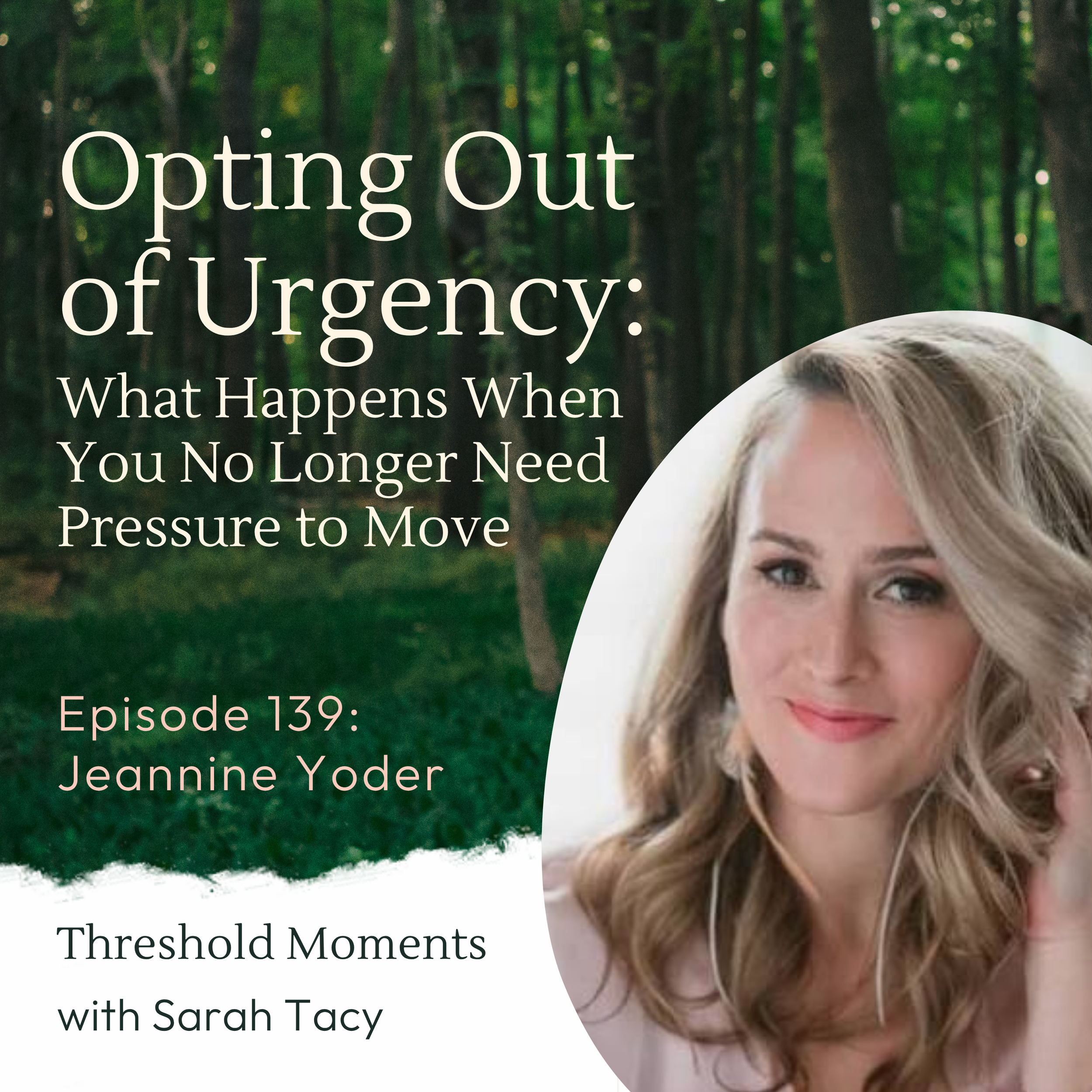
In this episode of Threshold Moments, Sarah Tacy sits down with her dear friend, breathwork practitioner and coach Jeannine Yoder, to trace the origins of Opting Out of Urgency—including the moment Jeannine first spoke the phrase that would become the name of Sarah’s workshop.
Jeannine Yoder is a New York Times–featured feminine leadership coach, breathwork teacher, and Broadway-trained performing artist. For over 15 years, she has trained coaches, healers, and facilitators while guiding transformational breathwork experiences, retreats, and private sessions rooted in nervous system regulation, somatic healing, embodiment, and ritual. She is the founder of Huntress House, a sacred studio for feminine awakening in Easton, Connecticut.
Jeannine shares how urgency once functioned as the fuel source of her life. Coming from a childhood where her nervous system learned to respond to a lack of safety, she became exceptionally good at identifying problems, mobilizing quickly, achieving, and creating solutions. But over time, that pattern became a cycle of desire, intensity, achievement, depletion, exhaustion, and then finding something new to mobilize around.
The surprising part? Even after her external circumstances became safer and more stable, her nervous system didn't automatically slow down.
Together, Sarah and Jeannine explore what it means to opt out of the internal experience of urgency—not necessarily to move slowly, do less, or give up ambition, but to stop manufacturing pressure in order to feel alive.
Episode Transcript:
EP140
===
Sarah Tacy: [00:00:00] Hello, and welcome to Threshold Moments. Today, we have with us Jeannine Yoder. Jeannine Yoder is a dear friend of mine. She's a breathwork practitioner. She's been in the coaching industry for the longest time. Um, and Jeannine is one of the reasons that opting out of urgency has its name. And so I asked her if she would come on to talk to us a little bit of where she was at when that came about, when this mantra came about, and that we could kind of go back to the beginning of the ideas I was working for- on for the workshop, and what I was so excited about, and how these two things overlapped.
Sarah Tacy: So first, welcome, Jeannine.
Jeannine Yoder: Thank you, Sarah. Hello.
Sarah Tacy: So [00:01:00] I'm just thinking. I'm like, "Oh, man. We both have such..." Well, you could correct me. I was gonna say we both have such full lives. I was just thinking about today, trying to find a time, or the number of times that we tried to find a time to record this podcast.
Sarah Tacy: And- Mm-hmm ... and we both have more choice in our lives than we've probably ever had before as well.
Jeannine Yoder: Mm-hmm. Mm-hmm.
Sarah Tacy: And last year, you and I met up with a few friends, and we were in New York. And I was starting to play with the idea of this three-day workshop, which had no name at this point. And I was like, "It's about the space in between.
Sarah Tacy: It's about what happens when we stop rushing long enough-" that we no longer go on our habitual pattern. So just like when we train an athlete, we go slow before we go fast, and once it's in there as something we've done many times, it is just the pattern the body will pull [00:02:00] towards. So I was like, when we pause-
Jeannine Yoder: Mm
Sarah Tacy: and we notice, we'll have access to new choices, and this is relational, and this is how we choose our pacing, and this is how sometimes we feel stuck in black or white thinking. Like, this is it. This is the magic to everything. And I said, "I think I might call it unrushed."
Jeannine Yoder: Mm.
Sarah Tacy: And Kate said to me, "I don't think that's a word."
Sarah Tacy: And I was like, "Oh, man, I've been using that for
Jeannine Yoder: 20
Sarah Tacy: years."
Jeannine Yoder: It's fine. You can create words if you want to.
Sarah Tacy: And, you know, we looked on AI to come up with names, and they all were blah. And then you said to me, "How about opt out of urgency?" Mm-hmm. And I was like, "That's it," and I was so excited. But what I didn't know at that time was that that was a mantra that you had been working with for a few months leading up to that.
Jeannine Yoder: Mm-hmm.
Sarah Tacy: [00:03:00] And so I'm wondering if you can share with the listeners how that came through for you, like what you were working with in your life- And how that came through and how you've been practicing it over the year.
Jeannine Yoder: Mm-hmm. Yeah, I think really this is why you and I fell in love, or at least why I fell in love with you, because, um, when we met, I hadn't met a lot of people who were kinda working the same intimate shift in identity and life, um, that I was.
Jeannine Yoder: And when, when we met, it was like there were so many parallels. You know, not only are our children the same age, I think we got married, you know, 10 years earlier, in the... 15 years earlier around the same time. So, like, our lives were tracking each other's in a way where it was like we went through these kind of big [00:04:00] changes of, like, partnership, career, m- getting pregnant, motherhood, you know, having babies, like literally 11 year old and, you know, well, gonna be 11 year old now.
Jeannine Yoder: They were younger when we met. Um, so it's just like... A- and then the letting go of the career to try to, um, work on adjusting to motherhood and the challenges that were presented to us within that, and to be listening to our bodies. Um, and then, and then trying to find what it looked like to bring our work back in tandem with that.
Jeannine Yoder: Um, and I think really for me that, that content and that deep work, I, I've been working with a coach specifically. When, when... Before this New York trip, I had been working with a coach for a year around, um, eroticism and eros and life energy. Yeah. And then also working on my human [00:05:00] design and learning more about how we can d- d- decondition from the way the world works to attune to our unique energy system, and if we were to, um, decondition ourselves so that we could find that and then exist in honoring of our unique system.
Jeannine Yoder: That's where that phrase was born from for me inside my sessions with my coach as we kept talking about what I was trying to do, which was really to- Opt out of urgency because urgency had become, in my conditioning, the fuel source of my life. So it was like in order to be successful and to feel happy and to function, I really thrived on needing urgency to, um, fuel my creation.
Jeannine Yoder: I'd always kinda been the kind of person that was like, "I'll study [00:06:00] for a test the night before." Um, you know, before going on stage, I'll, like, really learn the lines and the music the day before dress rehearsal. Um, and I thought that I could only be creative by working that way, and it actually was more
Jeannine Yoder: That was from a dysregulated place of also a lot of trauma from my childhood of just growing up in an unsafe circumstances. My nervous system became conditioned to, uh, a lack of safety and, and responding to it, and that was kind of just my instinct and way, that when I started to come to a place in my life which has c- happened over the last five years where there's been more safety in my relationship with my partner, structure and stability within my own family unit away from, like, the traumas of childhood, and safety in our [00:07:00] financial, uh, situation that we've come into, which gave me more spaciousness of time.
Jeannine Yoder: As I started to look at that, it really was, you know, for a long time I was exceptionally practiced at finding the thing that needed to happen next, the project, the business idea, the transformation, the house, the launch, the problem to solve, the version of myself that I was becoming. Um, and then when some- when something would give me a full body yes, I would have enormous energy behind it, and that full body yes used to come from urgency.
Jeannine Yoder: But the pattern underneath that was, like, desire, intensity, achievement, depletion, exhaustion, depression. What's next? Another thing to mobilize around. So what I was learning and trying to do was to retrain my nervous system to stop racing, because I didn't need to anymore in my life. There wasn't real [00:08:00] content for that anymore.
Jeannine Yoder: So that then I could feel a sense of consistent regulation without that up and down- And the phrase that came to us was, like, when we kept identifying the pattern and how it would work for me, it was really like what would it look like to train myself, um, and to recognize when, um, urgency comes, and to actually opt out of that, and to train the body that indeed, um, it is, it is...
Jeannine Yoder: what is safe is to actually be, um, there's so many words for it. I'm gonna say, like, down-regulated. I call it being bored. Yeah. Um, that lack of intensity. So yeah, that's kind of where it was born from, the, the depths of really trying to heal within myself and then re-establish a connection to who I am now and what life looks like, um, while kind of healing the nervous [00:09:00] system and retraining myself to understand what safety actually is, and therefore what it could feel like to create, um, create in my life, not from urgency.
Sarah Tacy: Jeannine, I'm gonna take a pause and ask you, so I'm gonna, we're gonna keep that whole recording. Do you have a microphone that you could use with it, or is that all the way out in the barn?
Jeannine Yoder: Um, that would be... Yeah, that would take a lot. Okay. But I have... I can just... It might be better just to use the sound from the computer.
Sarah Tacy: Try that.
Jeannine Yoder: Okay. Um, I wonder if it's because I also was on share computer audio. Let's see.
Sarah Tacy: I think we can use it. The sound is just a little tinny. I didn't wanna cut you off 'cause you were in a flow, and it's real good.
Jeannine Yoder: [00:10:00] Yeah. How's that sound? Much- Is that better? Yeah. Okay. Perfect. That's just the computer, then.
Sarah Tacy: Okay. Perfect. Perfect.
Jeannine Yoder: Great.
Sarah Tacy: All right. Here we go.
Jeannine Yoder: Do I need to say all that over again?
Sarah Tacy: No, you don't have to say that again. I'm gonna, in the intro, just say, like, give a heads-up, like, the sound will change halfway through. Um- Okay ... no, I thought that, that was really beautiful, and I didn't wanna cut you off at any point 'cause I'm like, "Yeah, this is all gold." So my follow-up question from that is, so as we've named, you and I are both in a place right now where we do have more stability in our lives than a lot of people on the planet have in their lives.
Sarah Tacy: We have financial stability. We have really solid family. Uh, and as you named, growing up you did not have that, and so your system was excellent. Like, you really, really thrived at knowing what the problem was and how to create a solution, and you really pulled yourself through [00:11:00] tremendously hard situations and found so much success.
Sarah Tacy: You had so much success, right? I mean, you were on Broadway, and you were in The New York Times as a coach. And so there are two things here for our listeners, which is some people may say, "Well, I don't have that spaciousness or safety yet." So I'm always curious of, well, what does it mean to opt out of urgency when it feels like everything is still on fire?
Sarah Tacy: But there's almost, like, this... It's almost like reading the end of a book a little bit when you get to say Even when We have layers of support and safety. Our systems can still be set to a feeling that we can then enact and live out to say, like, "See? It's still not safe. [00:12:00] See? I still have to do all the things.
Sarah Tacy: See? I can't rely on anybody else. See? I have to do it. See? My kids must do all of these things just to keep up." And so I think if we don't at some point start opting out, even if it doesn't mean opting out of responsibilities or opting out of how you pay your bills There, I think that the choice can come Before all of the outer things are aligned.
Jeannine Yoder: Do you agree? And I didn't mention this, but it did for me. So I, I'm talking from the now a little bit because the choice to opt out of urgency before I had the phrase was just, um, an instinct inside of like if I keep going at this pace- Hmm ... I'm, I'm not gonna make it. Uh, but at the time that I made the choice to opt out and didn't have the phrasing yet, um, I did not have the financial stability yet.
Jeannine Yoder: Um, my [00:13:00] husband... I was the breadwinner for our family. My husband had instable work, and actually he was fired from that, and I was on the v- there was so much urgency at the time. The safety was not there yet. Um, it was a very divinely guided instinct, but the content of... I, I, I somehow knew that that was the path to safety later, was to opt out and change the circumstances, but I did not have the proof.
Jeannine Yoder: So that looked like saying to my husband, "I'm not going to do my launch in one month. Um, I can't. Like, I'm sleep-deprived. My body is failing me. Um, you're gonna have to figure it out. Like, you- I'm gonna pass the baton to you to be the breadwinner." Um, we had some tough conversations about that. There was like, "Okay.
Jeannine Yoder: I'm gonna work [00:14:00] for six more months and save," and, you know, there was content around that. But yeah, the point you're making is so important because I don't know that I ever would've come to this place of safety, um, and the opportunity to slow down had I not recognized it, recognized the vitalness of that in my life, and then did the hard thing of trusting opting out before there was proof that it was going to work around all the stories I had my whole life around why I couldn't do that.
Jeannine Yoder: And the result of it, I think, is a fucking miracle, if I may say. Because I could not have ever foreseen my hu- my husband taking over for a period of time and being the breadwinner, and coming into that financial success, and where we are now. And it, it was that pattern I had to opt out of first. And then I think what we're also kind of [00:15:00] talking about here is that it didn't necessarily feel peaceful even once safety arrived, which was the shocking part.
Jeannine Yoder: Because the thought was, like, "Once I don't have all these things that keep me in it, um, it'll be easy. Life will be spacious. I can just slow down. I can just be chill." So the shocking part about- about it is once the content did shift and then I did indeed actually have financial stability, safety, um, that I could trust in, that was there and in my life, and the content of my life actually shifted, what was shocking is that when there wasn't a clear thing to mobilize around, it didn't necessarily feel peaceful.
Jeannine Yoder: It could feel disorienting, almost like, who am I when nothing urgently needs me? Yeah. And that, to me, is what eventually made opting out of urgency [00:16:00] necessary, 'cause I was trying to become less, uh, driven by only ambition, and trying to really be driven by living my life to the fullest in the moment, and beginning to question the assumption that li- that aliveness had to come from acceleration.
Jeannine Yoder: Mm-hmm. And at first, that just felt like dying. Like- Yes.
Sarah Tacy: Yes ...
Jeannine Yoder: yeah.
Sarah Tacy: 100%. I can think of a time where my husband and I were sitting in the sunroom and we were working with our therapist, and he was just like, "Guys, look around you. Look outside. Look at this room." your sense that you are not safe is not based in your current situation.
Sarah Tacy: So again, I say this knowing that some people might be listening and saying like, "That is my lived reality and I'm not [00:17:00] safe yet," and I appreciate you sharing the part where you're like, "I started before the external was safe." But it is interesting to see that when we have started to shift external, how much the internal can keep us driving at a rate that generally does lead to burnout, and generally- Mm-hmm
Sarah Tacy: does lead to collapse. That on a nervous system map, that is global high intensity activation, and it's placed six out of seven On the nervous system map. And it, it shows as high reward.
Jeannine Yoder: Mm-hmm.
Sarah Tacy: And so we keep going. And so when we move from chronic high reward, where people would say, you know, you heard me when I was like, "You were on Broadway, you were this and that," as if that is better or something.
Jeannine Yoder: Well, that's the conditioning, by the way. Yes. So we do live in a culture that totally glorifies urgency. So opting out is radical, and it's not as rewarding, except you learn to love yourself and reward [00:18:00] yourself from the inside. But yes, and no interviewer ever in a podcast is gonna be like, "This is Jeannine.
Jeannine Yoder: And what I wanna tell you most about her is that she lays in the grass outside and laughs with her children as her busi- biggest success." We don't. Like, we're really trained and conditioned to try to find the most glorified, ambitious thing we can share, which, you know, those things that you mentioned r- burnt me out to my core Mm-hmm To get there.
Sarah Tacy: Yeah. I can see, I mean, I can still see how we live, live in that now. And I'm wondering what you think about this. This is kind of a side note. This is not me, um, trying to enlighten anybody who's listening. Mm-hmm. So sorry. Uh, I was just having a conversation with a friend who is describing neurodivergence and, and I wonder if this is really coupled together or if it can be unwoven.[00:19:00]
Sarah Tacy: She was talking about how hard deadlines, similar to how you said the night before you learn the thing. And I know for myself, I love to prepare, but there's always gonna be a chunk that is left right before the big presentation, right before going live where I'm like, "Oh, shit, I have 15 minutes," the la, la, la.
Sarah Tacy: 'Cause it does something where it like activates my attention and clarifies. Mm-hmm. And even f- yeah, so the, that is a little bit around are some of us just wired differently, where having a timeline Can help to focus us. For me, this is like finding agency within the urgency. And/or this time around for opting out of urgency, I have more prepared.
Sarah Tacy: And so then it's very interesting to go, woo, without the fire of adrenaline, where do I source my next step? Mm. And it has been [00:20:00] such a different journey than it was last year, where it's like, "I gotta do this, and I gotta do this, and I have this tight timeline, and da-da-da-da-da-da-da." And now it's like, wait, I am more stable I'm less rushed And really getting to see if I don't have adrenaline helping to run the show, how do I show up?
Sarah Tacy: Mm-hmm. What motivates me? So I guess this- Mm-hmm ... isn't a question, 'cause now I'm just talking about myself.
Jeannine Yoder: I love that. No
Sarah Tacy: And what I'll share from there is that what's been so helpful is actually just conversations. So going back and talking to people who took the programming last year, and hearing how it has affected their life, and how they have a different relationship with time, or with their kids, or with work.
Sarah Tacy: And as I hear the stories, I'm reminded, like, "Oh, yeah, yeah, yeah." And I keep looking at it with my- in my own life, and it starts- it's starting to feel a little bit more mature [00:21:00] and rooted. A little bit more like a mycelial web with a little mushroom that comes up. And less like this big firework show.
Jeannine Yoder: Mm-hmm.
Sarah Tacy: And as you said, it's, it's the opposite of what we reward. I think about after I taught Opting Out of Urgency last year. After the first day, I felt so steady. I felt really in my body.
Jeannine Yoder: Mm.
Sarah Tacy: And I felt really well-paced, and I, and I spoke from what really moved me, along with some science. Yeah. And then I got off, and my body kind of freaked out.
Sarah Tacy: And I reached out to Kate, and she goes, "Well, you know, if you're teaching from the counterculture-" It can be a lonely place. Like, it can- Mm ... be a place that feels a little vulnerable. Mm-hmm. And so it's this thing where I think that I'm teaching, like, "Oh, yeah, we all want [00:22:00] spaciousness, and we all want, uh, more choice."
Sarah Tacy: And so yes, that's true, laying on the grass with your kids and being present and recreating a life that you actually want is beautiful, and there are moments that the system kicks up and tries to draw us back in, or there are moments where somebody is, like, touching their toes into it for the first time, and they're like, "This is too slow," or this is, you used the word boring.
Sarah Tacy: Mm-hmm. And it's like, oh, how do we- How do we let our systems pendulate and work with different paces? Because opting out of- Mm-hmm ... urgency is not about always going slow or, like, not getting to have- No way ... efficiency. It's about really getting to have this whole range. It's like widening the range of
Jeannine Yoder: possibility.
Jeannine Yoder: You, you can move super fast. You can be a quick person doing a lot of things, but still opt out of urgency and not feel that urgency internally.
Sarah Tacy: What does urgency internally feel like to you? [00:23:00]
Jeannine Yoder: Yeah, you know, it's like opting out of urgency isn't just opting out of, like, a packed calendar. It's, it's opting out of the internal experience of bracing.
Jeannine Yoder: You know, the feeling that something is always about to need fixing, deciding, improving, managing, becoming. And I think motherhood, entrepreneurship, homes, your body, your personal growth, they all, for me, gave urgency endless places to attach itself. Like, there could always be something that I would label legitimate that needed tending to.
Jeannine Yoder: And so the deeper experiment for me, and why it's a continual practice by the way, not mastered, why I love your program, and why teaching the workshop Opting Out of Urgency is so vital for, for all of us to come back to again and again, and why so many [00:24:00] people in your program took the program and are like, "I'm gonna do it again," because number one, it's taking me...
Jeannine Yoder: I f- I find myself to be a quickly masterful person- ... as you can imagine, by the fact that I need to study opting out of urgency. I'm shocked how much time it takes to focus on this, but the rewards are so incredible because the deeper experiment with what you and I are both doing, and what your program does, is it's becoming like can I have a beautiful, meaningful, creative life without manufacturing pressure in order to feel alive inside?
Jeannine Yoder: And maybe even more radically, can caring for myself and inhabiting my actual life be enough of an organizing principle even when I'm not producing something? And that is a [00:25:00] major identity shift for someone whose sense of direction and worthiness has so often been connected to being a high-achieving entrepreneurial person.
Jeannine Yoder: And I think where I'm at now, what it feels like now is I'm not on the other side of urgency. I'm just in this interesting stage of catching it. So yes, I still move quickly. I still get intensely interested in things. I can still have 20 decisions happening at once and genuinely enjoy some of that energy.
Jeannine Yoder: And my goal is not to become an endlessly slow person with no ambition laying in the grass. But what's changed is my relationship to energy. I'm beginning to distinguish between do I have the genuine energy for this because it's in alignment and desire, um, and [00:26:00] versus I need to get this handled so that I can fi- finally relax.
Jeannine Yoder: Those can look identical from the outside, but internally they're completely different. And then there's this phrase that has come from my own work too, which is that when there's a need, I have the energy to respond, and I always figure it out. But I'm opting out. You know, urgency says, "Handle everything now so that nothing can surprise me."
Jeannine Yoder: And it means a lot of the time I, I would pre-live every future problem so that I could reverse engineer to avoid, so I was bracing. Um, instead of saying like when life actually asks something of me, I'll meet it, and I have the energy to meet it, and then I can look more closely at what is real here, like you said.
Jeannine Yoder: Like what-- do I have the energy for this, and is the need for [00:27:00] this real or is that a manufactured need? And so the difference is I'm starting to feel less and less when a problem arrives like there's no answer, black or white thinking or a feeling inside of like, "I will die if I don't handle this now."
Jeannine Yoder: And it's an internal sense of peace that comes from like it's not that urgent. Everything's gonna be okay, and I have energy for this. I'm interested in moving quick or solving this problem.
Sarah Tacy: I am rewriting my newsletter that's going out tomorrow.
Jeannine Yoder: Mm.
Sarah Tacy: And in it, it's describing It was describing my experience of feeling urgency while preparing for opting out of urgency.
Sarah Tacy: And like being in the middle of the night going like, "Urgency, agency, emergency, urgent." And being like, oh, that gency is like a doom. It's a time-bound doom, 'cause otherwise you'd have a merge, right? Which is like when you talk about eros, right? Like, that's like that inner... And like an urge is an impulse, but you put the [00:28:00] gency on it, and suddenly it's like time-bound- Mm
Sarah Tacy: doomed. And agency is the A means without. Um, if anyone looks this up for et- etymology, it... This is, I'm making it up. The gency doesn't actually mean anything. But when I look it up- ... I'm like, wait a second, so this is a- It feels it, though. Yes. I see what you're tracking, the
Jeannine Yoder: energy-
Sarah Tacy: Thank you ...
Jeannine Yoder: of it. Mm
Sarah Tacy: So middle of the night thinking, where I'm like, "Is this delirious or brilliant?" And it really helped me, because I was at this retreat and I was like, I either... It was the black and white thinking. I need to lock myself in a library or in a hotel room and just work for 10 days straight or these five days, or go to this retreat to support my friend.
Sarah Tacy: And as I started to tune into agency and having choice within it, I was like, oh, I can just skip these lectures. And when I start to feel, as I'm working on my writing, when I start to feel like I can't leave until I get this done, [00:29:00] that's the exact moment I'm gonna go out and do a breath practice.
Jeannine Yoder: Mm-hmm.
Jeannine Yoder: Or
Sarah Tacy: I'm gonna go out and have the community meal, or they had song circle around a fire. So now that I'm home and I'm not at a retreat and it's a year later, it looks like going for a walk, laying on the grass, uh, dancing, calling you.
Jeannine Yoder: Mm-hmm.
Sarah Tacy: Um, there are signs that I can tell that urgency is there, and those signs always have to do with thinking I can't leave until I get all of this done, and then I can relax.
Sarah Tacy: Mm-hmm. And every time that I do something kind for my body before the to-do list is over, my to-do list clarifies. Where it's like you said, where you're like, "Oh, that's not urgent."
Jeannine Yoder: Mm-hmm.
Sarah Tacy: The other thing that happens is that the things that felt impossible suddenly feel like, oh, that's no big deal. Mm-hmm. I got that and I'm, and I'm excited to do it.
Jeannine Yoder: Mm-hmm.
Sarah Tacy: And so it's just a- [00:30:00] amazing how much a state change... And I know the physiology behind it. I know why it happens. And it still amazes me that the same exact thing that felt totally overwhelming, how am I ever gonna get it done? I can't leave until I kee- It's like I can actually get it done a lot faster, speaking about, like, going slow to go fast, I can get it done faster when I tend to myself first.
Sarah Tacy: Mm-hmm. And a lot of, like, the other stuff just kind of goes away, because I don't... Some of it I don't actually need to do.
Jeannine Yoder: Mm-hmm. This is why your program And joining, just starting with the opting out of urgency's call, I think is life-changing in itself for people because we don't, we don't know how stuck we are in these patterns- Mm-hmm
Jeannine Yoder: and how conditioned we are. And there are resources and tools, um, that in practice are really quite [00:31:00] simple, but also very profound. Um, and I know you'll talk a lot about in the pro- you know, all the science and physiology and all the things of it. But it, it's exactly that. Like, that's the probably the frontier of where I'm at now and maybe, maybe forever.
Jeannine Yoder: I don't know that you ever, like, aren't in practice with it. But it's like you said, it's not how do I eliminate urgency, but it's can I trust myself when nothing is urgent? Can I leave some things unfinished and feel okay about that? Can I experience desire without immediately converting it into a project or a task list?
Jeannine Yoder: Can I let the next chapter reveal itself rather than hunting it down? Can I rest before my body forces me to rest? Can I have a day that is [00:32:00] worthwhile because I moved, ate, connected with someone I love, went outside, slept well, laughed with my family, and not because I advanced something? Can I actually lay on my pillow at the end of the day and feel like nothing urgent was handled today, nothing was accelerated today, and I feel worthy, successful, proud, love myself?
Jeannine Yoder: I think that I'm considerably further along than I realize at times, like how far I've come from that moment of, like, living in urgency all the time. And that old pattern was like, I will create enough control that I can finally exhale, which by the way means the exhale never happens. And, and, and then where I'm at now is closer to, like, I can exhale first, and then from there I'll respond to whatever actually needs me.[00:33:00]
Sarah Tacy: I would like to say here, as, you know, in preparation for this workshop, that I called you yesterday. And we already talked, like we're not gonna talk about the content of the call. But I called yesterday with some real black and white thinking. And I know, 'cause this is day two of opting out of urgency, is catching black and white thinking- Mm-hmm
Sarah Tacy: and finding a sacred, sacred third. And what I found-
Jeannine Yoder: Which I just reflected back what I've learned from you, by the way, so that's my approach. Well, I love it
Sarah Tacy: because literally Sarah Jenks did the same thing for me two years ago. That's how the name Juice came about, where I was, like, in the middle of a ceremony and I was having this moment.
Sarah Tacy: I looked down at a rug that was woven, and I start just crying. And she's like, "What's going on over there?" And she's like, "I just feel like I'm in charge of weaving everything together, and if I don't, it will fall apart. It'll be complete [00:34:00] chaos." And she's like, "Is that 100% true?" And I started pulling up all the times where, like, I wasn't in full control, and things did fall apart.
Sarah Tacy: And- And so then she was like, "I don't know, Sarah, that sounds like a double bind to me," Of like hold it all together or it all falls apart. And so the inquiry was what is the sacred third? And so I spent the whole next year just of like I... For me, that was juice because it was, it was like presence with eros.
Sarah Tacy: And so I would just keep asking myself, "What would juice do?" Mm-hmm. Like it showed up in friendships. It showed up in scheduling things. It showed up definitely in my relationship with Steve, and everything got a little bit better, but it wasn't a clear sacred third. But it was the invitation of basically pleasure and eros guiding first and finding ways that were less black and white.[00:35:00]
Jeannine Yoder: Mm-hmm.
Sarah Tacy: And I don't know if I just totally pulled away from it, so I just like it was so fun 'cause I had just drawn out like maps for Shea and Kelly, and I talked ab- and then I found my... Often when we're in the double bind, we don't first realize it. Like we're, when we're- Mm-hmm ... kid, when the amygdala's hot, like we don't foresee it.
Sarah Tacy: So it's so great to share this with friends. And I, I think you would've caught me no matter what, but yesterday when you used that language back, reflected it back to me, I don't wanna say it's humbling. It's just like it's so great to be caught. Mm-hmm. You know? It's so great to be caught, and what was so great about the way you held the conversation too was it was really unrushed, and I also had this feeling of like I don't wanna take up too much of her time, and I think we just need to find an answer.
Sarah Tacy: In which way is it gonna be, this or that? Mm. And just in talking to me, it wasn't because we found nuance. It was actually just because I got to co-regulate with you.
Jeannine Yoder: Mm-hmm.
Sarah Tacy: That suddenly [00:36:00] I shifted from seeing the things ahead of me- To just like, oh my gosh, this is like my jam.
Jeannine Yoder: Mm-hmm,
Sarah Tacy: mm-hmm. This is my zone of genius, and everything is all set.
Sarah Tacy: Mm-hmm. Because I have an injury right now that made me feel like, how is this possible? And-
Jeannine Yoder: Mm-hmm ...
Sarah Tacy: just co-regulating with you. So just putting it out there to anyone, that could mean, like, petting your dog. I mean, you're better than petting my dog.
Jeannine Yoder: You can pet me.
Sarah Tacy: Um, you know, it could be, like, going for a walk with a friend.
Sarah Tacy: Um, I often say, like, co-regulation can happen with nature. But it is really amazing anytime we start speaking negatively to ourselves or seeing black or white, that that is not our truth, and it is not what's gonna lead us in the direction of lives that we love living. It generally means we're gonna opt out early from the [00:37:00] life that we wanna live, from the chance we wanna take, from the thing that scares us, or that we opt into things just to please people or appease them, and we end up in scenarios and situations that we don't actually wanna be in.
Sarah Tacy: So it's like we are saying yes that, and giving our energy to places that we don't actually want to give it, and we're- You know, and we're not doing the things that actually are in alignment with our next right step.
Jeannine Yoder: And I just wanna say, like, this is why even being in your chal- in your calls and joining these calls where other people are interested in a topic like this, because what is true and what is, is challenging is I've had the opposite, where I've needed to opt out of urgency, but called a friend who's not in this practice-
Jeannine Yoder: and who is very much living... Uh, you know, I have many friends who, who I was very drawn to and still love to this day and am very drawn to, have, who have no [00:38:00] interest in opting out of urgency or changing that, or at least they, they aren't yet. And it's very easy to get roped back into that conditioning, um, when you're receiving that advice or reflections, because people are going to, um, project out their own things going on.
Jeannine Yoder: And so it is so powerful to find a community or to be in a program where you can meet people who are aware of and actively trying to decondition from this. And as you said, that might be all they need. Like, just being in a room, able to co-regulate with a mentor who understands the concept of this, with a friend who's working the edges of this in their own life, with a program that has other people, other women working this, like, that is so impactful.
Jeannine Yoder: I- So I just wanna say, like, get on the call with Sarah. You know, ch- take the, the content. Meet [00:39:00] the other people. Follow the other people that you meet in these free workshops or classes. Like, follow their Instagram feeds because inevitably you're gonna, you're gonna be help, helping each other to ge- decondition.
Jeannine Yoder: And yeah, yesterday that, that was all that it was for me, was like, "I'm not in the urgency with you, and I don't see the same urgency, and so I can actually just hold for you that like..." I think I said to you a few times, like, "You're safe. Either way you're safe. Either option is safe. We don't have to come up with a conclusion for what you're gonna do by end, the end of this call.
Jeannine Yoder: Let's just feel what feels good in this moment, and then check in again tomorrow." And- Yeah, you need that. You need people who understand that concept to reflect it back to you to co-re- regulate with when urgency comes a- knocking. Yeah. And it's, like, really convincing. 'Cause
Sarah Tacy: it'll come.
Jeannine Yoder: It will come.
Sarah Tacy: And like you said, I b- I'm just sharing, like, yeah, it's, it is a frontier, which means I get to have the benefit of all the times that I naturally opt out, of all [00:40:00] the times that I naturally pause, and then the deep learning each time it comes in at a different angle, and I'm like, "Ooh, there you are again."
Jeannine Yoder: Mm-hmm.
Sarah Tacy: Um, one thing I wanna add about the free three-day workshop is that it's not just gonna be the science. On day one, I will give everybody a chart where they can begin to fill in and find self-care nervous system practices that really work for them that are at different paces so that if going slow actually activates someone's system, like it feels like death, as you said, that we don't have to go there first.
Sarah Tacy: Yeah. And so they'll have a chart that they can start to map out of like, what would feel good to me when I start to notice the urgency patterns, and what place and space can I go first that is already a safe landing pad? Mm-hmm. And day two is when we'll drop in a little bit more on the science and begin to look at how we find [00:41:00] sacred thirds.
Jeannine Yoder: Mm.
Sarah Tacy: And the last day, and I'm not sure if we've talked about this much here, but maybe we have when you talked about Brent and the way that things have changed-
Jeannine Yoder: Mm-hmm ...
Sarah Tacy: is the relational patterns that change.
Jeannine Yoder: Mm-hmm.
Sarah Tacy: And so here's how I see it.
Sarah Tacy: At a cellular level, we have ligands and receptors that want to receive the same exact things that they're used to receiving, and they all vibrate in certain ways. And when we declare a new way, not only does it break a contract with somebody else's system and somebody else's body who's used to getting dopamine or a reward from you acting the way you've al- always acted, but within our own system, it can almost feel like abandonment at a cellular level.
Sarah Tacy: Of like, "Wait. Why aren't you [00:42:00] completing this loop? Why aren't you... " But in that space, we get to notice we exist. We get to notice we have a desire, and practice speaking it out loud and not rushing to fix, which is a little bit what you said about our conversation yesterday. Mm. Where you're just like, "We don't need to find a solution by the end of the call."
Sarah Tacy: The solutions do feel, um, can feel very calming to the nervous system, so this is where resourced later comes in. Of like, how do we keep having signs of safety for our body so that- Mm ... we can- Create boundary repair. We can create relationships we really wanna live inside, and that we don't keep self-abandoning-
Jeannine Yoder: Mm
Sarah Tacy: because urgency says just like, "Just fix it fast."
Jeannine Yoder: Mm-hmm. Right?
Sarah Tacy: Just do the thing they want because then it'll be easier.
Jeannine Yoder: Mm-hmm. And
Sarah Tacy: so urgency for me comes up in our pacing, in [00:43:00] our ability to live into the answer, and in our ability to live in relationships that we wanna be in.
Jeannine Yoder: Mm-hmm.
Jeannine Yoder: Yeah.
Sarah Tacy: Yeah.
Jeannine Yoder: That is the lesson. I mean, that, what you just spoke to is like, yep, haven't figured that one out y- yet, how to, like, really feel safe without the solution, uh, when I'm in it. I can see it so clearly for you yesterday. Oh, I- But when I'm in it, it seems like the only way out is to f- is to solve the problem, and I'm still learning.
Jeannine Yoder: Yeah, that's the frontier is exhale first, and then from there I'll respond to what actually-
Sarah Tacy: Mm-hmm ...
Jeannine Yoder: needs me.
Sarah Tacy: Mm-hmm. I love you.
Jeannine Yoder: I love you and this work so much. I'm so excited for it to be open again, and
Sarah Tacy: f- I
Jeannine Yoder: know ... to have this topic with the world, 'cause we could never talk about it enough.
Sarah Tacy: Mm-hmm. [00:44:00] And I love how you started the podcast out by sharing our parallel paths.
Jeannine Yoder: Mm-hmm.
Sarah Tacy: Because it, I don't know, it makes this even that much more meaningful to me, and to really get to hear from somebody who's been living into the work as long as you've been living into it- Mm-hmm ... and not just from, "Here, here's the nervous system perspective," or, "Here's what I was already excited about teaching."
Sarah Tacy: It's like, what does it look like in real time? Mm-hmm. How has it
Jeannine Yoder: actually changed your life? Mm-hmm.
Sarah Tacy: And how it feels in a system when you have the benefits of the changes you wanted, but also how the nervous system can be like, "Wait just a second. I don't know how I feel about this." And so it's just- ... so
Jeannine Yoder: great to
Sarah Tacy: hear, and from you.
Sarah Tacy: And so many things you said, I'm like, "Oh, I couldn't have- Mm ... found better words myself." So thank you for, for bringing your lived wisdom to this.
Jeannine Yoder: Yeah. I think what I realized, too, just to, like, kind of say that out loud before we close, is that it, the [00:45:00] idea started internally- As a knowing and a shift that needed to happen, but externally, uh, the content made no sense with how that was going to be.
Jeannine Yoder: What was shocking about the process was that, like, that internal knowing led to an external new reality that had to come internal first. But then what was shocking and what I think the work is of opting out of urgency and resource is that the external... As you start the work, the external content of your life will shift.
Jeannine Yoder: You, your rela- as you mentioned, your relationships will change. Your careers can change. Like, the urgency can shift. When the external felt was safe, what was shocking was that internally I, I had not caught up actually. Um, and then it becomes more about the internal matching the external again. And then I don't know [00:46:00] what comes after that.
Jeannine Yoder: I don't know if you teach that in
Sarah Tacy: resource- Well, I
Jeannine Yoder: imagine ... but, but, like, to be continued next year.
Sarah Tacy: I imagine it continues to g- it to con- be that, like, if you think of the infinity sign of internal- Yes ... yeah, and
Jeannine Yoder: it's like- The next layer of external, like- Exactly ... shifting. Yes.
Sarah Tacy: And I know we need to end the podcast, and-
Sarah Tacy: what I love about resource, I, like, love it and also a little, like, ee, is- ... peop- everybody wants expansion. Here's the next thing. It's like everyone wants spaciousness. Everyone wants expansion. And as people start to expand their capacity in their nervous system, the things that show up are all the things that you couldn't feel when you were going fast.
Jeannine Yoder: Mm.
Sarah Tacy: So that's the other thing that urgency does is-
Jeannine Yoder: Which is why some people never do it. That was one of the things you wanted to say, like why, what hap- you know, why is this hard? That's why.
Sarah Tacy: Yeah.
Jeannine Yoder: Yeah. '
Sarah Tacy: Cause when you slow
Jeannine Yoder: down, you can feel that grief. Most people will touch that and they'll be like, "Nope, never mind," and they'll put their foot- Yeah
Jeannine Yoder: [00:47:00] right back on the gas pedal.
Sarah Tacy: And what I wanna say, if you're listening and you're like, "So maybe I'll just keep going fast so I don't have to feel a thing," I have one of my favorite-
Jeannine Yoder: Well, your back will go out or-
Sarah Tacy: My back
Jeannine Yoder: will go out ... life
Sarah Tacy: Um.
Jeannine Yoder: Life
Sarah Tacy: will- One of my favorite testimonials, though, is somebody who said, "How do I..."
Sarah Tacy: And excuse my language, "How do I even begin to unfuck this level of urgency, of dysregulation?" Mm. Well, the answer is slowly, but historically I haven't been able to do so. Mm. And that what this program does is taking baby steps into support, into expansion, and then helping us when a wave comes through where it's like, wow, I'm feeling a wave of grief I haven't felt before, that we're fully supported.
Sarah Tacy: That it's not just like a cathartic hu- that we're doing the smallest doable pieces each time-
Jeannine Yoder: Mm ...
Sarah Tacy: so that it is more digestible and not like, you know, one huge ayahuasca ceremony where on the other side you're like, "Oh, shit. What do I do with [00:48:00] that?"
Jeannine Yoder: Um,
Sarah Tacy: which I know is its, its own medicine and has its own place.
Sarah Tacy: Um- But yeah, we do it in small pieces over time because-
Jeannine Yoder: Mm-hmm ...
Sarah Tacy: everything that's beautiful that we get to have when we do the inner work will, like you said, boomerang back and ask for something new of us.
Jeannine Yoder: Mm. Mm-hmm. Mm-hmm.
Sarah Tacy: All right. I love you.
Jeannine Yoder: I love you. Thank you.
Sarah Tacy: Thanks.
Jeannine Yoder: Good luck everyone.
Sarah Tacy: Listening. Yeah, good luck.
Sarah Tacy: Uh, please join us. It's so fun.
Jeannine Yoder: It is so fun.
Sarah Tacy: It is so fun. Actually. And actually, with the relationships and the way my relationships have changed, it's awesome. It's really, really awesome. And to just keep working the work, um, I think that's why we're here on earth, so. Mm. All right. Well, I'll see you all at Opting Out of Urgency if this aligns for you.
Sarah Tacy: Thank you so much, [00:49:00] Jeannine. Thank you. And, uh, we often get to see Jeannine within Resource and throughout any of my programming. I love weaving her in.
Jeannine Yoder: Mm-hmm.
Sarah Tacy: Until next time. Thanks Jeannine.
Jeannine Yoder: Thank you. Bye.
Sarah Tacy: Bye.