
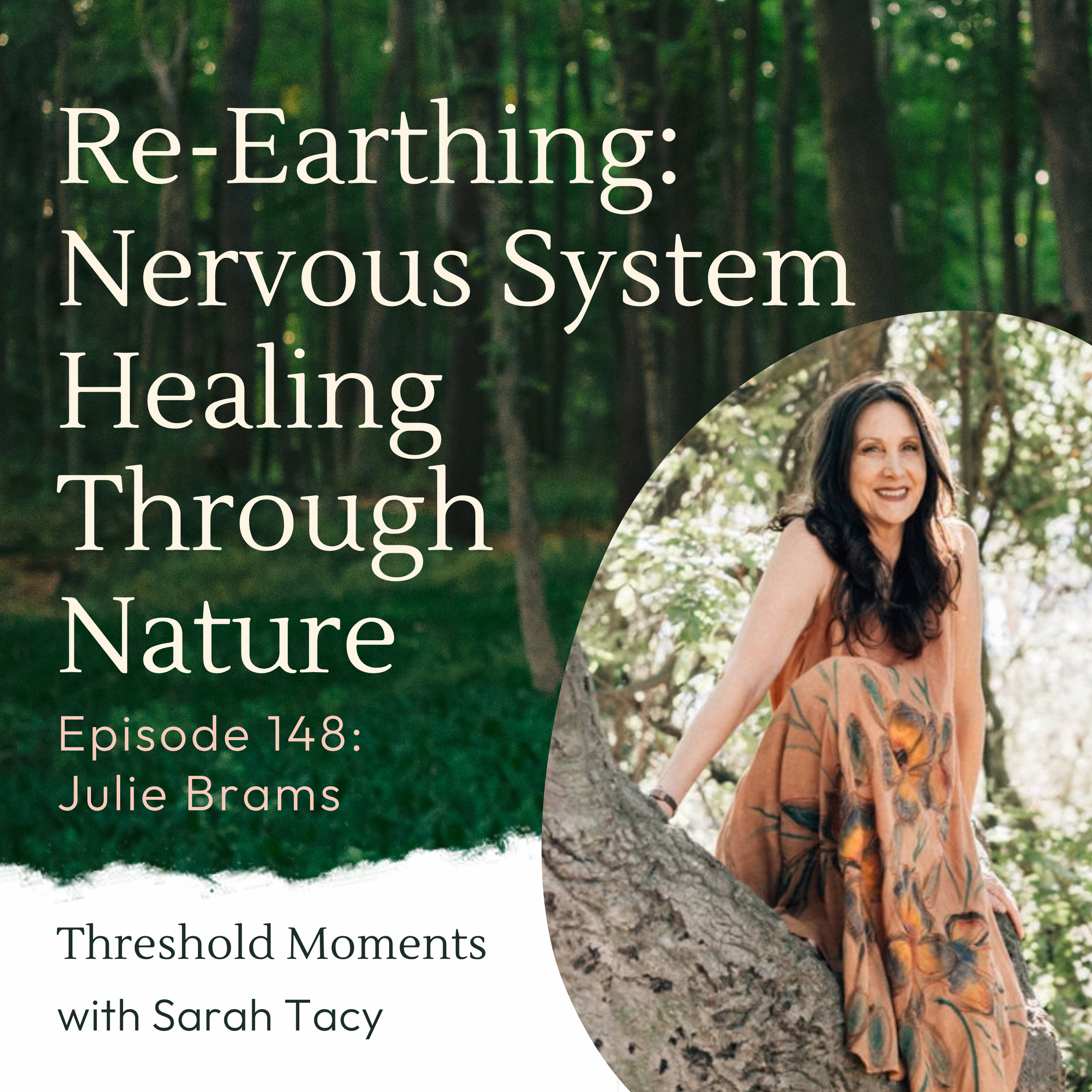
What if reconnecting with nature isn't about going somewhere outside of ourselves, but remembering that we are nature?
In this episode of Threshold Moments, Sarah welcomes psychotherapist, mindfulness teacher, forest therapy guide, and author Julie Brams for a conversation about our relationship with the natural world and what it means for our nervous systems, our communities, and our sense of belonging.
Julie shares the threshold moment that shifted the direction of her work more than 20 years ago. While watching her young daughter play outside, she began asking how she could use her experience as a mental health professional to help people reconnect with the Earth.
That question eventually led to her book, The Nature-Embedded Mind, and her concept of re-earthing—remembering that we aren't separate from nature, but part of it.
Together, Sarah and Julie explore the ways modern life can disconnect us from our bodies, the natural world, and one another. They discuss the importance of reciprocity, the role of awe in nervous system regulation, and how some of the most meaningful practices for connection have been available to us all along.
From the simple act of noticing a tree to the experience of a long hug, this conversation invites us to consider what changes when we slow down, listen, and begin relating to the world around us differently.
Episode Transcript:
Sarah Tacy: [00:00:00] Welcome to Threshold Moments. Today we have with us Julie Brahms. Julie Brahms is the author of The Nature-Embedded Mind, which she just let me know that it won the Nautilus Gold Award today. So we're celebrating that. We're gonna hear more about that. Julie Brahms is an LMFT, which I looked that up. I had an idea what it was, but a licensed marriage and family therapist.
Sarah Tacy: She was born in Chicago, based now in Los Angeles, and is a psychotherapist of over 30 years with a full integrative private practice. Also a mindfulness meditation teacher and an ANFT certified forest therapy guide. She is a mother to her daughter, Marley.
Julie Brams: Mm.
Sarah Tacy: And this book is dedicated to her mom and daughter.
Sarah Tacy: The whole project is a call to her own profession, mental health clinicians, to expand their sense of family and relational repair to include more than [00:01:00] humans in that perspective. Her core coined term is re-earthing, deliberately lowercase re- Hmm ... because in her framing she already knows that we are Earth, whether we are conscious of it or not.
Sarah Tacy: Welcome, Julie.
Julie Brams: Thank you. I'm excited to, to, to talk together about this.
Sarah Tacy: Yeah. So this is Threshold Moments, so I was going to kind of jump right in and ask you about your threshold moment in 2005.
Julie Brams: Hmm.
Sarah Tacy: You know what? Let's do that. Let's jump right in. Okay. Let's go, and then, you know, at the end if we can talk more about, um, this award, that would be so great, but for the listeners, can you describe the moment in 2005 when you're looking out the window and watching your daughter, and you read a phrase that, mm, maybe [00:02:00] reaffirms or amplifies a knowing that you've already had and changes the course of your profession a bit?
Julie Brams: Yes, absolutely. I mean, I can still transport myself right back there because it was... Yeah, it was something that was simmering in me or, or, you know, in me forever, you know, this, uh, kind of love of the Earth and value of, you know, at, what I understood then as, you know, like, indigenous way of being in relationship, in right relationship with other than human beings.
Julie Brams: And, um, yeah, so I read Tom Hartman's book, The Last Hours of Ancient Sunlight. Mm-hmm. It just the description of how human beings, for most of our [00:03:00] journey here on Earth, have been connected to Gaia and, you know, harmonious in a certain way. Like, we can get to the parts that people always push back, but this, but that, you know.
Julie Brams: But you know, honestly, living in a way that is sustainable, that is not just sustainable in terms of the culture sustaining, but in terms of our planet, you know, thriving with us and not being, you know, ruined. Um, anyway, and so I was sitting there and watching my girls, you know, Marley, my daughter, and her best friend Nikki, and they were young and sweet and playing on the lawn.
Julie Brams: And I was in the window above kind of w- w- looking down at them and going, "What can I do?" Like, and what can I do with my particular skill set? Because, you know, of [00:04:00] course there was a part of me that's just, "I'm gonna trash everything I've been doing and go do s-," you know, and I'm like, "Okay, let's not do that."
Julie Brams: But what can I do with my skill set as a mental health professional, as someone who is dedicated to the human mind, consciousness, m- more importantly, like human consciousness, human potential? What can I do, um, to contribute to returning us to this sustainabil- sustain- sustainability or this way of being that isn't k- you know, like s- like that, that might make it, like, just effortless, that people would effortlessly care for the rest of nature.
Julie Brams: At the time, I didn't even language it that way because that's a piece of what needs to change, but, um, to care for the rest of nature as family, which it [00:05:00] is. And the final leap, as I say in the book, which is h- harder to make, is to really understand we are Earth. There's really no separation, even in terms of dividing us into different species.
Julie Brams: We're one functioning organism, self-regulating organism, um- We can't get out of that reality. And so that, that m- was my rec- like, realization, that if I can help people realign their mind with reality, that would be a good thing.
Sarah Tacy: Earlier on, you said there are people who push back. What is the pushback?
Julie Brams: Hmm.
Julie Brams: Lots of pushback. The pushback is, um, humans are just violent. Humans are like this. Humans are, uh, [00:06:00] warfaring. Humans are, you know, just a lot of the negativity, the antisocial behavior that, you know, we see and we have to experience. People want to say, "That's just human nature." And I have always stood in challenging that, and I still do.
Julie Brams: Because if you look at nature, again, which we are, but if you look at nature, it's harmonious. You know, that's not to say there isn't death, because death is part of life, and it's not to say that there isn't, you know, a certain amount of, um
Julie Brams: Mm-hmm ... conflict, let's just say. But, uh, what humans do with it that I feel is part of this cognitive distortion is a kind of, uh, cruelty- Mm ... and, [00:07:00] um, self-destruction. Um, you know, this r- really I th- I believe, and I will stand on this, I believe it's a function of this, uh, cognitive dissonance and the dysregulation that comes from within oneself when you're l- living outside of reality.
Julie Brams: When you come back to reality, your nervous system down regulates because it's, it's congruent with the truth. And then whatever comes from that, we'll see, you know. Um, so that's some of the pushback. And then I also get pushback from people who think that this is woo woo or that it's some kind of, um... You know, there's all this, like...
Julie Brams: I don't think it's an insult, but you know, people are like, "Ah, you're a tree hugger," or, "You're [00:08:00] a..." You know, like, there's this downgrading of... And I know w- why, and I can speak to why I think that is. Um, but this ridicule and shaming of people who are outspoken about their connection, um, to other than human beings, which again, is a hard, hardwired way of being, but...
Julie Brams: So I get that pushback. And then, you know, and the one that I'm really working on helping to change is pushback from my colleagues-
Sarah Tacy: Hmm ...
Julie Brams: who seeing this a- as kind of an option. Like, "Oh, yeah, you could do that. That could be one of your niche." And I'm like, "No, this has to be the foundation. This is the new foundation, otherwise we're just, we're never gonna move the needle."
Julie Brams: So. [00:09:00]
Sarah Tacy: I'm unsure if this is related, but I am thinking about a woman who was friends with Buckminster Fuller, and he said, "In 50 years from now, society as we know it will collapse." And so this year would mark 50 years from when he said that. Because it's built on the lie of scarcity. And- So it's not necessarily that it's a new foundation, but the foundation that we had was one that may build things fast, but much of, like, us and them and not enough for everybody, and then we, you know, keep going at more and more resources and hoarding and, um...
Sarah Tacy: But he says since that's not the reality of this Earth, eventually that system will collapse, and it will return itself to its original system. And when I think of the natural world, I have cats that are [00:10:00] indoor/outdoor cats, so we rescued them from, like, northern Maine where they were born in a barn and spent their first part of their life outside, and so now they are both.
Sarah Tacy: And I watch how they can, you know, cuddle up, and if a daught- if one of my daughters is crying, it will run over to... You know, one of them will run over and just immediately like start... And it's actually the one who's not as cuddly, but if she hears one of my daughters crying, she'll immediately come. And she's also the one that if we're meditating outside on a rock, out of nowhere she'll just appear and be right there.
Sarah Tacy: And the other one is more like, you know, really wants to cuddle up. And if they go outside, they're hunters. You know, they, they see a mouse or a mole, and And for me, it's interesting because as humans, I think we're often looking at the triad of victim-
Julie Brams: Mm ...
Sarah Tacy: hero, savior, um, or victim, [00:11:00] perpetrator, and savior, and I watch these cats just fully inhabit both, and I could watch myself maybe judge one or the other.
Sarah Tacy: But as you were talking about nature and humans, it also made me think about a, I think it was a chimpanzee documentary of a tribe in Africa and how they did break off into, like, the east and the west, and then they did have a war against each other. And it did show a lot of, like, hierarchy in it, and it did show some violent tendencies, but it also did have a feeling of homeostasis, that everything returned to itself.
Sarah Tacy: Mm. And so I think what I heard you say is not that this doesn't exist in nature, but that humans have something that's specific more towards cruelty and also self-harm. Did I hear that right? Am I kind of building this p- picture properly? Yeah. Is there any adjustment you'd make? [00:12:00]
Julie Brams: No, absolutely. And I think, and correct me or anybody correct me, but, um, my understanding of that conflict with the chimpanzees is that it was unusual, that there was a circumstance that was happening that created...
Julie Brams: It was a m- more of an abnormal, um, brutality. Mm. And so that's kind of proves my point. We are brutal because we are living in an abnormal system. If we were back in alignment, it would go back to, I, uh, would imagine-
Sarah Tacy: Mm-hmm ...
Julie Brams: it would go back to something that is more, like, right-sized and not-
Sarah Tacy: Mm-hmm ... uh,
Julie Brams: you know, tr- trauma based.
Julie Brams: Because I think that this severing from our place within the web of life is the original trauma for the specie- for our species, and we [00:13:00] behave abnormally because of it. And when we're kind of rerooted, that's what I've been saying now, re-earthed or rerooted, when our mind... Because our body is always rooted in earth.
Julie Brams: It can't not be. Um, when our mind is rerooted into the body and then into earth, we would behave m- more systemically or kin-centric or... You know, there is a lot of n- new language trying to come to under- to teach each other what is this, what does this mean? Um, yeah. I will say, like a quick story even. I live in an apartment building, and I'm in Los Angeles, so I'm in a very urban setting living this lifestyle.
Julie Brams: But, um, I recently got a vertical garden so that I could try to grow some [00:14:00] food. Um, and so I have a tomato, you know, tomato plant, and I'm watching, you know, like, oh, the bud comes, and then I'm, like, watching to see is it going to become a fruit or not, 'cause not all of them do. So it's a little bit like watching a baby be born or something.
Julie Brams: Like, you're like, "Is it gonna take?" You know? And then I see the little baby tomato, and then it's growing, and I'm, like, so excited about that. And so when it comes to am I gonna eat it, I have a relationship with it. It's something that I consider. And if I decide... 'cause they're not ready yet, they're still green.
Julie Brams: But if I decide to eat it, I'm going to do it in a very particular way because my heart's involved. So it's not that things don't get killed, because we do need to eat, [00:15:00] but how we do it is what shifts.
Sarah Tacy: Mm-hmm.
Julie Brams: And the honoring and the... You know, um, there is a, a prayer or a blessing, Thich Nhat Hanh's monastery, the blessing for eating, and one of the lines is, you know, m-m-may I be worthy of this life that is now going to allow me.
Julie Brams: So what am I gonna do? If I'm going to take from or- You know, kill, then how do I want to live my life so that that sacrifice was made for something good? And that's what I'm saying. Like, it's, it's not about some weird Disney movie. Well, Disney's pretty brutal, but you know what I mean, like some Hallmark card of life.
Julie Brams: It's, yes, there is killing, but [00:16:00] how do we do it, and do we care? And, and if it's our family member, what do we give back, and what's the relationship? So that kind of thing.
Sarah Tacy: Will you talk to us about reciprocity?
Julie Brams: Yeah. Yes. Reciprocity, I think, is at the heart of the kind of nature and forest therapy that I'm certified in.
Julie Brams: There are other ways of doing nature therapy, and I could get into it. I don't... Maybe, but I want to stick with what you're asking, which is, um, really turning up the volume on relationality, on reciprocity, like you're saying, that, um, our culture, this anthropocentric culture that began around 500 BCE, which is relatively short, [00:17:00] um, is based on domination and extraction.
Julie Brams: You know, that human beings are separate from nature, and then it's ranked in a hierarchy with us at the top, and then therefore we can do whatever we want. Nature is here to serve us only, and we can take So this is, again, coming back to reality and restoring a sense of kinship or selfhood, and what do I want to give in return?
Julie Brams: So if I'm going to take something, what am I giving? And that can be... You know, so we do it anyway. There's no way around it. We are creating the atmosphere together. Every time we exhale, we're giving, especially if we're exhaling around plants, we're giving directly to them. So we do give. Um, [00:18:00] we drop hair, we drop skin, that's minerals.
Julie Brams: You know, we're sweating. You know, we know, like, bugs will come and have a little tasty treat, whatever. Um, but I think it's more the, you know, coming back to the intentionality that we know we're doing this. We're doing this, um, intentionally and beginning to ask. So that's, again, restoring the relationship, the kinship to ask an other than human, what do you need?
Julie Brams: And that answer may come in different ways. It's what we observe, what we notice. We get maybe a feeling. I mean, there are different ways that we begin, I have begun, you know, to understand what's being communicated and then provide that. Or no, okay, I'm just gonna give water when I go out, or I'm going to give, [00:19:00] um...
Julie Brams: I usually give, when I go out I have a bag of herbs and flowers and crystals and, you know, just something to say thank you. You know? Thank you, I, I know that you're giving me my life. You are making it possible for me to be alive. Here's a, here's a something to acknowledge you. So that's a little bit about reciprocity.
Sarah Tacy: Would you say that when you are watching the tomato and noticing it bud and the flower and then considering if you're gonna eat it, that even the appreciation and the interest- Mm-hmm ... is a form of reciprocity?
Julie Brams: I do. I do. Thanks for, for saying that because I have been spending a lot of time considering, and again, this is all for discovery.
Julie Brams: This isn't about what do I think. This is [00:20:00] really a welcome invitation for everyone to start to reimagine this and notice together. But I've been spending a lot of time contemplating vibration and energy as a gift, as what we give as human beings. So like the vibration of love, the vibration of caring, the vibration of awe.
Julie Brams: Mm. That one has been on my mind a lot. Mm-hmm. As what if having that heart swell moment, having that sense of wonder and awe is actually... I'm, I'm gonna use the word medicine. I don't exactly mean it that way, but the, the exchange or the, the s- the substance, the nutrition that we give as humans to the other than human beings.
Julie Brams: And I mean, [00:21:00] my gosh, if we cultivated that and walked around as human beings in a state of awe and love, what kind of world would we create?
Sarah Tacy: I wrote a newsletter last week, and it was reflecting on just the moment I took to write a letter to my mother- Mm ... appreciating all the unseen things that she did within our community, and she happens to be somebody who wouldn't want to be center stage.
Sarah Tacy: She would never do a podcast- Right ... or, like, be on a sports field. Um, but she created so many conditions- Mm ... even so that I could be on a sports field and that other women and girls could be on a sports field. And, and I was just thinking about all the things that we do and how beautiful they are as devotional things that we would do, whether anybody noticed them or not.
Julie Brams: Yeah. The
Sarah Tacy: sun will rise whether or not we bow down to it or not, and the [00:22:00] birds will come and go whether or not we, um, notice them and appreciate them, and the flowers will bloom. Mm. And to take a moment to appreciate it, there is actually really great science about what that does for our hormones and our nervous system and our state.
Julie Brams: Mm-hmm.
Sarah Tacy: And then on the human level, what it would do to their system, and then just a witness who sees an act of kindness. And my teacher, Bridget Vixens, also just used to say, "I wonder if when we appreciate the breeze or when we appreciate something in nature, if it appreciates that." Do you know what...
Sarah Tacy: When I say appreciate, I mean, like, expands or amplifies. So it will do the thing anyway, but do we expand and amplify the positive benefits for it and for us and for the third- Yeah ... that also is in that.
Julie Brams: I love that you're saying that. I [00:23:00] think that is exactly spot on, and yeah, takes that idea even further.
Julie Brams: Um, and then what I think of is if we remember or acknowledge we're one being-
Sarah Tacy: Mm ...
Julie Brams: with consciousness, that that is what we're putting into the field, that yes, of course, it expands because it's one thing. You know?
Sarah Tacy: Mm-hmm.
Julie Brams: The slippery part for us at this time in this paradigm is that we continue to separate ourselves out.
Julie Brams: But then when you plant yourself back in, yeah, when you're experiencing gratitude or all the feelings that I felt from you, um, into the one field, of course it does. Like, you know, there's a certain- [00:24:00] a new common sense. Like, we don't have to wonder. Mm-hmm. This is the part where I always feel like- ... it's great that we have science to validate it.
Julie Brams: Right. But it's common sense if- Yes ... we can be less afraid to just claim it.
Sarah Tacy: Yes. It's funny. I'm, like, going to all these posts and thing- So I did a post yesterday on the Disney hug, which is-
Julie Brams: Hmm ...
Sarah Tacy: apparently at Walt Disney they said to all those who dress up in, say, Mickey Mouse or Minnie Mouse- Mm-hmm ... hug until the child decides it's enough, like when the child releases.
Julie Brams: Right.
Sarah Tacy: Which is different for a parent who might be in a sense of urgency to just like, "Oh, hi," like, "So glad you're home," or even forget to hug. Um, so I have a child who probably does better with quicker contact, like a, like strong contact, but not... And I have another one who could just, like, hug forever. Hmm.
Sarah Tacy: And so the other morning I [00:25:00] was, she came in and I gave her a hug, and I was just remembered the Disney hug, and I just kept holding her. And then we're, like, six minutes in, and she's like, "Oh, this is just the best hug ever." And she goes, "You can let go if you want." I said, "Um, I'll let go whenever, whenever you feel complete."
Sarah Tacy: I was like, "Otherwise, I'll just hang here with you." And she's like, "How long do you think it has been?" So I started, like, timing it. And then at 26 minutes she's like, "I would stay here forever, but I am kinda hungry." And I was like, "Okay, I'll carry you downstairs." So I don't need science to tell me that this is great.
Sarah Tacy: Right? Like, I know my bo- Like, I actually, like, almost started even, like, falling asleep at one point. I was like, "Ah." I know my body felt better. I know it's good for us. I know it's good for her. I believe in ripple effects, that when she feels better and safer, then her interactions with her sister will be better, with the earth, with et cetera, et cetera.
Sarah Tacy: And on my post I was still like, "Here's what science says about..." Right? Right. And [00:26:00] so-
Julie Brams: Right ...
Sarah Tacy: I find myself in my work- Always, like, loving the both/and. Mm-hmm. The isn't it interesting when science backs something that we inherently know, that our ancestors knew? And in the nervous system world, I find it really important, because then people are like, "Oh, share a nervous system tool with us," or, you know, "What do you do when you're anxious?"
Sarah Tacy: Or what, and it's like, oh, our ancestors, they danced around a fire, and they drummed, and they ate communal meals, and they had grief circles. And they knew that when, uh, my friend Therese Jørgensen who has, um, been in community with a Dine elder for a long time. Mm. The Dine elder would say, "When one person calls a teepee-
Julie Brams: Mm
Sarah Tacy: everybody knows that it's for them as well."
Julie Brams: Mm-hmm. So it's not
Sarah Tacy: like, oh, we're not... We're, we just have to go support this grieving person. It's the knowing that when we gather and when we digest grief together, [00:27:00] that there's medicine there for all of us. Mm. And so while I appreciate science and tools and tracking, there's a really big part of me that wants to continue to remember- Yeah
Sarah Tacy: the practices that have always been known. And somebody once even said to me, like, "Oh, well, you're, it's your privilege as to why you get to do resourcing tools." And I remember reading my grandmother's hands, and he was like- Mm ... "No. We knew to braid hair." Yeah. "We knew to drum. We knew to cook." And I just think it's a really great reminder that- The things that we need never came from privilege originally.
Julie Brams: Right.
Sarah Tacy: And that they were, they were also in connection with the Earth. My husband, I don't know how you feel about this, but my husband started something, um, with a group called Sacred Hunting, um, where it was all about [00:28:00] meditating on the animal and tracking, and it could take a whole season or years s- and then the whole process of, like, the honoring and the giving back and using every piece of the animal.
Sarah Tacy: And, like, I mean, to, like, a pretty... I don't wanna say to an extreme, but it's like then every time there's a meal there's just like you know that there was a life that was taken or a life that was given. And so the honoring, and you just slow down when you eat, and you're just like you really get that this was a sacred animal and that there is an exchange of life.
Sarah Tacy: And it really changes things from even, like, store-bought food.
Julie Brams: Absolutely.
Sarah Tacy: I just went on, I just went on, like, a whole bunch of loops there. No. But this is... Yeah.
Julie Brams: No, absolutely. It's a fact, and I'm glad that you're, you know, kind of threading the other than humans into this even from the hug to, to this.
Julie Brams: It's like, um... Because again, [00:29:00] like, for us that are still stuck in that anthropocentric paradigm to extend that, you know. So what would it be to hug a boulder? Mm. You know? And, and I don't mean even hug, but it could be. You know? Or what does it mean to hug the ocean? You know? So again, I'm using these words to start to, you know, kind of poetically to let people begin to imagine, yeah, obviously it's not gonna be my arms around the ocean, so what would it be?
Sarah Tacy: Mm.
Julie Brams: You know? And, and what... How do I know when it lets go, or does it?
Sarah Tacy: Mm.
Julie Brams: Or do I? And, and to understand that that co-regulation is available from all the species, all the minerals, all the elements, all the... You know? D- And again, yeah, [00:30:00] i- I mean, I don't... Just again, how that does change the relationship even if it comes down to another animal or plant giving its life for our life.
Julie Brams: It, it, it becomes... It's just a different tone, right? It's, it's like- For myself, if I knew that I would be planted in the earth and decompose, I'm happy to do that.
Sarah Tacy: Mm-hmm.
Julie Brams: You know, there's still something like, it's like, hmm, do I wanna be in a casket where nothing's gonna get to me? Like, that doesn't feel right.
Julie Brams: It's like, yeah, please decompose me. Then I feel like, okay, good, my life meant something, and here it's gonna feed... You know, so the... It's, it's just a whole different... Even imagining what does that animal that's being hunted feel? Yeah, of course [00:31:00] it's, we all wanna be alive, but then we also maybe wanna give because it's like, okay, great, I know who you are and I'm happy to give my life for your life.
Julie Brams: It's just-
Sarah Tacy: Mm.
Julie Brams: Yeah.
Sarah Tacy: I don't... You know, in, in this manner, this is probably the least important part is that going back to like, for him, going back to a bow is just like the silence of it and the less, like, fear invoking portion of it. But as I hear you going back to something that feels Uh, when you said, like how would I hug the ocean and how would I- Mm
Sarah Tacy: how would it hug back? How would I know when it releases? I was trying to envision myself in the water, and how often... I live in Maine, so I love to go for ocean dips even in the winter, and how often I'm taking in the experience and in awe of nature, and [00:32:00] forgetting to ask. You know? Mm. And I might be appreciating- Mm
Sarah Tacy: but I remember a friend who was in the practice of, like, asking before she walks in. Mm. And then really getting to feel that relational element, and the co-regulation in a different way.
Julie Brams: Mm-hmm. Right, and, and the learning to hear no.
Sarah Tacy: Mm-hmm.
Julie Brams: Learning to hear no. And, you know, so maybe it is on a day the ocean says, "No, not today," and I'm gonna guess for your own safety.
Julie Brams: You know? Like, I think a lot of times the other, the other than humans are saying no because they care about you. You know? Like, um, a rattlesnake. Uh, no, don't, 'cause I don't want to... [00:33:00] You know, you're, there's something that they're needing that your approach is not welcomed, and they don't want to hurt you.
Julie Brams: They will rattle first. You know, it's just interesting to me too, like this whole respect around no.
Sarah Tacy: Mm.
Julie Brams: And, you know, and I will say, you know, I've gone up to trees and they've said no.
Julie Brams: You know, you just get a clear sense that n- n- I do not wanna talk to you. I don't wanna interact, and that to, to respect it and to walk away. So yeah, being with the rest of nature, again, it's not a fairy tale, it's real life. You know, there are definite nos out there
Sarah Tacy: Uh, we ask our daughter, our, our, my youngest daughter loves to pick flowers. And I'll often, you [00:34:00] know, first I find myself like, "Oh, those are for the bees. Don't pick them. Leave them out here." Yeah. And, and then it is just been about asking, and sometimes she's like, "But Mom, I can't hear an answer. Can you come over here and ask?"
Sarah Tacy: Um, and I, and I think she's an incredibly intuitive human. Um, but it is so, so in that way it's interesting to me when she's like, "I can't hear an answer." Where I think my oth- other daughter's like, "It said yes or it said no." Um, I'm skipping to something that may not be a conversation starter or continuer, but when you talked about being buried- Uh-huh
Sarah Tacy: I my entire life have told my parents, I've told my husband, I'm like, "When it's my time, please just dig a hole." I was like, "I would love just to be eaten by the ants and, like, return to the earth. I do not wanna be filled with chemicals and put in a box." Yeah. That sounds like hell to me. I also, like, being burned sounds weird.
Sarah Tacy: I just wanna... And, uh, and you're the first person, [00:35:00] because everybody thinks, they're like, "That's really gross. I don't think that's legal." And I think maybe now they have, um, perhaps, like, mushroom kits or even tree burial ways- Right ... where the roots can grow around you or something like that. But I've made it known to, uh, all those that are close in my life, I'm like, "I just wanna go back to the earth."
Sarah Tacy: Like, I just want to be eaten by the insects and have my body returned. So I was, like, dancing over here when you said that. I was like, "Okay, there's another one."
Julie Brams: Yeah. Yeah. Yeah. It's like the completion of the cycle it seems to me, you know? It's f- again, like a waste. Like, use every part of me. Why not? You know, like what you were saying about if you kill an animal to eat, you use every part of it.
Julie Brams: You're not gonna waste it, and that feels something similar about that, at least in my mind is like, uh, you know, I've got [00:36:00] some m- minerals and stuff here. Take it.
Sarah Tacy: Yeah.
Julie Brams: What am I gonna do with it?
Sarah Tacy: Right. You
Julie Brams: know?
Sarah Tacy: Right.
Julie Brams: Yeah.
Sarah Tacy: Well, I'm, I'm on the same page with you on that one.
Julie Brams: Mm-hmm.
Sarah Tacy: When you speak in your book about seeing through animal eyes-
Julie Brams: Mm-hmm
Sarah Tacy: can you speak a little to that? And was that something you did as a girl?
Julie Brams: Yeah. That's, that sort of was my first... Yeah, that was my first, I guess, version of what I'm living now. Um, I would-- I was kind of naturally suspicious for some reason of Western civilization. And so I would favor-- If I had, if I had a question about something, I would consider, what does the rest of nature do?
Julie Brams: Like, that seemed to me to be a [00:37:00] more reliable source of a good way to do something. So, um, yeah, like parenting or whatever, you know, childbirth or, I don't know, anything I would consider... Yeah, like what, what do indigenous people do? What do people who haven't been broken, um- Mm-hmm ... I mean, there's something to say about that, uh, in terms of Western civilization trying to break indigenous people.
Julie Brams: Um, but I would look, how, how does that culture handle it? Um, how do, yeah, like you were saying, chimpanzees or, you know, o- other closely related, um, species handle it to get a clue of, like you were saying, if, uh, uh, a, a [00:38:00] primate mother is carrying her baby around, that must be important to do because they're...
Julie Brams: A- and, and I would think to myself, like, what animal puts their baby, and they're pr- maybe there is, but what animal would put their baby away from them to sleep? Mm-hmm. Like, that feels really dangerous. Wouldn't you be close to your baby to protect it through the night? And then why wouldn't I do that?
Julie Brams: Why? Because there's- Freud said you need to put it in a crib down the hall with a monitor. Like, I'm not doing that. Mm-hmm. That just felt crazy. And when I look through the history of Western civilization, I'm like, that all feels crazy to me, you know? So luckily I'm here in a point in time where we can start to say, yeah, it is crazy and we have the science to prove it.
Sarah Tacy: Yeah. [00:39:00] I imagine that was also around the time of creating really like hyper independence, this idea that we should self-soothe everything. And, uh, I found myself in a real bind when I was trying to figure out, you know, how to help my children sleep who really didn't sleep much and... But then I wasn't sleeping at all.
Sarah Tacy: Mm-hmm. I just want to like name this civil bind because-
Julie Brams: Yeah ...
Sarah Tacy: in a culture where y- if we were in a village, I imagine if a mother were up eight times a night then she wouldn't be on full duty all day too.
Julie Brams: Exactly.
Sarah Tacy: And so this place of like, okay, I can try co-sleeping but then, then when that was like... And then I was like, okay I like feel like I might die.
Sarah Tacy: I, I need to find another source or resource or way.
Julie Brams: Right.
Sarah Tacy: But then being one studying the nervous system was like man I don't want my kids to think if they cry out no one will answer.
Julie Brams: Right.
Sarah Tacy: It just felt like such a bind of [00:40:00] like-
Julie Brams: Right ...
Sarah Tacy: wanting them to know that if they call out they will be responded to- Right
Sarah Tacy: but also just like feeling like death and I do think it's, it's hard. It doesn't have to be. I know that some babies sleep more and they could do it in a crib or some of them do it co-sleeping for six years and um, and there are other points where it's just so hard to do the indigenous ways when we're not in an indigenous culture.
Julie Brams: Right which is again- And it's like- Yeah. Mm-hmm. It's why I wrote the book. And not just the book but creating this hub for unlearning and re-rooting so that we have a chance to come back to a culture that is pro-social. That yes I mean- A- again, it's not like I have to know what it would look like, but [00:41:00] we would create something where you're not in a double bind of or you're not in a bind of, um, I have to do this thing alone.
Julie Brams: Like what do I do? How do I function the way my society wants me to which is counter to health? Yeah. It's counter to health. And then we live at a deficit. You know, this is more and more the reality. I know you know because of your work. Um, but the more digitized and away from our true habitat, we're functioning at...
Julie Brams: Our immune systems are function- functioning at a deficit. You know? So science shows if you spend 20 minutes with a tree, your natural killer cells go back up to where they [00:42:00] belong.
Sarah Tacy: Hmm.
Julie Brams: You know? So if we're not doing that, we're operating at a deficit and then we're getting sick. And then we're like, "Well, that's just how it is."
Julie Brams: Like no it isn't. And similarly with our mental health, you know, if we're constantly dysregulated because we're thinking we're not connected, you know, we're having to gaslight ourselves to function in this world, our nervous system is always dysregulated and as many things as we do to down regulate, if we don't get to the root, we're working at a deficit.
Julie Brams: Mm-hmm. So the more... Again, y- your m- mind back in your body, your body back in the Earth in specific ways, um, down regulates your system to a degree that feels [00:43:00] crazy. Like I didn't know I could be this relaxed.
Sarah Tacy: Mm-hmm. '
Julie Brams: Cause our society is keeping us agitated. Yeah. You know? So Yeah.
Sarah Tacy: When you say specific ways, so at the very beginning you also mentioned, mm, mind and body, body and earth.
Sarah Tacy: Can you give our listeners a couple ways that they can start to- Hmm ... reorient or re-earth
Julie Brams: Yeah. Uh, okay, so this is also kind of like a logical pathway f- for how I, you know, my journey of this. Um, the first practice that I had is Vipassana meditation, and so that very specifically is helping a person train their awareness or their [00:44:00] attention to m- move away from thought and move into sensation, right?
Julie Brams: So that's the one way to get your mind and your body, is sensing your experience and letting thinking about it go. I think you know this, probably your listeners know this, but that is crucial, is essential to be in a sensory experience of yourself and the environment, and then bringing that to the rest of nature and allowing the other species to communicate with you in that realm.
Julie Brams: You know? So yes, we have the five senses that we pay most attention to. We have a few others that people like you probably... You know, proprioception, interoception, you know, [00:45:00] like, these different senses that you recognize in your daily life. Um, and then I'm also hypothesizing that there are other senses that only come online when we're in relationship with the specific other than being, other than human being that would call that forth.
Julie Brams: So my guess is that there are other ways of experiencing oneself if you give yourself time and sensory connection with an other than human being That I, I always feel like you're either drawn to it or it's calling you. Like sometimes I say to people, "Wander out of doors and notice what other than human being grabs your attention."
Julie Brams: Mm. It's [00:46:00] maybe a sound. It's gonna be a movement. It's gonna be a color. It's gonna be a fragrance. Something will grab your attention. And to legitimize that that was intentional, that they wanted your attention, and then go for that conversation. Or I sometimes I say, like, "See who wants to play with you today," that something's gonna grab your attention and wants to get to know you.
Julie Brams: And go and, you know, again, in the way that I'm trained, you know, you sit with them. And, um, with enough time you begin to hear the invitations that are coming from that other than human being. In my training as a guide, this is what our function is, is to take people who don't have this practice and begin to, you know, [00:47:00] setting up in- invitations, um, so that it helps people move into that relational dynamic with an other than human of their choice.
Julie Brams: You know, it's all very ... It's about the person and their relationship. It's not about me making something happen. That's a critical difference, you know, to make sure that I'm not contaminating the relationship with my agenda. Mm. That whatever you find is what you find, and it, it ... Like your daughter saying, "I can't hear it," is like, "Okay, keep listening.
Julie Brams: That's fine. That's okay." It's ... You know, you're learning. It's learning a skill, learning to hear. Maybe it's not with your ear. Maybe you're, you're hearing with your eyes or your, you know, whatever. So taking people where they are [00:48:00] in their relationship, and a lot of people are actually afraid or f- feel, again, like there's been such a
Julie Brams: You know, going back into history, breaking us out of this relationship was very violent, very dangerous. If you dared to continue to have that relationship, you were punished in really scary ways. And, you know, 150 generations later, we are afraid of being ridiculed. We're afraid of being shunned. We're afraid of being, you know, um, banished from community.
Julie Brams: Um, and so we don't wanna talk about it, you know? So to break, again, those mental bars on this cage to come into relationship, and then to be able... Which, again, [00:49:00] is why this method, I think, I say is, I find, the standard because then you process with other people. In between these encounters with the other than humans, we come together as humans, and not, like, chitchat about it, but just sort of share from the heart, "Here's what I noticed."
Julie Brams: And then when you hear, again, this group kind of, "And here's what I noticed," and then you're starting to go, "I'm not crazy."
Sarah Tacy: Mm-hmm.
Julie Brams: It's a thing. It validates us in our experience. Again, like you were saying, it's like you- you know in your nervous system that it's true, and then when you hear other people going, "Yeah, that happened" And it sounds like some of the things that happened sound impossible, sound like that can't...
Julie Brams: That can't be true. And then you get a few people that are, "Yeah, I felt... I had that happen, too." And you're like, "Oh." You know, it's very, um, [00:50:00] yeah, confirming and allows us to be braver and- and- and say reality without shame.
Sarah Tacy: Hmm.
Julie Brams: Um, I feel like I got off on a tangent, but-
Sarah Tacy: I don't think so. But- I asked you what were some steps that listeners could do- Hmm.
Sarah Tacy: Hmm ... in order to have this experience of re-earthing or body to Earth. As you said, mind to body, body to Earth. So mind to body was Vipassana, and body to Earth would be that we go outside and we notice what might be calling to us- Mm-hmm ... and get curious and don't bring our agenda and listen, and then talk to others about it who might- Mm-hmm
Sarah Tacy: be in the same practice because there may be parts of it that get affirmed. Hmm. And I imagine, and I'd say m- perhaps even from my own experience, it's really calming to my system to feel- It can be very [00:51:00] easy in society the way that we are separated to feel like we're alone, like we're alone in our endeavors, we're alone in the effort, we're alone in all the ways.
Sarah Tacy: And to attune to nature is attuning to a web of oneness.
Julie Brams: Mm-hmm.
Sarah Tacy: And I was thinking about this thing that looked really crazy and silly that I saw on Instagram, but as you were speaking, I was like, "Oh, this might be a version of, um, contaminating with my own agenda." Hmm. And it was a woman who was next to a tree, and she was maybe, like, eight inches away from the leaves, and she stood completely still.
Sarah Tacy: And she said, "You can touch my face. You can touch my face." And she just said it over and over again. And then you see the branch, like, lift and move, and it's not a wind, and it eventually comes and touches her face.
Julie Brams: Hmm. I'm
Sarah Tacy: like, "There's no way." And so I went outside, and I stood there, and, like, three out of three [00:52:00] times...
Sarah Tacy: And I really was so sure not to, and then I was like, "Is it because of the CO2 and the branches moving towards the CO2?" But it gave me this feeling. This is not, like, my only experience of feeling the animation of life force beyond, but it gave me this feeling Of a call and response of like, oh, like the branch, I can't even explain it.
Sarah Tacy: It's like it lifts up as if it would take effort, right? Like it lifts up, and then it moves in a way that isn't the wind. And at first nothing's happening, and then after a few minutes and you're like, "Okay, this is not actually gonna work," it- every time it's like then eventually you see these little movements and like, oh, but there's no way it could actually reach me, and it does.
Sarah Tacy: Yeah. But maybe that is like the contamination of my own agenda. But it does give me this feeling of like, wait, re- really? Is that possible? And Zach Bush also speaks about- [00:53:00] Yeah ... when he will like lay under a tree, and at first he's looking at the leaves, and then he stays there until he can feel the leaves looking at him.
Sarah Tacy: Yeah. And I think about this woman I once heard speaking where she said, you know, some things are hard to believe, but if you try it on as an experiment-
Julie Brams: Yeah ...
Sarah Tacy: just what if this were true? And see how it affects your life. So it could be like, well, that's crazy. That doesn't make sense. You know, like you said, generations of people being burned at the stake and all of the things for having this relationship with nature that would tell us that we're not in scarcity and that there is enough, uh, and that we're not alone.
Sarah Tacy: Um, if we just try it on with some curiosity and see, how does my life change? How does my life feel now? How does my body feel? How does this relationship feel? Then it can be a little bit less of like, is this real? Is it not real? Is it crazy? Is it not crazy? [00:54:00] Instead it's- Mm ... how does it feel when I re- Really feel this embodied connection
Julie Brams: Yeah
Sarah Tacy: Not necessarily even to a divinity beyond me, but like nature all around and within me.
Julie Brams: Yeah.
Sarah Tacy: Exactly. And that is a completely, for me, completely stabilizing- Yeah ... and awe-provoking feeling. So I love- Mm-hmm ... the idea of down-regulating in a society that's often in a state of urgency, and there are a lot of people in freeze who- Yeah ... can use the upregulation of awe, right? And so- ... uh, I, I think nature gives us those two things, like the down-regulation of not being alone, and the upregulation of like, wow, this is so much more significant and amazing and miraculous than there could ever be studies to prove.
Julie Brams: Yeah. And yet there are studies to prove it.
Sarah Tacy: And yet there are studies, right? There are foresting studies and-
Julie Brams: Millions and millions every day Mm-hmm ... [00:55:00] more and more. You can't even keep up with it. Yeah. Well, the truth of it, right, is like any embodied practice, you can read about it, you can learn about the studies, but until you begin to do these things, it's not going to change anything in you.
Julie Brams: It's just a mental exercise. Um, and just going back to that, you know, that you had that experience of experimenting with the tree touching your face, that's, that wouldn't be contaminating it. It would be contaminating if I, as a guide, was to say, "Go out and ask a tree to touch your face." That would be contaminating your experience, rather than wander out and find a tree, what do you notice?
Sarah Tacy: Mm-hmm.
Julie Brams: You know? So just again, like our relationship with the other than humans is our own to pl- to play with, and then I would say also just to remember to give something back. Mm. And as you said, i- you know, even the awe or the [00:56:00] a- you know, the, whatever that is, that feeling, is a giving back. But n- knowing, intending I'm going to give this back because you showed me that you see me, and I see you, and yeah And that feeling, like you were saying, awe, I think is that sweet spot of down and upregulated simultaneously in the way that we do need to be present and available, not overstimulated and not understimulated.
Julie Brams: So when you're saying that, I was thinking maybe awe is also in a sense downregulating but with the expansiveness. It's interesting, you know?
Sarah Tacy: Mm-hmm.
Julie Brams: Yeah.
Sarah Tacy: Poses in, uh, in yoga as well that I used to be really interested in, like a headstand, because when you're upstair- when you're upstairs, when you're upside down- [00:57:00]
Julie Brams: Uh-huh
Sarah Tacy: your baroreceptors will say like, "Oh, that's too much bl- uh, blood to the brain," so your heart rate will slow down. Mm. And so it's downregulating in that way. Yeah. But then the nervous system will be like, "I don't know how to use my proprioception in this way," like, "I don't know how to perceive the world," so it's upregulating in trying to sense like where you are in space and this new...
Sarah Tacy: And so I would often say that inversions often are that stimu- like that perfect balancing stimulation for many, not for all. Yeah. Where if you're feeling dep- depressed- Mm-hmm ... or just like really low energy, um, and you're like, "I just wanna balance it out," or if you're feeling like anxious and all over the place, like it's just one of those middle grounds.
Sarah Tacy: And I feel like nature is also that, where it can just like help bring you right back to a homeostasis.
Julie Brams: Fact. Fact. And again, I think that's no coincidence.
Sarah Tacy: Mm-hmm.
Julie Brams: Because we're born from [00:58:00] the Earth, so of course-
Sarah Tacy: Mm-hmm ...
Julie Brams: the Earth puts us in balance and harmony.
Sarah Tacy: Mm-hmm.
Julie Brams: It's only our mind, our mental activity that pulls us out.
Julie Brams: So again, and this is where I'm saying my little mission statement that I want my field to take it seriously, that this has to be the foundation of mental health. It has to. We have to let go of this distorted, uh, framework and use our skills again. Especially my license, I think. You know, family therapy, like this it feels again like a no-brainer.
Julie Brams: Just expand it to the rest of- The people, so to speak, that we're creating this place with
Sarah Tacy: Mm-hmm.
Julie Brams: So yeah, it kinda goes full circle to why I, why I get fiery in, in [00:59:00] myself around my field. Like, come on, guys. Please. Mm-hmm. Please, please. How much good could we do to make- Mm ... the shift for everyone if that becomes, yep, that's the standard of mental health.
Julie Brams: Well, let's re-root everyone, and then take care of whatever issues.
Sarah Tacy: Yeah.
Julie Brams: Yeah. That's a
Sarah Tacy: beautiful mission statement.
Julie Brams: Yeah. Well,
Sarah Tacy: thank you for coming on today, and at the beginning, I know we said that you won this book award, and this may or may not feel important to close out with, but I'm just wondering what it is about the Nautilus Gold that made you say, like, "Oh, if there were any award..."
Sarah Tacy: Like, f- I don't know. Is it a memory of another book that had that stamp, or what was it about it that just felt-
Julie Brams: Yeah ...
Sarah Tacy: important to you?
Julie Brams: I think, again, it's, it's their mission statement, you know? Like, the, what they are looking for, and this, again, this kind of, um, [01:00:00] what do they say? Um, better books for a better world, or you know- Mm-hmm
Julie Brams: it's really about, um, what can help the world, what, what, what are the social justice issues, which I think this falls in the category of social justice. What are, you know, growth and green living, and all of that, you know, which is exactly what my, you know, I think of my book as sort of my gift after- 63 years around the sun, you know, and 35 years as a clinician.
Julie Brams: So to have them see what I'm saying felt like, ah, okay, I did it. I, I, I, I, I put it into language that other people understand. Um, so that was really important to me, and it's in the category of rising to the moment, which I thought- Oh ... is really cool [01:01:00] because, yeah, this is the moment.
Sarah Tacy: Mm-hmm.
Julie Brams: And again, I wanna, like, I, I, I re- really wanna emphasize the, the optimism that, you know, when we think about how quickly nature, you know, restores itself or reclaims things, and recognizing that's us.
Julie Brams: We can do this. Doesn't need to take centuries. It can take a, a moment, you know, of here I am back in, back into reality, and everybody else we touch can come back into coherence with us. Could be very quick.
Sarah Tacy: Mm. Well, I love that prayer, and I love that- Yeah ... possibility. Thank you so much for coming on today.
Sarah Tacy: Thank you for sharing your book with me, and thank you for sharing, uh, with my listeners. So Julie's book will be in the show notes for listeners to purchase, [01:02:00] and is there anywhere else you'd love for them to go to find you?
Julie Brams: Yeah, I would love you to join me. My company is Elemental, so if you Google search or if they're in the show notes, experienceelemental.com.
Julie Brams: There's more, um, information about this and practices and ways to connect, you know, online, hybrid, in person, so to, to actually live this, so. Beautiful.
Sarah Tacy: Yeah. Thank you so much, Julie.
Julie Brams: Thank you so much. It was a delight.
Sarah Tacy: I agree. Mm.