
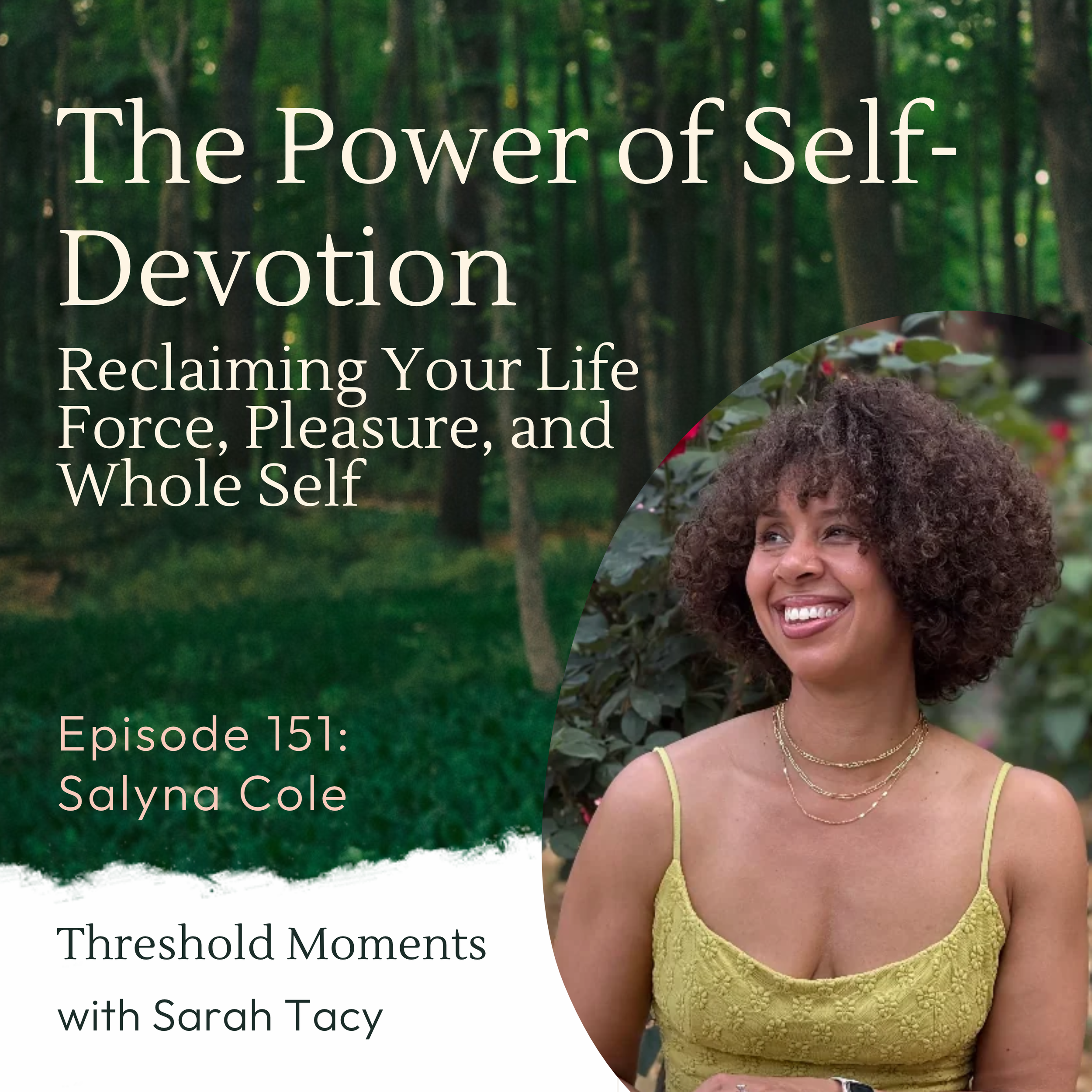
In this episode of Threshold Moments, Sarah sits down with Salyna Cole, somatic practitioner and founder of Feeling Yourself, for a conversation about self-devotion, the intelligence of the nervous system, and what becomes possible when we stop giving from an empty well.
Their conversation begins with a somatic exchange from 2022, when Salyna's hands communicated a clear no. At the time, she was navigating postpartum life, motherhood, partnership, and the demands of running a business. What emerged was a recognition that her body had been carrying too much and that the freeze she had been fighting was actually trying to protect something precious.
Together, Sarah and Salyna explore what happens when we begin listening to those protective responses rather than pushing through them. They talk about the discomfort that can arise when we stop over-giving, how changing our boundaries can shift our relationships, and why reclaiming our own life force sometimes means allowing other people to be disappointed.
Salyna shares how she has learned to meet freeze with warmth, patience, and care, including a beautiful practice of sitting with the frozen earth and trusting that, just as nature thaws when the conditions are right, our bodies can find their way forward without being forced.
They also explore self-care as community care, the importance of pleasure for its own sake, and the deeper blueprint of sacred reciprocity. What if self-devotion isn't about becoming more independent or putting ourselves above others, but about restoring a way of being where giving and receiving can happen from a place of fullness?
This is a conversation about reclaiming the parts of ourselves we've compressed, trusting the wisdom of our bodies, and creating a life where our own aliveness gets to matter.
Episode Transcript:
Sarah Tacy: [00:00:00] Hello, and welcome to Threshold Moments. Today we have with us Salyna Cole. I am going to give a tiny little intro, and I think that the way that we're gonna really get to know Salyna is through storytelling and conversation. Maybe what I would say here first is that Salyna and I first met in a course that we were both in, Alchemical Alignment, which I believe is described as trauma resolution and embodiment of the spirit, which is such a great subtitle.[00:01:00]
Sarah Tacy: Way to go, Bridget. Right. Um, and every time that I heard Salyna share or got to just, you know, be in circle with her or, her or do exchanges, there was a part of me that knew that I was learning just by being with her presence or being with her honest reflections or responses or inquiries. And it made me immediately both appreciative of her and just always curious to get to know her more.
Sarah Tacy: And I have been so lucky over the last two years when I teach Opting Out of Urgency, I've asked if she would, uh, support the program and, um, help chat with people in the chat when I say things that, uh, are either landing hard or not landing at all where [00:02:00] people are just like... And I cannot, uh, do both. And just to have somebody who, again, can answer from such an embodied place and a place of wisdom is such a gift to my whole community.
Sarah Tacy: And a little professional bio: Salyna Cole teaches somatic work foundations within alchemical alignment. In her private practice, Feeling Yourself, which is a genius name as well, she guides creative generational curse breakers in liberating their sensual power and reclaiming the pleasure of being their whole selves.
Sarah Tacy: Feeling Yourself grew from her own reclamation journey, not as something to fix or overcome, but as a place of wisdom, pleasure, power, and belonging. Salyna believes you deserve a life rooted in deep joy, [00:03:00] love, abundance, and pleasure, drawn from the practice of turning your attention back towards the fullness of who you are so your body becomes a source of wisdom, pleasure, resilience, and self-trust.
Sarah Tacy: On a personal note, Salyna is a wife. Maybe this is really just mixed. You can't take the personal out of the work itself, but- Mm-hmm ... Salyna is a wife, a mother to four little spirits, two earth side, two with the ancestors, and a self-devotional woman. Welcome. Mm.
Salyna Cole: Thank you. It's a pleasure and a honor to be here.
Salyna Cole: I really enjoy every time we get to connect.
Sarah Tacy: Aw. Thank you. Um, yesterday I thought I left you a voice note. Mm-hmm. Because our lives, uh... I wanna say they're both probably quite full, but I [00:04:00] could l- just say they, they both have their plans and their schedules, and so I said, "You know, should we make a time to meet?
Sarah Tacy: Should we leave voice memos?" We decided on voice memos. I left something I was... as I was walking, and then I was passing, um, an elderly woman, so I just wanted to get off my phone and, you know, say hello to her. And, um, so I stopped it midway through, and apparently I didn't send it. And the message es- essentially was like, "I know this might sound weird, but I keep thinking about our very first exchange we had in alchemical alignment where we were attuning to your hands, and would that be okay to share?"
Sarah Tacy: And I never sent it to you, and then this morning you sent me a message, and you were like, "I've been thinking about that very first exchange we had." I looked it up, because I wrote a piece on it- Mm-hmm ... with your permission. Um, and it was back in [00:05:00] 2022. So I think it is interesting that for both of us in the last 24 hours it was top of mind.
Sarah Tacy: So I'm wondering if you would be open to sharing anything about that experience? I'm just jumping right in. I'm here for it. I sometimes do this.
Salyna Cole: I'm so here for it. Okay. Yeah. Uh, also, how serendipitous that we were both thinking about it. I just ... The way that brains and bodies connect across space and time will always be a marvel to me.
Sarah Tacy: It's funny, 'cause I was like, "Oh, the universe", but the way that you just said that, the way bodies and brains connect over space and time, yes. Mm-hmm. I'm here for that perspective, for sure. Mm.
Salyna Cole: Yeah.
Sarah Tacy: Thank you. Beautiful. My pleasure.
Salyna Cole: Oh, yeah. So what was really standing out to me yesterday [00:06:00] was I think that was the first moment where I realized two things.
Salyna Cole: There was like a deep freeze in my hands, and I could start with no.
Sarah Tacy: Mm-hmm.
Salyna Cole: And in an alchemical alignment, that's consistently an invitation. You can start with no, you can start with no, and I had not heard that line- Yeah. ... at any point before then. 'Cause that's kind of what happens on Common Alignment.
Salyna Cole: You're, you're- Yeah ... you're there, and then, like, some things you just kind of miss, right? And we were in this exchange, and I think I was, I was s- I was going to do the thing. You know, you're in a practical, you're gonna do the thing. I was gonna offer my hand like you're ... like I thought I was supposed to do, and my hand, like, it couldn't move.
Salyna Cole: It couldn't, it couldn't come forward. It, it refused to, and I think we ... I think maybe you said, like, we could start with no, and I was like, "Wait, can we start with no?" [00:07:00] Like, that's not, that's not a thing. You don't start with no. I think I had a, a default yes. I ... You have an assignment, you, you do the thing, right?
Salyna Cole: And so I heard you, and I'm like, "Okay, maybe I could start with no", and I think it's you shared in your voice memo earlier, we found right distance. We sat with layers of support, and as we sat with layers of support, I found this, like, deep ache- Mm ... in my hand. It was, like, exhausted. Mm. And it had been holding too much, carrying too much, giving too much.
Salyna Cole: I could feel- I think the sense of, like, love and power that was in m- that sits in my heart, that funnels from my heart down my shoulder, through my bicep, my elbow, into my hand, and my hand was like, "No, we're not... We can't give more because there'll be nothing left at the source."
Sarah Tacy: Hmm. [00:08:00]
Salyna Cole: And that was actually maybe a little bit before I started my sabbatical, because I realized, oh, I- Wow
Salyna Cole: there's, there's no more left to give if I keep giving in this kind of way, giving to the near depletion of my life source
Salyna Cole: And so yeah, that's what's been, that's what I've been sitting with. And I realized, oh, since then I've been tending to that freeze, this freeze that's so brilliant, so protective. And before then I'd been fighting. I'm in a fight with freeze that's pissed.
Sarah Tacy: Yeah.
Salyna Cole: It was all upset. I have things to do, and I can't do them, and I'm like up- I'm upset that I'm like feeling this sense of freeze.
Salyna Cole: And that was one of the moments where I'm like, "Oh, wait, no, this freeze is, it's protecting me." Yeah. My poor little heart is drained.
Sarah Tacy: Ah.
Salyna Cole: And so I, I, I've spent the past maybe I guess four years [00:09:00] tending to the freeze and to get to the point where my heart felt God enough and full enough that I could give from overflow-
Sarah Tacy: Mm-hmm
Salyna Cole: versus from, like, the,
Sarah Tacy: the last little wisps. Yeah. I started calling that dry well syndrome.
Salyna Cole: Mm.
Sarah Tacy: Where it's that feeling that so many women have where someone asks something of you, or maybe they don't even ask, and you're just like, "Oh, I should do this. Like, I should do drop-off," or, "I should do..." whatever the thing is, and we're giving from a dry well.
Sarah Tacy: And then the fear, I'll just speak for myself, like, then the fear of asking somebody else to help is like they also might have a dry well. And, and what would it be like to slowly, over time, through self-care, and we'll get into self-devotion- Mm-hmm ... start to [00:10:00] fill that well? And I was just in Peru with Dr.
Sarah Tacy: Debra Kerns, and I got to see a woman holding space from an overflowing well. Mm. I... And, and to say her son is now, um... You know, she was fully financially responsible as mother and provider for so many years, and her son is now, um, older and on his own, and so it is a different phase and stage in life. But to also get to experience what it's like to be with somebody who is taking care of herself so well, and then also when she does give and create space, it really feels like overflow.
Sarah Tacy: I haven't really seen it before, you know? So I was like- Yeah ... oh, 'cause at first I was concerned for her. She... Yeah, I was sick at the beginning, so she really, like, tended to me. And I was like, "Is she giving too much? Is she..." But then I was like, "Oh, she's met these parts. She's met the [00:11:00] over-giver. She's tended."
Sarah Tacy: And it was just really beautiful to also be in the presence of someone who like, oh, so that's possible. That's good to know. You know? It's- Inspiration for us all ... 'cause I think we see a lot of, you know, we don't see a lot of examples of it, right? So it was really cool to experience. Yeah. Um, I pulled up this morning the piece of writing that I did as a reflection of our exchange together, and I'm wondering if it's okay with you if I read it.
Salyna Cole: Mm-hmm. I'd love to
Sarah Tacy: hear it. Um, I wanted to say that I, like, loved hearing from you first, because of course it was, like, inside your body, and where did it come from? And so there are pieces that you just filled in, like heart to hand and the intelligence of the freeze, that aren't in my writing. And so I love that we get to, like, start with your heart and your intelligence and how it moved from there.
Sarah Tacy: [00:12:00] Um, let's see. So I wanna say I wrote this after our exchange because I was so moved, and part of it again was the honor of sitting with somebody who could really attune to herself and getting to accompany you, Salyna, in that process. Um, and before I wrote this I reached out to Salyna to see if it was okay, and I was still even in doing that I was like, "Well, what if there's a frozen no?
Sarah Tacy: What if she says yes but she means no?" So it, like, felt so edgy even to, like, propose it. Um, but I felt that your story was something, like, you were able to put a somatic experience... have a somatic experience and put words to something that so many of us feel but push through, or so many of us feel but have never put words to, and that's why I wanted to write about it.
Sarah Tacy: Hmm. So [00:13:00] it says, "Stories and heartfelt requests reside in your body. Great healing happens when we listen with skill and care. Here is an example of a somatic exchange checking in with someone's hands." So I could say with Salyna's hands. And this piece is called Helping Hands. "And we asked her hands, 'Would you like to move?'
Sarah Tacy: They remained resting, clasped in her lap, unresponsive, as if they were hiding. We sat in the pause. Eventually they said to her, 'No, I do not want to move. Let me be. I barely want to be seen.'" And I'm just gonna pause here. I, I feel like I remember almost like she was like the energy of the hands were like, like they were hiding behind curtains.
Sarah Tacy: And then, "'I also don't want you to leave,' they whispered. We let our bodies stabilize more and more. [00:14:00] When the time felt right, I whispered a secret to her hands. 'We are not staying, waiting in hopes that you will change. We are staying simply to be with you exactly as you are. We will stay here, stable, until you'd like us to go.'
Sarah Tacy: Her hands relaxed a bit more, trust building. They whispered back to her, 'I do not want to hold another thing.'" "We so deeply understand," I affirmed. "Of course you do not. You hold so much." We stayed with our hands continu- continuing to offer presence and time. When the impulse arose, I offered my hands as a layer of support.
Sarah Tacy: Vulnerably, she accepted. I slid my hands under hers. I should say this was, like, energetic because we were at a distance. And I said, "My hands are resting on my knees. My knees are stacked over my feet. My feet are supported by [00:15:00] the floor. The floor is on the earth. One effortless layer of support upon another."
Sarah Tacy: Time, which means we sat, we sat, we sat. A deep breath arose and then fell within her. "Wow, I didn't realize I was- wasn't breathing," she shared. "I can feel my breath return." I saw her body drop into her chair more. She was arriving. Time, time, time. Her hands began to open. She sensed a string ball resting in them, each entwined string representing another's needs.
Sarah Tacy: As her hands opened more, it rolled out. The weight in the room shifted. Revelation? This powerful change-maker of a woman looked at her hands in awe, seeing them as her own. I've invested so much in learning how to hold more. What would it look like to invest [00:16:00] in support instead? What if these hands were more available for my soul's work?
Sarah Tacy: I saw her returning home to herself. I felt layers of my own recognition. I knew these hands. They were hands of great capacity. They were hands of caretakers and change-makers. They were hands invisibly filled to the brim, celebrated for supporting others' needs. As moms, business owners, or caregivers of ail- ai- ailing parents or partners, it can feel like we're without choice.
Sarah Tacy: People need us now. In a society that celebrates independence, our pattern may be when things are hard, I'm the best person to fix it It feels real because the pattern is old, preverbal, societal. Pattern shifting is not all or nothing. It's not help the people or let them fail. [00:17:00] Pattern shifting requires recognition, defini- uh, differentiation to create choice, and one small step at a time.
Sarah Tacy: And I'll end it there
Sarah Tacy: Yeah. And that was labeled February 2022, I think. At least- Mm-hmm ... yeah, something like that.
Salyna Cole: February 2022
Sarah Tacy: Might have that wrong. Let me, let me go back and see what it says on here. Hm, it says 11/4/2022. So it must've been, it must've been in like September or October that we had the exchange in 2022.
Salyna Cole: Mm-hmm, 'cause it was one of the first modules. 2022. I was, uh, okay, I'm trying to think about like where in my pregnancy was I?
Salyna Cole: I was postpartum [00:18:00] then. I had Spencer, my youngest, in April- Mm ... of 2022.
Sarah Tacy: Mm.
Salyna Cole: So, oh, those hands were tired.
Sarah Tacy: Oof.
Salyna Cole: They were, they were tired. Yeah. My body was tired.
Salyna Cole: Yeah, she's what? Um, maybe seven months. So I was main food source.
Sarah Tacy: Mm-hmm.
Salyna Cole: Main soother.
Sarah Tacy: Mm-hmm.
Salyna Cole: Mm-hmm.
Sarah Tacy: With an older daughter.
Salyna Cole: With an older daughter.
Sarah Tacy: And a partner.
Salyna Cole: And a partner. And a business that I was trying to figure out how to continue-
Sarah Tacy: Mm-hmm ...
Salyna Cole: with, you know, with these layers of support, with the responsibilities that I had.
Salyna Cole: Um, was just coming out of, like, my post- my postpartum leave, my maternity leave [00:19:00] And I think that was one of the times where I realized, oh, I might not be able to come out of this maternity leave at the same level that I had entered it. Right. Like, things would have to change. They would have to slow. And even as you read that, I felt another wave of, like, coming back-
Sarah Tacy: Hmm
Salyna Cole: home, coming back to the body.
Sarah Tacy: Hmm.
Salyna Cole: Yeah, I really appreciate you sharing that.
Sarah Tacy: Yeah. I appreciate you sharing to begin with, to get to have that exchange with you, and what the vulnerability of co-creation can do. Like, both of us just entering a space, not knowing what would happen, which is a little bit like coming on a podcast.
Sarah Tacy: Mm-hmm.
Sarah Tacy: Uh, and then getting to hear your version of that, which, you know, there's a part of me actually, if you wouldn't mind, I think somewhere along this time through of Alchemical Alignment, [00:20:00] we... In 2022, I think I... Siano was probably three, and I had one who, that was seven, and I was having moments of, like, looking in the mirror and being like, "Wait, I created this life.
Sarah Tacy: Where am I? Who am I?" And the attempt, the, you know, in Alchemical Alignment for sure, and some of these exchanges that we did within the class of, "Oh, I exist. Oh, I..." Like, I literally, "Okay, I have bones." Mm-hmm. Of, I have desires. Can I state those desires out loud? When that creates waves within my relational dynamic, can I stay with myself even through the waves?
Sarah Tacy: And I felt like perhaps you were also navigating some of that, and I'm wondering if you would be able to share with anybody here what that process, perhaps, like, [00:21:00] after the hands and noticing, like, oh, I need to let go of some of the things I'm holding. Whenever we let go of strings of responsibility, strings of commitment, strings of, um, assumed roles- It generally comes at the discomfort of another who may have benefited from you holding onto things.
Sarah Tacy: And it can be really uncomfortable and risky to say, "I'm not here for that contract anymore." And I'm wondering- Mm ... if you came face to face with that at all, like where you came face with, like maybe in your business, maybe in your partnership. Like, where did it show up when you started doing more of the self-devotional work and feeling your heart before giving out through your hands?
Salyna Cole: Yeah. It, it did come up in nearly every [00:22:00] relationship, which felt like a returning home, 'cause I was quite self-devotional before I was married and before I had kids. So, Yeah ... it felt like, oh, the, the wholeness of me now gets to be in my life, gets to create the life. Because at some point between ... I had my oldest before we got married, so the, the contract of like I'm a mother and I will be the mother in this home, and this was who I will be, this like all-pouring, ever-giving version of me, this is who I will be for the rest of our lives together.
Salyna Cole: That, um, that felt like the contract that I had agreed to. And in letting go of some of that, I was able to realize, oh, these are the pieces that I c- some of them I picked up on my own of like the kind of mother that I thought I should be or who I should be. And it came at, yes, the discomfort [00:23:00] of nearly everyone in my life.
Salyna Cole: To let some of those things go. I often challenged my partner to do more than what he was doing, and he's a great dad. He changed the majority of the diapers. He is the sleep wizard in our house. Like, he's a good dad, and I was still like, "In order for me to have a whole self, you need to do more." And there were consistent Consistent moments of tension that I think we're still untangling, um, in the request for him to do more because I, like I said, we entered this contract with like a Salyna can do it all.
Salyna Cole: She will cook from scratch, and she will nurse from her body for years at a time, and then she will go to work, and then she'll still, like, put together these beautiful experiences for everyone. And maybe there'll be moments of anxiety or panic where she's kinda snapping at everyone because those are [00:24:00] those are always there.
Salyna Cole: But, but she'll still give, give, give. And at a certain point, I said, "Okay. In order for me to give, this is what you need to give too, or I will not give." And the systems that I have created from my giving will crumble. And when they crumbled, people weren't happy.
Sarah Tacy: Mm-hmm.
Salyna Cole: My partner was uncomfortable at times.
Salyna Cole: My oldest was disappointed-
Sarah Tacy: Mm ...
Salyna Cole: when I refused to, you know, cook some holiday dinners. You know, extended family members were disappointed And And I think there was sometimes grief in how that changed relationships. And also in that grief, there tended to be a bit more distance.
Sarah Tacy: Hmm.
Salyna Cole: And in that distance, [00:25:00] I could feel the parts of me that I had diminished or compressed begin to fill out the space.
Sarah Tacy: Wow.
Salyna Cole: And at the time, I me- I remember being very kind of upset about the distance, in particular around, like, with me and my partner when those conflicts would come up and there would be distance because, you know, attachment wounds. I remember being upset about the distance, but the more I became self-devotional and the more I became deeply committed to filling up my own sense of self with like my eros, my power, my aliveness, then I was like, "Oh, in this distance, there's now more space for me to have a whole self.
Salyna Cole: There's more space for me to exist, and in that existence I can hear the desires of my spirit to create pleasurable experiences for me [00:26:00] And so yes, it did, it does cause some, some waves. And those waves, um, were gifts.
Sarah Tacy: Mm-hmm.
Salyna Cole: I can see that now.
Sarah Tacy: Mm-hmm.
Salyna Cole: They did not feel like gifts at the time.
Sarah Tacy: No.
Salyna Cole: Mm-mm.
Sarah Tacy: I think I shared with you at that time, I feel like we had an exchange where I said sometimes it feels like a brick wall before a bridge. Hmm. And the way that I see it on a cellular level is that, uh, with those attachment wounds or attachment strategies, there's a certain vibration that each cell has that would match it with a certain ligand.
Sarah Tacy: And when we make a new choice, the vibration changes, and suddenly the things that usually match don't match. And in the nervous system, that is... It, uh, it sets off [00:27:00] abandonment wounds or, um, I've been kicked out of the tribe fear patterns. Like, it doesn't generally feel good. And um, and so I'm sitting with this part that's like, man, it makes so sen- so much sense that when we're depleted, we would just say yes, and we would just go along, because it, it takes something, right?
Sarah Tacy: Mm-hmm. It's like, um, it takes something up front to have a no, or it takes something up front to have a re- reclamation that will, in the future, fill you up. But it's hard to have something take something if you already feel... if there's already an empty well. But I guess the truth of the matter is that either way it takes something, right?
Sarah Tacy: It- Yeah ... even when you say yes and you go along with it, it, like, takes a piece of your soul.
Salyna Cole: Mm-hmm.
Sarah Tacy: And I think when you say [00:28:00] no, and you s- or you make a statement of reclamation in any way, it takes a piece of safety. So it's kind of like, is it gonna take a piece of my soul, or is it gonna take a piece of my perceived safety?
Sarah Tacy: And I think the latter one, it can sometimes take, like, getting to a breaking point to go, "Oh, I would rather, I would rather give up s- safety to have my soul back."
Salyna Cole: Mm-hmm. Yeah, safety or connection.
Sarah Tacy: Yeah.
Salyna Cole: Yeah.
Sarah Tacy: Yeah.
Salyna Cole: I'd rather give that up to have a soul. Because what I've noticed is when I said yes, and I was at the bottom of the well, there was nothing actually left to give, and I said yes, and so I'm like s- like just scraping up what is that are at the bottom to give.[00:29:00]
Salyna Cole: Eventually, parts of me began to freeze.
Sarah Tacy: Mm-hmm.
Salyna Cole: Because there's also like, yeah, I could sense that I'm giving up pieces of my soul, but I'm also giving up, um, like the life source I need to actually survive. I'm giving up self-trust because if I'm scraping the, the energy that my soul needs in order to express, my body begins to not trust me.
Salyna Cole: It begins to not trust that, like, I won't give up everything, so it will begin to protect itself from me. And I found that there were just beautiful nuggets of soul aliveness encapsulated in freeze responses because I had ruptured that trust within myself
Sarah Tacy: I'm getting the little, like the tingles up my neck.
Sarah Tacy: Yeah. I am hesitant to say [00:30:00] this, and it's, uh, you know, it seems so parallel to what Gabor Mate talks about when he says that 80% of autoimmune happen in women, and then he mentions the four qualities. And all of them essentially come to us giving ourselves away to appease others. And the way that you are descr- And I hate to like over...
Sarah Tacy: Like what I don't wanna do when I, you know, what I'm mindful that I might be doing, is the over-coupling of w- the intelligence of our responses and the freeze with physical outcomes. Mm-hmm. So I don't want to over-couple that, and I'm just aware of the things that he said he has observed. And the way that you so incredibly just described, and I almost would love for you to say it again, the way of the wisdom being [00:31:00] encapsulated within the freeze, and the parts of self-trust.
Sarah Tacy: Could you say it all over again? As this... Have you ever had that- Mm ... in, like, in even an alchemical alignment where I'm like, "Can you say that again?" There's something here, and I just like want it- Mm, mm ... to wash over me again, if you don't mind.
Salyna Cole: Um, I will do my best. Great. There's no promises. Great.
Sarah Tacy: Even if it's like, 'cause it, but even if it comes from a different angle, you know, it just helps- Mm-hmm ... kind of like, yeah. Thank you.
Salyna Cole: Yeah, of course. Um, so yeah, when I say yes to something that I don't actually have the energy or capacity to do, I am scraping up like the bottom of the well of my life source energy.
Salyna Cole: And that energy is needed to fulfill my own purpose, to fulfill my own needs, to fulfill my own dreams. And when I give that energy to someone else, my body begins to not trust [00:32:00] my capacity to hold my own energy, and it begins to not trust me, and will encapsulate that aliveness, will encapsulate that eros in protective responses so that I can no longer take those last bits of me to give to someone else.
Sarah Tacy: Whoa.
Salyna Cole: Yeah. And I've found that when I'm like, "Oh, there's a bit of mistrust", there's this encapsulation. And when I can meet that freeze, the power and the pleasure that becomes accessible to me again- Life-changing
Sarah Tacy: I remember when Tel said that, Tel Darden said that freeze is the most energetically expensive response we have. And so as you were talking about it, how it encapsulates your life force energy, [00:33:00] it encapsulates it with, by also using life force energy. Mm-hmm. And so to begin to melt the freeze, and I would love for you, if you would be willing to share a little bit about what that process looks like.
Sarah Tacy: It's like energy times energy becoming available, which I think is the amazing part when I work with people in Resourced generally around like week three, four, or five when people are able to meet parts of themselves that weren't available before. It's not all rainbows and butterflies- Mm-hmm ... in the parts of like meeting the parts that felt too big or too unsafe or too uncomfortable to meet before, 'cause there weren't enough layers of support.
Sarah Tacy: Um, so why would anybody do that? Why would anybody go through the work of healing your nervous system if you're gonna feel more grief? And, uh, generally right there too is like more silliness, more joy, more eros, um, more anger, like the whole [00:34:00] thing. And I do think it's like the life force energy that becomes available to us, and more authentic relating.
Sarah Tacy: For me, what I've noticed is the ability to have truer conversations with people, even if they're uncomfortable, makes a life that's so much more rich.
Salyna Cole: Mm-hmm.
Sarah Tacy: Yeah. Yeah. So I just went in multiple directions there. If I were to weave back to a question for you from that, it would be... Actually, I had a few questions, but we'll go to the freeze.
Sarah Tacy: What did it look like for you to meet layers of freeze? What does that process look like? Yeah
Salyna Cole: So I have a, a myriad of ways that freeze shows up in my nervous system so it, it looks quite different, um, I think depending on the age that's frozen, depending on the part of the [00:35:00] body that's frozen. Um-
Salyna Cole: I would say the consistent thread is that meeting freeze came with slowing down.
Sarah Tacy: Hmm.
Salyna Cole: It, it came with gathering warm resources, whether that warm resource is something like a bath, a tea, um, the warmth of the love that flows through my heart. Gathering those warm resources, sometimes that love that flows through my heart is like, you know, being channeled from a, a matriarchal ancestor in my lineage, right?
Salyna Cole: Bringing their warmth to that part that's frozen, and then respecting. And w- so when coming forward with that warmth, coming [00:36:00] forward with a, a nothing has to happen, like what you offered me- Hmm ... in, when we were meeting our hands. Like, you weren't waiting for me to, like, now be able to go and do something.
Salyna Cole: When I'm coming to meet my freeze, I'm coming with warmth, with nothing has to happen. These are just expressions of care. Hmm. Until, yeah.
Sarah Tacy: We're just having, like, full body reactions over here. Like, like someone going through the matrix backwards. Um. Hmm. I, I think the big pause or the big hit that I just got there was this expression of care coupled with nothing has to happen, because often there's care given where something needs to be reciprocated immediately after, or with, like, an outcome that's needed.
Sarah Tacy: And so just to have that practice, which I do think, like, an archetypical [00:37:00] mother, like the great mother, that energy would be, like, I'm just here And so getting to give yourself that without thinking like, "And now I need to heal so I can get back at it right away", which I can find in myself for sure. Uh, just, yeah, that moment felt big.
Sarah Tacy: So please continue.
Salyna Cole: And thank you for sharing that. And I'm not gonna say that those parts of me were not there. It took work to actually create a container within myself where the parts of me that wanted to push the freeze to go and produce, to have them have, right, enough distance for a long enough amount of time.
Salyna Cole: Mm-hmm. Because yeah, sometimes after the bath with a warm cup of tea where I'm, like, letting the ancestors care for this little one that's frozen and terrified, afterwards I would have to, you know, get up and go take care of someone, and I would use a bit of that energy-
Sarah Tacy: Mm-hmm ...
Salyna Cole: if not all of [00:38:00] it, to go and give care.
Salyna Cole: Um, but yeah, I, it looked like bringing a lot of warmth. I did this maybe, maybe two winters ago. Every time I had a bit of freeze emerge, and for me freeze often looked like, um, confusion, inaccessible energy, um, like just a very heavy feeling or, like, a grief that I don't have the energy to swim up to the top of the water and find breath again.
Salyna Cole: That's what it looked like. And so every time I had that feeling I would actually sit with nature.
Sarah Tacy: Mm-hmm.
Salyna Cole: And I would sit with the frozen earth, and I would sit with the frozen roots of the tree as a way to help my body begin to trust freeze again. To trust like, okay, the earth is frozen. I planted, I planted some marigolds out there, [00:39:00] and they died when it froze but, like, they will still be there when the earth unfreezes.
Salyna Cole: The roots will still be there. And because it happens every year, right? Every single winter, everything freezes, and then it thaws during the spring. And I, I, like, there was my repeated meditative process so that I could trust my inner freeze enough- Mm ... that I didn't have to push it to thaw. My body is nature.
Salyna Cole: Nature freezes. Parts of my body freeze. They will thaw once the conditions are right.
Sarah Tacy: Mm. I don't know why I'm writing this all down because I don't need to write it down, but I think it's like this way when my body's like, "Yes." Writing it. Why am I writing it? I don't know.
Salyna Cole: I'm here for it. I appreciate. I would be s- I'm so curious.
Salyna Cole: Please, like, take a screen- It must be [00:40:00] like- ... write down a picture of what you wrote ...
Sarah Tacy: a s- like, the student of me, I'm like, "Mm-hmm."
Sarah Tacy: Oh, I'll tell you. Mm. I'll tell you what I wrote right now. I just trust the inner freeze. I don't, um... Just that it will thaw when the conditions are right, and I'm sure that I'm slightly obsessed with the idea of right conditions because of my time in alchemical alignment. And it's a big part of what will come up in Resourced, is the conditions so that our nervous system practices where, you know, people might do tools to feel better in an, uh, in a moment that feels intense To, for me to start to think about this practice in another way that would include the conditions.
Sarah Tacy: And as you were saying, that even if it's like I, I won't ... So it gets to be both. Like, I'm gonna [00:41:00] take a hot bath, and I'm going to say no to preparing this meal for the holidays. Mm-hmm. Which changes conditions. Mm-hmm. So it's like the both/and of like, oh, and then how do I self-care when people are disappointed in me, right?
Sarah Tacy: It's like the both/and of the, the a- enough activation to say no, enough freeze to protect certain parts, and a process of changing conditions over time, and changing contracts really through our actions or decision not to act. Yeah.
Salyna Cole: Mm-hmm. Which I see as an action.
Sarah Tacy: Yes.
Salyna Cole: And very in the, like, bell hooks sort of way where bell hooks says the, like the meaning of love is, or one of the definitions of love is to, is the will to extend one's [00:42:00] self for the purpose of nurturing one's own or another's spiritual growth.
Sarah Tacy: Mm.
Salyna Cole: And I find my no that leads to the, like actionable inaction is often from that. Like, I'm nurturing my own spiritual growth by saying no to this thing. And yes, I might meet discomfort within me, within someone else. When melting the freeze there, there might be, there likely will be waves of like fight or grief or, or disappointment or shame that come up that I then get to nurture from an act of love.
Salyna Cole: And I also get to be really grateful that those waves emerge because they give me such good information.
Sarah Tacy: Mm-hmm.
Salyna Cole: They give me great information about ... Like, grief gives me great information about what I love, what I care about, what I, what [00:43:00] I find like the most important thing to me to be in the world. My rage gives me great information about my boundaries.
Salyna Cole: Like, there were moments where I was in conflict with my partner and I was furious. And like- Like bone deep grateful for my fury
Sarah Tacy: Mm.
Salyna Cole: Because that was what differentiated his expression of his emotion from my own body. Like my rage created that boundary for me. And so answering the question I think that you might have said earlier, like why would someone go to Melt the Freeze when it brings up all of this stuff?
Salyna Cole: Because then I get access to my rage again.
Sarah Tacy: Mm.
Salyna Cole: And then my no, or this has been my experience, my no gets to be more rooted in life source because the rage carries that life [00:44:00] source with it.
Salyna Cole: Which is why in Feeling Yourself we go through the different waves of experience and how to meet the different waves of experience. Um, guilt, grief, fight, flight, hyper-social, freeze. I'm not counting them. I think that's all of them. But we, we meet them intentionally so that we can begin to listen to them and begin to let them work their magic.
Sarah Tacy: Mm.
Salyna Cole: Complete the wave so that our, our spiritual growth can come forward in the way that it's actually meant to versus in the way that it has had to develop or protect itself in order to exist in a oppressive world that does not like very powerful women to-
Sarah Tacy: Yeah ...
Salyna Cole: be whole selves.
Sarah Tacy: Yeah, man, this, this, so the, the system[00:45:00]
Sarah Tacy: Really benefits from forever free labor.
Salyna Cole: Really benefits
Sarah Tacy: And if we don't have our rage and we are consistently exhausted, it's hard to liberate ourselves.
Salyna Cole: Yeah. Hard, if not... I'm, like, what comes up for me is it feels impossible.
Sarah Tacy: Mm.
Salyna Cole: It feels impossible. Which is why I'm so devoted to this work. Feeling Yourself, I'm focusing on self-devotion this month, and it, it's, it's self-devotion, like, oh, we're gonna be here for a while.
Sarah Tacy: Yeah.
Salyna Cole: Like,
Sarah Tacy: many,
Salyna Cole: many ritual workshops, many pieces of work because, like, self-devotion is really wanting to come through right now. Um, because I see so many, like, change-makers, and leaders, and creative visionaries who don't have [00:46:00] access to the wholeness, the full power of their life force energy, and are depleting themselves in order to liberate others, to liberate themselves.
Salyna Cole: And I keep coming back to, if we were all more well-resourced, if we could hear, if we could really hear the lessons and the wisdom of what's coming up in our body, how much easier, how much maybe more pleasurable, how much maybe more potent our actions would be if they were sourced by the power of our eros
Sarah Tacy: I'm wondering if for the listeners you can speak a little bit to self-care as community care.
Sarah Tacy: Because I can imagine for some people, especially if this is a new idea, it could be like, well, it's gonna have the double bind- Mm-hmm ... and the all or nothing of like, oh, like I, you know, I can't take a bath because I [00:47:00] ha- And, and I wanna honor, like, because the systems are how they are, it does feel impossible, which is why the smallest piece matters, like just the smallest piece of self-care in any way.
Sarah Tacy: Like, could be like locking the bathroom door and taking a few breaths. And I always say it can feel condescending, 'cause when you're really in it, like, it feels like nothing could be enough to meet that. Mm. Um, but sometimes I also think that women who start to tend to themselves can be really judged by others around who feel like, "Oh, it's, um, must be nice.
Sarah Tacy: I can't do that." And it feels like an, uh, an all or nothing. Like, either you, you have the privilege of being able to do that or you don't. Um, and if there's hyper... So this is what I also love learning is, like, that there can be hyper range of resonance and hypo to pretty much anything, right? Mm. It could be self-care.
Sarah Tacy: It could be choice, like hyper-choice is like I need [00:48:00] to determine how everything happens for everybody in order, right? Whereas, like, I often say choice is the opposite of trauma physiology. So with self-care, I think we often see it in hyper or hypo. Hypo meaning it doesn't exist. Uh, not that there's no way it could exist.
Sarah Tacy: It seems impossible. Hyper might look a bit more narcissistic or it's all about me and I don't recognize how anything affects anybody else. And in the middle, I think there's this range of health where even if I get to start self-care for the devotion to my spirit and my heart, I've gotten to see in my own life, um, and I'd love for you to speak to it, how that self-care eventually does flow over into community care.
Sarah Tacy: And even, like, do you agree with that? You might- You know. Yeah.
Salyna Cole: Um, I definitely agree with it. Even just speaking to I'm gonna close [00:49:00] my door and lock it while to take a few breaths, or even to take a five minutes under my heated blanket.
Sarah Tacy: Mm.
Salyna Cole: Literally did that yesterday. That sounds so nice. It really does.
Salyna Cole: Everybody was wanting something, and I'm like, "I, I can't. I'm closing this door." They were outside the door, and I go, "You will, you will be okay outside the door. There are multiples of you. Y'all can take care of each other."
Sarah Tacy: You can just literally see it because often outside my, my office door that does have glass, it's just like suddenly all, like, the kids, like, right at the door- ... and like the knocking, and even my husband. And I'm like, "You sometimes are," I don't wanna say worse than the kids, but I'm like, "Can you see? Like, can you pretend that this space is separate from the house, please?"
Sarah Tacy: Mm-hmm. But just the, like that feeling of ... Okay, so back to you and your blanket and the door.
Salyna Cole: Um, where was I going with that? Self-care for community care. Oh, I'm so sorry that your gla- your door is glass. [00:50:00] Like, I would- I know, right? Like, I think I was ... Glass? Like, it's bad enough that I can hear them walk down the stairs towards my room.
Salyna Cole: I can see them? I lo- I love my kids. I love- Well,
Sarah Tacy: yeah.
Salyna Cole: Love them.
Sarah Tacy: No, both kids eat through. But ...
Salyna Cole: Yes.
Sarah Tacy: Yeah.
Salyna Cole: Um, yeah, so in those moments where I'm, I may be feeling overwhelmed and there's this tension of overwhelm that I put that heated blanket on to kind of unravel the tension, I would say the, the most immediate result of self-care as community care comes through when I, when I melt that tension.
Salyna Cole: Because often that tension of overwhelm is about mama's, mama's gonna scream in about three seconds-
Sarah Tacy: Mm-hmm ...
Salyna Cole: if, if this tension does not get to be met and unraveled. And so it shows up as community care because when I open that door, I'm not yelling. [00:51:00] I'm not yelling. I am nice and I have access to my heart.
Salyna Cole: Again, not nice, I am, I'm kind.
Sarah Tacy: Mm.
Salyna Cole: And I'm loving. 'Cause for me, there's this ball ... When I feel overwhelmed and at my limit, there's this ball of tension that sits right on top of the portal to my heart, and it encapsulates that, like, warm, syrupy, like, honey, loving feeling that can pour out. That tension just, like, strangles it.
Salyna Cole: And so if I don't give myself that moment of self-care, my family doesn't get that warm honey.
Sarah Tacy: Mm.
Salyna Cole: Like, maybe they'll get a hyper social through gritted teeth. Like, "I, I ... Fine, I will make dinner for everybody," and my jaw is tense, and nobody actually wants to eat this dinner 'cause now they're like
Salyna Cole: Nervous. [00:52:00] So that would be the, the simplest and most readily available way of how self-care can translate to community care. And I will also say I, I feel quite devoted to self-care does not always have to lead to community care. I feel very, very passionate about self-care gets to be for us to experience our whole existence.
Salyna Cole: Mm-hmm. Like, I believe my spirit came here for a reason. I came here to have an impact, to make an impact, to be a change maker. I feel I know that. And I came here to have a good time. I came here to experience pleasure- Mm ... to experience, like, the power that my body can hold to reclaim the power that was not accessible to the matriarchs in my lineage.
Salyna Cole: I came in this body at this time [00:53:00] to experience pleasurable power, so self-care gets to be just for that. And I would say it's, it's leaning towards that more than community care for me these days.
Sarah Tacy: Mm-hmm.
Salyna Cole: But maybe just because the community care is so, like, already alive. I'm, I'm already doing those things, so-
Salyna Cole: It gets to overflow, I guess. But the majority of my self-care is so, so I can go and sit with my marigolds.
Sarah Tacy: Mm-hmm. '
Salyna Cole: Cause they bring me joy. In the darkest of moments, my marigolds bring me joy, and I get to feel joy.
Sarah Tacy: Mm. Thank you.
Salyna Cole: Thank you.
Sarah Tacy: I notice even in of the asking of the question, I heard it in the question, which is why, was why I was like, "And do you agree with that?"
Sarah Tacy: Was almost like implicit, if that's the correct word here, in it was self-care is [00:54:00] community care. It feels like a gateway- Mm-hmm ... for people who think that self-care- is harmful to others, or self-care is not okay, or it's morally bad becau- yeah, it, it feels like, no, it's good for others, so then you can do it, right?
Salyna Cole: Mm-hmm.
Sarah Tacy: And then it's like- Which
Salyna Cole: I needed.
Sarah Tacy: Yeah. And so it's like it's so great that that gets to be there. And to start with a place of, I don't know if self-worth is the right one, but just I'm here to experience pleasure, you know, that in and of itself is so powerful to start with that, and then let ... The whole idea, I think, of overflow is really to start from there, and then the overflow gets to nurture and nourish the systems around us.
Sarah Tacy: Um-[00:55:00]
Sarah Tacy: I'm gonna take a little bit of a left, and it won't be that long of a journey. It's just in Peru, and this is a left because it, it wasn't necessarily about self-pleasure, but- I am thinking about ways of giving and receiving that are generative, in that in the giving you receive, so that it's not in the giving you're hoping that somebody immediately will give back.
Sarah Tacy: It was the way that so many of these guides who I ended up with, they would take the coca leaves and they would say a prayer, and they would offer it to Pachamama. Um, you know, that, that was how they were talking about Mother Earth. And, and they would also say, you know, it was prayers of gratitude, but it was also prayers of things they hoped for in life.
Sarah Tacy: And it was such a continuous process. And we're at the end of this very long hike at 12,000 feet, [00:56:00] and Wayra just poured some of his water on the earth, and he didn't say anything about it. He didn't make a big deal of it. And it was apparent, or maybe I even asked, that he was just constantly giving. And it seemed to me Because we just talked about, like, the over-giving, right?
Sarah Tacy: Mm-hmm. This seemed to me to be this way of, like, fully seeing and, uh, and, and being with the world through the heart. I'm getting into a whole nother conversation. I can see where this is going in my brain. Yeah. Um, it was good medicine for me, because I think sometimes there's, like, the all in, the thing I'm so excited about, the thing that will fill me up, and then maybe the slower part or the part that includes family that feels separate from it, that feels parallel but not woven.
Sarah Tacy: And as I [00:57:00] watched this man, and then actually it was, like, three other men, and none of them knew each other, and it was at different points along the journey. And I just watched their, um, their interactions with energy and earth, and one man was talking about how when they plant a seed, how they sing to it, and they dance with it, and as it's growing, they see it as a little child, and like, "Oh, what else would you need?
Sarah Tacy: Would you want fertilizer," right? And it's just like this, like, constant, like, dance where everything is living, and it was this different way of being where it wouldn't even... We wouldn't even be having the conversation that you and I are having right now. Does that make sense? Like, it's a- Yeah ... it's such a different way of being That it seemed like, you know, I'm just an outsider coming in for a little bit.
Sarah Tacy: It seemed like all of these people were living with an understanding [00:58:00] that everything is alive, the rocks, mountains, the sun, um, stories of ancestors. Like, everything is very alive. And it was such this constant giving and receiving that it wasn't, like, to a nuclear family. It wasn't on one person or one person's role.
Sarah Tacy: And so I don't even think there was, like, the conversation that we're having because it was just- Mm-hmm ... a whole, the conditions were so different. It was like a whole different way of being. Yeah. Does that make any sense at all?
Salyna Cole: It is. What I'm hearing is, like, the blueprint of community care was still, community care and, like, mutual reciprocity was alive and well.
Salyna Cole: Yeah. And thus there's no need to have a conversation about [00:59:00] self-tending or reciprocity because, and this is my assumption, you let me know if this is untrue, but, like, maybe the imprint of colonization that leads to hyperindividualism, that leads to I will give so that I can get, and I will give a little bit less so I can get a whole lot more.
Sarah Tacy: Yes.
Salyna Cole: That maybe was not in the community that you experienced. Like, we have to have this conversation- Yes ... because we are in a society that is fraught with the imprint of capitalism, supremacy, patriarchy, all of the things that still life force, that take it without care from a feeling of, like, hatred and fear.
Salyna Cole: So, so we have to have this conversation in order to bring love and care into that, you know, that experience [01:00:00] back into the collective. And so what I'm hearing is, like, maybe they don't even need to have that conversation because they're, the, the blueprint is alive and well.
Sarah Tacy: Yeah.
Salyna Cole: It's like, yay, I, that, it brings me such joy that you got to experience it, that that might be true.
Salyna Cole: That's, that's my sense. And so when I think about, like, self-care as community care, I do think of the blueprint of community care, right? That, and to me, self-devotion brings us back to the blueprint of community care, and it's not a, it's not a hyper self-devotion that we might find in supremacy culture.
Salyna Cole: It's the, it's the self-devotion that trusts the blueprint of community devotion to be alive in my bones. Mm. To be alive in my lineage, and to be alive in, like, the continuation of my lineage.
Sarah Tacy: Mm.
Salyna Cole: And self-devotion is the way that I, like, breathe life back into that blueprint. [01:01:00]
Sarah Tacy: Yeah, beautiful. Thank you.
Sarah Tacy: Thank you for naming the blueprint. These people that I w- was with, they were part of the Q'ero, which is Q apostrophe E-R-O community- Mm-hmm ... that went up into the mountains of the Andes, uh, about 500 years ago, right as the, um, Conquistador, the Spanish were coming. And some of them that I spoke to were like, "Oh, our ancestors knew they were coming before they arrived."
Sarah Tacy: Mm. And so they went up to an elevation that was, like, really near impossible for most people to be able to, like, breathe at, let alone how would we h- have food here? How would we... And so my understanding is this is one of the last indigenous cultures that were unknown to Western anthropologists until 1943.
Sarah Tacy: And so You know, if I were to think back to, like, my ancestors and, like, how [01:02:00] many, like, hundreds to thousands of years would I have to go to go back to an earth-based wisdom where there's just like, "Oh, y- you are alive," and this, right? Like, this... And so they have a word ayni, which is for that sacred reciprocity.
Sarah Tacy: And- Mm ... it was ha- it was hard to leave when you enter a space that feels like blueprint- Yeah ... where it's like, wow, we have to prove so much with science in the West, but these people don't need to prove anything. They just feel it in their heart. Mm. And so it is. And they really, um, held this, like- Hope for the masculine and the feminine to be woven and for the heart to be the place through which we see, um, and that the brain gets to come too.
Sarah Tacy: But that, yeah, and it was so many different people who weren't... probably who have never talked to each other holding similar pieces of wisdom that they just [01:03:00] seem to really want to share. They, um, look at us as their little brothers and sisters, like, "Ugh, our little brothers and sisters like really are having a hard time," and they like could really use some guidance.
Sarah Tacy: Ah. Yeah.
Sarah Tacy: And I'm like, "Yes, please."
Salyna Cole: Yeah.
Sarah Tacy: Yeah.
Salyna Cole: Um- That's beautiful
Sarah Tacy: So if I were to weave this back as we're, you know, coming to an end. Uh, wow, are you okay on time if we close in 10 minutes?
Salyna Cole: I am. Okay.
Sarah Tacy: Um, I'm usually pretty good at tracking time. I just, whoo, went.
Salyna Cole: Um- See, we need... We have many conversations, Sarah.
Salyna Cole: There's more to come.
Sarah Tacy: Um- So I think that our listeners, because I really wanted to give you time to speak of self devotion, but I do actually think that is the [01:04:00] thread that has been weaving us throughout from the very beginning, from the hands conversation to self-care as community care, to self-care for the purpose of self-care, for the blueprint of sacred reciprocity.
Sarah Tacy: And I'm wondering if you want to share anything with the listeners about the work you do. It could be, like, how they could find you, or, um, any last things that you feel like haven't been spoken. I know, as we said, we could, we could do days, but, um, within the realm that we are discussing, that you want to say before we close out.
Salyna Cole: Hmm. So self devotion as a, as a body of work, and thank you for asking, as a body of work is, is still weaving itself. It's still emerging. I've been with this body of work, honestly I think since my teen years. I've been gathering [01:05:00] practices, ways of relating to self. Um, and right now it's telling me that it wants to be with, like, the caregivers and the change makers.
Salyna Cole: And I heard that in the piece that you wrote, like, caregivers and change makers. I'm like, "Oh, it has been here since, since I..." And so just forever grateful for the energy of self devotion. But yeah, it wants to be here for the caregivers and the change makers whom, who self abandon maybe to the point of burnout, and who, who know they need, like, a, a consistent, predictable, and body attuned self-care practice.
Salyna Cole: Like, self devotion has a way of showing you what is the medicine that you need in the season of your life in order for your soul's aliveness to come forward more. Mm. And self devotion is wanting to guide [01:06:00] people towards creating those practices. And so what I'm doing this month in October and November is self devotion initial visits, just 45 minutes sitting with me somatically and the frequency of self devotion to hear, okay, what's the medicine?
Salyna Cole: What's the intention that self devotion wants to bring forward? And then in December I'll be doing a ritual workshop. Mm. So there'll be a guide that I'll be, that it's posting on Substack that completes with a self devotion ritual workshop. A little bit of movement, very light movement, a little bit of meditation, and then reflection to find the resonance of our values and how this frequency of tidal love that moves through us to us and through our bodies could, could help us bring our aliveness forward more.
Salyna Cole: So if anyone is interested in if any change makers or [01:07:00] caregivers are interested in, in sitting with self devotion, they can go to salynacole.com, sign up for book a session on my website, and there's also a little space to be on the wait list for the ritual that's coming- Mm ... in November or in December, which-
Sarah Tacy: Oh, good
Salyna Cole: uh, I'm so excited about it. I, I... This self devotion as a frequency is delicious.
Sarah Tacy: Ah.
Salyna Cole: It's delicious. I love it. I love it.
Sarah Tacy: And I think that's, I'm guessing it's probably something that has magnetized me in a healthy way towards you. Mm. Um, it is a frequency, and I think it Makes bodies wonder. I wonder what...
Sarah Tacy: Remember, uh, did you ever watch When Harry Met Sally? I watched that, yeah. This is different because she was totally faking an orgasm. But when the woman's like, "I'll have what she's having," I think sometimes it's like, what, like what is that woman having over [01:08:00] there? I would like some of that please.
Sarah Tacy: 'Cause it comes out, right? It comes out in a vibe, it comes out in a voice, it comes out in a way of being, it comes out in a pace, it comes out in a way that we relate to life, it comes out in a way that we relate to challenge. Um, and so yeah, I'm, I'm really excited for my listeners to get to know you, um, for me to get to know you, uh, more and more over time.
Sarah Tacy: Um, and thank you so much for coming today.
Salyna Cole: Of course. Thank you so much for having me. It was a pleasure and an honor. I've deeply enjoyed this conversation, and I'm looking forward to more.
Sarah Tacy: Awesome.
Yeah