
141 - Kate Northrup: Replace Adrenaline with Sustainable Motivation
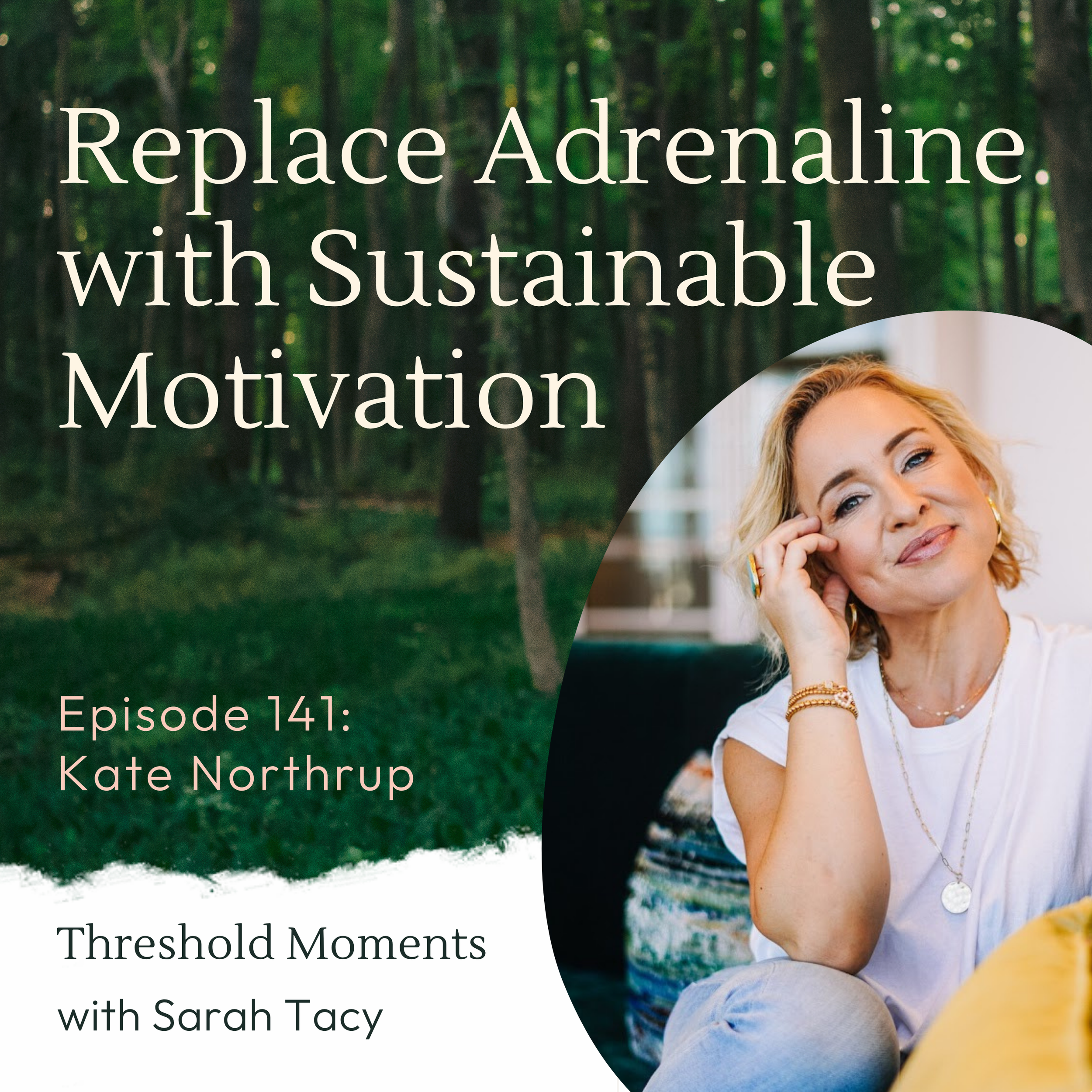
What if the goal of nervous system work isn’t to become calmer—but to become more alive?
In this special episode of Threshold Moments, Sarah is joined by Kate Northrup for a conversation originally recorded during an Instagram Live about Opting Out of Urgency in 2025.
Kate shares how Sarah’s work helped her begin unraveling a deeply ingrained pattern of running her business on adrenaline, and together they explore what becomes possible when we stop treating urgency as the only way to get things done.
Sarah shares why urgency can be so difficult to step away from—especially when it has been rewarded with success—and why opting out isn’t about abandoning ambition, productivity, or the things that matter to us. It’s about bringing agency and choice back into the equation.
They also explore why nervous system regulation doesn’t always mean “calming down,” what can happen when unexpressed fight-or-flight energy gets stuck in the body, and how creating the right outlets for that energy can lead to more clarity, creativity, joy, and aliveness.
And when you find yourself caught between “I must” and “I can’t,” Sarah introduces another possibility: the Sacred Third—the option we often can’t see until our systems have enough support to recognize that another way exists.
Episode Transcript:
Kate Northrup: [00:00:00] Today's conversation may be one of the most important things you ever listen to, to create the quality, the juiciness, the richness, and the aliveness that you want in your life. So I'm about to introduce you to somebody who has had a dramatic impact on me being able to go from running my business-
Kate Northrup: life on life force energy, which is actually a renewable resource. And we're gonna talk about that today. So if your life and the season of your life has been speeding up, and you're feeling like you don't have a choice about it, I give you Sarah Tacey. So hi, Sarah.
Sarah Tacy: Hello.
Kate Northrup: How are you?
Sarah Tacy: I'm good. How are you?
Kate Northrup: I'm great. I'm great.
Sarah Tacy: I like our color combos today.
Kate Northrup: Yeah. We did good.
Sarah Tacy: We look good.
Kate Northrup: We did good. Um, I'm just sitting on my floor, 'cause usually [00:01:00] that's, like, the best place to get the good stuff. Exactly. Yeah. So-
Sarah Tacy: In all the ways, by the way ...
Kate Northrup: in all the ways. So this is Sarah Tacey. If you don't know her work, um, you will now, and it's going to change your life.
Kate Northrup: Sarah has been our resident nervous system healer in Relax Money for the last two to three years, somewhere in between those two things. Um, and she has helped us to hold and support healing for thousands of students in that program, and Sarah's work and wisdom helped me personally really unravel my pattern of running my business on adrenaline.
Kate Northrup: And really, so much of what I know and so much of what my work has been infused with over the years, um, really came from a lot of conversations with Sarah while we walked around this one island so [00:02:00] many times. And so I'm so excited that you're here. Sarah's been working with high-performance athletes and executives, um, and folks for o-
Kate Northrup: Over 20 years, um, really tapping into the wisdom of the body for true alignment and aliveness and healing, and I'm sure you can say more about that. Um, but welcome, Sarah. I'm so happy you're here.
Sarah Tacy: Thank you. Thanks for having me. Thank you for that intro. Yeah. Do you want me to go off of anything you just said- Well-
Sarah Tacy: or do you have-
Kate Northrup: I'm gonna, I'm gonna ask you a question.
Sarah Tacy: Okay.
Kate Northrup: And so my my question is why, what happened in your life... And I have to unbutton my sleeves 'cause I got hot as soon as we started talking, so I needing, I really need air on my wrist. Um, what happened in your own life, and you can really tell, I know a lot of stories, but you can tell whatever story- Mm-hmm
Kate Northrup: feels the most alive, to have you [00:03:00] be ready to be walking people through an experience called- Mm-hmm ... Opting Out of Urgency, which is the most potent... I's just like, it's like I don't even, I mean, I will be attending, and also what's so medicinal about that title is, like, you get changed-
Sarah Tacy: Mm-hmm ...
Kate Northrup: just from hearing it.
Kate Northrup: Okay, so go. S-
Sarah Tacy: so I'm gonna add to that and answer your question, which is I have been changed by being in relationship to the phrase opting out of urgency, and in this moment I'll give credit to where credit belongs, which is Janine Yoder. All of us were in New York together, and I was like, "I'm gonna call it Unrush," and you were like, "I don't think that's a word."
Sarah Tacy: And I was like, "Shoot," 'cause I had been saying it for 20 years. And it kinda had a feel of, um, the last thing I should be telling anybody is, like, how to schedule, which is not what this is about. I feel like the big, big transformations, the catalyst for change, the [00:04:00] ability to move from familiar to optimal happens in the space in between, and that when we slow momentum, we can get there.
Sarah Tacy: And I was even trying with ChatGPT, and Janine Yoder's like, "Opting, opt out of urgency," and I was like, "Oh, that's it." And what my dad said about that title, I will answer your question, I promise. He was like, "What I love about opt out is the choice." I'm gonna just keep going on this thread for a sec because- It is the, these micro choices to opt out into a system that we've been co-opted into.
Sarah Tacy: So it hasn't necessarily ... We haven't, by choice, felt like we're gonna die if we don't do everything faster, everything better, but it is the way that life has gone. So to get to your question, I opted into urgency so hard with so much success early on in my life. And this is the-
Kate Northrup: That's the tricky part
Sarah Tacy: That [00:05:00] is the tricky part. There's so much reward. Yeah. But the payment that comes with that tends to be a body that is saying, "Please slow down. Please slow down. Please slow down." And so for me as an athlete and always wanting to do the best in school and wanting to do the best at everything I could do, my body was a hindrance.
Sarah Tacy: It was in the way. That's how I saw it. And it was through injury, and it was through pain and years of, of inquiry. I thought, "Oh, the wisdom." And so our minds tend to run at a pace that is ... could go light years into the future or into the past, but the body tends to move much slower. And so part of opting out of urgency is that we opt into the truth of our bodies.
Sarah Tacy: And so I would say I've spent 20 years practicing opting out, and [00:06:00] it still shows up. You know? Like, there was that one night where I'm like, "I have 17 emails to write and 15 podcasts to do, and I shouldn't go to this retreat." And I was like, "Oh, shit. Am I feeling urgency while preparing for opting out of urgency?"
Sarah Tacy: Um, and I have something to say about that if, if I- Please. You're good?
Kate Northrup: Carry on.
Sarah Tacy: Um, carry on. I will try keep talking. Um, the coolest thing is that night I woke up in the middle of the night, and I realized that my energy in me was not meant to be calmed, but it needed to be mobilized. And so I went out ... Um, I was at a retreat, so I went out and went into the car and had this moment of, like, urgency, agency, emergency, and, uh, and seeing the gift.
Sarah Tacy: So anyone listening, if you have times where you're like, "No, but I really have these things I wanna do, and this container matters to me," I think that we can have purpose, and we can have [00:07:00] ambition. And having the container that we sometimes see as urgency, if we add agency into it, if we add choice, then it becomes empowerment physiology instead of a trauma response
Kate Northrup: Just like Okay.
Kate Northrup: So if we add agency to urgency, it becomes empowerment physiology instead of a trauma response.
Sarah Tacy: And it feels so good.
Kate Northrup: It's so good, right? So from the outside, one of the things I really-- I, like, knew but I really learned from you, because you articulated it so well, was that so many people think that, like, regulating their nervous system means being calm.
Kate Northrup: Can you unpack that for us a little bit about why that's not always the case, and, like, calming down [00:08:00] is not necessarily the goal?
Sarah Tacy: Yeah. So even if you hear the phrase calming down, it often means we're pushing down something that wants to move up and out.
Kate Northrup: Mm.
Sarah Tacy: And so early on in the, in the learnings and explorings of trauma resolution work, Peter Levine had that big moment, you know, that he calls his book Waking the Tiger, right?
Sarah Tacy: That big moment where this woman that nobody could help, and she seemed like she was never gonna come back out of psychosis. And he's like, "I have no idea why I did it, but I just jumped at her like I was this, like, a lion or a tiger," and she screamed, and she ran across the room. And it was like she n- she had inside of her outlets that had never run, that had never expressed, that had never verbalized.
Sarah Tacy: And as he worked with more and more people, he saw, well, people have these unfinished patterns that happened in scenarios [00:09:00] that could be looked at as traumatic scenarios. But trauma physiology is not the situation itself. It's, did you feel empowered? Did you feel like you had choice? Did you feel like you could mobilize?
Sarah Tacy: Did you feel creative? Did you... Right. And if you have a really hard situation, but you got out of it, a lot of times we feel more empowered than disempowered. But many things in our lives and the way that society is also set up, you know, where we're so individualized, even in our individual homes, and our parents are so busy when we're kids and, um, that it comes down to feeling alone, not knowing who to talk to, feeling helpless and overpowered, and we get to reverse some of that physiology.
Kate Northrup: Mm-hmm.
Sarah Tacy: And so if we go into practices, again, I had a good, like, fifteen years, and it was my interpretation of the yoga practices that I used and how I used them. A lot of it was like, "How do [00:10:00] I be in a hard situation and find my breath?" And it was good, but what I was missing was, like, how, um, how do I express anger?
Sarah Tacy: How do I move frustration instead of just calming it and, you know, trying to suppress it and breathe it down because what's happening is my body is eating up energy. It's using energy every day to contain it.
Kate Northrup: Yes.
Sarah Tacy: And the side effect of moving the energy, so on the other side there may be calm, right?
Sarah Tacy: Like, after the healthy expression there may- But my side effect is, like, I laugh more. Mm. And I, like, giggle and I'm silly, and I'm like, y- it's, like, catching me by surprise. I'm like, "Oh," the, like, these, like, moments, and some of them I've shared with you. I'm like, this is so fun to have. Um, and, and maybe one of my restraining parts would be the perfectionism and the wanting to p- appear calm, and, um, I'm okay when you're [00:11:00] okay.
Sarah Tacy: Mm. And so this work has been so liberating for my own joy.
Kate Northrup: Yeah. Yeah, and one, so I wanna just for anybody who's just popping on, um, Sarah is hosting an incredible experience called Opting Out of Urgency, and you can just comment resourced in the comments, and we'll pop you a DM with the link to join in.
Kate Northrup: It's totally free, and she'll tell you a little bit more about that in a minute. But I just wanted to say that out loud. I had put it in the, in the chat. Um, so, you know, one of, what I, what I really heard from you, you know, we've had this conversation personally, and then you came on, um, Plenty, and we had a little bit deeper, and now we're having it more deeper, deeply and then, like, you know, I've, I, I read your newsletter.
Kate Northrup: I love it. And so just there's a lot there, and one of the things that I really understand from you, and it m- it, it, um, gave me words and a framework to explain what I had already been feeling, which is, [00:12:00] like, I don't actually, for me personally, you know, I'm an Enneagram 7. I'm an Aries. I, like, actually don't necessarily even want to feel calm.
Kate Northrup: Like, I really like feeling excited. And so when- I do. I really like feeling excited. It's my favorite feeling. I feel excited right now. I like- Oh, my God ... you know? And so whe- as I navigate the nervous system healing world, I had resistance because I sort of felt like if I heal my nervous system, I'm afraid I'm gonna feel dead.
Kate Northrup: Right. Because to me, like, calm kind of feels a little bit like dying. Mm-hmm. Um, which maybe we can unpack that in a minute. But regardless- Mm-hmm ... what I wanna say is, like, I love your methodology, and I've [00:13:00] witnessed you in this. You know, we've known each other for 10 years now, and I have witnessed you come so much more alive.
Kate Northrup: And something I've always, uh, experienced is that, like, the more I-
Kate Northrup: You know, kind of like let different ego deaths happen and, and, and do, you know, do whatever. Do the work, whatever that even means, 'cause it means a million different things. Like, the more alive I feel. And a word you've used and then, you know, both of our teacher, Tal Darden, has used is resonance. Like, working on our range of resonance as opposed to working on our range of regulation.
Kate Northrup: 'Cause regulation to me feels like control, versus resonance is like my whole body is singing. And so can you just ... That's not a question, but like what do you think?
Sarah Tacy: So I, my, my hair is tingling right now on this. But I also am seeing someone said, "It felt boring to me when I started doing nervous system work, but the more safety [00:14:00] I felt, the more alive I felt."
Sarah Tacy: So I think there are two things, because one of our good friends said to me like, "Don't do an online nervous system course. Nervous system work is so boring." And so part of me was like, like had this what Tal actually calls, um, intuition rehab, where I was like, wait, there's something here. There's something about being able to feel safe to be with boring, right?
Sarah Tacy: So there's something there that I'm like, this is important and not something to bypass. And I spent years... Well, you know, you know my story. Um, I spent many years highly under-resourced, especially the first five years, seven years of motherhood. Um, and I really worked to resource myself, and what that means is, like, layers of support for my nervous system.
Sarah Tacy: And then I had this day where everything [00:15:00] that I ever thought I needed was there. Like, someone literally made me dinner that night. I mean, my husband makes dinner, but he was working, right? Like, we had a nanny who made... She just started the- she made the most amazing dinner. She cleaned up after it, and I was like, "Oh, I can't be like I have to do this, I have to do this," and I went to bed, and I was so scared because I felt so flat.
Sarah Tacy: And I was like, wow, I have done such a good job of pacing. I've done such a good job of, like, layers of support, but what I was missing was expression. What I added to it was what brings me alive, and I think, you know, we'll talk about in the course, possibly in the free one too, is the reticular activating system and, like, asking the question, what brings me alive?
Sarah Tacy: Like, you know that excitement brings you alive. Um, I found that adventure- Mm ... being in a place of unknown brings me alive, which you need a certain amount of resourcing to be in the unknown.
Kate Northrup: Oh, yeah.
Sarah Tacy: Um, [00:16:00] and so it became really important to me to start to really look at, um, for me, fight outlets, flight outlets, and building them into my day because then it's less likely to come out at my children or my husband because we tend to fight more verbally.
Sarah Tacy: Our bo- the way that the, the system works is that our body feels it first, and then our brain tries to figure out what, who are we gonna defend ourselves from. Mm. And so we might pick fights because we're sure that that person's the reason why we're feeling like this or that person over there, but if we also build fight, flight outlets into our daily lives, it begins to clarify more of what actually matters to me and what relational things are really a boundary violation and what was just, like, me needing to let off some steam.
Kate Northrup: Yes.
Sarah Tacy: Does that make
Kate Northrup: sense? So as you're saying this, like, fight outlets and flight outlets, [00:17:00] I'm curious to what degree do you think for many of us, really me, um, is urgency a sort of sideways expression of a flight instinct?
Sarah Tacy: Yeah, I'm like a hundred percent. It's-- Yes, it's fight, it's flight. That's exactly where it lives.
Sarah Tacy: Um, I say it lives up in the fight and flight are, uh, four on a nervous system map, right up, freeze as being five down below the range of resonance, and then up at six is global high intensity activation, which is this like constant state where there's fight and flight energy that is usually super functional and highly rewarded.
Sarah Tacy: And it is what-- It is this feeling that only by living at this place is how we survive. And if I were to tell you that there were choice, someone might say, "F you, you don't understand." Because when we're fight or flight, it feels a hundred percent real. And so a realm [00:18:00] that you and I have been exploring, you know, together and separately is this realm of the sa- the sacred third because fight or flight is like, it's this or nothing, right?
Sarah Tacy: I must or I can't, and it can show up in parenting, it can show up in business, it can show up in so many realms. And the reason why I love being in conversation with my friends about it is because I can see it in others, and sometimes I don't see it in myself. Yeah. And someone will be like, "Hey, what's the sacred third?"
Sarah Tacy: You know, I'm like, "Oh." And it's the way to find it, and this is day two of opting out of urgency, um, that as we resource ourselves, again, meaning as we do like nervous system tools or things that feel good to our body It is not unusual that your perception of time and your perception of the challenge changes.
Kate Northrup: Yes.
Sarah Tacy: Your receptivity to what layers of support are available begins to broaden. [00:19:00] Your creativity changes. Your reticular activating system can open up to see possibilities it didn't see before. And some of my-- one of my favorite exper- um, stories of the sacred third was yours because I often am looking for, like, what is the one thing I'm not seeing-
Kate Northrup: Mm-hmm
Sarah Tacy: that is the next right step. And a story that you told on your podcast a few years ago when we were together was... Do you mind if I repeated it?
Kate Northrup: Yes.
Sarah Tacy: Um, it was around relaxed money, where it's like, you know, Mike had been ill for a long time, then got hit by a car, and you were, um, you are and were a mother to two.
Sarah Tacy: And this thing of like, "I must run my business to support my family. I can't run it like this or my body will collapse." So there's like, "I must, I can't." And what I loved about your story and what really opened up the sacred third for me was the small, you [00:20:00] know, Bridget's phrase, small doable pieces over time.
Sarah Tacy: Like going out and putting your feet in the grass and talking to the water and asking the water business questions. And like little piece by little piece, like, "I will care for myself." And you care for yourself before this, before the other answer is clear or before the right direction, and it just opens up little possibilities over time.
Sarah Tacy: And so sometimes, um, my example of that was when I go to this retreat, and I have all these things, and I do opt out of being there for all the talks. And someone comes in and asks for a yoga mat because there's breathwork, and I was like, "There's not a yoga mat here, but I'll go to breathwork with you.
Sarah Tacy: Wasn't an invite, but I'll come." And, and I- we did this breathwork, and then I jump in the water and I get back and I have that immediate, wow, this to-do list is so doable.
Kate Northrup: Mm.
Sarah Tacy: And here are [00:21:00] some things I'm just gonna drop off because actually I don't need to do all of these things. And clarity came and literally just this whole embodied feeling of like, this is not only doable, it's kind of exciting.
Sarah Tacy: Yes. I'm so excited that, like, I have something I care so much about that I'm so focused. And I just kept the whole weekend pendulating between like a song circle around a fire pit, a community meal, and like back in to do my work. And I got to feel in real time- How taking care of myself before the list is over- Yeah
Sarah Tacy: made life and time so much more enjoyable, instead of, like, the someday.
Kate Northrup: Yeah. It's so, um, profound because the vast majority of teaching that I've been around is either in the spiritual, physical, energetic realm, and [00:22:00] not super connected to the 3D, or it's about 3D strategy and, like, productivity tips, and here's how you need to structure your day, and with your mind, here's how you kn- need to go through your d- your to-do list and decide what's a priority and what can be let go of and whatever.
Kate Northrup: However, we... What we don't understand, and I saw somebody ask in the comments here, they said, "Can you explain again how it is that the body's, the body, uh, responds first before the mind?" Like, the body is having a trauma response before the mind, or really the body is doing anything. It doesn't have to be related to trauma.
Kate Northrup: That, like, what we don't understand is that the nervous system is the causational factor for all of our emotions, all of our automatic responses. I mean, it is r- it is m- um, modulating our entire lived experience of being human. [00:23:00] By the time we have a conscious thought, there's been a cacophony of automatic responses that have happened physiologically that are being run by the- You know, by our nervous system, which includes the brain.
Kate Northrup: But the huge mistake that your work does not make, but the vast majority of personal development work makes, and I don't even know if you would categorize what you do around that, but as that. But anyway, is that, like, it'll tell you, "Well, change your thoughts, change your perspective, look at your to-do list in a new way."
Kate Northrup: But when our body is in a particular response and we- Mm. It does-- It literally is like I don't have the energetic resources to see my to-do list in a new way, to make a new choice, to have a new perspective. And that, that, that, um, place between the old patterning and the new way, you have something that you call [00:24:00] it.
Kate Northrup: What is that phrase, and can you explain what it is and how we can hang out there while still feeling alive and resourced? Feeling getting- And by the way, comment resourced below if you would like to join in for Sarah's free workshop, Opting Out of Urgency. And then after you answer this question, I'll have you, like, say what the days are and what people- Yeah
Kate Northrup: are getting
Sarah Tacy: in that. I'm, again, I'm, like, getting all tingly. This is all so exciting. So going back to the first part of the body responding first, I'll add that, um, I wish I knew the name of the man who before there were electrodes that you could put on the body to see what's happening in what order, he spent years just really noticing in his body and he's like, "I think before I have a thought, my body has the feeling," and then my mind labels it.
Sarah Tacy: And so his conclusion was when somebody sees a bear, the body has a response, and then the mind says, "It's the bear." We often, because we don't express things, we [00:25:00] have stacked experiences living in our body. And then our mind is trying to be like, "Who's the perpetrator? Why, like, this feeling's in me?" And so I might notice, like, that I'm a little bit, like, more eludial.
Sarah Tacy: Like, it might be like something Steve did more, like, more, uh. But, like, what else is there? Like, what else is stacked? And the more I de-stack, the better. But, um- That's great ... I just thought it was so interesting that, like, 100 years ago, someone was really able to sit with that and feel and sense this is happening in the body first, and the mind is trying to put a story to it.
Sarah Tacy: To talk a little bit, like, is it, um, bottom-up processing? Once we have the story in our head, we can loop it back down to the body. So there can be the loop where we can say, like, mindset change can matter, but if we're not also working with the body, then there can be so much resistance which can lead to more frustration, which then gets pushed down.
Sarah Tacy: We've [00:26:00] tried more mindset change. And so, like, the two of them together is pretty awesome. Um, and then you asked me about the tension field, the place between what is familiar and what is optimal. Um, I'm gonna say it was, like, 2008 when I first read Candace Pert's book, and she was-- It's called Molecule- Molecules of Emotion.
Sarah Tacy: And I was so moved when she was talking about cells in our body having receptor sites and these little ligands that she was calling molecules of emotion. And she was saying how they're not lock and key, but they're vibratory. And so I was just really picking up that all the people around me were saying, "I feel like I'm changing on a cellular level."
Sarah Tacy: And our language gives us so much information of, I think, what is real. And I'm reading her book, and I'm reading about how when somebody, um, is taken off heroin, for example, uh, our [00:27:00] bodies have opioids that could match them, but the extr- the ones coming in from the outside aren't meeting it. And so we're having a withdrawal of like, "Wait, my dance partner's not showing up."
Sarah Tacy: And, uh, and for other things, it could be like our dopamine that we get from people-pleasing that gives us a sense of safety and reward when we don't do the same pattern we've always done. It can feel like abandonment at the cellular level. So this is my interpretation of it, and it feels really real, and it helps me in parenting because there are times where my child will throw a massive fit, and I can go like, "Oof."
Sarah Tacy: Like at a cellular level, there's this like, I'm not being met where I used to be met when we're like saying, "Hey, we're gonna change a pattern we've been doing." And so I might immediately wanna just like, "Okay, you can have the, you can have the crackers in bed." But to just say, "Okay, I'm gonna stay with her in the tension field because she's feeling withdrawal."
Sarah Tacy: And so when we think about when we do boundary repairs with people we love or people [00:28:00] we care about, and it feels like-- I say it feels like a brick wall before a bridge, it's often what I would say is we're in the tension field. And so this is a place of when we're there, can we resource by calling a friend?
Sarah Tacy: Can we resource by doing a nervous system, um, support practice? Can... You know, we start to look at what do we do to support ourselves when we're in the in-between, when we're in the unknown. And eventually, what's gonna happen is a new reality, a new dance partner's gonna show up to fit your new patterning.
Sarah Tacy: And I think anybody who's ever, uh, ever, you know, I hesitate to say like elevated their life, but anybody who has ever purposely chosen a new pattern generally knows that that place that feels like you are leaping off a cliff without knowing if there's a net or like will your wings spread, um, and inevitably, generally, they, they spread, and a new reality and a new pattern shows up And at the [00:29:00] new point, it's hard then to recognize the old pattern.
Sarah Tacy: Like, it was almost like we don't even... Like- Yeah ... what is that?
Kate Northrup: Yeah.
Sarah Tacy: Mm-hmm.
Kate Northrup: It's so good. Okay. So you are leading a free experience called Opting Out of Urgency coming up soon. Yes. So can you tell us what people will receive during- Yes ... that three-part series? And for folks listening, go ahead and comment resourced, and my little bot assistant will send you a link to reserve your spot for free.
Sarah Tacy: So smart with the bot. I was like, "How is she typing and talking at the same time?"
Kate Northrup: I'm not.
Sarah Tacy: Thank you for your support. I have yours all worked out. Thank you. Amazing. I love this. Um, okay, so you asked me what will be in the three days. Yeah. This course dropped in with such clarity of the sequence that I wanted to do it in, um, what I want to bring.
Sarah Tacy: So day [00:30:00] one, one of the biggest conditions we can create, I think, for our nervous systems, is recognition. And so day one, we are going to be looking at some nervous system maps for orientation of, like, where would you find yourself, and where you find yourself, what are doable ways to move towards resonance that won't trigger your nervous system?
Sarah Tacy: So for some people, if it's like, "Hmm, just take a bath," for some people, it'll be like, "This is so stressful. I just need to do the things I need to do." So we're gonna be looking at the multidimensional layers of a human, like what layer of you could receive some soothing while another piece of you is moving at a fast enough speed.
Sarah Tacy: Here's a really easy one that I'll, I'll, you know, I'll give it in the course, and I'll give it here is, like, if you take a bath and your body receives the benefit of slowing down and the heat, you could do your to-dos on your phone Right? And so you get mental speed while you have [00:31:00] physical slow.
Kate Northrup: Mm-hmm.
Sarah Tacy: And there are a variety of ways where it could be like you have relationals, you know, relational speed where you're having a quick conversation, but then you have, like, a physical slow-
Kate Northrup: Mm-hmm
Sarah Tacy: because you're going for a slow walk. You know what I mean? So it's like it's not all or nothing even within our body.
Kate Northrup: That's right.
Sarah Tacy: We have different parts of us that are in hyper or hypo, and so we're gonna look at, like, what parts of you specifically feel safe enough right now to move slow, and are there any parts that moving a little faster would help you?
Sarah Tacy: So it's ... We're looking for the dance of specifically what is gonna help you. That's day one, like, finding ways into resonant pacing. Day two is all about the sacred third. So we're gonna, like, do, we're gonna do some exercises around what double bind is in your life. What is the I must, I can't?
Kate Northrup: Mm-hmm.
Sarah Tacy: And how do we, uh
Sarah Tacy: We'll do some nervous system things. We'll do some embodiment work. Now that you're in [00:32:00] this space, are there any shifts that you can see that you couldn't see before? And day three will be relational- Mm-hmm ... so boundary repair, and that space between, like, the familiar and, uh, the unfamiliar and the unknown.
Sarah Tacy: Um, all of this, again, this is all free. This is all gonna be, like, so useful. Whether or not, what I will say is that I do have a course after it that where there's, like, daily drips, where there are meditations each day to integrate. Um, but the whole thing that I got so excited about, like, wow, these three days in and of themselves feel like the heart of the medicine that I wanna bring forward.
Sarah Tacy: And so it feels like such a gift to be able to do it, and it felt so good to feel so clear-
Kate Northrup: Mm ...
Sarah Tacy: like, where I think the magic lives and the potential for transmutation and transformation.
Kate Northrup: Amen. So- Amen ... good. So good. I'm so excited that you are spreading this work in a wider way, that you've built [00:33:00] enough layers of resource in your own life- Yes
Kate Northrup: that it is time for this expansion, 'cause I've been benefiting from these sorts of insights privately for years. Um, and I feel very grateful for that. And I'm so excited that the rest of the world is being able to receive this- I mean, like, I don't know, it's also so, it's also so practical. So I wanna say, like, I lean on this stuff every day, many times a day.
Kate Northrup: It's not like a nice-to-have. This material that Sarah is teaching is a must-have. It's, it's not an accessory to your life, it's foundational. So please join us for Resourced. Comment below, "Resourced". You'll get the invitation. I love you, Sarah. I'm so excited for this.
Sarah Tacy: Can I say, I'm like, I know this isn't our end.
Sarah Tacy: And Yeah. It's all right. One more
Kate Northrup: thing. One more thing.
Sarah Tacy: When you said that, [00:34:00] um, I reached out to people who took my course last year, and I don't know if you ever feel this way when you're teaching. You're like, "Is this landing? Is this helping?" And then when you, like, actually say, "Hey-" Yeah ... um, "How did this land?"
Sarah Tacy: And people are like, "Oh my God, my life has changed." Some of the things I heard was like, wow, you took this massive field of, and different fields, and wove them together and said it in a simple way that made sense. And every person who wrote in talked about, this is h- this is how it showed up every day to help me in my relationships and my work.
Sarah Tacy: And I'm just sitting there like, "Wow" You know? Like, they're using the tools. They're embo- like, they embodied the tools during the course, and they're using them. And I've even ... Adjust myself for a second. I even have gotten, um, emails from people who have listened some, some of the podcast and got the invite for Opting Out of Urgency, who are, like, changing ancestral patterns, and changing schedules, and seeing new opportunities for work because, again, [00:35:00] the name is medicinal.
Sarah Tacy: The field has already started.
Kate Northrup: Yeah.
Sarah Tacy: And I really feel like this is liberatory work.
Kate Northrup: It really is. It's, it's essential. Comment "Resourced" to opt in to Opting Out of Urgency and we will see you there. I love you. Love you.
Bye. Bye.