
142 - Emily Evans: From Functional Burnout to Resourced: Learning to Trust Yourself Again
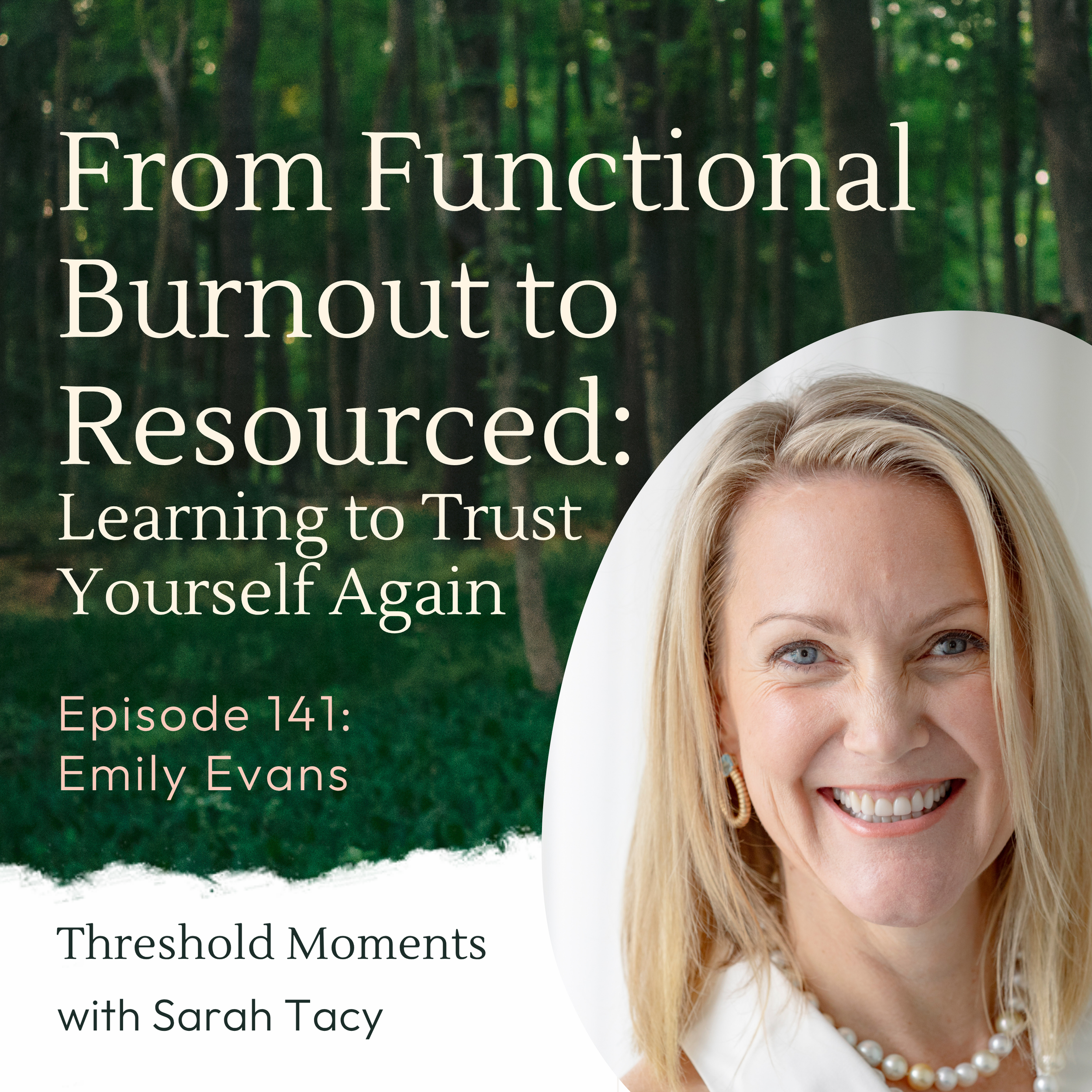
What happens when the life you built — the career, the identity, the pace, the version of you who could hold it all — no longer works?
In this episode of Threshold Moments, Sarah sits down with Emily Evans, a former Resourced student and founder of The Wander Years, to talk about functional burnout, identity shifts, nervous system work, and what it looks like to enter the “fertile void” without rushing to figure out what comes next.
Emily shares how she walked away from a decade-long career she loved after her body began sending signals she could no longer ignore. What followed wasn’t an immediate reinvention. It was years of slowing down, letting identities fall away, learning to follow small “micro yeses,” and discovering who she was when she stopped measuring herself by her output.
They also talk about Emily’s recent trip to Mongolia, where she experienced a powerful real-life moment of trusting her body, honoring a clear no, and realizing just how much had changed.
Sarah and Emily explore the difference between urgency and sustainable aliveness, the discomfort of not knowing what comes next, the importance of play and joy, and how slowing down can create space for a version of ourselves that has been there all along.
Emily also shares how her own season of wandering eventually inspired The Wander Years — a space for women over 40 to connect, travel, move, read, play, and discover what might emerge when they don't have to have everything figured out.
Episode Transcript:
Sarah Tacy: [00:00:00] Welcome to Threshold Moments. I am here today with Emily Evans. Emily is a previous Resourced student, and I have seen... Emily, I feel like, did I see you in Relax Money before that?
Emily Evans: Yes. Mm-hmm.
Sarah Tacy: And then there was another container that was smaller, and you were there for the calls, and then you were in, in Resourced.
Sarah Tacy: But I haven't really gotten to know you, but to be very honest, all the ti- and then you were in Juice. Yeah. And in the background I'm like, "Who is this woman? I wanna know her more." And then you posted something about your trip to Mongolia, and I was like, oh my gosh, this is so cool, and I would love for you to share with the people your story.
Sarah Tacy: Um, you know, the parts of it that are just yours separate from Resourced, and then also because this is happening during Resourced cart open, if you can share with them, like, any parts of the course that also played into any parts that are currently [00:01:00] unweaving or, or reweaving right now. But first just welcome.
Sarah Tacy: Thank you so much for coming.
Emily Evans: Thank you so much. I am so, well, first just honored to be here, but also really excited to have this conversation as well. Yeah. Um, because, you know- The times I've interacted with you in these programs you mentioned have been a really big part. I've had so much change that we'll talk about probably and, and rewiring and new identities, like deaths and new ones show up in the last few years, that, um, I really love letting people know who have helped me, you know?
Emily Evans: Yeah. And you have been one of them, like who's really provided another layer of support that I think all of us, as women especially, need when we're making really big changes, and even when we're not making really big changes. Yeah. Um, yeah. So thank you for having me on.
Sarah Tacy: Yeah. Thanks for being here. So I'm [00:02:00] wondering if you could walk us back.
Sarah Tacy: Before I s- before this podcast started, you and I were talking about points, and credit card points, and travel, and, uh, places that you are going to go for your 50th birthday or the place that you'll go for your 50th birthday, and then that brought us back to the job that you were in before. And I'm wondering if transitioning out of that job was any part of the threshold, or what was, uh, like a major threshold where you would start to say like, "There was a point where what was working no longer worked"?
Emily Evans: Yes. That was definitely a part of it. Mm. Um, so I was in a job for about a decade-
Sarah Tacy: Mm ...
Emily Evans: that I loved, and a part of that job, which is why we were talking about it, is, was travel. And that has... Something for me since I have been young has been travel, has been my medicine. It's been the thing I love the most. I think I fell in love [00:03:00] with it, um, I went on, during college, we went on a trip to Baja, Mexico, where we slept on the beach every night- Mm-hmm
Emily Evans: for a month and got to save a baby whale, and just all sorts... It just li- lit me up. And ever since then, you know, studying abroad, traveling abroad, working, all that. And my dog is licking from a bowl if you hear that. Um, so I was real excited when I fi- first started working this job was marketing and also holding community for a personal development company.
Emily Evans: Um, and I loved it. My kids were young, and I had been really asking for, "How can I have a job where I could still travel again?" When they were young, everyone told me, "You're never gonna be able to travel again. You're only gonna have female friends that are your kids'... the friend- the moms of your kids." And I thought, "Well, that doesn't make sense to me.
Emily Evans: I get how that can, could be." Um, so I loved that job and that work [00:04:00] for a while, and- It, I was very much in what I would say functional burnout by the end of that 10 years. Um, I didn't realize that. I was functioning from a very, I think as you would say, um, an optimized sympathetic state. Where it was like, "No, I'm on a plane every other week to a new country, and then I'm, come home and I'm a single mom to two girls, and then I hold a community of 10,000 people, and then I wor- and I gotta, I, I've got it."
Emily Evans: And I was just so holding it together, and genuinely feeling like I, I was loving it.
Sarah Tacy: Mm.
Emily Evans: And then I think the first thread that broke on the threshold was, um, I was in a relationship for about five years, and it was my post-divorce relationship. And he ended that, and we worked together. And I was like, "Okay.
Emily Evans: Not a partner anymore, but I still love this job." [00:05:00] And then that next year was so disorienting, 'cause then my body started finally being so loud I couldn't ignore it. Um, so then I quit that job, which provided, like, multi six figures, and as a single mom of two daughters, I had no idea how I was gonna replace that income.
Emily Evans: But it was so important for me. It wasn't in alignment anymore. There were things that I could then see once my nervous system allowed me to see different things with that company. I was like, "I need, I need to leave this. This is important to me, and my body is in a state," my nervous system was in such a state.
Emily Evans: So then that was the next thread.
Sarah Tacy: Before you go into the next string, can I ask you to- Yeah ... fill out the picture on what it felt like when you said functional burnout, and then when your body got so loud you couldn't ignore it. Could you let people know what that feels like? Mm. Because I think when you describe it, there's a chance that some people [00:06:00] listening might be like, "Oh, wait, that's super familiar.
Sarah Tacy: That's how I feel." You know, there may be a l- a number of people who are just- Yeah ... don't know the terminology, but when you describe the feeling or what it is for you, it might help them notice it in themselves or somewhere else.
Emily Evans: Yeah. I love that question, 'cause I didn't know wh- I had not, I didn't know what functional burnout was, and I was talking with a friend in the corporate space, and she was describing someone else, like what functional burnout looks like.
Emily Evans: And it was, um, you might have found a lot of enjoyment from your job before, and all of a sudden it's not there. Um, it felt like my fire was gone. I have always had a, a fire in my belly for things I love, and that felt very flat. I was frustrated and cranky- Mm ... about things all the time, and I'm not normally like that.
Emily Evans: And I kept thinking, "What is wrong with me?" It felt external, but it was very internal. I [00:07:00] couldn't shake it. And then when I did have to show up for certain, like, live events as part of work, I was either... Like, my body would just start crying or shaking. Right. And I had no idea what was going on. Like, it just would d- there was no external thing necessarily.
Sarah Tacy: Right.
Emily Evans: And people would say, "Oh, you must be so upset about the breakup," or, "You're this," and I was like, "No, it's not that." It was just my... So my body started behaving in ways that didn't seem related to the, the experience. Um, so it felt confusing. And I felt very much like there must be something wrong with me.
Sarah Tacy: Mm. I
Emily Evans: couldn't figure out.
Sarah Tacy: That's so interesting. Yeah. And so often when we bypass, I'll, I'll often say that when we have hyperactivity, it, in the nervous system map, it's up in the hyper range, like above our range of regulation, above where we, like, [00:08:00] really have true choice. But with urgency, it's... You get so rewarded for it.
Sarah Tacy: Yeah. And at first I would even say with urgency, you do get the reward system. So that actually really tracks even in that. It's like you get the reward system 'cause you're doing things that people didn't think could be done. Sometimes you're doing it faster or better, and you're... You know, the money is coming in, and so it's like dopamine, adrenaline, like all the things- Yeah
Sarah Tacy: that are like, "Whoo!" Uh, 'cause we all wanna feel alive, and- I think the inquiry is like, can we feel alive and have that pendulation and that tidal thing of feeling that activation and also being able to come down? Because oftentimes with the urgency, there isn't really a true come down. It's just like we keep going, which is really what burns it out.
Sarah Tacy: Because urgency itself isn't bad, it's just when it, we can't come down from it until later [00:09:00] when the symptoms start coming, and then it doesn't make sense because they don't seem matched with present external things. But often they're like stacked from previous things that are coming out later with the smallest, you know, the smallest external thing and it, and they don't match up.
Sarah Tacy: And so yeah, it's so confusing. And that was described so beautifully. Thank you.
Emily Evans: Well, you just put great words to it as well. I was like, "Yep, that was exactly what it felt like."
Sarah Tacy: Yeah.
Emily Evans: Yeah.
Sarah Tacy: So then it feels like it's you. Mm-hmm.
Emily Evans: And then what do you do from there? That felt so much like my identity and everything, you know, I had built, that then when I left the job, um, and now in hindsight it was wonderful, you know.
Emily Evans: That first year w- it was slowing down, but what was slowing down was I still... Then I was like, "Okay, I'll put my energy into my coaching business." I'd always [00:10:00] run that alongside my job as well. Um, so I put a lot of that, what I thought was me and that drive, was, "Okay, great. I'll get to put this all into this business."
Emily Evans: Now I, I slowed down, but it definitely In the moment, it would be working and then a crash.
Sarah Tacy: Mm-hmm.
Emily Evans: Like, I needed either a nap or just to zone out to Netflix. Or I'll have a glass of wine, and then I'll do my... And then the next day I'll wake up, I'll do yoga, and I'll go back and, and work really hard. So much of my worth felt tied to, um, output, 'cause I had been so rewarded that my brain couldn't conceive of, can I exist?
Emily Evans: And also, that layer of taking care of two daughters seemed so hard to never... Like, how do I not factor that in? That is there. Yeah. Um, so it was that, that year was such a interesting, um, [00:11:00] slow down, but nowhere near where I am now. Um, so I learned a lot about myself. And in that time, 'cause I left my, my work that I had been so involved in, I lost that community and a lot of friendships that I thought were, would have been there.
Emily Evans: So that layer was very intense. Um, and I'm glad that it seemed like one layer peeled off at a time. Uh, and then I realized I didn't have... And I think this is about the time I found you and Resourced. Um, you know, I had been doing breathwork, so I had, you know, I have a breathwork facilitator, and that was my own medicine as well.
Emily Evans: Mm-hmm. Um, and I realized I was coaching. I didn't have any love anymore for my sessions. Or I was doing a breathwork membership, and I was like, "This isn't quite it," but it felt so scary to say, "I've been doing this for a decade, and [00:12:00] I feel like I've been waiting for this inspiration or something to feel good again, and it just..."
Emily Evans: I was like, "This is not it." And so I closed down my website and emailed my, like, I didn't have a huge list, but 5,000 people and a good Instagram following and I was just like, "I don't... I'm gonna close this all down, and I don't know what's next, but I know if I don't, there's some honoring of this." Like, I had built that from such urgency and such an identity that I felt like if I didn't truly let that identity go and give myself time to grieve it- Yeah
Emily Evans: without jumping into the next thing, and just being in that fertile void space where I let myself actually listen and hear, and it was so hard to do. And I couldn't have done it without support, because everything in me told, told me, "Nope, you need to read another business book. You need to start right away."
Emily Evans: Yeah. "You need to figure out something." Um, yeah.
Sarah Tacy: The fertile void is something I love teaching. [00:13:00] And when I'm in it, I like curse the one who thinks it's so cute to talk about. And I'm like, "I know what this is," but the thing with the fertile void is you also don't know how long it's gonna last. It's, it's almost like labor pains where, uh, you don't know is this gonna be a 15-minute labor, is this gonna be a four-day la- Like, yeah, you just, you don't know.
Sarah Tacy: And with fertile void too, it could be three months, could be 10 years. Um- Yeah ... and it's hard for the nervous system too to be in the unknown. There are so many possibilities of what could happen, but sometimes it feels good when the possibilities narrow in a little bit more so we can focus on a thing.
Sarah Tacy: So I, I do think there's like a light and shadow to all of the things, because when we are in, in urgency, we often feel clear of like, "These are the things I need to do." Yeah. "And then I'll be okay," except we're not actually okay when those things are done. Um- [00:14:00] But in the fertile void, it is really being, can I be okay before I'm clear on anything that's to come?
Sarah Tacy: And like you said, there are the real world responsibilities of raising two girls, of, uh, affording, you know, food and living and everything that you built your life around. And so the other part of this nervous system work or opting out of urgency or resource is, can we still show up for the lives that we want to live, but also the ones that we have signed a contract to, like being parents, right?
Sarah Tacy: Um, in a way that we still get to honor ourselves. And I think that is, that is the dance, it seems, to really say, "I'm not opting out of life." But I do need to find other ways to do life-
Emily Evans: Yes ...
Sarah Tacy: [00:15:00] so that I can inhabit my body and my purpose while I'm here
Emily Evans: 100%. And I, and I think there's something in, you know, when I learned that term, the fertile void for you, from you, and I love maps.
Emily Evans: When you when you have maps, and I remember you explained that, and I was like, "Oh my gosh, I've been in that for a year." Yeah. And this was a year ago when I learned about it, and I would say I'm now... So it's, was a couple years. Two, two and a half years. And like you said, it is, it, this was, been the hardest time I've ever had.
Emily Evans: And I also, you know, it would help me be, uh, okay, I know that the metaphor of the butterfly and the goo phase, just going, "It's okay. I'm in the goo phase." Yeah. I might be here a while. It's okay. Um, and then adding in bits of where I would, did feel alive in my body. So if I don't [00:16:00] have everything figured out, and my brain really wants to do that, 'cause there's so much safety in there and planning the next thing.
Sarah Tacy: Yeah.
Emily Evans: And just keep reminding myself it was okay to not have it all figured out, and taking that as, in your, that one small doable step. Like, what are these micro yeses rather than I have to figure out everything-
Sarah Tacy: Yeah ...
Emily Evans: from point A to Z before I even go.
Sarah Tacy: Janine Yoder once said it, um, she's like, "If you're following the breadcrumbs, it doesn't mean that you're throwing the breadcrumbs out in front of you."
Sarah Tacy: Right? Like, I, 'cause it's, it's, again, it's one of those ideas where you're like, "Oh, I'm gonna follow the, I'm gonna follow the track of my life. I'm gonna follow the breadcrumbs." The actual process of following the breadcrumbs is a whole nother thing, because it really feels great to have a five-year plan.
Sarah Tacy: Especially if it's like- Mm-hmm ... I have a five-year plan. I'll give myself some flexibility. It doesn't have to go just like this. But when you are in the fertile void, and you really [00:17:00] don't know the next step, and you really are just tracking moment by moment, it is like navigating in the dark, right? When you navigate in the dark, you have to move a little slower.
Sarah Tacy: You're kind of feeling with your hands and your feet, and it's, it's not as fast. And it could sometimes be like, "Can we just turn the light on?"
Emily Evans: Yeah.
Sarah Tacy: But the light comes, like you said, like the little pieces. Like, the, the little places it comes in from the right or the left where you can say, "Okay, that is enough," or, "That piece helps me to get to the next place."
Emily Evans: Mm-hmm.
Sarah Tacy: And what little pieces of joy too.
Emily Evans: Were so essential. You know, I feel like for me, um, I love reading a book, taking a course, doing all of that, and that has been essential for me.
Mm.
Emily Evans: And the piece that I think was such a medicine was really focusing on, well, can I do something, especially in the, in that void space?
Emily Evans: Where everything is telling me I should probably do something that's worthwhile or focused. Can I just do [00:18:00] something for fun? Um, can I do something that feels like play or wonder, and not feel guilty about it afterwards? And if I do, notice it, and, you know, inquire what that is, but stop working on myself so much, and just really be in my body and enjoy the present moment.
Emily Evans: And I think that's been the biggest gift for me, for my daughters, all of that lesson. 'Cause I, I kept giving myself a deadline. Like, I think in that first year I was like, "Well, I'll take the summer. I'll do 90 days and not make any choice from urgency in my business. I'll only if it feels really alive. No pressure."
Emily Evans: And then that 90 days was up, and a lot changed in that. Mm-hmm. I was like, "Okay." But I still didn't have a clarity of what I wanted to do next, but all of those pieces were interesting. But it's somehow I was like, "But I need to have a deadline. I'll give myself another this, this, and this."
Sarah Tacy: It's funny, as you say this, I'm thinking of two things.
Sarah Tacy: One is [00:19:00] Kate Northrup's story is about her 90 days, right?
Emily Evans: Yeah. It's like she's like- That's, uh, yeah, I was inspired by
Sarah Tacy: it ... "And my therapist said, 'Give yourself 90 days,' and so I reworked this pattern." And then, uh, what is her program called? I wanna say Good With Money, but it's Relax Money. And she's like, "And then that's what Relax Money was born from."
Sarah Tacy: And so at the end of her 90 days she actually did, she had something. The, like the sacred third emerged. Yeah. And, and then there are gonna be so many times in life where it's like, wait, we did the 90 days, and then we're still, well, here I am. Looking around. Um- I do think there's something to still taking those small actions.
Sarah Tacy: There's, um, a man I know, his name is Boyd Varty, and he's a lion tracker, and he talks about the path of not here. So he says when you're tracking a lion, even when you go off track, you- it's information, right? It's like, oh, this is the path [00:20:00] of not here, so I'm gonna go back in this direction. Like, every... And so, you know, it's running the breathwork because that's what you know, and you have this big following and this newsletter and it worked, and you got something from it.
Sarah Tacy: And then at some point, it's like, okay, now this is the path of not here. And I, you know, fortunately or unfortunately, 'cause I'm sure it all shapes us, the path to here or actually tracking the paw and seeing the little fur in the tree, like, all the things of finally getting on track, uh, is usually not direct.
Sarah Tacy: And there are just all of these, what, what I might think of originally as going off path would just be like, no, just the, that's the path of not here, and it's all directing us- Yeah ... to, to a path that we haven't found yet.
Emily Evans: Yeah. And it's all really great information, but in the moment, it's frustrating.
Emily Evans: 'Cause like you said, I think, you know, being in this, um, world of those of us that I love [00:21:00] listening to podcasts and, you know, an entrepreneur, you have quite a lot of stories of people having, "I did this, and then there was this aha payoff." And I know everyone's path is different, and it's still quite frustrating to be like, really?
Emily Evans: Do I still not have a, this inspiration? I, and I could only go on a feeling. I just knew, okay, when I'm doing this, I know on paper this makes sense. I have people in my membership. I like doing it. Um, but it, there wasn't this feeling that I, I know in my body that I'm like, it can be more alive than this, and if I settle, I, my energy's not gonna be here and it's not gonna work.
Emily Evans: Um, it just didn't feel it. So yeah, I love that. That's, was definitely not here. Okay. So if it's not here, let's go in this direction, and just that really wandering to kind of, um, playfully find something that until something clicks.
Sarah Tacy: You said wandering, um, and I feel like this [00:22:00] brings us, I don't wanna jump ahead too much- I won't jump ahead too much.
Sarah Tacy: I'm just gonna put that as a little side note.
Emily Evans: Okay. '
Sarah Tacy: Cause we'll get to that. Um, can you talk at all about how resourced was the support during this period for you? If it wasn't a support, you don't have to make it up.
Emily Evans: No, it's so... That's what's so interesting, and I don't think it took me... The work I had done of tr- of slowing down made it just the right fit at the right time, 'cause I really wanted, um, community, uh, where I could show up live and be on calls, and there were...
Emily Evans: There was a, the nuance Mm-hmm ... that you have with nervous system work. 'Cause I've had learned, you know, there's s- stuff through my somatic and breathwork training, but there was a nuance and a, the pace. There was a pace that I was [00:23:00] encouraged to, like, okay, I can have... I loved having those daily drips to listen to in the morning, um, 'cause I, I'm a person that loves my routine, so I like to go wake up and walk my dog and, um, maybe listen to that when I get back.
Emily Evans: So I loved that. Um, I used to be a biology teacher and I'm a biology major, so I love all of the nuance of the nervous system work. Um, for me, when I understand something on a mental level, it helps it sometimes land in the body, and vice versa. So that, for me, really worked. Um, and the rhythm, I, I, I think being in that void was a perfect time to not have too much.
Emily Evans: I was very burnt out of long Zoom calls, and l- like, do not give me a bunch of hours to sh- be on a computer, 'cause my body was a full no for that. Mm. So I think the l- the, the bit of community and learning and calls were just enough to then still [00:24:00] go, "This isn't my life, but it's an incredible thread of support."
Sarah Tacy: Mm. I love that. And this year, we are going to have the daily drips go out after the 12 modules. And so I will still... I know, woo.
Emily Evans: I like that.
Sarah Tacy: Um, I'm still... So I love... I did a, I did a class with Mel Robbins, it was her launch course, and she had a video that was anywhere from two minutes to 20 minutes that would come out every day, and there was a little worksheet that we could fill out with it, and then we had our 15 minutes of action that we were supposed to take.
Sarah Tacy: I loved having something so clear of, I'm starting my day with this. Yeah. And it helped me focus, and it helped... And so that's why, that was part of the inspiration of taking this 90-minute call and breaking it down to five small meditations. You know, there's a little bit of information and some, and that meditative part.[00:25:00]
Emily Evans: Yeah.
Sarah Tacy: And I would say 70% of the people were like, "Love it. Love having it during the call." And some people felt like, oh, if they missed the call, and they had those to catch up with. So this year we are going to find a piece that is particularly useful for each person, and have that be their practice if they choose.
Sarah Tacy: The other thing we're gonna do, not to give too much away here, um, is at the beginning of the course, last year we walked through the cycle of awareness, which is what we were just talking about, the, the fertile void, and then you get that inspiration, which I think is where you're at right now. Mm-hmm. Um, integration, your new norm, and then it starts over.
Sarah Tacy: Um, and this year I'm gonna also look at it and help people kind of identify, am I in resuscitation phase? Am I in, uh, resource and pacing? Am I in tracking my joy, or am I in, [00:26:00] um... I'm gonna name it differently. But then there's also, like, the performance edge, where how do I create sustainable performance once I know where it is I wanna be?
Sarah Tacy: And from there we get to look at, do we wanna add another thing, or are we gonna... You know, just to kind of see what fits for each person each week. And once the program is complete and we've worked through the beginning of orientation into practical, into relational, um, then we're gonna release the daily drips, and then people will have those- For a nine months from the time they get it, because some people go through it two to three times in a year.
Sarah Tacy: Oh. Like, they'll just keep replaying it. Yeah? And I was like, "Wow." Somebody wrote to me the other day, and she's, she's retaking. And she was like, "I'm so glad I did it last year even though I didn't feel like I had capacity, because it planted seeds that made- Mm-hmm ... a huge difference. First, I felt the shame that I felt about where I was at disappeared, and that was enough for me, once I like, could...
Sarah Tacy: [00:27:00] And then she was s- she said, I think it was this June, that sh- this... I have permission to share this, I just want to say . Um, that she went back to the section on boundary repair. Mm-hmm. And she had hired somebody in her house that was super dysregulated and was dysregulating to her and her children. And there's that often that feel of like, "Oh, my God, but I need this help, but eh."
Sarah Tacy: And I don't want to hurt anyone's feelings, so that whole I'm okay when you're okay. And so she said she was just listening to the recording on repeat, and then finding the pieces that were most supportive, and then reaching out to this woman. And she's like, "I was able to fire somebody that I would never have, that I wouldn't have been able to fire in that timing before because I went back."
Sarah Tacy: So even though her capacity to take the course while it was going, she said it was scattered for her- That feeling less shame throughout the year, and then being [00:28:00] able to pull pieces of specific recordings later on in the year has been really useful. I'm not really a person who watches recordings, like, after something's done.
Sarah Tacy: Mm. And so I'm hearing back from all these people who go through two or three times, and they're telling me how it makes a difference, and I'm like, "That's so freaking cool." I'm learning from people- Yeah ... all the different ways that people learn and engage, and how my hope is always that it will release in right timing for people.
Sarah Tacy: And now I'm just getting to hear from people's stories what that looks like or what it sounds like or very specific- Yeah ... ways that it's showing up, and I am just in awe of the stories that I'm receiving. I'm like, wow, that's so cool. Um-
Emily Evans: I love that she said the first time it... the first layer was, well, now I don't have to feel ashamed of where I am.
Emily Evans: I would say that one of the things Resourced really did for me was I felt really seen. Mm. Rather than feeling like you were delivering content, when we [00:29:00] would, um... at boundary repair and fawning, I felt like when we were talking about those things, I felt so... my gosh, I almost get tear- like teared up just thinking, like so seen.
Emily Evans: It was like a part, a nuance that I didn't understand. Um, and so to, to be able to identify with that and then not, I think, yeah, not feel ashamed and not feel wrong about it and just like, okay, this was an intelligent response. My body has done so much of my life that feels like a personality. Um, and unwinding that, which I actually have a great story of where then in real time that showed up as, wow, that really is, um, I don't want to say healed.
Emily Evans: Cha- very, very changed. Um, and I love that, like when you actually notice in real time that the work you've put in Yes ... actually shows up and you're like, "I would have never said that to that person before or held my ground." And it was, um, a story from Mongolia, this trip I had this, this [00:30:00] summer that I thought, wow, that's amazing.
Emily Evans: That is a version of me that I was hoping was here, but to actually just see that be was so-
Sarah Tacy: Can you tell us? Are you will- Yeah ... Are you, yeah?
Emily Evans: Yeah, I would, yes. Um, so this summer, a few, uh, two months ago, I went to Mongolia for a trip I had wanted to go. People said, "Why did you wanna go to Mongolia?" Since I was in my 20s I've wanted to go, and something about the emptiness and space of that country, and ride horses across the open land, and sleep in yurts- I've wanted to do that since my 20s.
Emily Evans: So I turned 50 this month, um, and I wanted to do that trip this year in honor of that. So we're on the trip, and I have two friends that actually went with, but we're in a bigger group of people, like eight of us. And, um, on one of the last days we were there, we were scheduled to do kind of a nurturing, [00:31:00] like we'll go in hot springs.
Emily Evans: But instead, um, we couldn't go there 'cause there was a foot-and-mouth outbreak, so we couldn't take the horses and things. So he said, "Hey, there's a shaman, a local shaman. This isn't a touristy thing. He's, you know, been doing this 70 years for the local village, and our driver can make a call. Would you guys like to spend an evening and ask a question with a shaman?"
Emily Evans: And I was like, "Yes. Wish list, yes, absolutely." So I am thinking of my question and what do I wanna ask, and, you know, I'm in this space where I still don't quite know, but kinda know what direction I wanna go in. And We're, all day we're ta- I'm talking to my friends about, "What am I gonna ask?" And we get to this little house in the evening, and the man comes in with his, um, translator of sorts, you know?
Emily Evans: And he's in full dress, and his eyes are covered, um, with like a long headdress and, like, almost fake, fake hair and beads and ribbons hanging down. And he starts drumming. And then [00:32:00] immediately, like, sits down. He's ... And I can tell he's, like, channeling, you know, whatever being he uses for his shamanic ad- advice.
Emily Evans: And immediately my ... I was like, "Mm, this doesn't feel right in my body." And not I'm weirded out by the woo. I'm, I ... That, that part did, did not ... It was a, "Okay, let me ask some questions as I sit here in this group of people." And it was a very aggressive energy. Um, and he actually, like, was kind of smacking someone's hands and...
Emily Evans: So I sat there and asked questions to my intuition, like, "Is, is this for me? Is this, um, an energy I wanna interact with?" And everything was a, a no. And, and then my body, my heart started incr- my heart rate started increasing even though I was really, like, trying to connect to the Earth, and, and I was like, "Oh, this is the signal I had overridden before."
Emily Evans: Whoa. Like when we talked about Wow ... the, [00:33:00] that moment, like, where I was showing up to work and I was crying or my heart rate. And I was like, "Okay, I'm, I'm gonna listen to you." I'd asked enough questions. And before, here I am, I would have definitely said, "This man has been doing this for 70 years. There must be something I'm missing.
Emily Evans: I don't wanna offend everyone in the room and, and be culturally rude." There would've been so many reasons I would have sat through that and doubted myself and questioned myself, and I just, I got up and I said, "With all respect, this is just isn't for me," and walked out of the room, and also had zero thing that I
Emily Evans: I didn't feel like I missed out on anything. I didn't question it. I didn't wonder if, if that was okay. I didn't worry if anyone in the room was uncomfortable with my choice. Like, it just wasn't there. I thought, "I think this whole trip, if that was the only thing I got out of that trip," which it wasn't, that was stunning.
Emily Evans: And I thought, "Oh, my gosh. I have ... [00:34:00] That was so different and beautiful," and everything I, I didn't even know I had been working on. Um, and being in a group and also not needing to be liked and not performing. Like, the whole trip was so much not just about where I was at all. It wasn't what I thought it was gonna be.
Emily Evans: It was more meeting this version of myself that was here all along.
Sarah Tacy: Mm.
Emily Evans: And she just showed up and showed me, "Hey, this is, this is different." Wow. And it was like meeting someone new. Yeah.
Sarah Tacy: I'm just really having this picture of your wise woman. Like, that your wise... Like, I could almost imagine her with a staff, like, kind of putting the staff down.
Sarah Tacy: And I imagine in there, too, is, like, a young one, but that the wise woman stands up for the young one. Yeah. And is like, "Oh, not ours." And just that [00:35:00] ability to also not then feel like you have to apologize or tell s- like, make the, make an excuse or, like, or is it me? Like, it just sounds so clear.
Emily Evans: Yeah. And I think maybe for some people that w- if you knew my backstory, all of that, what you just said, was so hard for me before.
Sarah Tacy: Yeah.
Emily Evans: I wouldn't have been clear. I wouldn't have been able to say that. Would... That was so much of that. So it was just a beautiful, um, acknowledgement of what can change when you're not trying to force. I think I've been, you know, as we talked about urgency and my way of being, and I'm very good at pushing.
Emily Evans: Um, I think for a long time I thought, "Well, the more intense I do something, the more change I'm gonna get and payoff." And I think with, with, um, Resourced and working with you, uh, the idea that going slower and softer and actually not pushing- Mm ... on the hard thing, like, [00:36:00] starting with the softness, um, to really have, allow that to unfold and then see the payoff like that was what my, I think my body and mind needed to go, to rewire, to really trust myself in that process, um, because there is so much reward, or I had experienced so much reward in fast, in urgency, in, um, intensity.
Sarah Tacy: And so here I hear that there's some intensity coming in from the outside, but your ability to still find your body in the presence of somebody who's obviously running big energy and strong energy- Yeah ... to find the earth, to find your body, to find your voice, to have a steadiness. I'm just like, yeah, for...
Sarah Tacy: I it's like it's a big moment for womankind. You know? [00:37:00]
Emily Evans: Yeah.
Sarah Tacy: Um, also I, I think there's something... It would be interesting, I, I think you and I are, are close in age, um, if this conversation were us in our 20s, that would be interesting. And there's something about this threshold of mid-life where there is a clarifying, and I think it's probably some of the hormones that shift, too, where suddenly some of our people-pleasing hormones are, like, out the door.
Sarah Tacy: They've, like, gone to another party. Yeah, yeah. They're fueling a young system somewhere else, and then it's like- Yeah ... wait, this was never for me to begin with, or maybe it was once for me but it is not for me now, and to really step into that. And as you said, you're meeting a new version of yourself. And I also heard you say that you're meeting a version of yourself that you believe was there before that you couldn't hear fully before.
Emily Evans: Yeah. Maybe- And I think I was scared I wouldn't like her, or that I'm no- more so that other people [00:38:00] wouldn't like that version. Um, and I think another, another layer, um, of that trip, I arrived sick. I, I got, like, a, caught a cold before I left. Mm-hmm. And so you know when you literally aren't resourced enough to- Mm-hmm
Emily Evans: I'm, and all my energy was gonna go to my body and the two people that I went with. And so one was a very close friend, and the other one was her close friend but who I'd never met. And so here's a new person, and I didn't have the energy, I wasn't gonna try to- Make everyone friends or even in the bigger group.
Emily Evans: All those things I would normally do. Um, and that wasn't there. And then this new person was like, got to meet this new version of me.
Sarah Tacy: Mm-hmm.
Emily Evans: And we just... And he was like, "I love this version. This is great." We became great friends. Mm. And I think, again, that my mind thought, "This, this one won't be liked, so it's not safe, um, to not perform and not befriend and tend to everything."
Emily Evans: And [00:39:00] so to actually, again, get to see that in practice, and then have evidence back of, um, external and then internal, like most important was that I liked that version, and I was like, "This feels new." But like you said, this woman that all these... It was like dropping so many masks and identities and roles that I was like, "Oh, this is who's there?
Emily Evans: Like, I actually really like her."
Sarah Tacy: Wow.
Emily Evans: Yeah.
Sarah Tacy: And so as you came back, and I've been seeing you online, I do see this vitality running through you. And I do think that's part of, you know, going through the fertile void and then coming out. And what I think I just heard you saying is, like, there's a shedding, and it can be really hard and a lot of, like, energy, energetically expensive to hold so many masks and to drop them.
Sarah Tacy: Uh, and I'm wondering if you could tell us a little bit about the wander years. Yeah.
Emily Evans: Yeah. And
Sarah Tacy: if [00:40:00] I skipped anything by, you know, by going to wander years, please feel free to fill anything in. But it seems like it's a natural fit.
Emily Evans: Yeah. I think it's ... Well, I think a piece of this too which is so great, and so there's that big trip this summer, and right before that I also sold the house I'd been living in with my girls for eight years.
Emily Evans: And then my oldest one now drives, and so I also had, like, the role of I'm not a mother of little children that need me in the same way anymore. That fell away. Our house fell away. I go on this trip, and now ... And I had really been sitting, um, in that fertile void period of just, okay, I'm not gonna rush this, but what would I happily do for the rest?
Emily Evans: What have I always done that I love? What's been my medicine? Um, you know, those questions that we all know to ask, but I just felt like I hadn't had clarity on it. Um, and I think so much of being there in Mongolia and [00:41:00] this reflection of, wow, the one thing I've loved and s- the phases I've walked through is when I dropped all these identities, and especially I think, um, being single, a single person and having left a relationship and all of that, it felt so hard to have an open calendar and house, like a house that was pretty quiet on weekends, 'cause now my daughter's driving my other one and they're gone.
Emily Evans: And I love my alone time. And I thought, "Wow, I've walked through this," and I've really filled it with women, making new friends online and in person, big trips like Mongolia, but also I had planned a summer where I was like, "What's gonna feed me?" Mm. And this play without trying to make a plan. And it was like, okay, every week I'm just gonna make sure I take my body in nature somewhere new.
Emily Evans: Something novel, whether that's walking in a new neighborhood or walking into a store I've never [00:42:00] been, and something for my senses. So very, like, body nervous system things. And that brought me alive, I think, in a way that I went into that trip to Mongolia, and I came back, and I was like, "I, I know what my medicine has been."
Emily Evans: And I've also walked through this for a few years and been... I'm like, "I want to bring women together." Um and I was... If you know, if you're listening, maybe you know the, that show The Wonder Years? That was this was big when I was younger, and I was kind of talking with a friend about it, and I was like, "Oh, I love that show."
Emily Evans: And then I thought, "The Wander Years would be such a fun name for, like, a travel business to be with women." And so that's the name. We got inspired from there, The Wander Years. And also that magic of letting yourself wander, not having to have everything figured out. Yeah. Um, and then really narrowing in on I wanna work with women who are, you know, over 40, and create these [00:43:00] experiences of travel.
Emily Evans: Bigger travel, but before then having a monthly rhythm where we can connect. So a couple connection calls a month, a book we get to read together, or not read and just show up and talk and-
Sarah Tacy: Yeah ...
Emily Evans: be with women. That's like a female-centered, you know, whether it's a travel, um, inspired memoir or a novel. 'Cause the one thing I started doing too was reading fiction again for fun, which was so healing.
Emily Evans: Um, and then moving, doing, uh, the somatic... I also started, um, just following those breadcrumbs. Um, I teach, like, a somatic movement, kind of like dance, but you know, I get my '90s playlist together and we do nervous system repetitive movement, but then we pause, and then we regulate, and then we come back and dance.
Emily Evans: So I wanted to put all that together for women who are in that phase of, like, recently divorced or separated, and there's, you have an empty calendar and an empty, maybe a too quiet house, and it's like, okay, and that void space. Mm. And [00:44:00] what if you didn't try to fill it with we actually, like, had fun? And just that community of women and fun and travel, whether it's local or you'd like a bi- a bigger trip.
Sarah Tacy: I love it. And when I saw this, I immediately just felt like, oh man, this is what the world need- This is... I don't wanna say what the world needs. This is what women need. Mm-hmm. And again, it is, um- You know, it's so great to do nervous system work, and, and if we spend our whole lives... This was a really big moment for me a few years ago when I was like, "Oh man, I've, like, really done all the regulation things.
Sarah Tacy: I've done all the pacing practices." And it was a particular threshold where there were some hard, hard things that I don't think I had fully recognized had taken place. Like, I don't think I had really recognized the grief of it. And I was like, "Man, this is a lot of effort to live this life like this."
Sarah Tacy: Mm-hmm. Like, [00:45:00] what is this all for? Um, and everything looked great on the outside, and that is when I started asking the question, what brings me joy?
Emily Evans: Mm-hmm.
Sarah Tacy: And if you've been away from joy long enough, it might not feel like it's a real thing or a possible thing. And I just started tracking it, and my friend Janine Yoder, um, was going on this trip to Scotland, which I also got pretty sick on the way there.
Sarah Tacy: Actually, I think as soon as I got there. Um- And that's not usually, like, i- it's not that all of us can just be like, "I'm going to Mongolia," or, "I'm going to Scotland on an all-women's trip." Like, we can't. But it was such a great question to ask, what brings me joy, and just watch, like, what are the things that light me up.
Sarah Tacy: And for me, the hard thing about the answer to that question is that it's generally when I'm with women.
Emily Evans: Mm-hmm.
Sarah Tacy: And so my husband, he can go out and do archery, he can work out for two hours, he can go surfing. He can literally [00:46:00] leave our house and his thing is right there, and it can happen in, like, 30 minutes to two hours.
Sarah Tacy: And for me, I'm, like, gathering with women. And it's not always as easy or predictable. I can, of course, track other things, but that's such a major one for me, and I don't think I'm alone because I've been to enough gatherings for women, and I just see the way that we light each other up.
Emily Evans: Yeah.
Sarah Tacy: And I see the way that we weave.
Sarah Tacy: So I might share one idea, and then somebody else starts talking, and then I see something new about the thing I shared that I had never seen before. And then they... And then it's like, it's that one plus one equals five, you know, equation. Mm-hmm. You know?
Emily Evans: Yeah.
Sarah Tacy: Um, all, like, the mycelial webs start connecting, and it is definitely life-giving.
Sarah Tacy: And I love that other side, right? Like, we talked about how Resource has some s- like, some science in it, and practical [00:47:00] tools, and then right there next to it, what's so helpful is to also have places in our life where we're reading fiction- Mm-hmm ... and where we're wandering without trying to get anywhere.
Sarah Tacy: And, um, there are just, like, so many great ways to touch into ourselves. And so I was really moved when I saw what you're doing.
Emily Evans: Thank you. And you know what word you just said that is, um, weave? And at the beginning of the year, you know, I often pick a word for the year. Mm-hmm. And that was my, my word this year.
Emily Evans: And as you just said that, I realized that's what I loved about what allowed me to kind of land on this, on the Wander Years, was it can be a piece. It can be a thread. And every woman has these different threads, right? That, that we, when we're together, we weave together, and also in our own lives and our own growth, that we're like, "Okay, I'm gonna take this thread and this thread."
Emily Evans: And [00:48:00] I think before I, I had to figure out the thread or the thing, rather than I know, um, like, Resourced was a thread, and reading novels was a thread. And, like, and letting that all be there has been life-giving and life-changing, for sure.
Sarah Tacy: Well, Emily, thank you so much for coming on today. Happy almost birthday.
Sarah Tacy: Thank you. Thank you for sharing your journey with us. Thank you for being a part of Resource. Thank you for sharing with listeners about Resource and for sharing with us about Wander Years. And so if people want to find you or find Wander Years, where can they go?
Emily Evans: Thank you so much, uh, for having me. They can go to, um, Instagram @thewanderyears.fun is the Instagram.
Emily Evans: And then, um, I am starting the trips and a wait list for the monthly sort of rhythm, so if they go to thewanderyears.fun/wanderwomen [00:49:00] is gonna be, um... So it's not a .com, it's a .fun.
Sarah Tacy: I love it. And
Emily Evans: that will be where they'll have a wait list for the monthly rhythm and the trips as they're getting going.
Sarah Tacy: Oh, my God, Wander Woman, that's so good.
Emily Evans: Isn't that great too? So
Sarah Tacy: good.
Emily Evans: I was like, "Well, that's fitting." You
Sarah Tacy: have a background in marketing, you said?
Emily Evans: Yes.
Sarah Tacy: I love it. It's so good. It's so good when you can bring together, um, somebody who has, as you do, experience with the nervous system and breathwork and coaching, but also marketing so that people can, like, understand what it is that you're doing, and then, like, the little, like, the, yeah, the play on words that you have are just, like, it's so good.
Emily Evans: Thank you.
Sarah Tacy: Well, thank you so much, and best of luck with everything, and I'll be following you on Instagram, and I'll keep in touch with you. And
Emily Evans: I will you. Thank you.
Sarah Tacy: Thank you so much.
Emily Evans: Thank you. Bye.